

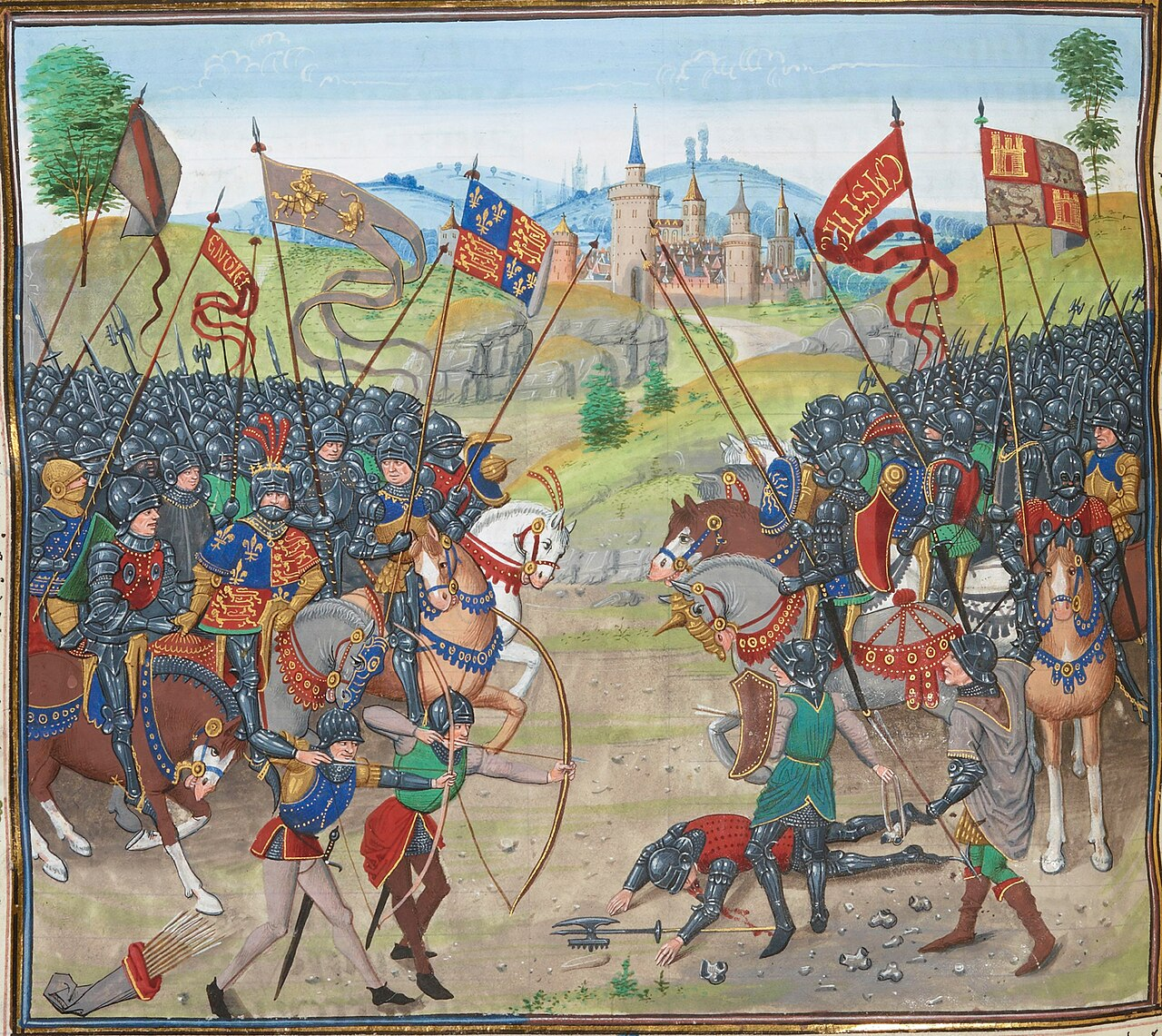
15th century Jean Froissart’s Chronicles
What changed the longbow from dread into wood on the hill of Aríñez?
A bodkin point rests in my palm like a small iron tooth, cold at first contact, then oddly private once the skin lends it heat. Such iron asks for an ash shaft, a cord, a shoulder schooled through years of ache, a field where distance matures into harm. Alone, the point carries the meekness of offcut metal; ranked among hundreds, blackening the air, it turns into weather spoken in an English tongue. At Inglesmendi, the hill that folded English presence into local remembrance, alteration moved in both directions.¹
Oak light falling through a workshop window teaches more about war than heraldic colour can manage. Heavy bows have bent in my hands until the left arm shook after the third shaft, the line from heel to fingers lengthened into a hard cord, the mark across grass altered through a single pace. Longbow dread rises from arrangement, from yew or elm in the fist, linen cord, ash arrow, goose feather, iron head, trained lungs, loose order, guarded flanks, selected rise, commander spending distance like coin. Shift one portion of that order, then the weapon returns to timber, sinew, breath, fear.²
Nájera, fought on 3 April 1367, commonly draws the gaze through the victorious Black Prince, Bertrand du Guesclin taken alive, Pedro of Castile restored for an hour, Henry of Trastámara escaping with futurity knotted into his reins.³ Aríñez opens the truer door for archers. A smaller action gives the sharper lesson, as a nick in a blade can reveal more than a polished sword hung above a hearth. Before the great plain battle, the skirmish occurred while Edward of Woodstock passed through Navarre into Álava in Pedro’s cause, after the promises at Libourne had dressed dynastic violence in contracts, money, hostages, territorial gifts.⁴
Castile in 1367 carried the smell of burned allegiance. Pedro, rightful king by blood, had scattered trust through killings, seizures, vendettas, fiscal hunger. Henry, his half-brother, shaped rival kingship from grievance, aristocratic fear, French interest, Castilian impatience. Pero López de Ayala, courtier, soldier, captive at Nájera, future chancellor, wrote from within that torn cloth, with the wary intelligence of a man whose own flesh had stood among the standards.⁵ Into that quarrel came the Black Prince as champion, creditor, lord of Aquitaine, son of Edward III, heir to victories in France. His army brought Gascon, English, Poitevin, Breton, Navarrese, company soldiers hardened by raids. Hunger travelled with them.
Terrain gave Henry his tutor. Around Vitoria, roads, rivers, passes, hills, forage routes, stone towns, ruined stores, wet ravines, familiar paths held counsel for the defender. For the invading host, horses required feed, men required bread, beasts required fodder, movement required safe reconnaissance. Don Tello’s riders could sting, draw off, vanish, return. Edward’s fame had grown on fields where enemies entered the killing reach of English archery; Álava made him taste a war of delay, dust, thirst, scouts, cattle, rumour.
Chandos Herald gives the English version its keenest thread. Sir Thomas Felton, seneschal of Aquitaine, asked leave to ride ahead for knowledge of the enemy host; the Prince granted it.⁶ With him rode a company of knights, squires, archers, names sounding like mailed feet on flagstone: William Felton, Thomas d’Ufford, Richard Taunton, Ralph Hastings, Gaillard Beguer. Romance-light touches the chronicle’s figures, yet practical need lies beneath the glitter. Scouting meant the finding of roads, strength, forage, signals, passages. Reconnaissance in a hungry campaign becomes a hand inserted into another man’s dark pocket.
Aríñez stands near Vitoria, beside roads linking movement to supply, a village set in the ribbed country of Álava.⁷ Its later name, Inglesmendi, the Englishmen’s hill, turns event into topography, as though soil accepted custody of a wound. Place-names of that order act as more than labels. Local speech drives them like nails into communal memory. A walker crossing that country meets earth taught to speak through slope, mound, lane, field edge. The hill keeps tactical truth in its shape.
Felton’s detachment, drawn across the path of a larger enemy host, climbed a small hill.⁸ Inside that choice lived old English wisdom: height breaks a charge, loose stones trouble hooves, an upward attacker spends breath, archers gain sight, men-at-arms gain a shorter line to hold. Under practised hands, a hill becomes a rough palisade. Height also fixes flesh. Protective slope can trap. Retreat thins. Rescue needs time. Ground serving as shield can close like a fist.
William Felton rode from the hill with lance lowered, pierced a Spaniard through, then lost horse, footing, life.⁹ His gesture belongs to chivalric theatre, yet it reveals strain inside a mixed English company. Men schooled to value aggressive honour stood beside archers taught to make distance sacred. A downhill charge broke the grammar of defence. In the chronicler’s telling, William receives praise before the cost appears through the body: horse killed beneath him, sword drawn, Castilians pressing from every side, a man fighting on foot until the ring sealed.
At Aríñez, the archers’ value first arose through conditions they preserved. Castilian light cavalry, armed for speed, skirmish, javelin-work, harassment, tested the hill. From the slope, missile men could answer horses through angle, rhythm, menace. Hooves met gradient; riders met rising shafts; thrown darts spent themselves against a position denying clean rush. Here the longbow retained its public dread. The weapon worked as boundary. Space grew costly. Approach became exposure.
Yet the hill tightened time. Arrows hold authority across interval, while a close body asks another question. How swiftly can a man lower bow, take sword, draw falchion, step back, keep footing on torn grass? Which count of shafts remains in the sheaf? Whose shoulder blocks the draw? Where does the wounded horse fall? Which cry means rescue, which cry means the rear has folded? War reduces doctrine to fingers, mud, breath. Theory ends at the wrist.
Decisive alteration came when French, Breton, Norman, Picard, Burgundian soldiers reached the field through a valley, then dismounted at once.¹⁰ Their action changed the moral weather of the fight. Light cavalry had tested the hill as horsemen; dismounted men-at-arms advanced as hard bodies with blades, armour, discipline, appetite for contact. Across open ground, a longbow can scour an advance, wound horses, scatter riders, bend a formation before collision. In close foot combat, the archer’s tall weapon becomes clumsy lumber. Training remains in shoulders, legs, eyes, yet its finest instrument has lost the interval granting majesty.
Chandos says the English, Gascon defenders saw the day’s measure. Courage appears in his romance diction: Roland, Oliver, feats of arms. Beneath that embroidery, a stern tactical sentence remains. Fewer than one hundred defenders faced several thousand. Early action drove assailants downward again; later mass reached them. A hill can multiply courage; it can also count bodies with a cold clerk’s hand. The name Inglesmendi carries that arithmetic.
Captives followed: Hastings, Degory Says, Gaillard Beguer, the Felton brothers, Richard Taunton, Mitton, others whose names slip through the poem’s torn purse.¹¹ In fourteenth-century war, taken men carried value as money, honour, bargaining stock, news. A dead archer fed memory; a living knight fed ransom. The Black Prince, learning of the blow, tasted the campaign’s first public bruise. His enemy had proved that English detachments could bleed. Reputation, that invisible armour, rang beneath a hammer.
Nájera soon reversed the local lesson. On the plain near the Najerilla, English archery regained the greater conditions it loved: mass, sight, interval, flanks held long enough, enemy cavalry entering the beaten zone. Chandos tells how arrows fell thicker than winter rain, wounding horses with men until Castilian riders turned away.¹² That phrase endures through corporeal exactness. Rain touches everything. It finds neck, sleeve, cheek, seam. Against cavalry, massed arrows create weather made of points, with fear travelling through horseflesh before it reaches the rider’s soul.
Modern argument around the longbow often hardens into camps: weapon, system, culture, training, armour, rate of fire, social recruitment, supply of bows, plate quality.¹³ Aríñez cuts through that quarrel with a hill’s simple blade. Power belongs to the weapon; such power arrives through a system. A bowman standing alone beside a ditch differs from massed archers on prepared ground with men-at-arms guarding the centre. Famous technology remains mortal once stripped of scale. Dread belongs to relation.
English armies of the later fourteenth century increasingly used mixed retinues where archers formed a steady, substantial portion beside men-at-arms.¹⁴ Such arrangement created a tactical body with two pulses. Men-at-arms held, received, struck at close quarters; archers shaped approach, killed horses, broke rhythm, provoked disorder. At Aríñez, stress separated those pulses. The archer’s domain shrank as infantry closed. Steel entered where the shaft had ruled. Flesh resumed its rank.
Ground asks closer reading. A hill has several faces. From below, obstacle; from above, prospect; from the flank, invitation; from the rear, peril. Felton’s men used elevation to impose a front. Enemy numbers searched the edges. Mounted jinetes met slope, so their speed thinned. Climbing veterans shortened the relation between blade and defender’s body. Arrows need passage through air. Blades need reach through ribs, cloth, mail rings, panic.
Distance carries its own theology. The longbow allows one man to harm another across a span where the face remains partly idea. Close fighting removes that mercy. Breath enters breath. A glove grips a sleeve. Steel searches gaps. After training to loose twelve shafts in a hard minute, a bowman becomes a man wrestling with weight at his hip, ears full of shouts, fingers slick, friend crushed against friend. Aríñez marks the conversion of distance into contact.
Formation supplies the third condition. Massed archery creates density: air fills, choices narrow, horses rear, files bunch, commanders lose clean signals. A compressed group on a small hill carries a different tempo. Men can shoot, then fight, then shoot again where space grants it; yet each action begins to hinder the next as the ring closes. Tactics become furniture in a crowded room. Every elbow has a price.
Timing crowns the rest. Longbow dread begins before collision, during the seconds when an attacker sees a drawn line, hears strings answer, feels first shafts strike among the front ranks. At Aríñez, defenders gained time through elevation, then lost it through enemy adaptation. Dismounting changed the clock. Infantry could absorb ground in slower, grimmer rhythm; cavalry shock turned into foot assault; skirmish became closure. The English hill stand endured through courage, then ended through the enemy’s correct answer.
A larger campaign moved around that small scene. Henry had received counsel from Charles V, with French captains advising avoidance of open battle, holding passes, starving the invader. The Black Prince needed decisive action before hunger, disease, pay, mistrust, heat, debt soured his victory.¹⁵ Aríñez showed Henry the merit of attrition; Nájera showed his impatience. In the great battle he accepted the open field where English archery, Gascon flanking, disciplined men-at-arms could speak in their strongest tongue. Victory restored Pedro in appearance, yet Henry’s escape carried reversal’s seed.
Aríñez has weight through stern disenchantment. The bow deserves respect as tool, inheritance, discipline, instrument of social order, beautiful object. Truth belongs to it as well. A bow asks a body for long apprenticeship; command must give it ground, comrades must give it flank, time must give volleys, distance must give meaning. Remove those gifts, then a longbowman stands as any fighter stands: breathing, sweating, hearing the ground answer beneath the sole.
Chronicles often praise the noble body at the instant of contact, while archery works as near-impersonal weather. Such habit can hide the archer’s labour. The longbowman trained through pain. Shoulder, back, wrist, fingers, eye, breath, stance, judgement all entered the shot. Discipline lived in repetition so deep it seemed natural. Yet at Aríñez the same body needed another education, the brutal curriculum of close assault. Visibility returned to the archer precisely when his arrow had lost command.
A philosophical lesson rises from the soil. Technologies acquire myth when viewers detach them from their conditions. Bow, armoured knight, cavalry charge, hill fortress, royal seal, treaty document: each object claims authority through use, setting, bodies arranged around it. Alone, each object waits. In relation, each object commands. Aríñez strips command from object, then hands it to circumstance. Hill tells us power lives as arrangement.
Memory chose the Englishmen. Don Tello’s riders, Audrehem’s dismounting, William Felton’s doomed charge, Henry’s attritional opportunity, the Black Prince’s bruise before triumph: each could have claimed the place-name. Yet the spoken hill gathered the foreign dead or taken into one word. Inglesmendi holds a people reduced to locality. A campaign famous across Europe shrank there into a mound beside Aríñez. Large history entered small ground, then stayed.
The question opening this inquiry asks what changed the longbow from dread into wood on the hill of Aríñez. Altered conditions did it. Ground first strengthened the archers; distance gave the bow its first authority; formation sustained defence; timing allowed resistance to bite. Enemy adaptation then changed the terms. French, Breton, Norman, Picard, Burgundian men dismounted, closed through the valley, attacked the hill as infantry, compressed the defenders, spent the interval, brought flesh against flesh. Longbow dread lived in ground, distance, formation, timing; when those powers shifted, the archer became flesh again, with an iron point in memory as cold as a tooth.¹⁶
Scholia:
¹ Chandos Herald, Life of the Black Prince by the Herald of Sir John Chandos, ed. Mildred K Pope & Eleanor C Lodge, Oxford, Clarendon Press, 1910, pp. 156–57; Francisque Michel, ed. & trans., The Life & Feats of Arms of Edward the Black Prince, London & Paris, JG Fotheringham, 1883, pp. 186–91. I begin from Inglesmendi as a place-name turning combat into local speech. Pope & Lodge identify Felton’s position at Aríñez in Álava, a village on the route from Vitoria to Burgos, then state that Felton’s death lingered in the Englishman’s mound near Aríñez. That annotation deepens my reading of ground as witness. The record gives more than coordinates. It grants the action a second life in naming, as though the hill itself kept custody after the chronicles finished their chivalric business. Michel’s bilingual edition keeps the rougher poem close to English paraphrase; Pope & Lodge supply the historical stitching that lets me place the scene inside Álava in place of vague romance-theatre.
² Matthew Strickland & Robert Hardy, The Great Warbow: From Hastings to the Mary Rose, Stroud, Sutton Publishing, 2005, pp. 15–23, 127–55; Jim Bradbury, The Medieval Archer, Woodbridge, Boydell Press, 1985, pp. 71–104. I use Strickland, Hardy, with Bradbury to keep the bow inside hands, timber, training, supply, sinew, law, practice. Their work draws attention away from a magical weapon story into a disciplined social body. Material life gives the bow weight here: stave choice, draw weight, corporeal adaptation, arrows, battlefield supply, tactical grouping. My palm-image of the bodkin grows from that scholarship. Aríñez becomes legible as a breakdown of relation in place of a simple defeat of a tool. A shaft needs air; an archer needs room; a line needs flank; a commander needs timing. Strickland’s work especially helps me resist folklore that turns the bow into a charm. Bradbury’s broader account places archers within recruitment, pay, training, battlefield use, giving the hill fight a work history beneath its chronicle glamour.
³ LJ Andrew Villalon & Donald J Kagay, To Win & Lose a Medieval Battle: Nájera (April 3, 1367), a Pyrrhic Victory for the Black Prince, Leiden, Brill, 2017, pp. 1–23, 329–75. Dating, combatants, consequences, with the pyrrhic reading of Nájera, come through Villalon & Kagay’s full campaign study. I lean on their treatment to keep Aríñez attached to Nájera while granting the smaller fight its own authority. Their book shows how triumph on the field yielded a strategic burden for Edward of Woodstock: debt, illness, Pedro’s conduct, Henry’s survival, French advantage. That frame gives the hill action extra weight. Aríñez anticipated a lesson Henry could have used more fully: harassment, supply strain, terrain control. Nájera then granted the Black Prince the open battle his army wanted. Contrast gives my central argument its spine, as the same archery system appears vulnerable in one setting, dominant in another.
⁴ Peter E Russell, The English Intervention in Spain & Portugal in the Time of Edward III & Richard II, Oxford, Clarendon Press, 1955, pp. 69–91. Russell remains central for the diplomatic frame: Pedro’s bargain, the Black Prince’s intervention, Navarrese passage, payment promises, territorial hopes.
⁵ Pero López de Ayala, Crónica del rey don Pedro, in Crónicas de los reyes de Castilla, ed. Jerónimo Zurita & Eugenio de Llaguno Amirola, Madrid, Imprenta de Don Antonio de Sancha, 1779, pp. 551–55; Pero López de Ayala, The Chronicle of King Pedro, vol. 3, trans. Clara Estow, Liverpool, Liverpool U.P., 2020, pp. 147–59. Ayala’s value lies in his embedded position. He stood as a Castilian noble within the political storm, later rose as royal servant, carried defeat with imprisonment in his own biography. I read him as a witness formed by allegiance, survival, intelligence, class interest. His account of Salvatierra, Vitoria, Henry’s movement, English companies seeking provisions, the action near Aríñez, then the battle near Nájera gives Castilian texture to a story often tilted through English celebration. Estow’s translation helps modern readers hear sequence clearly, while the Sancha edition keeps me close to early printed Spanish tradition. Ayala deepens the argument by making supply, local knowledge, royal legitimacy, noble calculation part of the same field. The hill then ceases to be anecdote. It becomes a node in civil war.
⁶ Chandos Herald, Life of the Black Prince by the Herald of Sir John Chandos, ed. Mildred K Pope & Eleanor C Lodge, Oxford, Clarendon Press, 1910, pp. 149–57. The Herald’s account of Felton asking leave to ride ahead gives the skirmish its narrative hinge. A request for reconnaissance sounds clean in noble verse, yet its reverse face is forage, hunger, mapping, enemy sighting, control of roads. Pope & Lodge print the French text with English paraphrase, allowing the reader to feel the poem’s double allegiance: chivalric praise beside operational detail. Lines 2450–70 describe Thomas Felton asking to spy the host, then summoning companions; later lines show the party riding ahead of larger movements. That supports my claim that Aríñez was shaped by the practical stomach of war. Bow effect depends on placement; placement depends on intelligence; intelligence depends on men risking isolation. Felton’s ride therefore ties the tactile world of archery to the campaign’s logistical nerves.
⁷ Mildred K Pope & Eleanor C Lodge, notes to Chandos Herald, Life of the Black Prince, Oxford, Clarendon Press, 1910, p. 210. Their annotation places Felton’s company at Aríñez in Álava, near Vitoria, on the road system leading onward to Burgos.
⁸ Chandos Herald, The Life & Feats of Arms of Edward the Black Prince, ed. & trans. Francisque Michel, London & Paris, JG Fotheringham, 1883, pp. 186–91. The small hill supplies the tactical key. Source text states that Felton’s men took their station on a “petite montaigne,” with English paraphrase calling it a small hill. That word governs my reading. A small hill grants local advantage, yet its smallness also limits depth, movement, relief. It makes one front strong while tightening each later choice. Romance shapes the poem’s numbers with memory, but its tactical sequence has a hard feel: mounted enemies test defenders; missile exchanges cut the slope; attackers from a valley dismount; attack turns into close infantry assault; named men yield. Michel’s edition gives French phrasing with English rendering, so the hill remains a physical object in place of vague heroic platform. Object remains the answer to the guiding question.
⁹ Chandos Herald, The Life & Feats of Arms of Edward the Black Prince, ed. & trans. Francisque Michel, London & Paris, JG Fotheringham, 1883, pp. 186–87. William Felton’s downhill charge appears there with horse, lance, killed Spaniard, fallen mount, foot defence, death.
¹⁰ Chandos Herald, The Life & Feats of Arms of Edward the Black Prince, ed. & trans. Francisque Michel, London & Paris, JG Fotheringham, 1883, pp. 188–90. Dismounting gives the argument its tactical turn. Named troops include French, Bretons, Normans, Picards, Burgundians arriving through a valley, with Audrehem beside Jean de Neufville present, then the text says they dismounted at once. That moment converts the fight from mounted harassment into infantry closure. I treat that conversion as the hinge through which archery loses its governing interval. The passage also guards against a simplistic account in which Castilian light cavalry alone overwhelms the English. Chronicler grants the defenders success against missile cavalry assault, then marks the arrival of dismounted professionals as decisive. Source evidence deepens the argument by showing adaptation in motion: an enemy reads terrain, changes mode, closes distance. At Aríñez, tactical intelligence belongs to the attackers as much as courage belongs to defenders.
¹¹ Chandos Herald, Life of the Black Prince by the Herald of Sir John Chandos, ed. Mildred K Pope & Eleanor C Lodge, Oxford, Clarendon Press, 1910, pp. 158–59. Pope & Lodge record the taken names after the hill fight, including Hastings, Degory Says, Gaillard Beguer, Feltons, Taunton, Mitton.
¹² Chandos Herald, The Life & Feats of Arms of Edward the Black Prince, ed. & trans. Francisque Michel, London & Paris, JG Fotheringham, 1883, pp. 226–28; Villalon & Kagay, To Win & Lose a Medieval Battle, Leiden, Brill, 2017, pp. 249–53. Nájera’s rain of arrows supplies the counter-scene. Michel preserves the famous winter-rain image, with arrows wounding horses with men until riders turned away. Villalon & Kagay place that moment on the English left, where Castilian cavalry led by Henry with the count of Denia met the densest effect of archery. I use the contrast with Aríñez carefully. At Nájera, archers worked inside a larger army body: flank, elevation, mass, open approach, enemy cavalry in motion. Aríñez offers a smaller detachment holding a hill while rescue, depth, space, scale all tightened. Same weapon thus produced two results through altered arrangement. Pairing gives my argument both poetry with modern tactical analysis.
¹³ Clifford J Rogers, “The Development of the Longbow in Late Medieval England & ‘Technological Determinism’,” Journal of Medieval History, 37, 3, 2011, pp. 321–41. Rogers gives the strongest modern case for the fourteenth-century English war bow as a newly powerful military instrument within wider tactical change.
¹⁴ Andrew Ayton, Knights & Warhorses: Military Service & the English Aristocracy beneath Edward III, Woodbridge, Boydell Press, 1994, pp. 219–53. Ayton’s work on retinues supports the claim that archers formed a regular component of English expeditionary military organisation during this period.
¹⁵ Jonathan Sumption, The Hundred Years War, III: Divided Houses, London, Faber & Faber, 2009, pp. 543–57. Sumption’s campaign narrative helps me hold hunger, strategic delay, Henry’s counsel, Nájera’s open battle, Pedro’s restoration, debt, sickness within one arc.
¹⁶ LJ Andrew Villalon & Donald J Kagay, To Win & Lose a Medieval Battle: Nájera (April 3, 1367), a Pyrrhic Victory for the Black Prince, Leiden, Brill, 2017, pp. 199–204, 233–53, 329–75. My final answer rests on their integration of campaign movement, Felton’s party, longbow debate, battlefield deployment, aftermath. The book’s value for my purpose lies in its integrated reading of tactics with campaign consequence. Maps trace roads, supply trouble, Henry’s choices, English delay, smaller actions around Vitoria, then the great battle’s archery. Through that scale, Aríñez emerges as more than prelude. Aríñez becomes a diagnostic event: the English system revealed both strength with vulnerability before Nájera displayed its full destructive reach. I use Villalon & Kagay to frame Aríñez as a test of conditions. Their treatment confirms that a weapon’s reputation becomes intelligible when placed inside route, command, terrain, timing, food, morale, political aim. Hill answers the plain; the plain answers the hill.
Views: 159


