

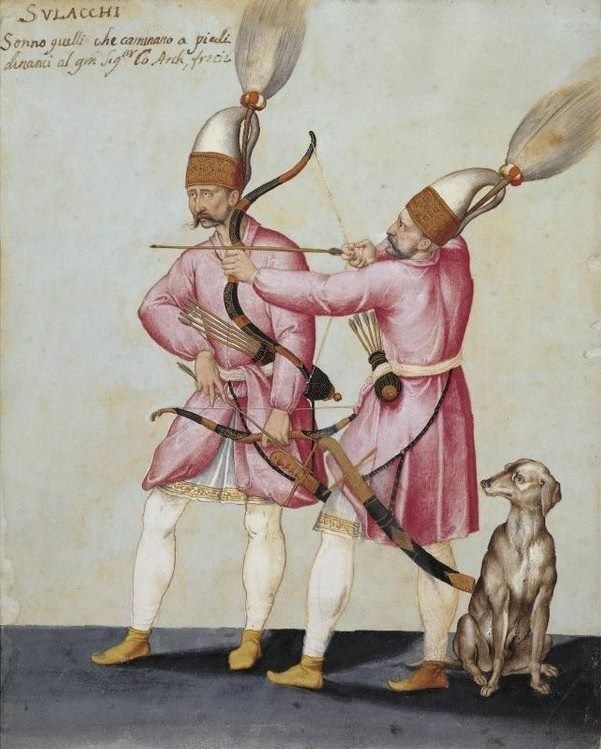
What survives of Taybugha al-Ashrafi al-Baklamishi al-Yunani once common biography narrows into grip, stance, breath, thumb draw, schooling, horse, treatise? Horn at the base of my right hand gives the first reply: a small crescent of polished material, warmed after a minute upon skin, shaped to spare the thumb from the string’s hard gathering. Through such a ring, the archer’s frame becomes a record. Across it, the fourteenth-century Mamluk writer reaches me less as an armoured figure than as strain at a joint, a rule written in flesh, a narrow gate through which intention enters the arrow.
TIFAM readers know the bow as a companion with temper: one limb speaks before its fellow, a string gives its thin complaint, feathers scrape the shelf, shoulders confess vanity after a dozen spoiled releases. Such practical closeness gives the proper entrance into Taybugha, whose Arabic work enters English scholarship through Saracen Archery, the 1970 version prepared by J. D. Latham with W. F. Paterson.¹ His name offers a life; the record hands over a workshop. Where childhood might stand, stance arrives. In the place of household talk, fingers weigh horn, wood, sinew. At death’s far edge, a taught sequence remains for novices, as if rescue could pass by muscle.
I take such scarcity as evidence carrying mass. Biography commonly seeks birth, patron, office, quarrel, estate, burial. Taybugha calls for another scale: the archer’s body treated as archive, each joint bearing a small clause of law. His manual renders the man legible where chronicle supplies a hard splinter. Ibn Hajar’s entry, as reported by the editors, places a Taybugha ibn ʿAbd Allah among men of the eighth Islamic century, a renowned warrior who died in prison at Aleppo in 797 AH, corresponding to 1394–95 CE.² That notice has the shape of a nail struck into a door: brief, cold, serviceable, final.
Around that nail, the manual raises a room. Latham with Paterson read Taybugha as a Turkish mamluk drawn from Greek lands, later freed through conversion, with al-Yunani in the name carrying recollection of origin while al-Ashrafi marks attachment inside a patronal world. Such naming holds weight here through density. A Mamluk name behaves like armour: each plate gives a route through purchase, discipline, conversion, loyalty, advancement, hazard. Institution takes the boy; method returns the adult. Flesh passes through rule, then speaks by practice.
Language keeps the scar of that formation. Latham notes rough Arabic in Taybugha, learned military prose carrying technical purpose more plainly than courtly polish. I find that coarseness fertile. Courtly burnish can hide a life behind compliment; workshop vocabulary exposes strain. Technical words must hold thumb, string, joint, bow-belly, horse, stirrup, error. Once a phrase limps, the hand steps forward to finish meaning. The text asks for a reader with grammar in one palm, practice in the other.
Structure gives further witness. Near its centre, a didactic poem stands close to commentary, while supplementary passages extend practice beyond the poem’s ribs. Technical discussion begins in the bow’s material life, touches string, arrow, thumb guard, then sinks into the hand through grip, nocking, draw, sight, loose, follow-through before the saddle, bracing posture, flight work, injuries, physique, masters, novice, teacher carry the art outward again. Such ordering acts like a body assembled on the page. Tools meet fingers first; only after that does the shot rise, carrying horse-work in its wake before correction closes the circuit. Its sequence resembles training: object, contact, alignment, motion, consequence, supervision.
At the core of the work, the didactic poem deserves heed. Verse fixes memory in the mouth; commentary opens memory for service. Cadets could carry the poem as rhythm before full grasp arrived, much as a beginner carries a coach’s phrase long before muscle honours it. Explanation then enters like a whetstone. Taybugha’s form therefore joins recitation to drill. Page becomes a training yard where cadence stores rule, while prose tests rule on wood, horn, sinew, skin.
A Mamluk body belonged first to a system of making. David Ayalon’s account of the Mamluk military order helps here, for the mamluk entered elite life through purchase, barracks, Islamisation, drill, manumission, household attachment, then service.³ The scandal of the word rests in its literal sense: a possessed man could become a lord of war, commander, sometimes kingmaker, while ascent carried the mark of having been handled. Taybugha’s manual breathes inside that paradox. It teaches freedom by recording trained constraint. As thumb, knees, calves, heel, eye enter prescribed relation, release earns dignity through obedience.
Furusiyya gives the wider frame, though the word feels too clean beside leather, sweat, bit-metal, dung, bruised thighs, torn nails. Within Mamluk military culture it gathered horsemanship, archery, weapons, games, veterinary knowledge, courtly display, practical violence.⁴ Therefore a treatise on archery sits inside a larger stable, armoury, parade ground, hunting field, border raid. Taybugha’s archer stands at the meeting of book culture with animal breath. Study of terms ripens only when sinew answers through pain.
Close reading begins with the hand. Saracen Archery preserves discussion of bow grip, including the order of load through little finger, ring finger, middle finger, index finger, thumb. Such instruction feels almost domestic in precision, like an older craftsperson setting a novice’s fingers around a tool, then allowing the tool to chastise arrogance. In Taybugha’s grip, authority spreads across the palm. Low power gathers carefully, the index finger stays clear of spoiling labour, the thumb guides more than crushes. An ethic hides there. Command arises through measured contact.
One sentence on the thumb can carry more biography than a court panegyric. Taybugha’s counsel imagines flesh at risk, the thumb serving as guide for the arrow, a nail darkening after bad strain, a blister forming where vanity overrules measure. The manual knows the body as a field of small penalties. Each correction has lived heat behind it. I sense a teacher who has seen hands torn open, a warrior schooled by blood into knowing that precision protects the person who obeys.
Thumb draw sharpens that ethic. Mediterranean release spreads labour across three fingers; Taybugha’s world teaches the thumb as a locked hook, guarded by ring, governed by index finger, answerable to the whole arm. The string settles near bone, pain stays close, injury instructs. Darkened nail, blistered joint, index finger stung by a hurried loose: these details change suffering into diagnosis. A modern coach says form; Taybugha says consequence in the body’s own script. In that reckoning, the hand becomes a court where every fault leaves a mark.
Such marks make philosophy practical. Marcel Mauss called techniques of the body learned forms of action, social habits carried as posture, gait, gesture, limb use.⁵ Within that claim, Taybugha’s manual could serve as a severe case study. The Mamluk archer performs more than shooting. He rehearses a whole social order in miniature. Purchase becomes training; drilled habit thickens into second flesh; from that remade flesh the shaft departs. Through an empire of instruction compressed into the thumb, the arrow flies.
Standing before the target offers another biographical clue. Taybugha gives attention to the relation among feet, mark, bow hand, sight, mouth, draw. At first the passage seems technical, yet repeated reading yields a rule for self-command. Before any heroic release can occur, the archer must set his body inside chosen geometry. Ground steadies the feet as breath sets pace; with the shoulder ranked, the mouth receives the draw as if speech itself required discipline before action. Biography reappears there, transformed into posture. Our searched-for man stands wherever the manual teaches a body to stand.
The target’s face holds moral authority in such writing. Its surface receives the arrow with brutal fairness. At impact, praise with pedigree, confidence with pious phrase, handsome equipment with fine posture fall away as one spent skin. Through Taybugha’s insistence on standing, sighting, drawing to the mouth, releasing cleanly, following through, the archer returns to a plain trial. A person handling a bow learns quickly that intention gains value through ordered flesh. Impact reads the body better than the tongue can defend it.
Anatomy guides his thought. The hand receives names for its parts; faults acquire addresses in flesh; remedy begins by locating the hurt place. Such attention has a surgeon’s sobriety. A bad release lives in a finger before it lives in an idea. Weakness appears in a shoulder, excess in a grip, haste in the bruised nail. Manual instruction teaches a scholar to read downward from doctrine into flesh. Theory arrives after contact has paid for it.
Mounted shooting deepens the case. A foot archer wrestles with balance; a horse archer enters a moving covenant with fear. Latham’s study of Mamluk horse-archers reminds us that admiration for such fighters often rested on feats requiring years of schooling: riding, turning, drawing, releasing, timing, all while animal motion displaced certainty.⁶ In Taybugha’s sections on shooting from horseback, on the stirrup crossbow, on heel, knee, calf, rein, rearward shot, the horse appears as participant more than platform. The mount keeps its own counsel. Skill lies in persuading motion to carry aim.
Here, the manual becomes a biography of strain. Horseflesh receives the calf while a rider’s thigh locks, loosens, leather creaks beneath a bow rising inside the narrow weather of the saddle. Every instruction imagines danger as a teacher standing close enough to smell. Battlefield enters less as spectacle than as a demand that small errors carry blood. Such pages give military life at the scale of tendons. War appears in the thumb joint before it appears in the chronicle.
The manual also preserves a world of masters. Abu Hashim, Tahir al-Balkhi, Ishaq al-Raqqi, al-Tabari: these names move through archery literature as transmitters of lineages in grip, draw, finger placement, stance. Tradition debates where the index finger lies in relation to the string, how the thumb locks, how a draw gains speed, strength, range. Any biography of Taybugha must admit that authority rests upon inheritance as much as personal mastery. He survives by arranging older voices into serviceable discipline. Originality lies less in display than in custody.
Custody has teeth. Manual pages teaching faults, injuries, adjustments for differing physiques, duties of master, conduct of novice, turn skill into moral supervision. The beginner brings enthusiasm; the text gives correction. A heavy bow flatters pride until tremor answers in the body. Distance tempts vanity, then the target rebukes the pose. Within that exchange, Taybugha’s voice sounds less like a court poet, more like a stable master who has watched too many clever youths injure themselves with ambition. Scholarship sometimes floats above such things; archery drags thought back into the wrist.
Novice conduct deserves special weight. Through that section, the manual changes from a store of tricks into a school of personhood. A beginner enters as appetite: eager for draw weight, speed, approval, distance. The teacher answers with pace, sequence, cleanliness of grip, watchfulness over pain. In that pedagogy, Taybugha’s presence gathers substance. He cares more for preserving the learner from damaged habits than for dazzling the reader. Disciplined cautions remain.
Manuscript culture adds another layer. Latham argued elsewhere that Taybugha’s Ghunya circulated widely through copies, recensions, related treatises, with the British Museum manuscript Add. 23489 holding special editorial value.⁷ Such spread means the manual itself became a training ground after Taybugha’s body had gone to earth. Through ink, scribes carried his drills. Practice received them from readers’ hands. In a culture where teaching moved through household, patron, oral transmission, written custody, such a text gave technique a second body. Michael Chamberlain’s work on medieval Damascus helps clarify how knowledge functioned as social practice, tied to households, status, survival, memory. Taybugha’s manual belongs to that wider logic: knowledge lives by being performed, transmitted, owned, corrected, recited, embodied.
Translation leaves its own grain in the wood. Latham’s English must carry Arabic technical vocabulary, scribal variation, Persian terms, Turkish usage, practical archery. Paterson’s archerly eye steadies the philologist’s hand. That joint labour reminds me that a manual of skill asks for readers who can read with hands as well as grammar. A word for grip can mislead a scholar whose palm has felt only paper. Certain phrases about thumb strain can lie dead in print before a bowstring teaches their meaning.
I return to the thumb ring on my desk. Its little curve rebukes a lazy separation of text from life. Taybugha’s words preserve a body precisely through the acts they demand from bodies. Each technical phrase has a tactile shadow: horn on skin, string on ring, bow grip in palm, horsehair at wrist, dust in the mouth, sweat inside sleeve. The manual speaks in the grammar of parts, yet those parts gather a person. Shoulder lifted too high, thumb bearing too hard, heel set too far from the flank: such details become fragments of character, small confessions of impatience or fear.
Modern archery culture often loves famous shots, named heroes, trophies, clean photographs of release. Taybugha asks for humbler reverence. His request turns the reader to repeated practice, bruise, corrected grip, the master’s hand closing over a pupil’s hand, memory in the body that outlives anecdote. Biography takes the shape of disciplined use. The archive gives a prison at Aleppo, a probable Mamluk career, a name full of movement across languages, a manual around 1368. Remaining evidence arrives by contact. I know him most vividly when the string would have hurt him.
That claim carries a darker edge. Technique can humanise, yet it can also recruit the body into systems of violence. Taybugha’s manual serves warriors, campaigns, mounted attack, fortress practice. Its beauty has an iron taste. A clean release may feel like grace on a field course, yet in Mamluk military culture the same grace could enter flesh. Scholarly admiration has to keep that edge bright. The same thumb ring gathers teacher, warrior, former mamluk, writer, each role leaving a different stain.
Once common biography thins into grip, stance, breath, thumb draw, training, horse, manual, what remains of Taybugha al-Ashrafi al-Baklamishi al-Yunani? A trained body remains: made by the Mamluk institution, refined by furusiyya, tested by bow, steadied by horse, preserved by manuscript, carried into English through Saracen Archery. Legend’s opposite survives: disciplined contact. Such an answer feels small in the mouth, yet it weighs like iron in the palm after release. His bones are pressed into the manual in each instruction that turns flesh into memory, in each acceptance of the ring, in each draw where the old world tightens, then releases into measure.
Scholia:
¹ Taybugha al-Ashrafi al-Baklamishi al-Yunani, Saracen Archery: An English Version and Exposition of a Mameluke Work on Archery (ca. A.D. 1368), trans. J. D. Latham, with W. F. Paterson (London, The Holland Press, 1970), pp. ix–xl, 1–28. Latham’s translation gives my chief point of contact with Taybugha, while Paterson’s practical expertise remains in view at each turn. For me, the edition carries weight as a meeting of philology with the archer’s hand. Introductory pages present the Arabic title, manuscript base, authorial problem, date, textual kinship, terminology, editorial hazards. Opening passages move quickly from pious purpose into bow construction, string, arrow, thumb guard, hand, grip. Such movement supports my reading: Taybugha survives through disciplined use more than anecdotal fullness. Technical manuals can become biographical vessels when the author’s social life reaches us chiefly through habits he teaches. The English title Saracen Archery carries its own period flavour, yet beneath that label lies a Mamluk text whose charge sits in the exact placement of fingers, feet, eye, breath.
² J. D. Latham & W. F. Paterson, introduction to Taybugha al-Ashrafi al-Baklamishi al-Yunani, Saracen Archery: An English Version and Exposition of a Mameluke Work on Archery (ca. A.D. 1368) (London, The Holland Press, 1970), pp. xiv–xvi; Aḥmad ibn ʿAlī Ibn Ḥajar al-ʿAsqalānī, al-Durar al-kāmina fī aʿyān al-miʾa al-thāmina, 4 vols (Hyderabad, Dāʾirat al-Maʿārif al-ʿUthmāniyya, 1929–31), IV, entry for the year 797 AH. With due care, I treat the Aleppo prison notice as the editors do, for its power lies in proximity more than full certainty. Patronymic ibn ʿAbd Allah fits Mamluk conversional naming practice; the Syrian setting of the Ghunya also gives the identification weight. For my purpose the notice functions like a shard from a broken bowl: small, sharp, authentic in feel, sufficient to cut romantic invention down to size. It gives a death-place, a year, a reputation as warrior. Around that small fact, the manual supplies motion. Such contrast helps my central claim: a life can be known through trained continuance of the body when chronicle grants only a cold terminal mark.
³ David Ayalon, The Mamlūk Military Society: Collected Studies (London, Variorum Reprints, 1979), pp. 1–68. Ayalon remains indispensable for grasping the institutional grammar behind the word mamluk. My use of his work keeps Taybugha inside a system of recruitment, conversion, household loyalty, training, manumission, military service. Such structure prevents a sentimental reading of the manual as pure archer lore. Each instruction bears the imprint of a world where bodies were purchased, remade, disciplined, then promoted through a hierarchy that joined dependency to authority. His work also clarifies why technique counted as social identity. Within such a military society, skill served as proof of formation. The bow hand revealed more than talent; it revealed the schooling of a whole order. Accordingly, my reading treats grip, stance, horse control, breath as traces of institution entering the muscles. Authority in Taybugha comes from that formed body, a body shaped by coercion, loyalty, religious passage, household service, martial ambition.
⁴ Shihab al-Sarraf, ‘Mamluk Furūsīyah Literature and Its Antecedents’, Mamluk Studies Review, 8/1 (2004), pp. 141–200. I place Taybugha among the manuals of furūsīyah through al-Sarraf’s study of a corpus joining horsemanship, archery, weapons, veterinary care, games, exercises, martial etiquette. Its value lies in breadth: archery in the Mamluk milieu belonged to a whole trained environment more than a detached sport. That training ground smelled of stable, armour oil, sweat, parchment, parade ground dust. Through furūsīyah, a section on horseback shooting belongs beside sections on hand position or novice conduct. Each element belongs to one art of producing the military person. The term furūsīyah can sound courtly, almost ornamental, so I keep drawing it back to tactile discipline. Al-Sarraf’s survey helps make that move legitimate: the literature itself binds refinement to practical violence, high culture to the managed animal body, book learning to mounted power.
⁵ Marcel Mauss, ‘Techniques of the Body’, trans. Ben Brewster, Economy and Society, 2/1 (1973), pp. 70–88. I bring Mauss into the discussion as a conceptual whetstone. His account of techniques of the body as learned social acts sharpens Taybugha’s technical prose. After long practice, an archer’s draw, stance, release, mounted turn can appear natural, yet Taybugha’s manual reveals the training behind that apparent ease. Mauss gives me language for that revelation: bodies carry society in their habits. The Mamluk archer therefore acts as a living archive of instruction. Thumb ring protects flesh, yet it also marks belonging to a lineage of technique. Breath, foot placement, hand order, injury correction, masterly supervision all become social facts in motion. Such source deepens my argument by allowing the manual to speak beyond military history. Accordingly, the text becomes evidence for how a society writes itself into the body, then sends that body into the world as skill.
⁶ J. D. Latham, ‘Notes on Mamluk Horse-Archers’, Bulletin of the School of Oriental and African Studies, 32/2 (1969), pp. 257–267. Latham’s article helps me resist a flat reading of mounted archery as picturesque military colour. Horseback shooting demands joined timing: gait, turn, hand, eye, draw, release, recovery. His study gives historical weight to the feats implied by Taybugha’s sections, especially where the archer works from the saddle or manages shots across the body’s axis. My reading of the horse as participant in technique rests partly there. Animal carries its own rhythm, fear, breath, heat; the rider’s authority has to move with that living rhythm. In that frame, Taybugha’s instructions on heel, stirrup, calf, rearward shooting, mounted bracing, stirrup crossbow feel less like scattered technical curiosities, more like parts of a disciplined relationship. Biography of the Mamluk archer includes the horse’s flank as surely as it includes the thumb.
⁷ J. D. Latham, ‘A propos of Archery in the Maghrib: The Oriental Background’, Revue des mondes musulmans et de la Méditerranée, hors-série 8 (1970), pp. 107–118. For its manuscript horizon, I use this shorter study. The study notes the range of Ghunya-related manuscript material, including copies or adapted versions linked to Taybugha’s work. That transmission carries weight for my claim that the manual gave Taybugha a second body in script. A living teacher dies; a manuscript keeps arranging fingers. Copied treatise enters new rooms, new hands, new disputes over grip or release. Such textual afterlife fits archery with special power, as the written word has to become movement again before it proves itself.
⁸ Michael Chamberlain, Knowledge and Social Practice in Medieval Damascus, 1190–1350 (Cambridge, Cambridge U.P., 1994), pp. 1–32, 108–151. Chamberlain’s Damascus lies earlier than Taybugha’s prime, yet his account of knowledge as social practice helps me read technical transmission in Syria with greater steadiness. Through Chamberlain, I think about books, households, status, teaching, survival as practices linked to bodies, reputations. Taybugha’s manual belongs to that wider world of learned custody, where a text gains life through recitation, correction, copying, use.
Views: 507


