What does a 108-centimetre yew bow lifted from Lake Banyoles mud¹ ask us to learn about archery before kings, heraldry, tournaments, or written war?
A yew stave, darkened by lake-mud, carries a question heavier than any painted coat of arms. Its span reaches from my hip to the height just above my shoulder; in the hand it would feel like disciplined timber narrowed by judgement. Lake sediment held the bow in brown counsel, where grain stayed sealed beside tool-facets, crushed fibre, and the small decisions by which a bowyer turned tree into stored breath. An artefact of this kind keeps its own manner of speech. It tells us that archery, at its earliest farming threshold in the western Mediterranean, belonged first to touch. Risk followed through resource, training, household labour, animal movement, and social honour. Another lesson rises from the same stave: a weapon can enter history first as hand-skill, only later as emblem. La Draga lies on the eastern shore of the Estany de Banyoles, in Catalonia, a lake with a karstic body fed from below, where water rises like memory carrying strain from depths the eye measures poorly. Archaeological work began there in 1990, after groundworks for a park opened a prehistoric village to daylight, with sectors on dry ground, at the lake edge, as well as beneath the present waterline.² Near the close of the sixth millennium BC, the settlement belonged to the early Neolithic Cardial world. The record begins with oak posts, then passes through worked timber and twisted fibre into food remains, ceramic, hearth-stone, pavement, and the lake-silt that held them, making a village whose archive rests less in heroic story than in preservation. Everyday substance became archive.
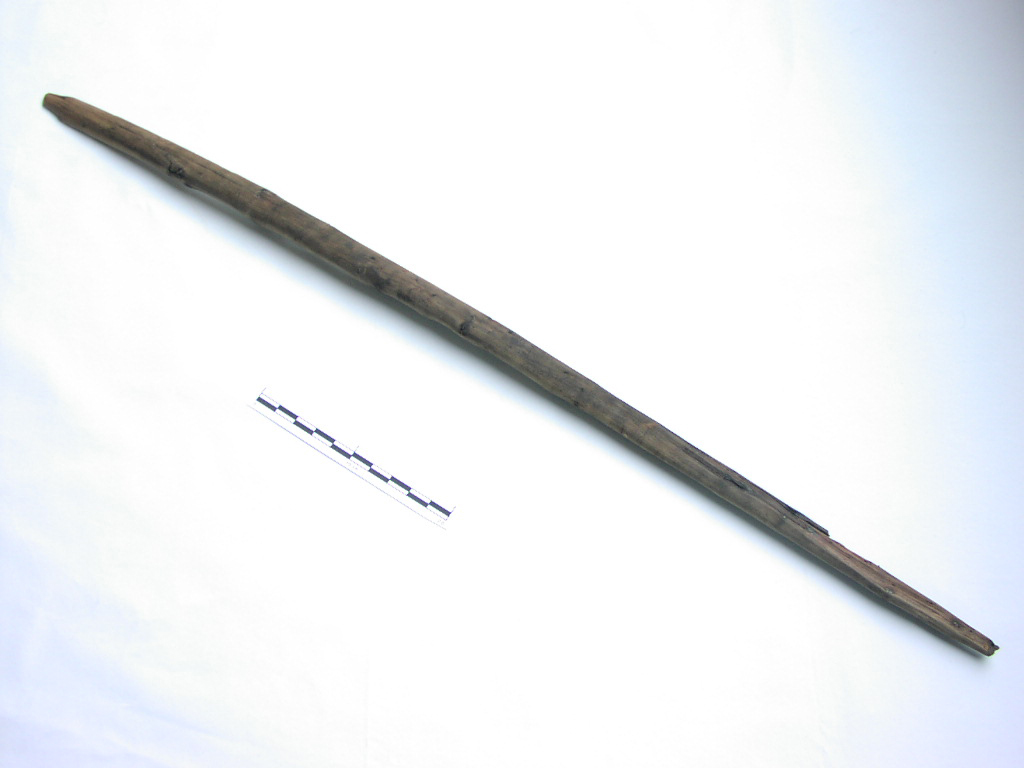
During the 2012 season, that archive gave up its bow. A whole yew bow emerged from an early settlement context dated by the excavators to roughly 5400–5200 BCE, joining two earlier bow fragments found in 2002 and 2005.³ The piece measures 108 centimetres; its section runs between convex and plano-convex; width sits near 25 millimetres, with thickness near 15 millimetres. Organic sediment marked both surfaces, though one end, held against carbonate sand, kept more of its working memory. At that end the bow reveals a face following the final growth ring after bark removal, along with a worked face where rough hewing facets received polish. Its tapered ends come to points. String seating on the whole bow arrives through form itself.
I pause over that last point, for it returns the bow to fingers. A later archer trained by horn nocks, linen strings, standardised limb profiles, club measurements, and laminated convenience might ask where the neat string groove sits. La Draga answers through the taper. Form performs the task. The bowyer trusted the shaped end, the friction of fibre, the exact relation between cord, wood, pull, and release. Such trust arrives only through repeated handling. Green yew cut from a stem or branch began the labour; bark peeled away, twigs fell under the blade, one side stayed close to the tree’s own last ring, and the opposing side took hewing, scraping, polish, then trial against the body’s measures. Workmanship of this kind records cognition as contact.
That contact belongs to a broader wooden world. La Draga has yielded a working grammar of water, field, fibre, and house. Paddles carry rubbed authority; adze handles show the memory of impact; sickles keep the darkness of harvest, while the quieter company of digging, binding, combing, serving, and cutting tools receives dignity through use.⁴ Boxwood served objects demanding hardness; oak took containers, paddles, and structural load; yew gathered itself into bows. Such a wooden record resists the familiar stone-age simplification that lets flint speak while timber rots away. Here, water saved timber. Mud became a scriptorium. Banyoles village appears as a school of hands, a place where daily work sorted species by behaviour, assigning each wood a task according to bend, density, polish, edge, and its taste in the tool-maker’s palm. Waterlogged preservation changes scholarly ethics. Dry sites often give pottery first, then flint, bone, burnt daub, the durable grammar of survival; lake-mud gives perishables a voice with a throat full of silt. At La Draga the fragile persists as evidence, so cordage speaks beside fibre, wood grain, tool polish, and plant remains, carrying the low register of tasks usually rubbed from time. Such survival asks for a slow reading. I treat the bow as part of that wet archive, in which the hand that shaved a stave stands beside the hand that stirred grain, tied a basket, sharpened a sickle. From that company, archery loses the later habit of separateness. Banyoles teaches the bow as one skilled answer among many to the demands of shore-life.
Bow-making, within that school, held a special grammar of flesh. Harvest lives differently in a sickle handle, passage in a paddle, order in a comb. The bow answers distance. Distance enters the hand through it. Muscle becomes flight. Even so, the La Draga bow sits among domestic remains, within the settlement’s working fabric, before it entered the later theatre of armour, kingship, heraldic display, and tournament ranking. Its first social field appears close to food, timber, water, season, and skill. A person could carry it from the house line to the woodland edge, then along reed beds to a deer track, or into a teaching moment with youth that ended in a shared kill, meat, skin, and story.
Farming deepens the question. The people of La Draga cultivated early wheat forms with barley, tended legumes, gathered fruits, and kept cattle among smaller domestic animals; nourishment came through fields near the lake, herds under care, woodland plants, and occasional pursuit of game.⁵ A bow inside such an economy carries a mixed charge. A foraging band whose subsistence turns daily upon game lives on one side of the bow’s meaning; a later warrior class hardened around arms lives on another side. Between them stands La Draga, where a made weapon was maintained in a community already invested in cultivation, harvest, storage, and animal care. Agriculture gives the bow a different weight, for hunting shifts from mainstay to valued supplement, from everyday necessity to seasonal insurance, prestige action, and collective sharing.
Faunal evidence gives the claim its bone. Wild mammals form a small percentage of recovered mammal remains at La Draga, while their potential biomass stands higher due to the size of animals such as aurochs, red deer, boar, goat, and roe.⁶ That difference lands in the muscles. A rare large animal can feed memory as well as stomach. Meat crosses thresholds; hide enters labour; antler or bone joins tool-making; pursuit tests courage, planning, luck, and stamina. The bow therefore gains social value beyond the calorie. It becomes a device for bringing a distant, wary creature into the village’s moral economy. Arrow flight does physical work; the tale of that flight does communal work.
I have seen this in small rural contests, far from Banyoles, where a day’s shooting ends with hands comparing arrows at a target face, each shaft lifted as evidence. Success belongs to the archer, certainly, yet it also belongs to the fletcher, the lender of a string, the older voice correcting stance, and the group whose laughter turns shame into instruction. La Draga allows an older version of that social texture. A bow found in a domestic settlement speaks of distributed knowledge. Wood procurement precedes the stave; drying judgement and scraping angle live in the wrist; cordage, shaft selection, and point fitting belong to the same web as practice ground, safe instruction, and the timing of hunts. Each arrow released would carry more than one person’s labour.
European comparison sharpens the scale. Mesolithic bows from northern contexts reach deep into earlier time; many Neolithic examples cluster in later fourth-millennium wet deposits around Alpine lake margins, peat, and ice. La Draga’s bows, dated to 5300–5000 cal BC in the technical study, stand among the earliest Neolithic evidence, with the Linearbandkeramik Kückhoven-Erkelenz bow near 5090 BC as a close chronological companion.⁷ The Mediterranean setting gives La Draga its authority. Yew appears there as a chosen wood in a farming lakeside village where organic preservation allowed a vanished wooden intelligence to survive. The bow’s modest length also troubles easy typology. A whole bow of 108 centimetres sits small beside many later European whole bows, while one fragment from La Draga, 105 centimetres in its preserved length, points to a larger weapon. Size therefore becomes a clue with several doors: youth training, particular use, mobility in wooded ground, individual preference, and repair history.
Measurement also has humility. A 108-centimetre bow invites a quick shrinking of status, as modern shooters used to longer limbs may hear smallness as weakness. Experimental archery teaches another lesson: draw length enters the bargain with wood quality, limb width, arrow mass, terrain, stature, and technique. Within reeds or scrub, a shorter bow can move with less snagging; during instruction it can fit a growing body; for communal hunting it can serve a particular role. The object therefore asks analysis to stay near the stave, where speculation must wear the bridle of measurement. The largest fragment, D/02 KA-89/11 in the study’s register, measures 105 centimetres preserved, with a maximum width near 34 millimetres, thickness near 22 millimetres. Its section is biconvex; one face follows the original outer growth-ring surface after bark removal; the opposing face bears polish. D/05 KE-90/7, the smaller fragment, preserves an end with two lateral notches forming a fixation head, a detail that sets it beside the whole bow’s pointed simplicity. Variation at La Draga therefore lives within a shared material choice. Yew gathers the family; ends, sections, and sizes reveal particular makers or tasks. Archaeology here gives kinship with difference before tidy classification. Siblings share a brow yet carry separate tempers. That yew deserves close respect. Taxus baccata grows slowly, with dense, elastic wood, hard yet responsive, poisonous in leaf, shadow-loving in many European memories. A bowyer values the meeting of tension paired with compression in yew’s growth. Modern longbow talk often fixes upon sapwood as back, heartwood as belly, but La Draga’s bows answer through their own early technology, with the last ring surface preserved on one face, the worked face shaped opposite. The bowyer read the tree’s architecture. Such reading belongs to a technical intelligence that resists our habit of treating prehistory as childhood. I would sooner call it apprenticeship written in grain. Hand knowledge came first; theory came later.
Archery before written war also asks for moral care. Projectile points lodged in bodies, fortified sites, mass killings, and later iconography all give European prehistory a vocabulary of violence. La Draga itself offers a domestic bow record where hunting, resource acquisition, prestige, and social cohesion remain stronger immediate readings.⁸ The bow can kill a person; that capacity lives inside every bow. Yet an artefact’s capacity differs from its best evidenced context. At Banyoles, the mud held bows inside a village where farming, herding, gathering, carpentry, and fibre-work shared the same shore. There the first reading has to begin with making, maintenance, teaching, hunting, and distribution. Violence remains in the object as a hard potential, like the edge in a sickle, but potential alone makes a poor verdict.
Such restraint steadies archery history. Later ages wrap the bow in banners, sending it through statute and frontier, cavalry memory and royal hunt, guild mark and battlefield chronicle, saintly image, sport trophy, and national romance. La Draga stands before that noise. A lake settlement grants a bow stripped of heraldry, written command, and knightly fantasy. The instrument comes to us dark, compact, practical, preserved through water more than through legend. Field archers receive a demand to look past costume. Historians receive another demand to place workmanship ahead of ideology. Philosophers of tools receive a third demand to admit that a weapon may begin as a relation between hand, wood, animal, season, and group.
Arrow-shaft material from La Draga widens that relation. Within the projectile assemblage, wooden points sit beside bone tips; geometric flint shares the record with massive wooden heads, while dogwood elements and boxwood tips show experiment as practice. Bow alone remains a promise; arrows give that promise its grammar. An arrow’s straightness, point weight, fletching, binding, balance, storage life, and repair decide whether intention becomes flight. At a lakeside village, reed and willow entered the same practical conversation as dogwood and boxwood, while oak, yew, lime fibre, clematis fibre, sinew, or hide ties held the kit together. Out of that intimate library of textures the archer’s equipment emerged. Every shot began long before the draw.
British prehistory offers a later comparative echo through the Somerset yew bows from Ashcott Heath as well as Meare Heath, studied by Clark in the mid-twentieth century.⁹ Those bows belong to another time, another wetland, another technological setting, yet they help place La Draga inside a larger European truth: water saves the perishable body of archery. Stone arrowheads travel widely through ordinary excavation; wooden bows need peat, lake, ice, mineral luck, and a sealed sleep. The archive of archery therefore favours places that keep water close. In places where wood perishes, the archer thins into points, wounds, and images. When mud keeps faith, the archer returns with a stave in hand. That return changes the language of evidence. Flint point tells of penetration, cutting, hafting, sometimes blood or impact fracture. Bow-wood tells of stored energy, embodied posture, tree knowledge, measurement by eye, lived training. Curve asks us to imagine stance. Worn surface asks us to imagine maintenance. A damaged tip asks us to imagine a moment when fibre crushed, perhaps during use, deposition, excavation, or life in saturated earth. Scholarship rightly guards each possibility. Even so, the object pushes imagination in disciplined ways. It keeps us close to mechanics, as a rosary keeps prayer close to thumb. The bow makes theory kneel.
I return, often, to the bowyer’s hand. Selection came first: the stave, knots, straightness, yew from a surrounding region where the tree grew at low or middle altitudes beyond the immediate lake-edge record. Shaping came next, as one face stayed near the tree’s final ring while the opposing face took the blade, twigs lost their small claims, facets received polish, and bend met trial. Those acts form a biography of work. They carry decisions made before any arrow flew. A warrior ideology begins after many such decisions. Hunting prestige begins after them too. The bow first enters the world as a shaped tension held in reserve.
Water gave La Draga a rare mercy. It kept the village’s organic memory dense enough for us to meet woodworking as culture before it becomes a footnote to stone. In that preserved density, the bow becomes part of a tool-ensemble, a wonder in company. Within that company, the bow belongs to tools that touch earth and cereal, lake and fibre, animal, timber, and fire. A farming settlement at the edge of Lake Banyoles made archery part of its working life. Such placement alters the old question about origins. Early farming archery carries wet wood before any crown or tournament trumpet. Wet wood, scraped yew, shared meat, teaching, and embodied skill become its first heraldry.
At last, the first question returns: what does a 108-centimetre yew bow lifted from Lake Banyoles mud ask us to know about archery before kings, heraldry, tournaments, or written war? The answer begins with archery as a technology of touch before it became a technology of display. From that answer the archer appears through mixed labour: a farmer who hunted, a learner beside the maker, a household member bearing a skill whose meaning grew through wood, cord, shaft, animal track, and collective memory. La Draga answers directly: the bow served hands ahead of banners; distance became usable ahead of visible status; lake-mud kept the bowyer’s work alive ahead of written war’s naming of the archer.
Scholia:
¹ Raquel Piqué et al., ‘Characterizing Prehistoric Archery: Technical and Functional Analyses of the Neolithic Bows from La Draga (NE Iberian Peninsula)’, Journal of Archaeological Science, 55, Amsterdam, Elsevier, 2015, pp. 166–173. I rest the main reading on this study due to its direct handling of the three yew bows, its measurements, its wood identification, its treatment of tool marks, with its discussion of hunting as social practice among early farmers. The paper holds greatest value where it resists romance by returning to measurement, yew identification, worked face, growth-ring face, and pointed ends. Those figures keep my prose in the mud. Its argument that La Draga’s bows belong among the earliest Neolithic archery evidence in Europe also gives the object chronological weight. More quietly, the authors’ attention to social cohesion lets the bow enter a village more than a legend, which strengthens my answer to the opening question.
² Josep Tarrús, ‘La Draga (Banyoles, Catalonia), an Early Neolithic Lakeside Village in Mediterranean Europe’, Catalan Historical Review, 1, Barcelona, Institut d’Estudis Catalans, 2008, pp. 17–33. Tarrús gives me the settlement before the weapon, from the eastern shore and the 1990 discovery to the sector work, Cardial date, oak posts, cereals, wooden tools, animal bones, and preserved grain. I need that village as the bow’s first house. A weapon severed from its house grows theatrical; placed among posts, hearths, paddles, sickles, fibre, and clay, it regains scale. Excavation method also gains importance through his attention to pumps, divers, and sector names, which keep La Draga from becoming a pretty origin tale. Bow meaning comes through waterlogged context. That context allows a scholarly claim with soil on its boots: preservation shaped interpretation.
³ Universitat Autònoma de Barcelona, ‘The Oldest Neolithic Bow Discovered in Europe’, Bellaterra, Universitat Autònoma de Barcelona, 2012. I use this institutional notice for the discovery announcement, date range, full length, yew identification, and the relation to the 2002 and 2005 fragments.
⁴ Àngel Bosch, Júlia Chinchilla, Josep Tarrús, Raquel Piqué, ‘Els objectes de fusta i fibres vegetals’, in Àngel Bosch, Júlia Chinchilla, Josep Tarrús (eds.), Els objectes de fusta del poblat neolític de La Draga: Excavacions de 1995–2005, Monografies del CASC 6, Girona, Museu d’Arqueologia de Catalunya, Centre d’Arqueologia Subaquàtica de Catalunya, 2006, pp. 27–126. This catalogue of wood with fibre keeps the bow among neighbours. A bow has kin in paddles, combs, sickle handles, adze handles, digging sticks, ropes, and baskets. Catalogue value lies in the ordinary abundance that surrounds the rare weapon. Wood species become decisions, each with task. Boxwood, oak, yew, pine, lime fibre, and clematis give texture to early Neolithic knowledge. Through that company, I read the bow as one product of a larger ecology of hand-skill, a local discipline formed by selection, cut, polish, binding, wear, and repair. Such a view prevents fetishising the bow as lone marvel. Marvel spreads into the hands that made the village work.
⁵ Ferran Antolín, Ramon Buxó, Stefanie Jacomet, Vanessa Navarrete, Maria Saña, ‘An Integrated Perspective on Farming in the Early Neolithic Lakeshore Site of La Draga (Banyoles, Spain)’, Environmental Archaeology, 19:3, Leeds, Maney Publishing, 2014, pp. 241–255. Farming gives the bow its strain. Antolín, Buxó, Jacomet, Navarrete, and Saña place crop work, plant gathering, animal resources, storage, processing, and household scale within a single economic reading of the settlement. Their work lets me argue that hunting at La Draga existed within an agricultural life. That setting alters archery’s meaning. A bow among farmers carries risk management and seasonal supplementation; prestige, training, and perhaps feast-distribution also gather around it, beyond pure daily subsistence. Those data let me speak with scholarly footing of cereals and legumes, fields and gathering, herds and lake-edge resources. Modern fantasy often desires archaism, yet the bow belongs to people already skilled in cultivation, planning, storage, and scheduling. Beside the sower stands the archer.
⁶ Maria Saña, ‘La gestió dels recursos animals’, in Àngel Bosch, Júlia Chinchilla, Josep Tarrús (eds.), El poblat lacustre del neolític antic de La Draga: Excavacions de 2000–2005, Monografies del CASC 9, Girona, Museu d’Arqueologia de Catalunya, Centre d’Arqueologia Subaquàtica de Catalunya, 2011, pp. 177–212. Saña’s faunal work supports the contrast between domestic stock with wild game, giving bone to the claim about hunting’s social weight.
⁷ Jürgen Junkmanns, Pfeil und Bogen: Von der Altsteinzeit bis zum Mittelalter, Ludwigshafen, Verlag Angelika Hörning, 2013. Junkmanns gives the long European bow family, from earlier hunter contexts to Neolithic wetland survivals, while his forms, lengths, woods, nock treatments, and practical reconstructions keep comparison practical. I use that family tree to keep La Draga both exceptional as Mediterranean preservation as well as connected to broader bow-making practice. Comparison proves useful here, for the 108-centimetre bow can mislead a reader into quick judgement. Smallness may imply youth, special use, terrain, personal choice, depositional biography, or a mixed history. Junkmanns’ experimental sympathy for bows as used objects helps sustain that caution. His work also honours the maker’s problem: a bow carries the mathematics of wood in a body-friendly form. That attention to making deepens my claim that archery begins as tactile knowledge before it enters heraldic memory.
⁸ Lawrence Keeley, War Before Civilization: The Myth of the Peaceful Savage, Oxford, Oxford University Press, 1996. Keeley helps frame pre-state violence as a serious archaeological question, while La Draga’s own bow context draws my reading first to workmanship, hunting, training, and social distribution.
⁹ John Grahame Douglas Clark, ‘Neolithic Bows from Somerset, England, and the Prehistory of Archery in North-western Europe’, Proceedings of the Prehistoric Society, 29, Cambridge, Cambridge University Press, 1963, pp. 50–98. Clark’s Somerset study gives a later wetland comparison, useful for the larger claim that water preserves archery’s perishable body.
Views: 169