

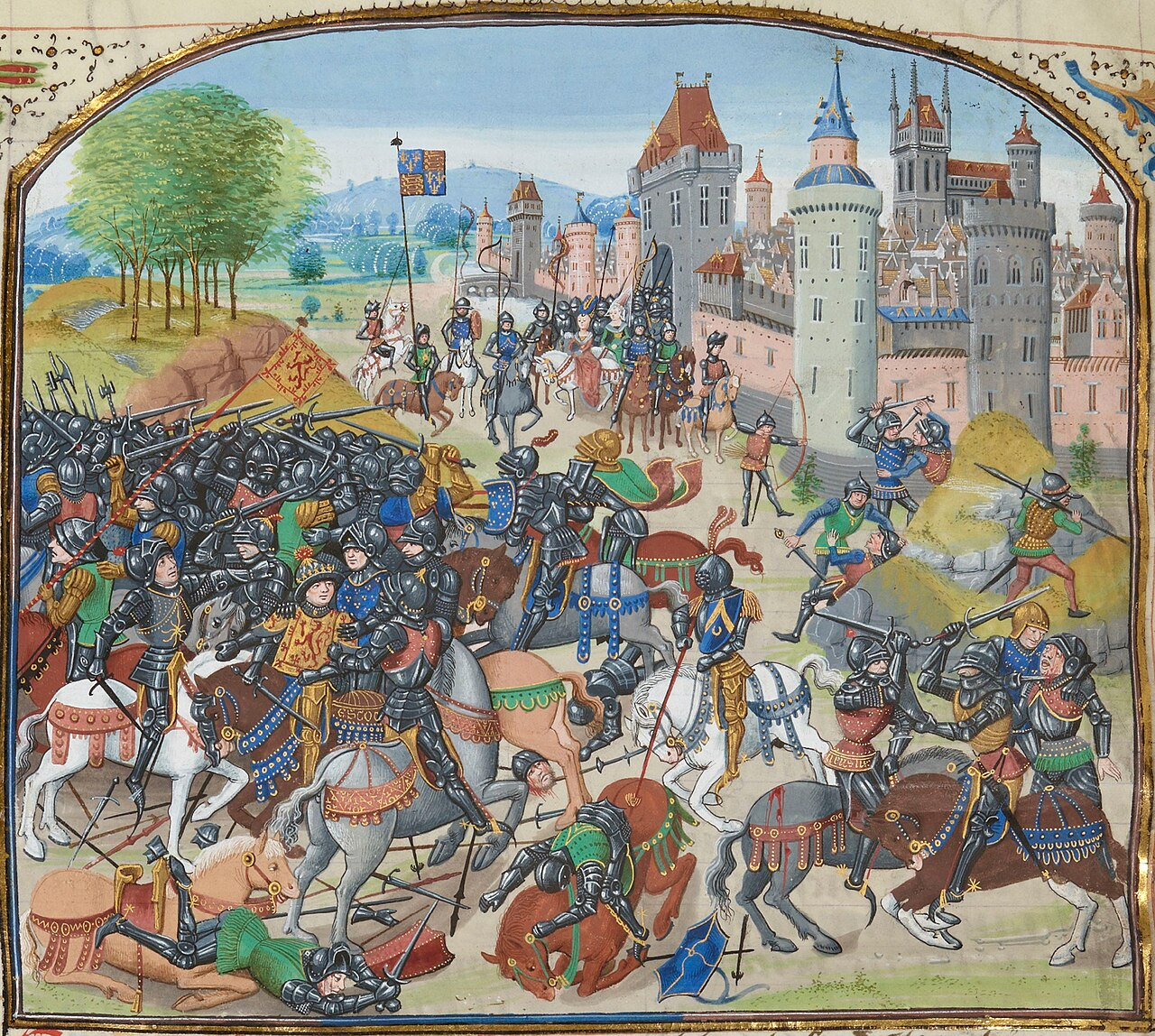
What lesson passed from the narrow mouth of Dupplin Moor into the longbow, once a bodkin head rested in my palm like a cold tooth pulled from an iron beast? Hammered into a small point, the bodkin head grants blunt theatre. Its socket swallows shade; four planes retain the rasp of a file; the taper keeps the conduct of a nail taught to seek flesh, leather, mail, horsehair, cheekbone. My thumb found the ridge first, then the socket’s lip, then the frail burr where a shaft had once entered. Touch steadies argument. Any hand learns that a weapon enters history where terrain, command, hunger for rank, weathered fear, and one chosen gap draw force into action. Dupplin Moor, held in records near Perth in August 1332, carries that lesson with grim patience.¹
Historic Environment Scotland sets the ground inside its national inventory with plain force: an opening fight of the Second War of Scottish Independence, a severe Scottish defeat, a fresh aperture for English ambition.² Its record also marks a tactical pattern later borne across Berwick, Picardy, Normandy, clay lanes, ploughed ridges, and vineyard edges, wherever missile range could break a proud advance. The official record feels like a boundary stone polished by many palms. Its prose accepts altered terrain, disputed placement, surviving slopes above the Earn, the Dupplin plateau, and the labour of fixing exact deployments. Such caution suits the place. With its narrow mouth, the battlefield keeps its jaw clenched.
I have loosed a longbow on wet Irish ranges, feeling yew answer through the heel of my hand, seeing the left shoulder climb as the body tries to buy accuracy with vanity. Wet range practice gives stern grammar: draw to anchor, loose, then watch the shaft confess its path. War arrows bend that syntax toward rank, angle, flank, release, wound. The English order later crowned with fame—dismounted men-at-arms holding a defensive front, archers spread wide, the enemy’s advance drawn through a channel of harm—appeared here with early brutal clarity. Crécy carries painted thunder. Agincourt carries English memory like a reliquary wrapped in mud. Dupplin carries a smaller key, colder to the touch, made for the lock before the door gained ceremony.
Lanercost supplies the first hard contact. Edward Balliol, son of King John Balliol, came ashore at Kinghorn on 6 August with Henry de Beaumont at the centre of a circle that included David of Strathbogie, Gilbert de Umfraville, Ralph Stafford, and other dispossessed lords, leading a compact company the chronicler sets at fifteen hundred, while a second tradition gives two thousand eighty.³ Numbers flash with a propagandist gleam, yet the scale remains credible through smallness. Credibility survives in the compact nature of the expedition: a claimant moved by sea, carrying the grievance of men stripped of Scottish estates after Bannockburn, entering a realm governed for the child David II through guardianship. Political cause travelled in ships. Victory’s shape waited on land.
Scalacronica tightens the scene through the voice of a knightly house versed in marches, ambush, fear, face-saving. Thomas Gray’s account, in Maxwell’s older translation, recalls Beaumont’s companions reproaching him as the Scottish host loomed above the Earn, the smaller army seeming meagre from the valley.⁴ Shame entered before strategy. Beaumont answered through piety, honour, profit, disgrace, the language of noble sinew drawn across peril’s frame. Men can speak of God while measuring a ford by darkness. That speech performed practical labour: it held a frail company in one piece for a night crossing.
Ground supplied the second commander. Reports place the Scots above the Earn, near Gaskmore or Gledenmore, with Perth close enough to press political urgency into each choice. Brut tradition preserves the phrase of a “streite passage,” a tight way that restricted frontage, turning mass into a squeezed body. In that hour the ground ceased to behave as setting; it became a jaw. Massed Scottish strength could carry banners, pikes, lineage, and confidence born from Bannockburn, yet a host descending through a narrowed passage enters the geometry chosen by its foe. Descent through that constriction granted Balliol’s party what small armies crave: a means to make numbers arrive in pieces.
Andrew of Wyntoun, writing from a Scottish line of memory, keeps the hurt through verse chronicle, where action moves beneath the old burden of moral reckoning.⁶ His value lives in the counter-pull against northern English triumphal habit. Lanercost turns defeat into providence. Scalacronica turns collapse into miracle through knightly nerve. Scottish chronicle keeps shame nearer the family hearth. Between them, I hear a field speaking through rival mouths. One source has a hand inside the corpse. Parchment receives the grease.
Military historians have treated Dupplin as a hinge in infantry practice, though the hinge creaks beneath thick murk. Kelly DeVries gives the most disciplined reading of the tactical body: archers on the flanks, dismounted men-at-arms at the front, spearmen in the centre, a small mounted reserve behind, each part answering the lesson Bannockburn had written with English blood.⁷ Cavalry pride had met Scottish spear mass in 1314. Beaumont’s formation at Dupplin accepted that lesson, folded it, sharpened it, then turned it back against the Scots. Tactical learning owns an ugly holiness. The dead teach the living to kill better.
A longbow alone wins scraps. Weapon-seduction begins in the hand, where a stave seems to gather judgment inside itself. Dupplin shows that a bow becomes sovereign through placement. Matthew Strickland with Robert Hardy stress the composite nature of the warbow system: trained bodies matched to suitable timber, arrow supply, social regulation, battlefield integration, and a missile culture grown through practice.⁸ Arrow virtue rests in repeated labour. Yew staves store years of tree-weather; a string stores twist; the archer stores callus, breath, shoulder memory. On a field, all that stored time leaves the fingers in a storm.
Scottish advance brought its own inheritance. Schiltron carried victory inside the word after Bannockburn, a spear-thicket that had shamed mounted aristocratic confidence. At Dupplin, that inheritance became dangerous weight. Robert Bruce of Carrick led the foremost division according to Lanercost’s tangled witness, while Mar commanded the greater arrangement from the rear. First ranks met lance-points, spear-points, arrow-flights. Stafford’s remembered cry urging Englishmen to turn shoulders into the pikes gives the scene a fleshly intelligence: armour angled, torso twisted, impact managed, survival sought by inches. Line yielded ground, then held.
Clifford Rogers frames Edwardian warfare through a habit of drawing battle onto terms favourable to a smaller prepared host, a habit that would mature in Edward III’s campaigns.⁹ Though Dupplin stands slightly beside royal command, as a private expedition with tacit royal sanction, the field taught the royal imagination. Yet a narrow mouth can instruct a king at distance. Once word reached England that a compact Balliol-aligned army had shattered a far larger Scottish array, the lesson lay ready for Halidon Hill in 1333. At Halidon, archers on wings could make the enemy lower the face, lose cohesion, stumble into the central front. Men-at-arms, dismounted, could then convert disorder into slaughter.
Ranald Nicholson’s study of Edward III’s early Scottish years keeps that learning inside politics beyond tactics.¹⁰ The young king emerged from Mortimer’s shade, carried grievance over Northampton, dealt with the Disinherited, weighed Scotland’s French alliance, then found in Balliol’s victory a license to act more openly. Dupplin did more than crown Balliol at Scone for a season. Restraint loosened. Policy gained a wound to point at, proof that Scottish power could break in set battle. Political will loves such proof. Field blood dries into ink, then receives the name of reason.
The Treaty of Edinburgh-Northampton had sought settlement in 1328, with recognition of Scottish kingship plus provisions touching dispossessed lords. Michael Brown places that settlement inside the larger fracture of lordship after Bannockburn, where cross-border aristocratic claims survived treaty language like roots beneath a paved road.¹¹ Thus Dupplin began before the ships left the Humber. Beginnings lived in charters, forfeitures, marriages, feudal custom, and a gentry class whose estates crossed a border more easily than loyalty did. Land grievance became a lesson in massed archery.
Iain MacInnes presses the civil-war nature of the Bruce-Balliol struggle, reminding me that “Scots” against “English” flattens a harder tangle.¹² Balliol’s claim drew Scottish adherents; Bruce loyalty carried its own divisions; English magnates pursued property as much as royal programme. On the ground near the Earn, identities rubbed raw. Service could run toward a claimant from Scotland with wages from England, or toward a Bruce child-king beside a distrusted guardian. Bowshot cared little for those distinctions. Its arc translated civil fracture into wounds distributed through the face.
Lanercost lingers over faces. Medieval honour gathers there: recognition joins lineage, prayer, breath, command, and shame. Arrow-strike to the face attacks personhood before it attacks formation. I have seen target bosses shredded at twenty yards, straw loosened into hair, paper faces torn into mute white curls. That sight carries a childish portion beside war, yet it gives one measure: repeated shafts alter surfaces fast. Packed into a living front, surface became panic.
Scalacronica’s most terrible image arrives after the clash of vanguard with rearguard. Such a passage strips clean romance from archery. Arrows opened the work. Compression finished it. Dupplin’s killing shape arose from missile flight meeting tight terrain, rearward urgency pressing into forward resistance, and breath crushed in wool, mail, leather, sweat. Out of that tangle the longbow learned that wounding the front could weaponise the mass behind it.
Sir Charles Oman, though written in an older military idiom, grasped the broader pattern: Dupplin formed a turning point in the Scottish wars, after which English commanders repeatedly preferred the defensive order used by Balliol with Beaumont.¹⁴ Older prose can carry firm bones. Oman’s account sometimes smooths the field too cleanly, yet the main line stays useful. Discipline in a chosen place let a small army make the large army move, use arrows to disrupt, dismounted steel to hold, then crowding to consume courage. That formula has the simplicity of a trapdoor.
J. E. Morris, writing on Crécy, placed Dupplin inside the genealogy of English archery long before modern tactical revision sharpened the debate.¹⁵ His late Victorian confidence needs careful handling, as every age polishes the weapon it admires. Yet his instinct to trace Crécy backward was sound. Crécy grew from earlier soil before that summer field in 1346. Predecessors stood in border war, at Boroughbridge, at Dupplin, at Halidon. Technique travels through scars.
Comparison with Crécy tempts grandeur. Andrew Ayton with Philip Preston show how Crécy gathered scouting and terrain, discipline and supply, battle order and royal command, all caught with French misjudgment in an event of continental consequence.¹⁶ Dupplin offers harsher intimacy. Forces there were smaller, politics more tangled, fame thinner, yet the formula appears naked. Crécy’s royal theatre surrounds the mechanism. Dupplin’s mechanism sits close to bone. A narrow mouth, flanking archers, a held centre, a pressed enemy: the thing stands almost stripped for inspection.
Agincourt tempts greater song. Anne Curry’s work on Henry V’s campaign restores the machinery around the battle: muster evidence beside sickness, fatigue inside marching, ransom culture braided through road, mud, law, and calculation.¹⁷ Henry’s victory owed much to conditions far beyond archery alone. Dupplin helps cleanse the eye here. Earlier family action shows in a rougher house. Longbows wounded while ground cramped, men-at-arms held, and enemy numbers became liability. Another field later repeats that grammar in another tongue, at grander volume, with another king listening for providence in the groan of mud.
Walter Bower’s Scotichronicon, drawing from Scottish ecclesiastical memory, places later moral weight on the crisis that followed Bruce’s death, Balliol’s intrusion, the fragility of David II’s minority.¹⁸ Such writing holds weight for me by virtue of its grief. A chronicle shaped after events has its own kind of truth: it records how a community chose to remember injury. In Scottish memory, Dupplin becomes more than a tactical defeat. Warning gathers around guardianship, overconfidence, faction, and the peril of assuming that yesterday’s victory guarantees tomorrow’s breath.
Geoffrey le Baker offers another English clerical witness for the wars of Edward III, useful chiefly for the moral atmosphere through which English victories received providential gloss.¹⁹ Medieval war writing often treats success as divine grammar. I trust such claims after rubbing them against bone, payroll, slope, supply, fear. Providence in these pages can smell suspiciously like a well-placed archer. Religious language itself belongs to the field, for men fought under prayer and oath, beside relic, absolution, curse, and patron saint. Belief shaped courage, hence belief shaped formation.
Adam Murimuth with Robert of Avesbury bring the documentary mood of Edwardian war closer to administration, diplomacy, rumour, cost.²⁰ Those records remind me that arrows require accountancy. Before shaft wood found a field, woodland hands cut it, fletchers dressed it, smiths headed it, carts hauled it, wages summoned it, victuals sustained it, and oath fixed it to service. Killing shape at Dupplin may seem almost elemental, yet statecraft later learned to feed it. A longbow victory begins far from the field, in woodland, forge, exchequer, port, oath-roll. Visible storm is the last form of many hidden labours.
Archaeology at Dupplin keeps a modest voice. Historic records mention reported weapons from Dupplin Parks, a horse pendant associated with Sir William Keith’s retinue found in the wider field zone, high grave potential, many open questions over exact placement.²¹ Fragments suit the battle better than a monument would. Pendant speaks of a retinue’s identity on leather strap. Buried point speaks of a body gone. The ground retains its evidence as a mouth retains a taste after iron. Reticence suits me. It bites the comfortable story.
Depth here means the clarity of an early cut. Under Crécy’s black sky stand royal command and quarrels. At Agincourt, dynastic claim, siege sickness, rain, ransom custom, saints’ days, and Shakespeare’s later breath gather around the field. Dupplin carries thin veils. A compact war-band chose a throat of ground. Another larger host came on with confidence. Archers bit the faces of the front. Dismounted men endured the push. Rear ranks of the attacking host turned mass into a millstone. Chalk could set the geometry on slate with dust still on the thumb: wings, mouth, block, crush. Such simplicity gives the event its terror. It asks the historian to look at killing before pageantry softens it.
Field archery has taught me that distance can feel clean while the target lacks breath. Targets set beneath trees accept error with a straw sound; a living front receives error as agony. Old warbow practice therefore carries a moral double edge. Dupplin stands at that border. A flank archer likely saw men as faces: lifted shields, caps, helmets, mouths opening, heads turning away from the storm. He loosed into them through trained calm. Technique steadied the hand while terror spread at the receiving end. At this border, military history touches philosophy with a dirty finger: skill can serve courage or plunder, prudence or vainglory, necessity or revenge. The object in my palm stays cold through every answer.
Memory favours banners, while practice favours joints; pain keeps the tally. Touch keeps old accounts. At Dupplin, the joint lay where earth shape met hand skill, where a throat of ground received a storm of shafts. My palm returns to the bodkin head for that reason; iron teaches by edges, history by places where edges meet breath.
So what did the narrow mouth of Dupplin Moor teach the longbow? Such teaching began with the bow’s power living beyond the bow. Missile power required angle, nerve, disciplined feet, chosen ground, a held centre, and a foe compelled to enter compression. Bannockburn’s spear lesson could be reversed; aristocratic grievance could hire infantry genius; a smaller army could turn a large one into its own burden. Above all, it taught English war-making a killing shape before fame gave that shape a golden mask. Dupplin answers the opening question directly: the longbow learned its murderous greatness when a narrow place made distance, crowding, fear, and discipline act as one weapon.
Scholia:
¹ My opening claim rests on Historic Environment Scotland, ‘Battle of Dupplin Moor (BTL8)’, Inventory of Historic Battlefields, Edinburgh, Historic Environment Scotland, 2012, sections ‘Overview’, ‘Historical Background’, ‘Inventory Boundary’. As a field-map held against the palm, the entry gives coordinates, broad placement near the Earn, the Dupplin plateau, the date tradition, the Balliol-Beaumont company, the heavier Scottish host, with careful admission that exact placements remain contested by the ground. Its value for my reading lies in restraint. Official inventory prose seldom sings; here such restraint steadies the bloodier claims. The record names the battle as an early tactical event in which archers, dismounted men-at-arms, terrain, with compressed advance formed one killing instrument. That sober frame lets my reading lean into the human cost behind it.
² Battlefields Trust, Dupplin Moor: UKFOC 619, London, Battlefields Trust, 2005, pp. 1–4. My reliance falls on its field summary, troop estimates, tactical sequence, battlefield location debate, source base.
³ Lanercost gives me the smell of border writing: harsh, clerical, quick to read victory as divine favour, yet rich in names, routes, troop estimates, wounds. Herbert Maxwell’s translation remains serviceable when handled with care: The Chronicle of Lanercost, 1272–1346, translated by Sir Herbert Maxwell, Glasgow, James MacLehose & Sons, 1913, pp. 264–270. My Lanercost reading follows Balliol’s arrival at Kinghorn, the small expeditionary company, the figures attached to both armies, the march to the Earn, the night crossing, the description of Scottish divisions, the arrow wounds to faces, with Stafford’s shout in the press. Chronicle texture deepens the argument by making numbers feel mobile yet socially meaningful. Fifteen hundred, two thousand eighty, thirty thousand: such figures carry rhetoric, awe, fear, providential desire. Their very size helps reveal the imagined scandal of Dupplin: a small host could maul a great one when the field shaped the fight.
⁴ Gray’s Scalacronica gives my reading a knightly ear, meaning a witness tradition trained by lineage, shame, service, with the pride of men who measure truth through peril. Thomas Gray, Scalacronica: The Reigns of Edward I, Edward II & Edward III, translated by Sir Herbert Maxwell, Glasgow, James MacLehose & Sons, 1907, pp. 88–94. My hand returns to Gray for the reproaches aimed at Beaumont, Beaumont’s reply, the night ford over the Earn, Roger de Swinnerton’s drowning, the attack on Scottish grooms, the daybreak sight of two Scottish columns, with the later crush of bodies. That passage deepens my central claim through its staging of morale. Tactics appear here as social courage before they appear as diagram. A small army first survives its own fear, then uses ground to make the opponent’s confidence turn heavy.
⁵ Friedrich W. D. Brie, editor, The Brut or The Chronicles of England, Part I, London, Kegan Paul, Trench, Trübner & Co., 1906, pp. 289–291; see also Clifford J. Rogers, editor, The Wars of Edward III: Sources & Interpretations, Woodbridge, Boydell Press, 1999, pp. 21–24. My reading takes the “streite passage” tradition through these textual paths.
⁶ Andrew of Wyntoun, The Original Chronicle of Andrew of Wyntoun, edited by F. J. Amours, volume VI, Edinburgh, William Blackwood & Sons, 1914, pp. 211–220. Wyntoun gives me Scottish memorial grain beside English triumph.
⁷ Kelly DeVries gives the clearest modern tactical skeleton for Dupplin, especially when I need to keep romance away from the bow: Infantry Warfare in the Early Fourteenth Century: Discipline, Tactics & Technology, Woodbridge, Boydell Press, 1996, pp. 115–122, 180–181. I take his account for the formation: dismounted men-at-arms holding the front, archers placed on the wings, spearmen in support, mounted Germans in reserve, with the Scots entering a constricted attack. His reading deepens my argument by giving Dupplin a place inside a wider military education after Bannockburn. English adaptation appears there as practice, discipline, tactical memory. That fits the bodkin in my palm: iron alone explains scraps; a learned formation explains much. Dead men from 1314 become grim tutors for 1332, as spear victory teaches missile victory its own shape.
⁸ Strickland with Hardy keeps the weapon joined to its culture, which guides every sentence where my hand might be tempted by the beauty of yew. Matthew Strickland with Robert Hardy, The Great Warbow: From Hastings to the Mary Rose, Stroud, Sutton Publishing, 2005, pp. 143–178. Their study places the longbow inside training, timber, arrow production, statutory habit, tactical placement, social practice. My reading draws from that breadth to cut away the charm of a single object. A bow in isolation becomes a museum piece; a bow inside bodies, stores, wages, carts, field order, command, with terrain becomes a system. For that reason, Dupplin can teach: it joins archery skill to geometry. The source deepens my tactile reading by making the bow answer to hands far beyond the archer’s fingers: fletcher, smith, forester, paymaster, captain, messenger.
⁹ Clifford J. Rogers, War Cruel & Sharp: English Strategy, 1327–1360, Woodbridge, Boydell Press, 2000, pp. 21–31. His study gives me the strategic habit of making an opponent attack prepared ground.
¹⁰ Nicholson helps me keep Dupplin inside the young Edward III’s political apprenticeship, away from the comfort of a weapon tale alone. Ranald Nicholson, Edward III & the Scots: The Formative Years of a Military Career, 1327–1335, Oxford, Oxford UP, 1965, pp. 113–132. His book gives me the setting after Northampton, Edward’s early kingship, Balliol’s circle, the Disinherited, with the way Scottish events shaped later English action. The book deepens my argument by linking tactical learning with policy. A field victory enters council speech, diplomatic posture, aristocratic appetite. Dupplin therefore works as event-sign: proof that Scottish power could be broken in open fight, invitation for a king to test the method at Halidon Hill. Nicholson’s careful chronology lets my reading move from mud to parchment.
¹¹ Michael Brown, The Wars of Scotland, 1214–1371, Edinburgh, Edinburgh UP, 2004, pp. 223–240. Brown gives me forfeitures, cross-border lordship, Balliol allegiance, with Bruce political strain.
¹² Iain A. MacInnes sharpens the civil-war edge, which gives the field its most bitter taste for me: Scotland’s Second War of Independence, 1332–1357, Woodbridge, Boydell Press, 2016, pp. 25–52. My use of his study cuts through a flat national pairing of English arms against Scottish arms. Bruce-Balliol conflict involved Scottish adherents on both sides, English aristocratic interests, land claims, personal service, dynastic loyalty, with local calculations that could shift beneath a lord’s hand. Such a reading deepens the moral grain. A longbow’s arc crosses categories that later memory likes to harden. Near the Earn, a shaft may strike a man whose language, kinship, patronage, property, prayer, with allegiance belonged to several claims at once. His work helps keep the dead from becoming symbols too quickly.
¹³ Thomas Gray, Scalacronica: The Reigns of Edward I, Edward II & Edward III, translated by Sir Herbert Maxwell, Glasgow, James MacLehose & Sons, 1907, pp. 91–92. Gray draws me back to the crush of Scottish ranks.
¹⁴ Sir Charles Oman, A History of the Art of War in the Middle Ages, volume II, London, Methuen & Co., 1924, pp. 103–106. Oman supplies the older tactical genealogy from Dupplin to Halidon for my reading.
¹⁵ J. E. Morris, ‘The Archers at Crécy’, English Historical Review, volume 12, Oxford, Oxford UP, 1897, pp. 427–436. His 1897 study gives me the early scholarly impulse to trace later archery fame backward.
¹⁶ Andrew Ayton with Sir Philip Preston, editors, The Battle of Crécy, 1346, Woodbridge, Boydell Press, 2005, pp. 1–37, 159–221. Ayton with Preston give me Crécy’s terrain, command, supply, with tactical debate.
¹⁷ Anne Curry, Agincourt: A New History, Stroud, Tempus, 2005, pp. 191–248. Curry gives me the campaign frame around Henry V’s field, especially muster, movement, exhaustion, ransom culture.
¹⁸ Walter Bower, Scotichronicon, volume VII, books XIII–XIV, edited by D. E. R. Watt, Aberdeen, Aberdeen UP, 1996, pp. 6–35. Bower gives me later Scottish moral memory of crisis after Bruce.
¹⁹ Geoffrey le Baker, The Chronicle of Geoffrey le Baker of Swinbrook, translated by David Preest, edited by Richard Barber, Woodbridge, Boydell Press, 2012, pp. 32–48. Baker gives me Edwardian clerical atmosphere around victory, providence, war.
²⁰ Adam Murimuth with Robert of Avesbury, Adae Murimuth Continuatio chronicarum: Robertus de Avesbury De gestis mirabilibus regis Edwardi Tertii, edited by Edward Maunde Thompson, London, Her Majesty’s Stationery Office, 1889, pp. 27–42. Murimuth with Avesbury give me administrative texture around Edwardian war.
²¹ Historic Environment Scotland, ‘Battle of Dupplin Moor (BTL8)’, Inventory of Historic Battlefields, Edinburgh, Historic Environment Scotland, 2012, section ‘Physical Remains & Potential’. My reading uses its remarks on reported weapons, pendant evidence, grave potential, with field-zone caution.
Views: 189


