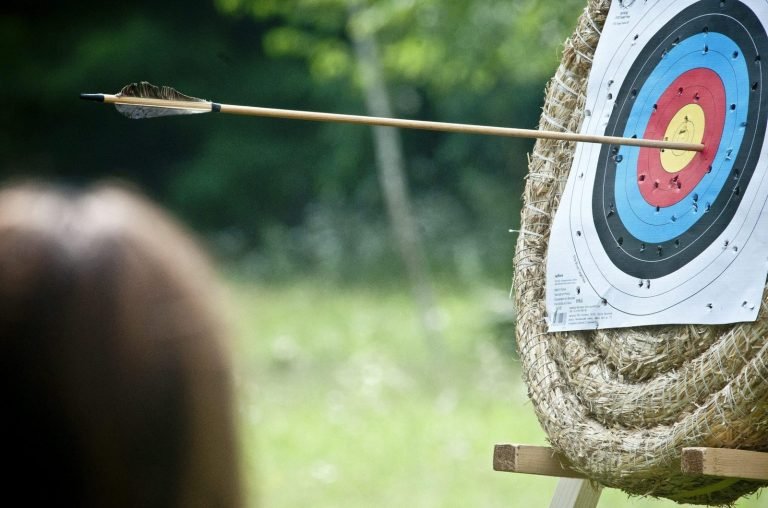
Why does an arrow that leaves the bow with a clean report begin to plane left or right before it meets the mark? I set that question beside a scarred ash shaft on my kitchen table; the pile had cut a dark crescent in the timber, a hen feather carried dried burr from a Laois course, the nock mouth gleamed after a hundred departures. Whether the shaft is wood, carbon, or aluminium, whether the fittings are horn, plastic, glue, or brass, every piece seems obedient in the hand. A thumb drawn along the cock feather meets a raised rib, a small sternward oar. Through that rib, the mystery finds speech, in that the arrow flies as a quarrel among nose, tail, air, loose, ground, weather. Such quarrel signs itself sideways on the boss.
A true shaft carries a hidden hunger for slant. Leaving the bow in compression, it flexes through the shot, then meets air as a moving rod with fins, a point, a centre of balance, a tail correcting through drag as well as lift. Researchers at JAXA placed modern target arrows in a magnetic suspension balance, then traced flight with high-speed cameras, giving the archer’s old hunch a laboratory body: the arrow oscillates, turns, sheds speed, pitches, yaws, while drag, lift, pitching moment press thumbprints into every yard of passage.¹
The point declares direction, yet the tail keeps casting its vote. String-memory takes time to settle. Hence the first error in judgement comes from treating flight as a clean line while it behaves as a living quarrel.
Planing begins when the arrow meets relative airflow at an angle. A feather or vane can do it; so can a broadhead blade, a raised wrap edge, a rough crest, a bead of glue, or a single nick on one vane, each tipping airflow into a lateral load. Geometry alters the labour of air; NASA’s primer gives the plain doctrine that size, shape, surface roughness, velocity, inclination alter lift as well as drag.²
A high-profile feather can govern a broadhead with authority, yet it also offers wind a larger handle. Low-profile fletching keeps less cloth in the gale, though it may grant a fixed blade too little command. The right feather sits like a parish elder at the back of the shaft, stern, frugal, ready to correct a foolish nose.
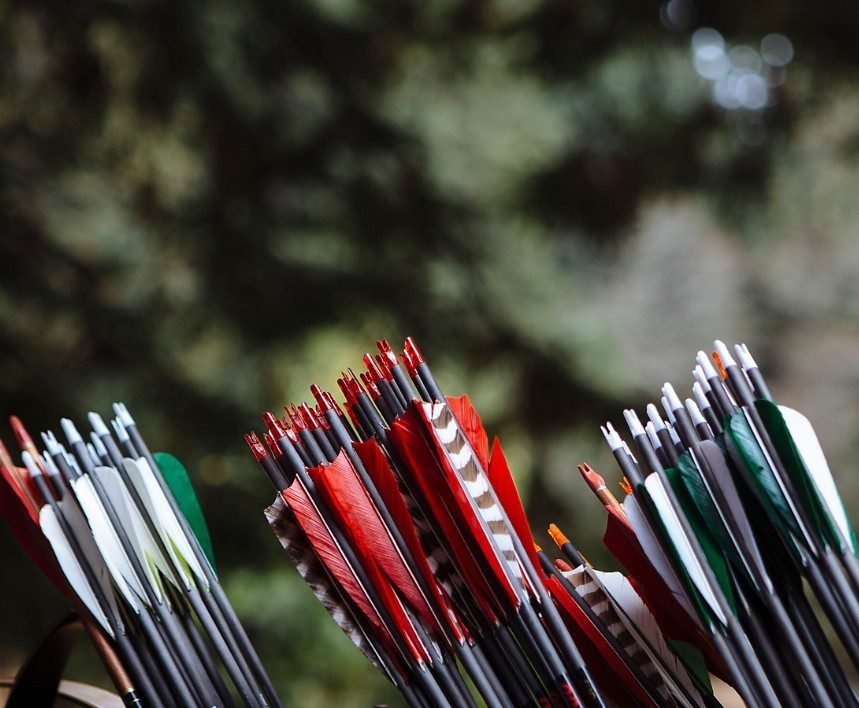
Feather profile, then, deserves reading as a moral economy of surface. A shield cut purchases correction differently from a high parabolic vane; a short low vane buys its peace through thrift, while helical and offset settings spend drag to purchase rotation. Helical fletching gives the shaft rotation, a small rifling of the air, useful where minor crookedness in shaft or point might otherwise spend itself in a widening group. Large feathers arrest yaw early, making good companions for rough release, wooden shafts, fixed blades, short ranges, gusty woods. Slim vanes preserve speed, giving long target distances, clean releases, small-diameter shafts a quieter passage. A flu-flu is the sermon preached too loudly: it turns correction into brake, bringing the arrow down in a hurry, fit for stump, rove, aerial mark, short safe play.
On Irish target courses, the lesson sits cleaner. Surface governs drift by inviting air to grip. Every extra millimetre of height asks the wind to take a little pinch.
Tuning error is the oldest ghost in this room. Easton’s tuning guide treats left-right planing through shaft-only comparison, paper tears, short-distance lines, broadhead grouping, with fishtailing named as the nock leaning side to side through flight; the guide links left or right impact to stiffness, point weight, bow weight, plunger tension, rest position, clearance.³
A weak shaft for a right-handed finger shooter may leave the line with the tail kicked one way. Stiff spine may answer in the opposite direction. Compound release can hide one fault at twenty yards, then expose it at sixty. Powder on the last quarter of the shaft, touched to rest, window, fletch base, can reveal a contact scar that scores only in mutter. Here tuning becomes touch before theory: chalk dust on a shelf, torn paper at close range, vane smear under lamplight, a left group, a right group, the small forensic chapel of the range.
The bow hand adds its own handwriting. Torque rotates the riser during the last instant, altering the arrow’s starting line. Plunger tension, set too firm or too soft, changes how the shaft leaves centre. String-set height can turn a vertical porpoise into a false lateral diagnosis, inasmuch as the archer sees a wandering arrow while the root sits above or below the hand. Brace height changes the timing of the shaft’s bend. Serving diameter joins limb alignment, cam lean, release aid travel, tab wear, nock fit, centre shot, shelf contact in the same ledger.
Each fault has a smell: burnt serving wax, powdered plastic, feather barb split at the quill, a rest arm polished by contact. A target face records the verdict, yet the bench often speaks first.
FOC, front of centre, gives that grip its lever. The phrase names the measure by which the balance point sits ahead of the arrow’s midpoint, expressed as a percentage of arrow length. Easton’s guidance places common hunting balance near ten to fifteen per cent, with lower values below roughly seven to ten per cent tracking poorly in outdoor wind, as greater forward balance steadies the nose while leaving the feathers a longer rear lever.⁴
Knife spine teaches the principle before any chart does. Lay the shaft across steel, mark the balance, mark the middle, feel how a heavier point makes the back of the arrow into a longer handle. Excess weight forward steepens the arc, sharpens release sensitivity, asks cleaner form. Scant forward balance lets the nose wander. Balance behaves like a family table at Christmas; shift one heavy relative to the far chair, every conversation changes course.
Broadheads make the lesson sterner. A field point slips like a nail through air, presenting little side surface. Fixed blade heads arrive as small weathercocks at the front, eager to steer whenever yaw appears. Here the word “plane” earns its keep. The broadhead does what a little wing does: it creates side lift once set at an angle to the flow.
Fletching at the rear must answer before the front drags the whole shaft across the lane. Such answer depends on rear area, distance from balance point, spin rate, arrow mass, shaft diameter, launch yaw. Mechanical heads keep one signature, compact fixed heads another; large two-blade and four-blade heads differ as sharply as knives on a whetstone. Any archer who swaps field points for broadheads has changed the court hearing while keeping the same judge.
Terrain turns wind into a local creature. The IFAA field manual treats uphill shots, downhill shots, slope stance, target angle, distance judgement, body alignment, butt angle, with practical concern for the archer whose feet stand on slanting earth while the mark sits above, below, across a hollow.⁵
I have stood on wet clay above a 3D deer, one boot biting, one heel searching, bow canted a hair downhill despite every intention. One arrow struck low-left. Cause seemed wind until the next shot, made with a tree trunk used as a plumb line, landed true. Ground had entered the bow through my ankles. Field archery teaches that air travels through terrain, yet terrain also travels through bone, hip, shoulder, wrist.
Slope-cant masquerades as aerodynamic drift. When a bow tilts, the sight picture remains persuasive, the archer feels honest, the arrow departs along a rotated plane. Downhill side hits often accuse wind, while the true culprit is a body leaning with the bank. Across a valley, distance judgement stretches; through a corridor of trees, the mark can seem farther; on steep faces, the circle turns oval to the eye.
A crosswind in that same place carries two ledgers at once: one from actual air, one from the archer’s stance. The hill keeps counsel against easy blame. It lets the archer call a bad arrow “weather,” then leaves the same mark on the next shaft as a quiet rebuke.
Wind behaviour deepens the case. Air on a field course seldom behaves like a single shove from one side. It rises from cut grass, curls over a bank, spills around a hedge, slides cold along a ditch, splits at a tree trunk, then returns at ankle height with a sly little tug. Roger Ascham already knew the old grammar of it in Toxophilus, advising the archer to learn side wind through grass tossed by the hand, through attention to blasts near earth or aloft.⁶
Modern calculation keeps the same humility in sharper clothes. James Park’s work on wind drift compares arrow selection through shaft diameter, mass, downrange drag, showing why a slimmer, denser shaft carries less lateral exile.⁷ Wind acts on time. A slow arrow lives longer in the weather; a fat shaft offers a broader cheek; tall vane-work gives the gust a latch.
Left drift deserves its own autopsy only after the archer asks which left. The arrow may leave left, begin planing left in flight, strike left, gather a group left of centre, or be aimed left for wind. Different crimes share one address. Field-point groups left with clean holes usually indicate sight or form. In Easton’s reading for a right-handed archer, shaft-only arrows landing left of fletched shafts indicate stiffness. Broadheads left of field points suggest steering imbalance or rest position. Sudden leftward movement in gusts directs attention to wind exposure, arrow diameter, feather height, speed. Low-left from a sidehill carries the smell of cant. Target paper tells only where the body ended up; the arrow’s life in air must be reconstructed from residue.
Right drift asks the same discipline. Many archers adjust a sight after a handful of bad arrows, then spend a month chasing the wound they made with a hex key. Such right group may come from weak spine, soft plunger, riser torque, face contact, vane contact, crosswind, slope lean, peep alignment, release travel. Evidence has to arrive in order: group first, paper or shaft-only test second, clearance third, broadhead or long-distance confirmation after that. The ledger has worth here. Record the weather beside the distance; set down arrow build, point weight, fletch, tune change, footing, perceived wind, all in a cramped hand while the boss is still near, while the shot still has warmth. Memory flatters the archer; graphite has a harder mercy.
Feathers keep a special authority in this inquiry. Natural feather folds across a shelf, forgives a brush past the bow, dries into a slightly altered shape after rain, raises or lowers its edge with age. Plastic vanes keep a sharper form but punish contact with a cleaner scar. Wing choice, helical clamp, offset jig, glue bead, quill trim: each sets a little law on the shaft. Traditional archers know this by fingerpad. One feather with a lifted front edge can turn a group into a confession. Three matched feathers from the same wing settle like siblings; a stranger at the table changes the talk. Such details sound small only to a person yet to watch a mark drift out of the scoring ring one inch at a time.
At last the guiding question returns with its point darkened by use: why does an arrow that leaves the bow with a clean report begin to plane left or right before it meets the mark? The answer is direct. An arrow planes left or right when its surfaces, balance, launch angle, wind exposure, terrain-shaped stance, or tuning state present the air with an angled lever; feathers may correct that lever, broadheads may magnify it, FOC may lengthen rear control, wind may prolong the sideways argument, ground may cant the body, tuning faults may start the quarrel at release. A true arrow, then, is a treaty between hand, bow, shaft, feather, point, air, earth. Break any clause, the boss receives the signature sideways.
Scholia:
¹ Takeshi Miyazaki, Keita Mukaiyama, Yuta Komori, Kyouhei Okawa, Satoshi Taguchi, Hiroki Sugiura, ‘Aerodynamic Properties of an Archery Arrow’, Sports Engineering, 16/1, Dordrecht, Springer, 2013, pp. 43–54.Miyazaki’s and coauthors article provides laboratory spine to may writing. Its authors used JAXA’s 60 cm Magnetic Suspension Balance System to measure an arrow free from the disturbance of a mechanical support, then used high-speed cameras in flight tests. Their measurements treat drag, lift, pitching moment, Reynolds value, boundary layer state, velocity decay, rotation. For an archer, the chief lesson lies in their refusal of simplification: the arrow flexes along its length, spins around its axis, pitches, yaws, sheds speed. Such work deepens the argument in that planing emerges as a measurable relation among attitude, airflow, surface, speed, moment. A shaft in the hand looks like a line. In air it becomes an event.
² National Aeronautics & Space Administration, ‘Factors That Affect Aerodynamics’, Cleveland, NASA Glenn Research Center, 2023, n.p. NASA’s public primer supports the article’s use of geometry, velocity, surface roughness, inclination as governing terms for lift, drag.
³ Easton Technical Products, Arrow Tuning & Maintenance Guide: The Complete Archer’s Resource, 2nd edn, Salt Lake City, Easton Technical Products, 2014, pp. 4–14. That guide supplies the practical grammar by which left-right planing moves from rumour to diagnosis. It names fishtailing as side-to-side nock motion, places shaft-only planing, paper tuning, short-distance tuning, broadhead tuning in sequence, then links impact patterns to stiffness, point weight, plunger tension, bow weight, rest position, clearance. Practical value rests in repeatable contact: shoot matched arrows, read tears, inspect powder marks, adjust in small measures, test again. Such procedure suits the field archer as much as the target archer, for it separates an aerodynamic symptom from a launch error. My writing leans on Easton to keep its lyric claims answerable to paper, rest, nock, feather, group.
⁴ Easton Technical Products, ‘What Is F.O.C. & How Does It Affect Arrow Flight?’, Salt Lake City, Easton Technical Products, 2014, n.p.; Easton Technical Products, ‘The Simple Guidelines to Correct Arrow Balance (FOC)’, Salt Lake City, Easton Technical Products, 2022, n.p. These Easton sources define front-of-centre as the percentage relation between balance point as measured against arrow length, then give a common recommended range near ten to fifteen per cent for many hunting arrangements. Their deeper use here concerns lever work. A forward balance point gives the rear fletching a longer correcting arm, yet very high point weight changes arc, release tolerance, tune. Lower front balance can keep a flatter path for a time while accepting greater disorder in outdoor weather. FOC therefore belongs beside feather profile, broadhead area, shaft mass. It is a lever in the hand before it becomes a mark on a target.
⁵ International Field Archery Association, IFAA Field & 3D Archery, Lugano, International Field Archery Association, 2019, pp. 19–22. The IFAA manual extends the argument from air to ground. Its guidance on uphill shots, downhill shots, side-slope stance, distance judgement, body alignment, steep target appearance, butt angle, competition limits gives technical shape to a truth field archers learn through their boots. Drift can arise through weather, yet a leaning archer can build the same lateral result with a canted bow. Manual insistence on hip movement, vertical alignment, tree-trunk reference, visual correction for steep targets turns terrain into evidence. For TIFAM’s field readership, this source carries local value: Irish courses are full of banks, hollows, roots, wet clay, sheltering hedges. Arrow flight reads each one through the archer’s body.
⁶ Roger Ascham, Toxophilus: The Schole of Shooting, edited by Edward Arber, London, Alex. Murray & Son, 1868, Book II, pp. 105–108. Ascham’s counsel on wind, first printed in 1545, makes a Renaissance witness for grass, blast, side wind, quartering wind, weather close to earth.
⁷ James Park, ‘Minimizing Wind Drift of an Arrow’, Proceedings of the Institution of Mechanical Engineers, Part P: Journal of Sports Engineering & Technology, 226/1, London, SAGE, 2012, pp. 52–60. Park’s comparison gives the modern proof of arrow choice in wind: shaft diameter, mass, downrange drag, lateral displacement. His work anchors my claim claims about slim dense arrows.
Views: 210