

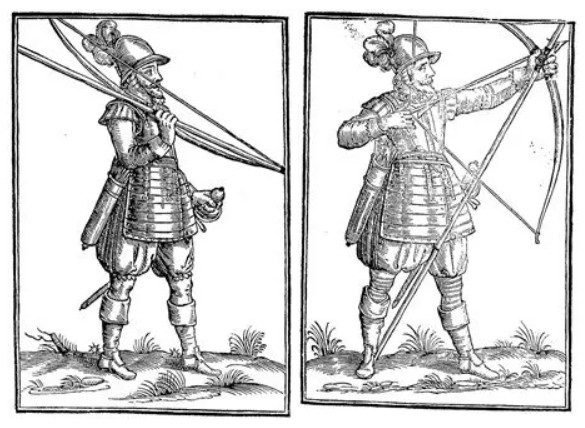
What did William Neade truly try to save in 1624: the longbow itself, or the commonwealth of trained bodies that had gathered around bowstave and shaft, across parish field and statute, through drill, prayer, and pay? Within the small quarto of 1625, the answer first appears as a fastening. Like a rib bound to a staff, a longbow leans against a pike, while the archer’s raised hand turns his armoured frame into a hinge. Martial apparatus gathers upon him across the page through spur-and-sword gleam, corselet shell, quiver burden, and pike-bound bow. Courtly vanity settles at his feet, war occupies his torso, and an older England, schooled again by drill, survives in his hands. Though William Neade named the figure the double-armed man, the image presents a weightier creature, a bearer of many loads, trained to send a shaft over exposed ground before closing into pike-work once horsemen pressed near.¹ Paper preserves the splice with keener firmness than iron. Ink allows the graft to hold.
Entering the record, Neade arrives as a thinly lit figure: an archer-inventor active in the last years of James I, more clearly apprehended through petitionary print, royal witness, Artillery Garden practice, and later patent language than through parish cradle or graveyard stone. Around his device, biographical knowledge gathers as filings collect around a magnet. Nineteenth-century notice in the Dictionary of National Biography gives him the name of archer-inventor; his experiments fall within James’s reign; his demonstration appears before the king in St James’s Park during 1624; and the account follows the matter from civic trial into royal proclamation, appointed commission, formal patent, and debt.² Biography here resembles a rain-stiffened glove, since the outline remains visible while the skin has grown scarce and every crease follows the tool once clasped.
After this implement appeared, its hour had already grown late. Firearms had become an armed habit across Europe, while English trained bands, voluntary companies, and pike-shot manuals sought a disciplined grammar by which stance, command, formation, volley, and charge could be governed. Familiarity with that world allowed Neade’s book to speak its tongue. Service, thrift, and rescue formed the three claims by which he set the invention before monarch, kingdom, and endangered archers. During the approach, a bow borne upon a pike would permit a pikeman to shoot before fastening the bow as ranks closed. Such a claim sounds fanciful only when the page is treated as caprice. Held as drill, it carries the odour of sweat in buff coat, the tick of command passing down the files, and the small dread of waiting while cavalry gathers its metallic gleam upon the field.
Across many generations, English archery possessed the nature of discipline, ordinance, parish compulsion, and trade economy. Tudor law pressed boys with men into practice, bound recreation to military readiness, and required a public culture of shooting in which bow, shaft, inspection, and exercise served civic maintenance.³ Roger Ascham gave that world a humanist idiom in Toxophilus, where the bow entered courtly learning through the honest labour of hands, eyes, judgment, and breath.⁴ Later, Gervase Markham divided the archer’s craft into a tactile sequence by which equipment, stance, and loose became knowledge fitted by touch.⁵ From that whole tool-chest, Neade inherited both authority and burden. Innovation lay in the lash that bound memory to present drill.
Promissory force and strain inhabit the title The Double-Armed Man. Extra equipment offers strength, although it also brings increased obedience, harder labour, and sharper demand upon attention. Dedication praises the bow as the famous weapon of earlier victories, then insists that a soldier wearing corselet with pike may use longbow and arrows with agility, service, and advantage. Practice takes place in the king’s park, where court ceremony met grass, and where a weapon could become argument before royal eyes. There, theatrical force deepens: one man performs old England for Stuart sovereignty, asking memory to bend its knee and then rise again as state technique.
Print gave the performance a second body. Beyond recording commands, the quarto changed the soldier into a diagrammatic proof offered for patronage. Artillery Garden practice, as Neade tells the reader, lasted twelve months, gained approval from captains and commanders, and promised perfection through further use. Weak shooting becomes, in his framing, a question of time, use, authority, and habit. Palm-borne logic governs the claim: a skill thins when hands depart from it, and thickens when hands return. Hence his appeal reaches for laws of shooting, trade, royal favour, and civic order. Argument turns archery into something larger than a weapon alone: a social organ. Tradesman, practising youth, parish field, and old victory carried in popular speech all ask for renewed life through the same splice.
Plainly, Neade’s weapon reveals his mind. A bow attached by a movable fitting at the pike’s middle allowed the pikeman to carry both instruments. Command could move his hands from ordered pike to freed bow, from drawn shaft to renewed staff, until shot and march formed a single taught routine.⁶ Beside the right foot, the pike-butt meets earth; under the raised arm, the bow draws; from the tightened string, the arrow leaps; after the loose, the frame returns to the staff. Inside that routine, the soldier becomes a loom where two military ages cross thread over thread. Older projectile art passes through a newer collective grammar.
Barker’s reading of Neade’s illustrated soldier helps explain why the figure feels so strained. Woodcut evidence presents a fantasy foot soldier whose equipment carries medieval chivalric glamour into the posture book of early Stuart war.⁷ Tension in the image counts as evidence. Horse culture speaks through the spurs; national memory through the longbow; continental formation through the pike; a field altered by shot through the corselet. Several histories therefore settle upon Neade’s man at once. Resembling a saint in a parish window repaired with mismatched glass, each pane catches a different century.
Tactical reasoning supplied genuine attraction. Exposed pikemen protected musketeers from horse while firearms threatened their own ranks. Loading required shelter for musketeers, cavalry demanded reach from pikes, and smoke forced captains to maintain order. Formation with bows on pikes promised added missiles from ranks already present. In Neade’s description, front-rank pikes hold the charge while the files behind send arrows through opened spaces, wounding horses and troubling riders before close work begins again. At roughly six score yards, the bow would be fastened, order tightened, and pike-work resumed. Device and formation imagine a moving hedge that flowers into arrows before hardening back into ash-staff points.
Beauty in the idea carries a thorn. Longbow practice demanded years in the shoulder. Musketry required drill, powder, match, rest, maintenance, and courage; archery remade bone, tendon, eye, and rhythm across youth. Mary Rose archaeology has made that corporeal truth visible in curved spines, enlarged shoulders, worked joints, and the skeleton itself shaped by repetition. Season after season, practice, officer, statute, and habit could recall that form. Spliceable materials existed in wood, cord, printed command, and trained flesh; the deeper join between adult militia time and childhood art carried the greater weight.
Militia culture in early Stuart England sharpened the difficulty. Trained bands represented local obligation, civic finance, county status, and household means. Depending upon rank, parish, corporation, and patronage, men supplied or received equipment. Records from places such as Ludlow or Shropshire show musketeers and pikemen counted, armed, sorted, and expected to fit a pattern that royal policy desired as local life shaped it.⁹ Into that world, Neade brought a device needing extra gear, skill, and time. Petitionary traces speak through debt, expense, and fatigue. Official favour, public words, and authorisation for instruction accompanied the invention; civic uptake moved like a cart in clay.
Generous reading grants him intellectual seriousness. He saw that weapons live inside economies of attention. Gunpowder practice had become more than the handling of a firearm; it had become a system of procurement, drill, command, doctrine, fear, and prestige. Formerly such a system, archery had slid into memory, sport, pageant, and nostalgic pride. Graft attempted to convert archery from remembrance into function. Seeking a doorway through which the old weapon could enter the new formation, Neade gave it fresh credentials. Written advocacy, therefore, made him an engineer of custom. Pike became passport.¹⁰
Inheritance is the hard question asked by the double-armed man. Communities often love an old tool after the tool’s labour has passed elsewhere. Hands polish what the field has ceased to require. Offered discipline moved beyond museum affection and pure military futurity. Contact governed him. Conviction pressed him to demand proof in the body, before a king, across ranks, and through repeated words of command. Heard aloud, those commands acquire a liturgical taste: pike set in order, bow freed, shaft drawn, string loosed, frame returned to usefulness. Sequence becomes beadwork, each verb touched in turn, each posture a small genuflection before service.
Contemporaries treated related combinations with interest. Military writers of the 1630s lived among hybrid forms, as half-pike, target device, musket rest, defensive scheme, and illustrated posture entered the same printed weather. Robert Ward’s Animadversions of Warre belongs to that field of experiment, while William Barriffe’s military manual gave pike practice a polished, public voice for London’s citizen soldiers.¹¹ Among such writers, Neade stands as the man who made England’s old archery serve the posture-book imagination most visibly. Pages reveal a culture trying to solve vulnerability through assemblage, through added straps, increased functions, and fresh gestures placed on one trained frame.
Ceremony enters the story through royal record. August 1633 brought a proclamation urging practice of the bow-pike, with Neade named as inventor; May 1634 brought a patent for instruction in the use.¹² Documents of this kind carry weight through the way they dress experiment in authority. Monarchical language attempted to move the device from curious performance into sanctioned training. Proclamation gives the state a mouth; patent gives it a hand, seal-wax on its fingers. Receipt of both honours did little to move paper favour beyond market, habit, local budgets, military fashion, and the thicker time required by archery muscle.
Petitions carry the roughest human grain. Claiming that the cost of the invention had consumed his estate, Neade named a sum of six hundred pounds, sought reward, blamed civic neglect, and asked that London’s trained bands receive firmer direction. Here the old archer-inventor becomes visible as a man who had poured money, patience, and hope into a device caught between admiration and adoption. Demonstrations did occur; one account places three hundred of the Artillery Company before Charles. Movement remained small, then thinned into the margins of military memory. By the English Civil Wars, bows appear as rare survivals, local flashes, Highland or Irish edge-cases, and antiquarian sparks more than a national arm.
Bayonet development carried the deeper historical tide. Later seventeenth-century flintlock firearms with socket bayonets offered infantry the joining Neade had sought by other means: missile power joined to close defence in a single soldier.¹³ Socket steel solved the pike-musketeer split inside the gun itself. Long view makes Neade’s bow-pike appear as a mistaken answer to a genuine question. Phrases of failure sound cruel when one sees how many tools in history carry truth while losing the contest. Invention recognised the need for fusion. Raw material belonged to the losing side of time.
Handheld longbow teaches resistance differently from a musket. Into the frame, stance, haste, and fear all travel into the arrow at once. From the pike comes another lesson: discipline through alignment, courage through shared depth, survival through the file’s obedience. One ambition guided Neade: to make one man carry both moral trainings. Desired form was elastic solitude inside collective order, where the archer’s personal judgment joined the pikeman’s social geometry. Strain within that desire gives his invention its beauty. State power wants bodies that act in concert; an archer must also feel the weather of a single loose.
Little quarto leaves me with a smell of oil, paper, cord, and old glue. Woodcuts ask the eye to believe in a body able to answer every summons. Dedicatory prose asks monarchy to recognise usefulness in what custom has kept warm. Commands ask memory to submit to cadence. Pathos gathers along a hard interval: diagram against daybreak drill, inked line against parish shoulder, royal park performance against county muster. Splice was Neade’s invention, yet every splice tests the living grain. Joints take or open under strain; each tells the carpenter where the fibres wished to travel.
The answer to the question of 1624 is therefore clear: through the bow, William Neade tried to save the commonwealth of trained bodies that had formed around bowstave, shaft, parish field, statute, drill, prayer, and pay. As visible relic and working relic, the weapon became the hard object he could lash to a pike, exhibit before a king, print in a book, commend to officers, and defend through petitions. Larger service lay in a culture of trained touch: youth bending yew, trades feeding war, law shaping recreation, and memory earning use through practice. Awkward graft though his bow-pike became, the question it embodied endured. How does an older skill survive when the field changes its rules? Answer came brave, costly, ingenious, doomed in outcome, alive in meaning: a man may lash memory to a staff, but only a whole people can keep the string drawn.
Scholia:
¹ William Neade, The Double-Armed Man, by the New Invention: Briefly Shewing Some Famous Exploits Atchieved by Our Brittish Bowmen, London, John Grismand, 1625, sigs. A2r–E4v. Neade’s quarto appears here as a handled object: small, illustrated, eager for command. Archive metadata confirms the London imprint, publication date, decorated initials, full-page illustrations, folding material, STC 18416, and dedication to Charles I. Title-page and postures make the invention visible, while dedicatory prose turns visibility into petition. Close reading above relies on Neade’s sequence of claims, especially his insistence that bow-pike practice could allow a soldier to act as archer and then as pikeman through the same corporeal routine.
² Sidney Lee, ed., Dictionary of National Biography, vol. 40, London, Smith, Elder & Co., 1894, pp. 151–152, s.v. “Neade, William.” The entry supplies the narrow biographical spine. Its notice names Neade as archer-inventor, places his experiments during James I’s reign, records the 1624 St James’s Park demonstration, the Artillery Garden trial, the 1633 proclamation, the commission to Neade with his son William, the 1634 patent, later petitions, and his claim of £600 spent, while further record remains thin. Chronology deepens the argument: Neade appears through the device he made, official response, money lost, and practice attempted. Sparse evidence makes his life reach us as tool-shadow, which suits a study of invention at the edge of military change.
³ 33 Henry VIII c.9, in Great Britain, Statutes, vol. III, London, Record Commission, 1817, pp. 837–839. Older statutory culture receives its ground from the Henrician act that ordered maintenance of shooting, regulated games, required household archery equipment, and protected the trades that supplied bow, string, shaft, and head. Public character carries weight here. Longbow culture exceeded personal skill, standing inside law, parish custom, youth training, market production, and royal war-memory. These pages draw upon that sediment. When Neade invokes the trades of archery, he calls up a civic body of labour as surely as he calls up the archer’s shoulder. Statute works as a deep background hum beneath his invention: a reminder that the bow once lived as a social discipline, with recreation bent into readiness.
⁴ Roger Ascham, Toxophilus, The Schole of Shootinge, London, Edward Whitchurch, 1545, sigs. A1r–K4v. Ascham marks the learned dignity attached to English shooting in the Tudor mind. Bibliographic record fixes composition in the mid-1540s and publication in London.
⁵ Gervase Markham, The Art of Archerie, London, Ben Fisher, 1634, chapters 1–15. Markham supplies the tactile divisions of the archer’s art, where equipment, stance, and release become a grammar of hand, eye, and judgment. His table of contents alone shows how archery knowledge entered use by parts.
⁶ Neade, The Double-Armed Man, London, John Grismand, 1625, sigs. C3r–D4v. Drill-sequence reading comes directly from Neade’s command vocabulary, which instructs bodies in files as pikes are ordered, bows freed, arrows drawn, shafts nocked, volleys delivered, bows fastened, pikes ported, and ranks closed. Treating the commands as litany clarifies Neade’s ambition: he sought a disciplined body as fully as a clever object. Six score yards supplies the tactical hinge, with arrows during approach and pikes for close event. Within that hinge, the bow-pike becomes a piece of theatre as well as a weapon, arranging time, distance, fear, and breath.
⁷ Simon Barker, “‘The Double-Armed Man’,” in War and Nation in the Theatre of Shakespeare and his Contemporaries, Edinburgh, Edinburgh U.P., 2007, pp. 76–106. Barker follows the visual intelligence of Neade’s soldier. His account stresses the extraordinary illustrated body, whose load joins chivalric image, classical habit, national archery memory, and current military fashion. Such reading deepens the sense that Neade’s figure gathers several martial time-zones onto one frame. Comic at one angle, devotional at another, the soldier remains impressive in sheer equipment load. Awkwardness therefore becomes evidence, for the image’s strain reveals the cultural work Neade needed the body to perform.
⁸ Mary Rose Trust, Weapons of Warre: The Armaments of the Mary Rose, Portsmouth, Mary Rose Trust, 2011, pp. 62–87. Mary Rose archer evidence acts as material witness for the years of strain needed by heavy bows; skeletons, bows, arrows, bracers, and equipment turn training into bone-memory.
⁹ Jonathan Worton, “Ludlow’s Trained Band: A Study of Militiamen in Early Stuart England,” Journal of the Society for Army Historical Research, vol. 91, 2013, pp. 4–23. Worton gives county texture to trained-band service, where social rank, property, muster, equipment, pike, musket, and civic obligation shaped the soldier before any printed device reached his hands.
¹⁰ M. C. Fissel, “Tradition & Invention in the Early Stuart Art of War,” Journal of the Society for Army Historical Research, vol. 65, issue 263, 1987, pp. 133–149. Fissel’s study gives the exact doorway into Neade’s age, since “tradition” and “invention” meet in a military culture trying to preserve older social energies while absorbing newer tactical demands. Treatment of the double-armed man as a triple-burdened soldier also helps explain the sword as part of the load.
¹¹ William Barriffe, Military Discipline: Or, The Young Artillery-Man, London, Thomas Harper, 1635, pp. 1–96; Robert Ward, Animadversions of Warre, London, John Dawson, 1639, pp. 45–88. Barriffe and Ward give Neade his surrounding military weather. Barriffe’s manual trains London citizen soldiers in posture and pike-grammar; Ward’s later book belongs to the same culture of illustrated readiness, defensive invention, and printed advice for officers. Their paired witness keeps Neade from appearing as a lone eccentric. Early Stuart military print was full of bodies arranged by command, weapons explained through diagrams, and hopes attached to better order. National tone comes from Neade’s attachment to the longbow, while printed postures show his kinship with manual writers who trusted that paper could reform bodies.
¹² Charles I, A Proclamation for the Use of the Bow & Pike Together in Military Exercise, London, Robert Barker, 1633; Charles I, Letters Patent to William Neade for Teaching the Use of the Bow & Pike, Westminster, 16 May 1634. Proclamation and patent prove that Neade’s device received official ceremony, seal, instruction, and public voice.
¹³ Peter Harrington, ed., The Badminton Library: Archery, London, Longmans, Green & Co., 1894, pp. 60–72; English Heritage, “The Bayonet,” London, English Heritage, 2024. Badminton account tracks later petitions and archery afterlife, while English Heritage helps mark the flintlock-bayonet joining that absorbed the pike’s role into the firearm.
Views: 159


