What must the archer guard after the first three shafts land clean: the score already pencilled onto the card, or the form that bore those arrows through air?
Rain-soft paper curls beside the bow case, pencil marks gleaming like fish scales beneath clubhouse light. Near it lie a tab blackened at the hook, a bracer nicked by string, two vanes with clay at their roots, a cooling mug beside the fletching jig. I have seen such cards turn perilous after a bright first end, for paper gains the nature of a small household idol once the hand lends it breath. Early success comes as a clean thud, then arithmetic, then guardianship; by the fourth arrow, the archer has started tending a number in place of serving the shot.
Sweetness gives early excellence its blade. A novice expects clemency from a poor beginning, while the archer who opens well receives a debt stamped into the palm. High first scoring turns the next arrow into a witness, almost a bailiff. Through that alteration, form moves from living cadence into endangered possession, with shoulders lifted as though weather had entered the room, fingers thickening on the string, release seeking licence from the tally.
Roger Ascham offers an older cure, coarse as linen, in the second book of Toxophilus: fair shooting grows from “standing, knocking, drawing, holding, loosing,” those five duties kept inside the archer more deeply than inside wind, weather, or mark.¹ That sequence has the plain strength of a farm gate. Each term asks for contact. Standing takes its authority from boot sole, hip, earth; at the nock throat, serving, thumb, the knock finds its register; the draw gathers scapula, elbow, lung; measured strain gives holding its temper; through skin, loosing passes as trained trust. Clinging to a fine score turns the archer from those duties, hence the card starts governing the fingers.
At the gate of ethics, Aristotle’s archer stands with matching severity. In the Nicomachean Ethics, he asks whether people with a target gain a better chance of striking the right mark.² The line often flatters those who love goals. My own experience at the peg gives it a harsher face. A target serves action only while it orders attention; once worshipped, it steals the act it was meant to guide. Medals, selection, ranking, reputation, the neat total at day’s close, can serve as useful marks when kept at a working distance. Any one of them becomes ash in the mouth once it replaces the movement by which aim becomes deed.
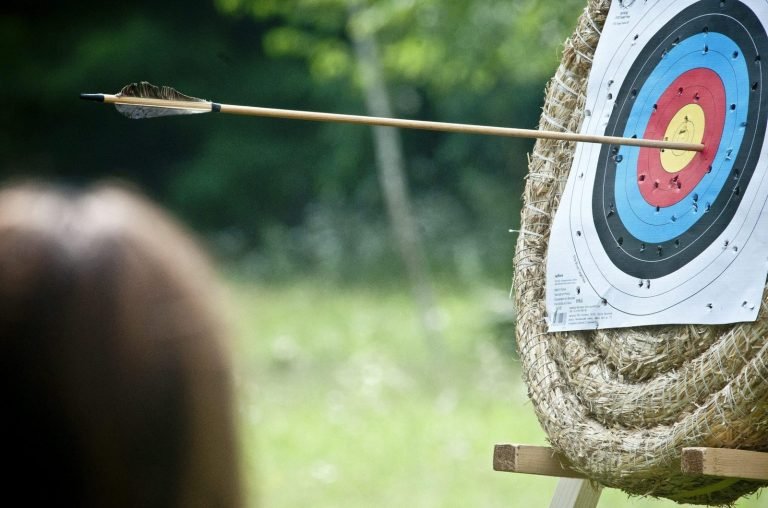
One raw morning in Laois taught me that lesson, where a boss stood between wet hawthorn stems, its face bruised by a hundred small convictions. My first two arrows struck near centre. Arrow three followed. A private heat rose through me, sweet at first, then sour. In place of feeling the string line through my back, I began feeling an imagined scorer’s smile behind me. That fourth arrow left in haste, low, with a feather-cut whisper; its small fall taught more than the three clean arrows, for it showed the precise instant when care curdled into custody.
Ancient poetry knew that break in the hand. In the Bhagavad-Gita, Arjuna enters battle as the supreme bowman, yet the sight of kin across the field makes his limbs sink, his mouth dry, his frame tremble; Miller’s translation lets the weapon speak through flesh: “The magic bow slips / from my hand.”³ Skill remains alive in him. A renowned archer stands there with the famous bow, memory of training in the sinew, battle knowledge in the eye. Collapse rises from meaning. Due to a world pressing through the grip, the weapon slips.
That scene helps name the early-score panic with more dignity than mockery allows. After a strong start, the archer has glimpsed a possible self, clean in form, worthy of praise, fit for the final lane, carrying a name that may travel home in another person’s mouth. Such a figure carries warmth, yet warmth can scald. One arrow later, the body shoots beneath the gaze of that imagined figure, while the present hand contracts around a future verdict.
W. Timothy Gallwey’s tennis court gives archery a useful vocabulary here, for he distinguishes the commanded self from the performing self, the chattering supervisor from the player who has learned the stroke.⁴ Archery sharpens that division into leather, string, shoulder, throat. Self-command speaks in the idiom of rescue: keep it, protect it, hold the lead, stay safe. Performing flesh has a different grammar: stand, hook, breathe, widen, release. One grammar counts coins on the table. Another sends the arrow.
Psychological research gives old range wisdom a tested spine. Roy Baumeister’s experiments on choking named a pattern in which added stakes draw attention back onto the performer, turning skill into an object of scrutiny.⁵ The skilled act then meets a strange theft: conscious mind, eager to assist, reaches for the very levers that practice has placed beneath reflective command. A shot sequence learned through thousands of repetitions becomes a set of brittle instructions. Keen to preserve the high score, the archer begins inspecting the machinery while it runs.
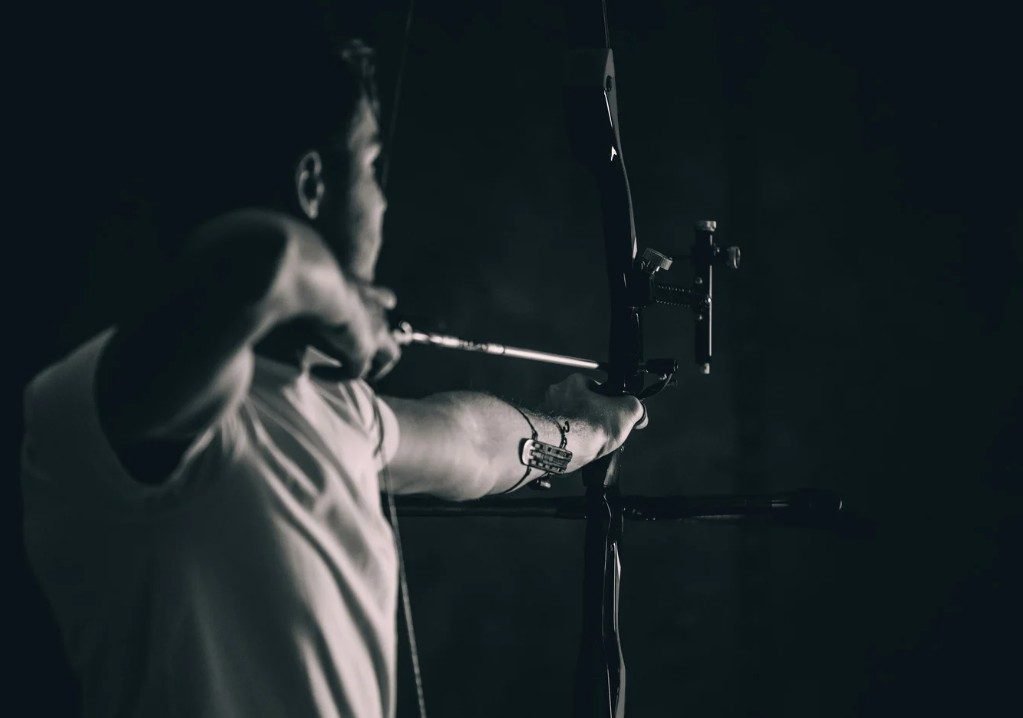
Richard Masters gave that theft a precise name through work on explicit knowledge in motor skill breakdown.⁶ A performer loaded with step-by-step rules carries a toolkit that can become a snare in competitive heat. My tab hand knows the feel of that snare. As the string reaches the face, anchor touches, then language crowds the mouth of the shot. Elbow, wrist, bow shoulder, sight picture, release hand, follow-through arrive as separate demands, each taking a small tax of time as rhythm pays the bill.
Sian Beilock with Thomas Carr deepened the account by showing how skilled performance can become fragile when attention turns to procedural details made fluent by practice.⁷ Their work serves archery in view of the sport’s deceptive quiet. From outside, an archer appears to have abundant time. Inside the shot, time narrows into one passing bridge. Too much self-surveillance loads the bridge with cattle, carts, parish gossip, family debt. The release arrives burdened, crowded, late.
Gabriele Wulf’s research on attentional focus offers a counterweight: movement often improves when attention rests on action’s effect in place of body segments.⁸ An archer may feel that truth through a plain shift. Command the shoulder into obedience, it stiffens. Attend to the arrow’s path through a small window of air, the shoulder often settles into service. With attention placed on the tab’s farewell to the string, the hand travels more honestly than when ordered into cosmetic smoothness. The body likes being trusted with work it has earned.
Target panic scholarship brings the question home to archery itself. Erin Prior with Janine Coates listened to archers describing performance blocks, finding a pattern in which outcome focus leads to a fierce wish to take control, then to sensations of control slipping away.⁹ The phrase “target panic” can sound theatrical, yet the experience often starts modestly, in tiny negotiations at full draw. A sight-pin lingers outside gold; breath turns managerial; the release aid feels like a locked door; fingers ask for a certainty the shot can supply only after flight. Before acting, the archer wants a guarantee, while archery grants knowledge through action.
An exploratory study of choking episodes in archery by Pierluigi Diotaiuti with colleagues also ties choking frequency to anxiety, coping style, decentering, coach support.¹⁰ Such findings suit the field better than bravado. The range remains a social place even in quiet. A coach’s raised eyebrow, a teammate’s score, a parent leaning against the rope, a ranking list folded in a pocket can all enter the hand. Early success makes those presences louder. It tells the archer that something valuable has appeared, then invites caution to wrap itself around the prize.
Caution has its proper office. Loose nocks, frayed serving, cracked limbs, poor footing all answer to its inspection. Trouble starts when caution leaves equipment, enters identity, then impersonates virtue. Careful hands inspect the arrow. Frightened flesh inspects itself as though a flaw might leap from the ribs. Beneath that inspection, form grows ceremonial in the poorest sense: gestures remain visible, life drains from them. Stance looks correct, the hook looks tidy, the bow lifts with public civility, yet the release carries the pinched smell of hoarded money.
Score protection also alters time. Strong starts make the archer live backward from an imagined final total. Last end begins haunting the present end; the fifth arrow carries the weight of the twentieth; a single miss becomes prophecy. I have felt that haunting in the fingers, a small freezing of generosity. Shot ceases to be one act among many; it becomes the lock on a cupboard where reputation sits wrapped in cloth. Good form, by contrast, lives forward only as practice, moving from stance into draw, from release into the plain accounting after the arrow lands.
Flow theory helps clarify that forward life. Mihaly Csikszentmihalyi described optimal experience as deep involvement in a task where challenge meets skill, feedback stays clear, action with awareness draws close.¹¹ Archery at its best knows that condition through touch, with target, bow, ground answering through rings, riser, soles. Protecting a score breaks that channel by moving attention into self-narration. The archer begins composing an obituary for form while form remains in the hand.
A review by Denise Hill, Sheldon Hanton, Nic Matthews, Scott Fleming gathers choking research across sport, linking performance decrement to high-stakes situations, attentional disruption, self-focus, perception of threat.¹² Archery adds material clarity to those themes. The whole drama passes through small things: a clicker, a serving thread, a tab seam, a black ring on a boss. When a strong start creates threat, those objects gain the rude authority of court furniture: clicker judges, tab bears witness, gold turns into an eye.
How, then, should the archer meet the strong opening? Treat it as spent weather. First arrows have gone; they deserve gratitude, then burial. Their score belongs on the card, while their method belongs in the body. A good beginning asks for maintenance of ritual, with preservation of result set aside. At the table the archer marks the number, lowers the pencil, touches the tab, returns to the peg. In that small return lies the whole discipline.
Practical teaching should begin there. Coaches often ask athletes to hold process goals, yet the phrase can grow pale through overuse. I prefer a rougher discipline: give the archer one object at a time. The tab strap comes first beneath touch, then the front foot settles, the bow hand receives weight, the string speaks, the arrow leaves through the same door. After a strong start, such objects rescue the archer from the glittering fiction of a score that can be protected by tension.
A club culture can deepen the same ethic. Praise the shot sequence before the total. Ask after the decision inside the draw. Honour a recovered arrow after a miss as much as a lucky ten. Teach young archers that a high opening end is a visitor, a guest with muddy boots. The visitor may sit by the fire, take tea, leave ash in the grate. Practice owns the house. When a club speaks this way, expectation loses some of its teeth.
Fear of keeping form therefore grows from false custody. An archer believes a good score has placed form in his keeping, as though form were a child asleep upstairs. In truth, form keeps the archer only while the archer serves it. It lives in renewed contact, in small obedience, in the willingness to let each arrow stand alone beneath the same law. Score leaves residue. Form keeps the rite.
After the first three shafts land clean, what must the archer guard: the score already pencilled onto the card, or the form that bore those arrows through air? He guards form. Score belongs to arrows already gone into straw, timber, memory; form remains the living grammar by which the next arrow earns passage. Strong beginnings become dangerous when the archer kneels to them. Buried quickly, like hot ash beneath soil, they become useful, so the hand can return to leather, string, breath, release, with clean poverty in the heart.
Scholia:
- Roger Ascham, Toxophilus: The School of Shooting, ed. Edward Arber, London, A. Murray & Son, 1868, pp. 117–125. I place Ascham at the opening by reason of his stern material intelligence. Those five points make technique a moral sequence as much as a mechanical one. Old spelling, dialogue form, Tudor confidence in handwork: all suit the modern range better than many glossy manuals. As I read the sequence, protection against score-idolatry comes through every point returning the archer to something handled directly. Standing occurs in the feet; at the string, nocking finds its narrow station; across back, breath, drawing gathers; governed strain gives holding its measure; through trained surrender, loosing arrives. A fine score can seduce the archer into guarding an outcome, while Ascham sends the mind back to operations. Ascham’s prose also keeps social rank near the bow, for Toxophilus defends shooting as fitting labour for gentlemen, yeomen. That civic breadth deepens my claim: form belongs to shared discipline, visible in the body, teachable at a peg, tested by weather.
- Aristotle, Nicomachean Ethics, trans. Terence Irwin, Indianapolis, Hackett Publishing Company, 1999, I.2, 1094a18–24, pp. 2–3. I use Aristotle’s archer as a teleological image: aim guides action, yet action remains the ethical site.
- The Bhagavad-Gita: Krishna’s Counsel in Time of War, trans. Barbara Stoler Miller, New York, Columbia U. Press, 1986, 1.28–30, pp. 25–26. I take Arjuna’s slipping bow as a great image of skilled collapse born from meaning. A warrior’s body registers moral sight before argument catches up. The sequence passes from sinking limbs to a dry mouth, burning skin, a bow sliding from the hand, giving philosophy a sensorium. In archery terms, the scene counts through its resistance to reducing breakdown to weak technique. Arjuna’s training remains immense. His weapon carries renown. Yet the field changes the meaning of the shot. For the modern archer, a high opening score can perform a smaller version of that alteration. Straw with rings ceases to be merely straw; it becomes reputation, expectation, kinship, selection, future talk. Miller’s translation keeps the line spare enough to feel in the hand. Whenever a scorecard begins to look larger than the bow, I return to it.
- W. Timothy Gallwey, The Inner Game of Tennis: The Classic Guide to the Mental Side of Peak Performance, rev. edn, New York, Random House, 1997, pp. 13–33. I cite Gallwey for the useful split between the instructing self, the performing self, a distinction archers often feel at full draw.
- Roy F. Baumeister, 1984 choking study, Journal of Personality and Social Psychology, 46/3, 1984, pp. 610–620. I lean on Baumeister for the classic experimental account of choking as performance decrement in high-importance conditions. Outcome value moves into self-attention; archery feels that passage at once. A strong start draws the archer closer to a prize, a personal best, a team place, a praised version of the self. That nearness invites monitoring. His work helps explain why extra desire can spoil fluent skill: the performer becomes audience to his own action. In range terms, the archer begins watching the draw as though seated in the stands. The shot then inherits a second spectator inside the ribs. As a hinge between old range language with modern psychology, the study gives Ascham’s warning about affections a laboratory cousin.
- Richard S. W. Masters, 1992 study on explicit versus implicit knowledge in complex motor skill breakdown, British Journal of Psychology, 83/3, 1992, pp. 343–358. I use Masters to name the trap of reinvestment, where the performer takes back conscious control over a skill already learned by deeper systems. His golf-putting work travels well to archery by reason of shared precision, quiet, repetition, score consciousness. The archer who starts well may begin reciting the shot as though a catechism can secure grace. Yet a catechism recited at the wrong instant clogs the mouth. Such clarification shows how explicit rules become burdens during competitive heat. A coach, therefore, must handle technical language carefully near the line. Instruction belongs to practice space, repair work, slow rehearsal. During scoring ends, too many verbal keys can jangle like iron at a church door.
- Sian L. Beilock & Thomas H. Carr, 2001 study on the fragility of skilled performance, Journal of Experimental Psychology: General, 130/4, 2001, pp. 701–725. I cite Beilock with Carr for explicit monitoring theory: practiced skills suffer when performers attend to procedural mechanics during high-stakes action.
- Gabriele Wulf, Attention and Motor Skill Learning, Champaign, IL, Human Kinetics, 2007, pp. 75–107. I cite Wulf for external focus, especially the claim that attention to movement effect often serves performance better than attention to body parts.
- Erin E. Prior & Janine K. Coates, ‘Archers’ Experiences of Target Panic: An Interpretative Phenomenological Analysis’, Qualitative Research in Sport, Exercise and Health, 12/2, 2020, pp. 224–241. I use Prior with Coates as the archery-specific testimony beneath the larger choking literature. Their interviews give language to experiences many archers hide through shame: the frozen draw, the rushed loose, the punched trigger, the hunger for control. Central to my argument lies outcome attention preceding the wish to seize the shot. A high opening score offers exactly such an outcome lure. The archer wants to secure a future total, so the hand begins to bargain with the present arrow. Phenomenological work serves here due to its respect for lived texture. Numbers can show decrement, yet interviews reveal the strange interior weather of the draw, where prolonged waiting, the gold’s watching eye, the command of a release answering only to trust all share the same breath. That texture keeps theory honest.
- Pierluigi Diotaiuti, Stefano Corrado, Stefania Mancone, Lavinia Falese, Fábio Hech Dominski & Alexandro Andrade, ‘An Exploratory Pilot Study on Choking Episodes in Archery’, Frontiers in Psychology, 12, 2021, 585477. I cite this study for its archery-specific model joining anxiety, coping style, decentering, coach support.
- Mihaly Csikszentmihalyi, Flow: The Psychology of Optimal Experience, New York, Harper & Row, 1990, pp. 49–67. I use flow as a careful lens for score protection, for flow depends on clear feedback, absorbed attention, matching challenge with skill.
- Denise M. Hill, Sheldon Hanton, Nic Matthews & Scott Fleming, ‘Choking in Sport: A Review’, International Review of Sport and Exercise Psychology, 3/1, 2010, pp. 24–39. I close the source chain with Hill, Hanton, Matthews, Fleming for their review gathers theories of choking into a map suitable for coaches. Its breadth counts by carrying self-focus through distraction, anxiety, threat appraisal, coping, into the field. Archery, however, gives those terms a particular material vessel. A review can sound broad till the reader puts a tab on the fingers, feels the serving bite, hears the clicker snap. Then the concepts settle into leather. Near the close, the review shows that fear of keeping form belongs to a studied family of sport breakdowns, while archery retains its own ritual grammar. The scholarship strengthens a practical conclusion: protecting score raises threat; serving process restores the shot’s proper scale.
Views: 127