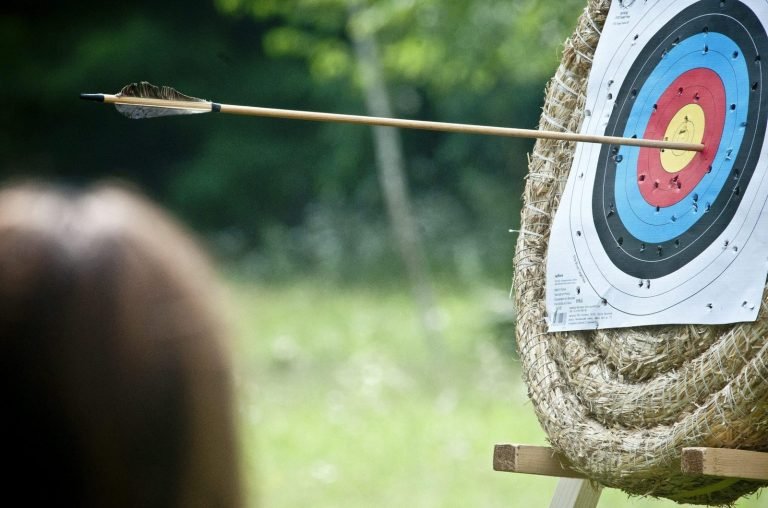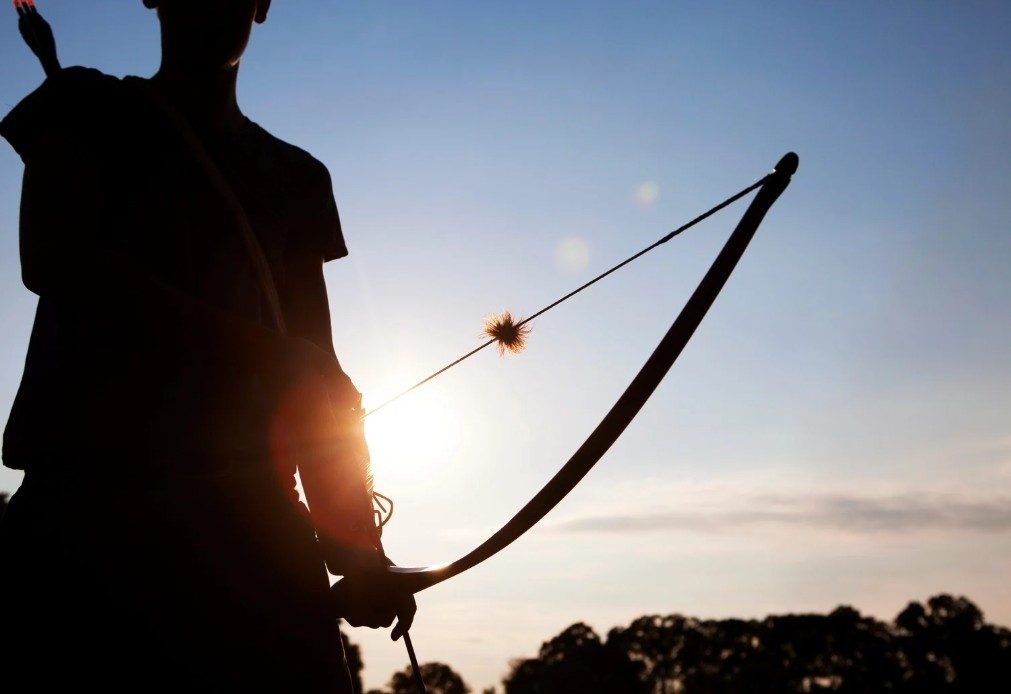
What happens to an archer in the last walk to the peg, when the shot has already entered the pulse before the bow rises? The peg looks small enough to vanish beneath a boot heel, yet it governs a whole moral geometry: distance, order, turn, rank, witness. A wet ribbon may hang from it, or a painted stake may lean in the grass, rubbed by shoes, ticked by arrows carried past, faintly scarred by the patience of many hands. World Archery’s field rules give each field or 3D shooting position a peg or mark shaped to receive at least two athletes, so the place of aim begins as a shared threshold, a public inch of ground where private technique receives social heat.¹
I have watched archers slow down before that inch, though their steps kept moving, the quiver knocking lightly at hip bone, the bow hand flexing as if opening a gate inside the palm. Range officials speak softly there, competitors wait well back, friends turn their faces aside with a courtesy that fails to hide its own listening. At that instant the target sits downrange as a painted animal, a paper face, a roundel with its small centre; the truer target rises in the archer’s body, where breath, pulse, memory, pride, fear, training, rivalry, club talk, family expectation, petrol money, old mistakes, the wet smell of earth, all press close as parishioners at a grave rail. Score paper waits in somebody’s pocket, clean enough to shame a hand.
That walk has its own length apart from measured metres. Five paces can contain a winter of rehearsal, a father at the practice butt giving counsel, a coach’s thumb tapping a scapula into place, a bad miss kept alive by club laughter, a lucky ten distrusted in secret. Near the peg, ordinary materials gather authority: boot lace, finger tab, waxed serving, brass nock, biro, laminated card, whistle, rain darkened sleeve. Each item tells the archer a task has become public. The bow ceases to be equipment alone; it becomes a social instrument, drawing witness through wood, carbon, string, shoulder, jaw.
Roger Ascham knew that shooting begins long before the arrow flies. In Toxophilus, his Tudor school of the bow, “fair shooting” gathers through standing, nocking, drawing, holding, loosing; each office belongs to the archer’s own handling, even as the watching eye judges countenance, footing, grace, composure.² His famous sequence feels at first like technical instruction, yet it also reads as an ethics of exposure. The body makes a sentence before the shaft leaves the string. My point starts there: competitive fear touches an old wound in shooting, the conversion of a practised private order into a visible form others may read.
Competition adds grammar to that visible form. Once named, the archer enters a rotation, accepts a peg colour, hears a name called, waits through another person’s arrow, then steps into a cleared patch where the ground seems to remember every boot. Civil order feels polished, yet polish has teeth: it makes the shot legible, recordable, comparable. During practice, a casual miss sinks into grass. Ink receives a tournament miss with arithmetic, memory, anecdote. Before the feet move, the walk to the peg has already begun, in the instant a person accepts measurement by other people.
Modern psychology gives the old wound a rough scale. Yerkes–Dodson experiments, working in 1908 with dancing mice, found that a difficult discrimination favoured a relatively mild stimulus, whereas easy discrimination carried stronger stimulation more profitably; the later law bearing their names entered sport as a warning that arousal carries use only in the right dose for the task.³ For archery, the task demands delicate discrimination amid load: the archer reads distance, slope, footing, bow weight, sight picture, anchor, string feel, wind drift, release timing. Arousal may sharpen the first approach, lift the head, brighten the target, summon the body to the day’s seriousness. Excess charge turns the bow into a witness against the hand.
Walter Bradford Cannon gives that charge its older corporeal scripture. In his work on fear, rage, pain, visceral change, he traced emotional excitement through adrenal secretion, blood sugar, circulation, muscular readiness, the body’s ancient preparation for impact or escape.⁴ Adrenaline therefore carries a magnificent loyalty, though a loyalty suited to tooth, claw, ditch, collision. The archer asks that same loyal body for a more severe obedience: a quiet bow arm, a smooth back, a face free of grimace, fingers opening like a latch lifted in chapel. Fear before the peg becomes strange chiefly through this mismatch; the flesh prepares a charge while the discipline asks for a thread.
Easterbrook’s cue-utilisation theory gives the mismatch a field of vision. Emotional arousal narrows the range of cues taken into conduct, which can help where the central cue alone deserves command, then hinder where peripheral information keeps the act wise.⁵ On a course, such narrowing may draw the sight into a hard bright tunnel while the archer loses slope beneath the boots, leaf-tip drift of crosswind, bow-shoulder pull, a lengthening hold that begins to sour the loose. Eysenck, Derakshan, Santos, Calvo later sharpen the cognitive account: anxiety weakens goal-directed attentional control while stimulus-driven signals seize more of the mind’s working room.⁶ Spectators contribute exactly such signals: a cough behind the rope, score-table whispers, one phone lifted like a small mirror, a rival’s arrow landing with a dry sound in the boss.
Beilock, Carr, MacMahon, Starkes bring the archer closer to the peg again. Their experiments on sensorimotor skill found that expert performance could suffer when attention turned step by step onto the skilled process itself, while divided attention sometimes protected fluent action.⁷ A skilled shot lives by an almost liturgical trust in sequence. The archer draws; scapula receives; anchor settles; vision accepts; string leaves. Self-consciousness cuts into that liturgy by asking the hand to watch itself while working, as if a mason, halfway through setting a stone, had to explain every motion to a clerk standing inches from his shoulder.
Here self-consciousness deserves a colder description. It arrives as a second archer inside the first, a clerk of the body taking notes at the worst possible hour. One presence shoots; another checks whether the elbow looks foolish, whether the release appears clean, whether the face has betrayed panic, whether a coach has seen the creeping bow shoulder. The skilled act divides beneath that inner clerk. Technique turns from lived sequence into inspected evidence, with each movement made heavier by the thought of its own display.
Zajonc’s account of social facilitation clarifies the crowd’s double nature. The presence of others tends to strengthen dominant responses, improving simple or well-mastered action while impairing more difficult or fragile action.⁸ Triplett had already heard a related disturbance in competitive pacing during the 1890s, naming “brain worry” among those who lead, calculate, answer rivals, measure themselves against another body in motion.⁹ Such company can raise an archer into clean authority when the dominant response is sound. Public looking can also feed the crooked habit, the rushed loose, the lifted head, the little drama of saving face that sends an arrow wide with all the ceremony of a public oath.
Material detail keeps the theory honest. Bow limbs carry their own weather, string wax leaves a faint shine on finger pads, tab leather takes the groove of a life, arrows remember each knock in a flecked shaft, a release aid clicks with the cold neatness of a confession box latch. Peg, target, rope, marshal, score card, club jacket, lane of grass, all convert skill into ceremony. Spectatorship grows from those objects as much as from persons. A single score sheet can look back harder than a crowd; one pencilled five beside a name can burn hotter than any shout.
History often enters archery through weapons, kings, battles, guilds, old statutes, green butts on common ground. Fear at the peg asks for a smaller archive. I place in that archive thumb rubbed raw after a long round, wet fletching straightened with a breath, bracer mark on the forearm, silence after a first arrow drops low. Such scraps carry scholarship of their own. They prove that competitive shooting belongs to a tradition of touch, where thought reaches truth through leather, string, paper, muscle.
Lu–Zhong gave contemporary archery a rare measurement of that burn. During the Tokyo 2020 Olympic archery competition, camera-based contactless heart-rate data from 122 archers across 2,247 shots allowed them to link real-time corporeal arousal with scoring; higher heart rate before a shot correlated with lower scores, with the association gaining intensity in later, higher-stake moments of matches.¹⁰ Their data make the invisible walk visible. Here the audience saw pulse placed on broadcast screens, an intimate red drum translated into public information. Biometric spectatorship entered the sport: even the heart became part of the gallery.
Tokyo’s measurement should chill any easy romance about nerves. Elite archers stand among years of coaching, selection, travel, funding, corporeal discipline, technical service, psychological rehearsal, yet a raised pulse leaves its print in the score. From that fact I draw a humble conclusion for ordinary tournaments in Irish fields, halls, club ranges. Club archers at the peg share a family resemblance with the Olympian, though the stage differs in size: both must bring an old animal body to a task requiring a needleworker’s mercy.
Coaches often speak of routine as if it were a tidy mental checklist, yet the better word may be rite. A routine gives the archer a small lawful country to inhabit while the crowd shifts, while the score thickens, while the body sends old animal messages through tendon, gut, throat. I mean the particular sequence rehearsed till it gains the humility of household labour: stand, feel sole against earth, set grip, breathe, raise, anchor, accept, loose, follow, receive the result. Training amid public conditions counts by virtue of this rite, for the archer learns to let spectators, pulse, adrenaline, memory take their places around the shot while sequence keeps the centre.
Philosophy enters at the release. Preparation, posture, breath, sequence, attention, equipment care, courtesy all answer to the archer. Arrow flight then belongs to a mingled world: release, weather, distance, judging, past labour, present nerve, material truth. Peg-fear springs from that division. Sovereignty tempts a person to claim the whole act, while the shot grants sovereignty only through surrender to practised form. At release, the hand opens, control becomes trust, the target receives what the body has been.
What happens to an archer in the last walk to the peg, when the shot has already entered the pulse before the bow rises? Answer: the archer crosses from skill possessed in private to skill offered in public, carrying an animal body into a ceremonial task that demands fine obedience. Fear wakes the blood, narrows the eye, invites self-scrutiny, magnifies spectators, thickens the score card, gives every object a mouth. Thus competitive shooting becomes an education in corporeal truth: the arrow leaves by the hand, yet it passes first through the crowd within the archer.
Scholia:
- I use World Archery here for the peg as rule, object, threshold. World Archery Federation, World Archery Rulebook, Book 4: Field & 3D Archery, Article 23, Lausanne: World Archery Federation, 2025.
- I return to Ascham whenever archery begins to look modern in its anxiety, for his five offices of shooting already carry a public theory of grace. Roger Ascham, Toxophilus: The School of Shooting, ed. Edward Arber, London: John Murray, 1868; first published London: Edward Whitchurch, 1545. Ascham’s standing, nocking, drawing, holding, loosing appear at first as technical order, yet the Tudor language keeps turning back to comeliness, countenance, shamefacedness, use, custom, visible correction. That public grammar counts for tournament fear. A person at the peg inherits more than technique: he inherits a scene of being seen. I read Ascham as a primary witness to the old bond between corporeal method joined to social judgment. His dialogue lets me treat anxiety as a historical companion of the bow, carried inside instruction long before sport psychology named self-consciousness or social facilitation.
- The arousal curve entered my argument through a splintered wooden box built for laboratory mice, a fact that keeps humility in the claim. Robert M. Yerkes; John D. Dodson, “The Relation of Strength of Stimulus to Rapidity of Habit-Formation,” Journal of Comparative Neurology and Psychology, 18 (1908), pp. 459–482. Their experiments concerned visual discrimination in dancing mice, in place of archers, so my use stays analogical. The durable lesson lies in task difficulty: strong stimulation helped easy discrimination, while difficult discrimination favoured milder stimulation. Competitive archery resembles the latter class more closely than the former, due to fine motor control, perceptual reading, timing, balance, self-regulation. I therefore take Yerkes–Dodson as a caution against crude praise of excitement. The archer needs enough charge to honour the moment, then enough governance to keep that charge from coarsening the release.
- Cannon’s physiology gives fear its muscular dignity. Walter B. Cannon, The Wisdom of the Body, New York: W. W. Norton, 1932.
- Easterbrook’s cue theory helps me name the tunnel that many archers know through their own eyes. J. A. Easterbrook, “The Effect of Emotion on Cue Utilization and the Organization of Behavior,” Psychological Review, 66.3 (1959), pp. 183–201.
- I draw the attentional claim from Michael W. Eysenck; Nazanin Derakshan; Rita Santos; Manuel G. Calvo, “Anxiety and Cognitive Performance: Attentional Control Theory,” Emotion, 7.2 (2007), pp. 336–353.
- Beilock, Carr, MacMahon, Starkes give me the most useful laboratory hinge for self-conscious technique. Sian L. Beilock; Thomas H. Carr; Clare MacMahon; Janet L. Starkes, “When Paying Attention Becomes Counterproductive: Impact of Divided Versus Skill-Focused Attention on Novice and Experienced Performance of Sensorimotor Skills,” Journal of Experimental Psychology: Applied, 8.1 (2002), pp. 6–16. Their experiments with skilled golfers together with soccer players showed that expert action can suffer when attention turns step by step onto execution, while divided attention can protect highly practised movement. I carry that finding to the peg, where an archer can start inspecting elbow, face, release, reputation, all while the shot asks for sequence. The source deepens my claim that self-consciousness is a practical disturbance, felt in timing, grip, shoulder, gaze, breath.
- My account of spectatorship rests partly on Robert B. Zajonc, “Social Facilitation,” Science, 149.3681 (16 July 1965), pp. 269–274.
- Competition as rival-presence enters through Norman Triplett, “The Dynamogenic Factors in Pacemaking and Competition,” American Journal of Psychology, 9.4 (July 1898), pp. 507–533.
- Lu–Zhong bring the archer’s pulse into the archive. Yunfeng Lu; Songfa Zhong, “Contactless Real-Time Heart Rate Predicts the Performance of Elite Athletes: Evidence From Tokyo 2020 Olympic Archery Competition,” Psychological Science, 34.3 (2023), pp. 384–393. Their study used broadcast heart-rate data from Tokyo’s individual Olympic archery matches, treating contactless camera measurement as a real-time biomarker of stress. The sample of 122 archers with 2,247 shots gives rare field evidence in a setting where ordinary laboratory probes would disturb the act being studied. I rely on their finding that higher pre-shot heart rate correlated with lower score, while the relation intensified during later match moments. The deeper value for my reading lies in spectatorship: the heart became visible to viewers, so the body’s private weather entered public sport as a number.
Views: 113