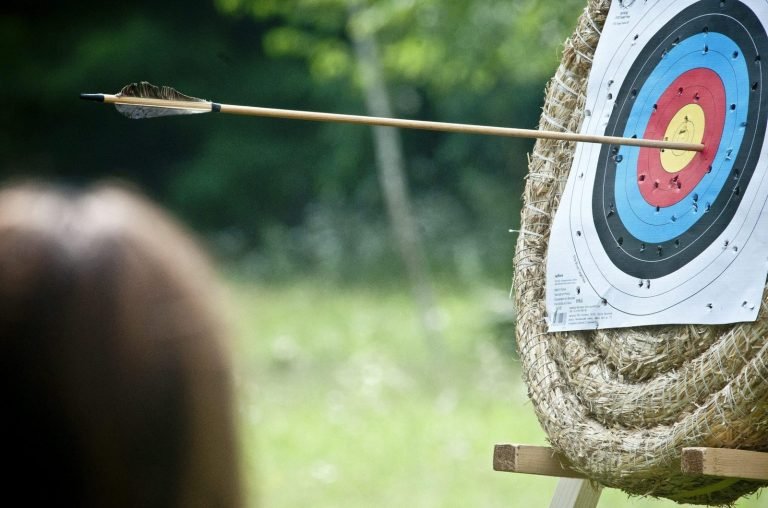
What does a long outdoor shoot truly test once the arrow leaves the fingers: aim alone, or a whole body kept in pact with weather, food, ground, recovery, patience? A wet scorecard asks that question better than any lecture hall. Beside the peg, its paper swells at the corners, pencil graphite sinks into fibre, a thumbprint of mud crosses the last end like a small verdict. From that smudged sheet the honest argument begins: field archery measures accuracy through a body that has walked, shivered, sweated, eaten too late, carried too much, stood too long, drawn once more after comfort has thinned.
Field archery has always given the lie to the tidy fantasy of archery as a single clean line between eye, string, arrow, centre. IFAA course guidance describes a standard course of twenty-eight targets set along a walking track, commonly two to four kilometres in length, with groups moving from target to target as scores are recorded across the day.¹ Such a form makes the archer a travelling creature before it makes that archer a scoring creature. Every peg is reached through ground, so the shot carries the walk inside it.
A course eats quietly. Slopes take the calves first, soft soil takes the ankles, rain takes heat from cuffs, wind takes composure from the face, waiting takes warmth from the fingers. Irish field archery’s own competitive arrangements recognise the event as more than a single act of release: classifications, gains, field championships, bowhunter weekends, guest rules, scorecards, divisions, safety practice, all gather the archer into a governed day rather than a loose pastime.² The form itself teaches endurance, for a score grows target by target, with appetite, weather, memory of the last arrow, plus the long arithmetic of what the next peg demands.
Rain changes technique by entering it through the smallest doors. Serving wax gathers grit. The tab grows slick. A glove stiffens near the seam. The arrow shelf takes a shine from wet fletching, while the bow hand learns the treachery of a grip made glossy by weather. Mud gives instruction through insult: a foot placed badly makes the hips plead, a slipped heel travels through the ribs into the sight picture, a knee held against a slope asks the shoulder for payment later. Weather, in that sense, acts as a stern examiner; it writes on tendons, breath, attention.
Blood sugar has a quieter theology. A biscuit eaten at the wrong hour can feel like rescue, then like debt. Too much sweetness may climb fast, then leave the hands faintly estranged from the task. Too little food makes the world narrow. The target remains visible, yes, but judgment grows smoky at its edges: distance feels longer, a branch seems closer, the release arrives with a small impatience that the archer calls bad luck. The body names that luck more truthfully. Carbohydrate availability supports sustained work, central effort, motor skill, concentration, perception of fatigue; in prolonged stop-start sport, suitable intake can help maintain blood glucose as labour continues.⁵
Archery’s peculiar cruelty lies in the union of delicacy with strain. A runner may look like effort; an archer must hide effort inside posture. The drawing shoulder, scapula, forearm, fingers, trunk, hips, feet, jaw, breath all take office for a few seconds, then repeat the ceremony again. Studies of elite archers describe overuse injuries clustered mainly in the shoulder, especially the drawing arm, which suits what any archer knows by dusk: the bow writes asymmetrically.⁴ The shot looks small from the path. Inside the body it is a mill.
Heart rate deepens the puzzle. Elite work shows that elevated heart rate alone may fail to reduce score in highly trained archers, a finding that should humble easy talk about calm as mere slowness.³ Trained composure may live inside faster blood. Yet outdoor shoots differ from a controlled test hall by virtue of duration, terrain, waiting, weather, conversation, hunger, damp clothing, equipment checks, searching for arrows, returning uphill to a peg, then finding the group already watching. The heart can learn the shot; the day keeps adding new witnesses.
A long event also tests the archer’s talent for ordinary care. Water must be carried where water can be reached. Food must travel in a pocket as more than reward. Spare socks may protect a score as surely as a tuned nock. A hat may preserve judgment. Warm layers may preserve dexterity. NIOSH cold-stress guidance for outdoor work stresses warm liquids, warm break areas, layered clothing, protection for ears, face, hands, feet, movement into warmth during breaks, plus monitoring one’s own condition with the condition of companions.⁷ Such guidance speaks plainly to shooting days where a person can grow proud, chilly, quiet, then clumsy in sequence.
Hydration has its own moral texture. Thirst seldom arrives with a trumpet. It comes as a thicker tongue, a duller estimate, a reluctance to bend for arrows, a small irritation at another archer’s breathing. The American College of Sports Medicine position on fluid replacement treats hydration as a practical support for health, thermoregulation, perceived effort, performance, post-event recovery.⁶ Field archery rarely feels like “exercise” to the newcomer in the way a run feels like exercise, yet a course builds work through accumulation. A litre lost in fragments remains a litre. The body keeps the ledger.
Strain also gathers through waiting. At a crowded peg, muscles cool while the mind keeps rehearsing. The archer stands with one boot half sunk, bow hanging, shoulders carrying both equipment weight and social expectation. Talk rises, falls, turns courteous; inside the wrists, warmth retreats. When the peg opens, a small haste often enters: get it done now. Here fatigue wears the mask of decision. A disciplined archer learns a counter-ritual: plant the feet again, let the ground be read by the soles, check jaw, settle breath, draw from the back, leave the arrow its clean road.
The shoulder deserves special reverence. Competitive archery literature has treated shoulder pain as a recurring concern, with studies ranging across wide prevalence estimates.⁸ Earlier work by Mann and Littke already placed shoulder injury near the centre of archery medicine, long before weekend archers began speaking so casually about “a bit of tightness” after the last target.⁹ Pain often arrives as a whisper in a sport built from repetition. The wise archer treats that whisper as weather in the joint.
Technique, then, grows from preservation as much as ambition. The bow may be legal, handsome, dear; the draw weight may also be a slow little tyrant. Shoulder-girdle research in elite archers points to muscular characteristics that deserve training attention, which means strength, mobility, control, rest, tissue tolerance, all must be taken seriously rather than left to folklore.¹⁰ A field course turns poor preparation into public handwriting. The tired archer plucks. The hungry archer snatches. The cold archer shortens the draw by a fraction. The proud archer calls each sign a mystery, though the body has been speaking all morning.
Recovery begins before the last arrow. A person who eats only after collapse has treated food as apology. A person who drinks only after headache has treated water as penance. A person who stretches only after pain has allowed the body to become archive before becoming steward. Contemporary recovery scholarship urges attention to sleep, load, psychological strain, nutritional repair, travel, soreness, monitoring, athlete self-knowledge.¹¹ Field archery needs that same sense of care. The evening after a shoot belongs to the next shoot already.
History also sits beside the peg. Archery was once read as war skill, hunt skill, discipline of distance, mark of rank, village practice, courtly exercise, folk recreation. Modern field archery carries the old grammar while changing the moral object. Foam animal, paper face, marked path, whistle, scorecard, insurance, safeguarding, committee table: these civilise the bow. Yet the body receives the old lesson. Distance humbles. Ground instructs. Weather strips vanity. Companions become part of safety. A clean shot arises from a whole life managed, for an arrow is only the visible portion of a larger discipline.
Nutrition often attracts either comedy or superstition at club level. One archer swears by bananas, another by strong tea, another by crisps with the solemnity of a monk naming relics. Beneath the banter lies a serious point: long outdoor events reward practised eating. The stomach deserves rehearsal just as the loose does. Foods for a course should sit kindly, travel safely, deliver usable energy, offer salt where sweat or cold diuresis has taken its due, spare the archer from a heavy belly at the peg. The right snack is a piece of equipment.
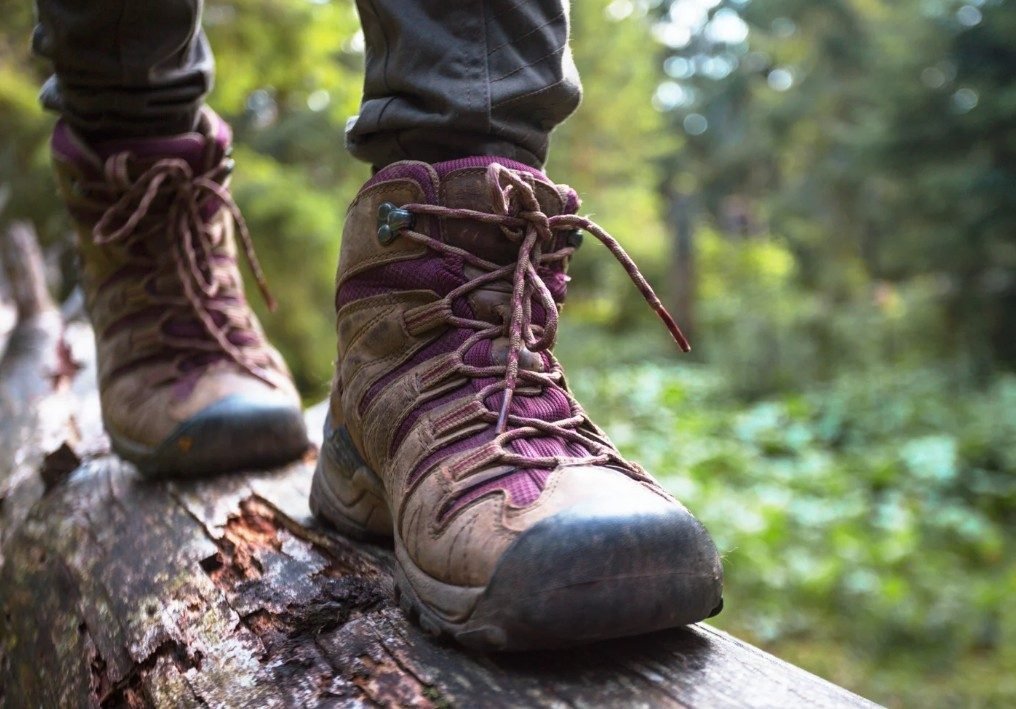
Weather planning belongs to ethics, as much as to comfort. A club that sets a course through exposed ground should think about shelter, route length, access, emergency contact, warmth, water, early finish options, visible signage, safe footing, the varied capacities of older archers, juniors, beginners, guests. The archer, likewise, must arrive as a responsible creature. Clothing, medication, food, water, phone discipline, footwear, spare string, dry layer, modest pace: each item forms part of courtesy. A person who arrives ill-prepared often borrows the stamina of the group.
There is an old temptation to romanticise misery. Irish sport knows it well: rain as badge, cold as character, mud as proof. Such talk may carry charm near the stove, but out on the course it can become a crude little idol. Endurance differs from neglect. Hardiness differs from numb fingers misreading the string. Courage differs from hiding dizziness. The best outdoor archer carries humility as a tool. They know that weather receives respect, calories require timing, pain earns attention, rest belongs inside training, companionship includes watching for the archer who has gone pale behind a joke.
At the target face, all of this vanishes into the score. The paper records only rings, perhaps an X, perhaps the small disgrace of a line-cutter lost by a hair. Yet the scorecard also bears hidden inscriptions: breakfast, sleep, boot tread, rain shell, draw weight, water, pride, patience, glucose, tendon, warm-up, lift home, Tuesday’s recovery. A field score never belongs to aim alone. It belongs to the whole animal that carried the bow from the car park to the final peg, then back again with mud on the calves.
So what does a long outdoor shoot truly test once the arrow leaves the fingers? It tests aim through the body’s full covenant with the day. It tests whether the archer has fed attention, warmed skill, respected weather, protected joints, paced desire, accepted recovery as part of the shot. Mud, rain, blood sugar: these are not distractions from archery. They are archery made honest, the target enlarged till it includes the ground beneath the feet.
Scholia:
¹ International Field Archery Association, IFAA Field and 3D Archery: Field Archery Manual, Lugano, International Field Archery Association, 2019, pp. 4–6. I take the manual’s description of a twenty-eight-target course spread along a walking track, commonly two to four kilometres, as a correction to my earlier, overly clean idea of archery. I understand a field shoot as structured travel. The archer walks, waits, scores, returns, repeats. That form places fatigue inside the discipline rather than beside it as an accidental discomfort. The same pages stress natural features such as forest, hills, slopes, lakes, obstacles, and course accessibility across age groups. Such detail deepens my claim that the ground participates in performance. I understand the bow as something held after a climb, on a peg, in weather, among others, inside a regulated route.
² Irish Field Archery Federation CLG, IFAF Handbook 2024–25, Dublin, Irish Field Archery Federation, 2025, pp. 9–16, 28–30. I use the IFAF handbook as the Irish institutional frame for my practical argument. Its sections on shooting styles, divisions, scorecards, classifications, gains, shoot rules, championships, guest participation, and safety responsibilities show me that a shoot is an organised social form. Its account of the Field Championship as a two-day weekend event between April and July, with specified rounds selected by the host club, supports my emphasis on duration, administrative order, record culture, and embodied stamina. The discussion of scorecards matters especially to me, as official recording turns physical endurance into formal memory. The score becomes more than a personal feeling after a hard day. It enters a system of classification, awards, evidence, eligibility, and communal recognition.
³ Caner Açıkada, Tahir Hazır, Alper Asçı, Sinem Hazır Aytar and Cevdet Tınazcı, ‘Effect of Heart Rate on Shooting Performance in Elite Archers’, Heliyon, 5, 2019, e01428. Açıkada and colleagues examined thirteen international-level elite archers, raising heart rate through shuttle running before shooting. Their reported result, in which elevated heart rate produced little statistical change in scores among these elite athletes, complicates the easy coaching folklore that equates performance with simple calm. I use the study carefully. I still treat fatigue, weather, hunger, footing, and long duration as active pressures. Rather, I separate heart rate from the wider ecology of an outdoor shoot. I recognise that elite skill can carry a quickened pulse; a field course brings terrain, cold, waiting, equipment changes, social rhythm, nutrition, and route length into play. I therefore sharpen the distinction between laboratory stress and lived event strain.
⁴ Christoph K. Niestroj, Volker Schöffl and Thomas Küpper, ‘Acute and Overuse Injuries in Elite Archers’, The Journal of Sports Medicine and Physical Fitness, 58:7–8, Turin, Edizioni Minerva Medica, 2018, pp. 1063–1070. Niestroj, Schöffl and Küpper report fifty-two overuse injuries and six acute injuries among elite archers, with overuse injuries mainly situated in the shoulder, especially the drawing arm. I lean on this finding to treat shoulder pain as a structural risk within archery practice rather than a colourful inconvenience. The repetition of draw, hold, aim, and release gives archery its beauty, yet the same repetition asks tissue to tolerate asymmetric load over many sessions. During outdoor shoots, fatigue can alter technique, thereby shifting load onto already stressed structures. The study deepens my claim that preservation is technical wisdom. Protecting the shoulder is part of protecting the score.
⁵ Academy of Nutrition and Dietetics, Dietitians of Canada and American College of Sports Medicine, ‘Nutrition and Athletic Performance’, Medicine and Science in Sports and Exercise, 48:3, Indianapolis, American College of Sports Medicine, 2016, pp. 543–568. I use this joint position statement to support my blood-sugar argument. Its carbohydrate section explains that carbohydrate availability serves muscle and central nervous system work, while depletion is associated with fatigue, impaired skill, weaker concentration, and higher perceived effort. It also gives practical ranges for events lasting over an hour, commonly thirty to sixty grams of carbohydrate per hour, with individual tolerance rehearsed in advance. Field archery is intermittent, often slow, sometimes cold, yet it can last long enough for poor fuelling to enter decision-making. I therefore move “snacks” from club comedy into applied sport practice. Food becomes part of concentration management.
⁶ Michael N. Sawka, Louise M. Burke, E. Randy Eichner, Ronald J. Maughan, Scott J. Montain and Nina S. Stachenfeld, ‘American College of Sports Medicine Position Stand: Exercise and Fluid Replacement’, Medicine and Science in Sports and Exercise, 39:2, Indianapolis, American College of Sports Medicine, 2007, pp. 377–390. Sawka and colleagues provide the hydration basis for my claim that field archery can hide exertion through its stop-start texture. Their position stand frames fluid replacement as support for thermoregulation, health, perceived effort, performance, and post-exercise restoration. I find the relevance to outdoor shoots in accumulation. An archer may feel only mildly active at each peg, yet walking, carrying kit, sweating through rain gear, standing in wind, or competing through heat can create gradual fluid loss. The source also helps me resist theatrical toughness: thirst is poor proof of seriousness. It is data arriving late.
⁷ National Institute for Occupational Safety and Health, ‘Cold and Work: Types, Causes, Preparation’, Atlanta, Centers for Disease Control and Prevention, 2026; Health Service Executive, Staying Safe in Hot Weather, Dublin, Health Service Executive, 2026. I read NIOSH cold-stress guidance as material written for workers that also maps closely onto long outdoor sporting events: layered clothing, warm liquids, warm break areas, protection of extremities, movement into warmth during breaks, extra socks and gloves, and peer monitoring. I also keep Irish hot-weather spells in view, where HSE advice on heat exhaustion and heatstroke widens my caution from cold to temperature stress generally. These sources deepen my ethical point. Weather planning is practical care for dexterity, judgment, safety, and group responsibility.
⁸ Jugal Kishore Grover and Ashok Kumar Sinha, ‘Prevalence of Shoulder Pain in Competitive Archery’, Asian Journal of Sports Medicine, 8:1, Tehran, Brieflands, 2017, e13338. Grover and Sinha summarise available studies reporting shoulder-pain prevalence across a wide range. I use that range to support my caution around casual shoulder complaints in archers, especially where discomfort becomes normalised through habit, pride, or the ordinary silence of sporting culture.
⁹ D. L. Mann and N. Littke, ‘Shoulder Injuries in Archery’, Canadian Journal of Sport Sciences, 14:2, Ottawa, Canadian Association of Sport Sciences, 1989, pp. 85–92. I treat Mann and Littke’s early study as a historical marker for the medical recognition of shoulder injury within archery practice. Their work helps me place present-day concern inside a longer record of attention to the archer’s shoulder.
¹⁰ Ran Nayoung Kim, Hyun Seok Lee, Sang Hoon Kim and Jin Yong Lee, ‘The Characteristics of Shoulder Muscles in Archery Athletes’, Healthcare, 8:4, Basel, MDPI, 2020, pp. 1–9. Kim and colleagues examine shoulder-girdle muscle characteristics in elite archers. I use their findings to strengthen my insistence on strength, control, mobility, and tissue tolerance as practical requirements rather than optional additions to technique.
¹¹ Michael Kellmann, Markus Bertollo, Laurenz B. Kallus, Jürgen Beckmann, Jürgen Behrens, Andreas Ferrauti, et al., ‘Recovery and Performance in Sport: Consensus Statement’, International Journal of Sports Physiology and Performance, 13:2, Champaign, Human Kinetics, 2018, pp. 240–245. I use this consensus source to support my closing claim that recovery belongs inside performance rather than after it. Rest, restoration, and load management shape the archer’s next shot as surely as sight picture, anchor, and release.
Views: 118