What should an archer do with the arrow that has already gone wrong, while the next one lies cold against the fingers?
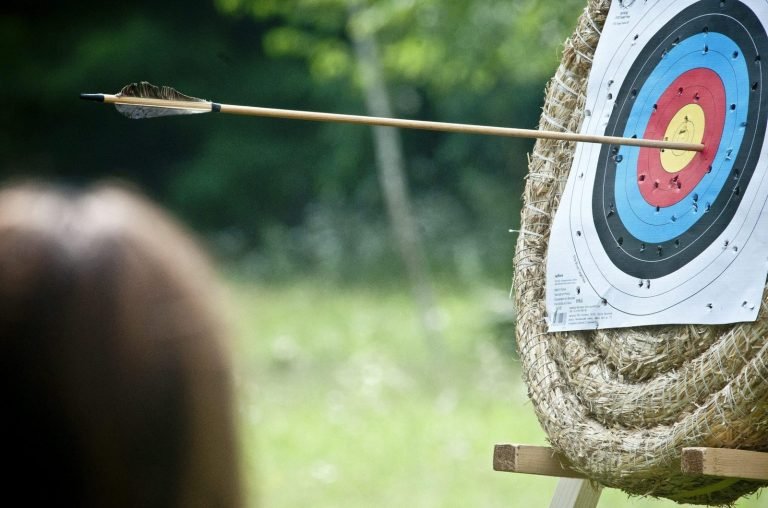
A cedar shaft sits high in the grass beyond the boss, its fletching tilted like a wounded bird. Paper keeps its coloured rings clean, almost insolent, as if a target face could hold a verdict. Fingertips smell of resin, leather, rain on sleeve, brass from the nocking point. In that small aftershock, the missed arrow begins its second life, leaving the string once, then travelling again through the archer’s chest, along the jaw, into the cramped theatre where shame gathers props, anger finds a tongue, identity reaches for a mask. I have watched that theatre rise on Irish field courses where lanes run between wet fern, blackthorn, alder root, old stone, a place where every bad shot seems overheard by birds, by companions, by the moss itself. Such grass carries one event; the archer carrying it back may add a second wound.
Ancient Buddhist teaching gives that second wound its cleanest grammar in the Sallatha Sutta, where painful contact comes first, then another arrow follows through sorrow, lament, agitation, craving, aversion.¹ On a course, the first arrow is the shot that strays. Second comes the sentence pressed into the blood: I am ruined, I am exposed, I am a fraud in boots with a bow. Language of that sort feels private, yet it behaves like public weather: a group tightens, a scorer looks down, a coach clears a throat, the body reads those small signs as tribunal. Shame turns the miss from information into stain.
Archery offers a stern mercy, in that it leaves evidence in substance. Roger Ascham’s Toxophilus, first printed in 1545, treats shooting as a school of body, eye, wind, tackle, judgment, temper.² Evidence remains available after error: grip clenched, loose plucked, shoulder climbed, gust entered just as the point settled. Target panic, flinch, collapse, impatience, over-aiming: each has a bodily signature, each leaves a little ash on the hand. Recovery begins when the archer bends to read such ash, before the archer kneels to a harsher god called the self.
Aristotle’s ethics opens by treating action as aim, as a directed search for a good, then reaches naturally for the archer who benefits from a target.³ A mark gives action measure, while repeated contact with the mark trains desire. Gold sits fixed in archery, yet the archer’s relation to it changes from arrow to arrow: one miss may teach, a cluster may accuse, a whole round may tempt the archer to trade practice for self-trial. Civic feeling enters when Aristotle gives anger, shame a public body in the Rhetoric, anger around a perceived slight, shame around imagined disgrace before those whose regard carries weight. Thus the target becomes more than straw or foam; it becomes a little polis, a court of eyes, even when only three people share the peg.
That civic body explains why anger so often arrives after shame, wearing boots too large for it. Shame says the self has been seen in a diminished shape. Anger seeks a culprit with better posture: the wind, the peg, the noisy companion, the bowyer, the rule, the ill-chosen shaft, the marshal, the whole day. Seneca’s De Ira calls anger a movement that seeks repayment for an injury, a heat that mistakes its own smoke for justice.⁴ His Roman theatre differs from a field course in Laois, yet the mechanism crosses the centuries neatly: a miss pricks the self, shame reddens, anger strides out to collect a debt from the world. Composure begins where that debt is examined before collection.
Epictetus sharpens the same discipline with colder steel. In the Enchiridion, disturbance arises through judgments carried about events, as distinct from the events themselves.⁵ Harsh ears may hear that sentence as an easy dismissal of pain, while a kinder reading holds firmer ground. The philosopher grants the event its place, then places custody of response in the trained faculty of judgment. Real things remain: arrow in grass, score on card, hot face, clumsy breath, sudden urge to snap the bow into the case. Yet the verdict built from them belongs to the archer’s workshop. A workshop can be swept.
Shame becomes most dangerous when it fuses the whole person to one act. June Price Tangney, Ronda L. Dearing separate shame as a global wound to the self from guilt as pain attached to a specific deed or lapse.⁶ At the peg, guilt says: that shot came loose from a hurried anchor. A darker sentence follows: I am the sort of person who sends arrows into bracken. Guilt keeps a hinge in the sentence; technique can enter through it. Once shame nails the door to the frame, anger often lends it a hammer, since rage gives the humiliated body a sensation of height. Slamming a quiver clip may grant brief enlargement, yet the enlargement costs dearly. It spends the next arrow before the nock touches the string.
Sporting identity deepens the risk. Brewer, Van Raalte, Linder’s work on athletic identity describes the strength with which a person sees the self through the athlete role, an identity that can steady commitment yet sharpen collapse when the role receives injury.⁷ Years of practice enter shoulders, calendar, friendships, speech. Bow case by the door becomes a second coat of arms. Tournament score can feel like a family name spoken aloud. Devotion gives stamina, as long winter practice proves; its shadow appears when the archer confuses rank with being. After such confusion, the missed arrow appears to injure existence itself. A reset has to separate person from performance while preserving duty to the shot. Soft comfort rarely helps here. Firmer mercy says: you are more than the miss; therefore you owe the next arrow your whole care.
Failure spirals have mechanical workings as well as moral heat. Carver–Scheier control theory describes self-regulation as a feedback process in which a perceived gap between current state, desired standard guides adjustment.⁸ Such a model suits archery with almost embarrassing precision: aim, act, receive evidence, compare, adjust. Trouble begins when comparison grows swollen; a small gap becomes a public accusation, attention meant to refine the next act turns back upon face, reputation, history. Breath rises. Fingers grow clever in the worst way. Fine motor skill receives a crowd inside it. Reset, in this frame, is the art of reducing comparison to usable scale: arrow, body, mark, one correction, release.
Strong archers sometimes attempt to conquer the second arrow by forcing the mind into vacancy. That contest usually feeds the very thought it seeks to bury. Daniel Wegner’s work on ironic mental control gives a modern psychology for this old nuisance: attempts to suppress a thought can keep scanning for the thought, thereby keeping it active.⁹ Telling the mind, do anything except remember that miss, keeps the miss polished like a relic. Better reset gives the mind a task with edges. Feel the tab against the jaw. Set the feet into the earth. Let the bow hand receive the riser as a guest, free of suspicion. Count one breath through the ribs. Name the next usable cue. Given a tool, the mind loosens its grip on the wound.
Practical composure therefore has a material liturgy. An archer walks to the waiting place, plants the feet, lets the bow hang, touches the serving, checks the nock, rolls the shoulders once, allows the exhale to travel into the belly, then chooses a single command: tall spine, clean anchor, soft hand, finish the shot. Each cue earns its place by being small enough for obedience. Grand vows rot quickly after a miss. Flesh trusts humble orders. Smoke rises from a cue such as shoot better. Grain, skin, edge live inside a cue such as feel the string settle into the tab. Reset works through contact, by virtue of giving attention a handle.
Close reading of a miss also asks for time. Immediately after error, the face wants to speak before the facts arrive. A wiser archer gathers evidence like field notes. Where did the arrow land? How did the shot feel against the scapula? Did the bow arm drop, or did the release hand fly? Which sight picture held in the last half-second? Inquiry turns shame into witness. Body becomes archive, free of the dock. Through that change, failure recovers its proper size. Previous error becomes a messenger carrying poor news to the next shot. Poor news can serve.
Anger requires a sterner handling, for it flatters the archer with energy. Heat feels almost useful. Pulse rises, spine lifts, speech sharpens, the field brightens at the edges. Yet anger spends perception. A mind busy prosecuting wind has little room for the wind’s actual work. Hands angry at a bow forget how often that bow has served. Companions begin to manage the archer’s mood before the round can be shared. Foam then sees a group reduced by one person’s theatre. In archery, as in most arts of repetition, the social world forms part of the instrument. Courtesy keeps attention clean. Rage puts grit into the mechanism.
Shame asks for witness of a different kind. Direct counsel can make it shrink, yet exact speech can also rescue it. One coach says forget it, placing a veil over the useful fact. Another says that was poor, look at your bow shoulder, opening a gate. Exactness can be merciful. Vague consolation can be cruel. The recovering archer needs speech that returns event to craft: that arrow left from the fingers, that drift came from the front shoulder, that rush began before full draw. Through craft-language, self gains breathing space. Shot receives blame enough; archer receives a task.
Historical archery, from Ascham’s Tudor dialogue to the modern field course, keeps returning to one severe lesson: shooting joins liberty to discipline. An arrow leaves freely only after the body has submitted to form. Emotional recovery follows the same pattern. Freedom from the second arrow comes through chosen constraint: one breath, one cue, one honest reading of the mark, one respectful bearing among companions. A person performing that little rite after a miss practices a philosophy older than sport science, yet sport science confirms its lineaments. Resilience grows through repeated returns, through trained passage from disturbance to function, through keeping one arrow from recruiting the whole self into ruin.
A failure spiral, then, is rarely a single emotion. Its braid holds shame, anger, identity, attention, memory, breath. Pull one strand too hard, the rest tighten. Bravado aimed at shame feeds anger. Self-disgust aimed at anger feeds shame. Blank suppression aimed at both feeds recurrence. Recovery works by putting each strand back into its own hand. Shame becomes evidence of value: the archer cares. Anger becomes evidence of violated expectation: the archer wanted a truer shot. Identity becomes a wider room: practitioner, companion, student, citizen of the range. Attention returns to the object: string, tab, riser, boss, air.
The next arrow deserves special reverence. Fresh from the quiver, it withers when treated as a trial, sourly swells when treated as revenge. A reset gives the next arrow its own life. Hands touch it, see the grain, set the nock, raise the bow, receive the weight through the back, let the aim gather, release. Error may visit again. Such truth carries severity, yet also grace. Recovery is a covenant with attention, a pledge older than any bargain guaranteeing gold. Practiced hands promise to meet the shot that exists, leaving the ghost of the shot that went wrong behind.
What should an archer do with the arrow that has already gone wrong, while the next one lies cold against the fingers? Answer plainly: receive the first arrow as fact, spare it the right to become a second wound, translate shame into craft, translate anger into measured repair, loosen identity from the score, then give the next arrow a clean body to leave from. The miss belongs in the grass. At the mark, the archer belongs alive to hand, breath, bow, company, the difficult mercy of beginning again.
Scholia:
¹ Bhikkhu Bodhi, trans., The Connected Discourses of the Buddha: A Translation of the Saṃyutta Nikāya, Boston, Wisdom Publications, 2000, volume II, pp. 1263–1265. I return to the Sallatha Sutta as the cleanest old teaching for the wound that follows a wound. Its account of the first arrow and the second arrow gives me a way to understand the archer after a miss: the first shaft goes into grass, straw, bark, or mud; the next one may enter the mind through judgment, shame, agitation, craving, anger. I have seen that second arrow travel faster than cedar. Bodhi’s translation preserves the disciplined sequence of feeling, reaction, grasping, aversion, and mental disturbance, so I use it as a governing image for recovery. The source deepens my claim by keeping pain and proliferation apart. A miss deserves honest contact. The story built on top of it deserves scrutiny. Such separation gives the archer a path back to breath, hand, bow, and mark.
² Roger Ascham, Toxophilus: The Schole, or Partitions, of Shootinge, London, Edward Whitchurch, 1545; modern text in English Works, ed. William Aldis Wright, Cambridge, Cambridge University Press, 1904, pp. 1–119.
³ Aristotle, Nicomachean Ethics, trans. Roger Crisp, Cambridge, Cambridge University Press, 2000, I.2, 1094a18–24; Aristotle, On Rhetoric: A Theory of Civic Discourse, trans. George A. Kennedy, 2nd edn., New York, Oxford University Press, 2007, II.2, 1378a30–1379b13, II.6, 1383b12–1385a15. I read Aristotle here through the feel of a target lane: the mark gives action measure, yet the archer’s shame and anger arise among human eyes. In the Ethics, the archer image lets me think of aim as moral orientation, not merely technical direction. A person can miss the gold while still belonging to practice. In the Rhetoric, anger grows from perceived slight, shame from imagined disgrace before those whose regard carries weight. That pairing matters at the peg, where a bad shot can feel like public exposure. Aristotle helps me treat the miss as both material event and social wound. Straw receives the arrow; companions, memory, and pride receive the tremor.
⁴ Lucius Annaeus Seneca, Moral Essays, Volume I: De Providentia, De Constantia, De Ira, De Clementia, trans. John W. Basore, Cambridge, MA, Harvard University Press, 1928, pp. 107–355.
⁵ Epictetus, The Handbook, in Discourses, Fragments, Handbook, trans. Robin Hard, Oxford, Oxford University Press, 2014, pp. 287–306.
⁶ June Price Tangney and Ronda L. Dearing, Shame and Guilt, New York, The Guilford Press, 2002, pp. 17–40, 94–132. I rely on Tangney and Dearing for the crucial distinction between a damaged act and a condemned self. Their work lets me say with greater exactness what field experience already suggests. Guilt can remain close to repair: the anchor hurried, the bow shoulder rose, the release broke backward, the archer can adjust. Shame spreads across the whole person and begins to speak in total verdicts. I have watched that spread in the body: jaw tightened, eyes lowered, hands too busy with equipment. Their account also clarifies why anger so often follows shame. A humiliated self searches for an outer culprit, and the bow, the wind, the peg, or a companion becomes convenient flesh for blame. The source deepens my argument by grounding recovery in precision rather than comfort.
⁷ Britton W. Brewer, Judy L. Van Raalte and Darwyn E. Linder, ‘Athletic Identity: Hercules’ Muscles or Achilles Heel?’, International Journal of Sport Psychology, 24:2, 1993, pp. 237–254.
⁸ Charles S. Carver and Michael F. Scheier, Attention and Self-Regulation: A Control-Theory Approach to Human Behavior, New York, Springer-Verlag, 1981, pp. 11–43, 171–203; Daniel M. Wegner, ‘Ironic Processes of Mental Control’, Psychological Review, 101:1, 1994, pp. 34–52. I place Carver and Scheier beside Wegner because the two bodies of work explain a familiar post-miss trap. Control theory gives me the feedback loop: action, result, comparison, correction. Archery lives inside that loop. Wegner then shows why a desperate command to forget the miss can keep the miss active, polished, and near. I have felt that paradox under the fingers: the mind told to banish an image keeps patrolling for the image. Hence my emphasis on small tactile cues. Feet in the ground, tab at the jaw, bow hand soft, finish through the back. Attention needs a task with edges. These sources give practical force to the reset ritual, making it less a superstition than an economy of attention.
⁹ Nick Galli and Sandy P. Gonzalez, ‘Psychological Resilience in Sport: A Review of the Literature and Implications for Research and Practice’, International Journal of Sport and Exercise Psychology, 13:3, 2015, pp. 243–257. I use Galli and Gonzalez to keep resilience close to lived practice rather than myth. Their review treats resilience as a response to setbacks shaped by appraisal, coping, motivation, and social context. That breadth matters on a course, where an archer carries previous shots through lanes, weather, companions, and the scorecard’s small theatre of ink. Resilience, as I understand it here, is not a heroic substance hidden in the chest. It is a trained return. The archer meets difficulty, reads it, recovers form, and remains answerable to the next act. Their work strengthens my closing claim that composure grows through repeated, disciplined beginnings after disturbance. The next arrow asks for a person who has learned how to come back.
Views: 231