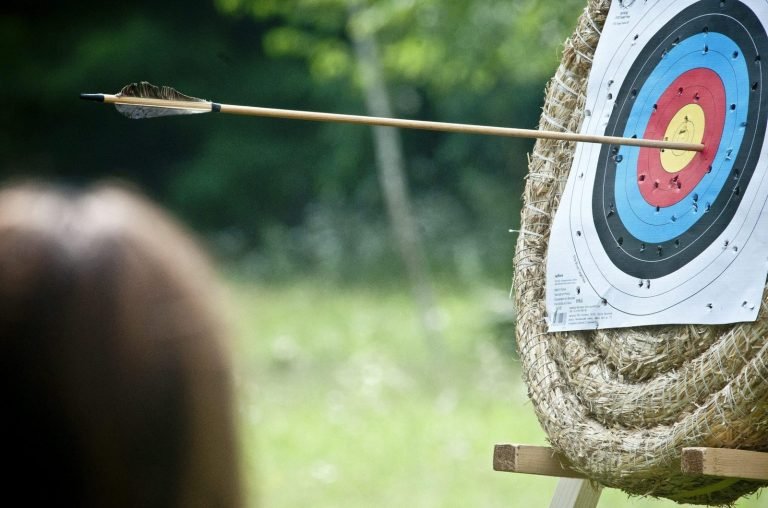
What does a scorecard do to friendship when one archer’s arrow cuts closer to the centre than mine? The card looks slight enough, a crease in rain-soft paper, thumb grease along one edge, pencil dust in the boxes where names sit in a row like small legal persons. Beside the target, the shaft shivers in straw or foam, feather tilted, point buried, its coloured nock bright as a tiny accusation. My friend reaches first, fingers careful at the boss, then he calls the value with that decent voice I have trusted over tea, lifts his chin, waits for my pencil. Friendship enters the ledger through my hand. Lead darkens the square. A number becomes a bruise with neat borders.
At a match the scorecard has manners. It asks for totals, signatures, witness, calm sequence, tidy arithmetic. World Archery’s target format makes the moral geometry plain: an individual set carries three arrows, a win in a set gives two points, a drawn set gives one, with six set points enough to carry an archer onward.¹ Field archery adds its own tactile schooling, for the group walks together, reads lanes together, scores together, then steps aside together as a small moving court among trees.² In each case, the card turns the hand of a friend into a public instrument. By mid-afternoon, the person who shared wax for the string at morning can become the keeper of my small humiliation. Sport calls that fairness. Gut calls it exposure.
I learned that exposure first on a club line where a yew bow, borrowed for kindness, sat heavier than pride in my palm. Rain had left the targets swollen; the straw smelled like old cattle bedding, the kind that keeps a winter in its chest. A man I liked stood two pegs away, loose shoulders, old tab darkened by years, the string touching his face as naturally as a priest’s thumb finds ash. My arrows wandered high, then left. His settled in the red with a quiet domestic authority. After the end, he smiled with real warmth, said the wind had a twist near the hedge, offered a glance at my stance. Gratitude rose in me, clear as water. Resentment rose beside it, dark as tea in a cracked mug. Two liquids met in the same cup.
Archery makes such mixtures hard to hide due to the arrow’s severe honesty. Roger Ascham, in Toxophilus, gives the chief point of shooting in the plain reply, “to hit the mark,” then divides that pursuit into shooting straight with keeping a length.³ His dialogue carries courtly polish, humanist learning, Tudor policy, yet its finest truth sits inside the hand: the mark receives every tremor that courtesy hopes to cover. A friend’s good arrow speaks in front of me. My lesser arrow speaks after it. Small talk at the peg can soften the air, yet the boss keeps its own account. The straw has memory. Foam has memory. Paper has memory.
Older English archery culture knew the bow as a social instrument as much as a weapon or pastime. Hugh D. H. Soar traces longbow practice through musters, statutes, clubs, revival circles, pageants, bowyers’ rooms, sociable fields, the bow moving between war-readiness, recreation, display, masculine fellowship, family leisure.⁴ Such history gives present envy a deeper root. A bow gathers people into visible order. Bodies stand at a common distance; arrows fly into a common face; rank appears by impact. In contrast with many games, archery leaves every claim stuck in the target. The evidence waits at eye height. Someone can laugh, shrug, praise, blame a gust, adjust a bracer, speak with grace; still, the little wooden or carbon witness remains lodged where it landed.
Play, then, carries law in miniature. Johan Huizinga wrote of play as a voluntary ordering set apart in time, rich with rule, tension, ceremony, beauty.⁵ Archery fits that thought with peculiar authority. The whistle, the peg, the line, the hush before the loose, the turn to scoring, the return to shelter: each element makes a circle within daily life. Yet the circle admits the real heart. My friend’s arrow can wound me precisely by virtue of play’s safety. Bread, rent, marriage, illness, grief stay outside the rope for a while, so a cleaner wound may appear. In that cleared interval, superiority arrives with a round face, coloured rings, a neat centre. I find out what praise costs when praise must pass through my own injured pride.
Aristotle saw that envy belongs near equality. In the Rhetoric, envy concerns pain at the good fortune of those who resemble us in age, birth, standing, or pursuit; emulation carries a sharper dignity, for it sees another’s excellence as something worth striving after.⁶ Archery tests the hinge between those passions. For me, a stranger’s perfect group may inspire a mild admiration, cool as light on a glass case. A friend’s perfect group enters my house. Similarity brings the arrow close. He trains on the same field, complains of the same mud, buys serving thread from the same shop, loses shafts in the same briar. His success says, in effect, “the path lay open here.” Pain follows that sentence for I had placed my own boot on that path.
Aristotle’s account of friendship deepens the trouble. The finest friendship, in the Nicomachean Ethics, is grounded in wishing good to the friend as good, with virtue as the shared measure.⁷ Such a question has a hard grain. I can cheer my friend’s success in public yet feel a tightening beneath the ribs. Politeness may keep the mouth clean while the hand grips the pencil too tightly. Virtue enters through that grip. Affection means little when the friend misses. Loyalty earns weight when he beats me by one clean ten, then looks to me for a handshake.
The medieval theologian gives the pain an older name. Thomas Aquinas treats envy as sorrow over another’s good, especially when that good seems to lessen one’s own excellence or good name.⁸ On the range, that definition acquires texture. Such good can be a group the size of a fist at thirty yards. Release may be so smooth that the bow seems to breathe on its own. Perhaps it is simply another archer’s ease after the shot, the loose body of a person at home inside practice. Envy chews at that sight. A whisper says another’s gain has eaten from my plate. Its lie has the intimacy of a relative.
Adam Smith helps me hear the public side of the wound. His moral psychology asks persons to test passions before an imagined spectator, a figure of judgement seated inside social life.⁹ An archer beaten by a friend faces that tribunal at once. My disappointment asks to be read as effort more than vanity. Triumph asks, in his case, to be kept human more than priestly. The impartial eye asks for proportion. It allows the sting, then trims it. A lost match deserves a clean palm extended, a word of praise, a careful signature. Resentment, once measured, can become discipline. Left loose, it becomes gossip at the car park, a sour little liturgy beside boot mats, flasks, muddy soles.
Modern psychology gives the old passions a finer anatomy. Leon Festinger’s account of social comparison starts from the drive to evaluate opinions with abilities, especially through comparison to others near enough to make the comparison meaningful.¹⁰ Archery clubs live inside that principle. The novice watches the county archer with awe, yet judges the self by the archer in the next lane, the friend with similar limbs, similar time, similar kit, similar years of practice. Their scores become mirrors set near the face. Nearer glass cuts deepest. A friend’s victory hurts in that way: it carries evidence from a comparable life.
Achievement-goal research sharpens the distinction between growth in the task itself and status over persons. John G. Nicholls describes ability as measured either against one’s prior performance or against others, a split that changes feeling, attention, choice, performance.¹¹ A target can serve both measures in the same end. Gold may ask, “Was my shot cleaner than the last?” The score sheet may ask, “Did I stand above him?” Each question makes a different archer in me. First question brings me back to breath, back tension, front hand, stance in clay. Status question brings me to hierarchy. Friendship survives best when the first question governs practice while the second receives its rightful hour, then returns to the box.
Rivalry forms through relation, proximity, similarity, repetition. Gavin Kilduff, Hillary Anger Elfenbein, Barry Staw show competition as a relational condition, intensified by prior encounters with likeness between competitors.¹² That finding explains the friendly enemy. He is friendly in ordinary life, yet enemy in the ritual enclosure of the match. Such a word carries sporting shape, a clean edge cleansed of malice. A rival made from friendship can raise effort with a power that random opposition lacks. Seeing his name on the target list changes the muscles. My bow hand dries. Tab feels newly intimate. By dusk, a casual round grows teeth.
René Girard’s account of desire as mediated through another offers a darker gloss.¹³ I may believe I desire the medal, the badge, the higher classification, the clean score; often my desire has learned its heat from the friend who desires the same object. Such wanting teaches my wanting. Achievement lends the object shine. In archery the model stands beside me with a bow in hand, a person close at hand, far from mythic hero or remote champion, but a person who shares lifts, biscuits, club gossip, spare nocks. That closeness gives rivalry its warmth. It also gives jealousy its sour breath. The desired thing grows more desirable once my friend touches it first.
Recent work on envy separates its upward pull from its destructive appetite. Niels van de Ven, Marcel Zeelenberg, Rik Pieters distinguish forms often called benign and malicious envy, with the first tending to self-improvement, the second to pulling the envied person down.¹⁴ Every archer knows both currents. One current sends me home to fletch, stretch, journal my shots, ask for coaching, learn from the friend’s clean draw. The other current invents excuses: his bow is faster, his boss was easier, the scorer favoured him, the wind favoured his lane. A community lives or rots by the current it rewards. Clubs teach ethics in jokes, lifts, tea, target repair, the small praise offered when nobody gains from offering it.
Shame has its own mark face. David E. Conroy, Jason Willow, Jonathan Metzler treat fear of failure as tied to feared outcomes such as shame, self-devaluation, a clouded future, loss of interest from valued others, upsetting valued others.¹⁵ Losing to a friend can strike several of those at once. The result says, “I shot worse.” The inner theatre adds, “I am smaller here.” Dislike offers armour; affection removes it. To be beaten by someone I despise permits crude anger. Being beaten by someone I love asks for a cleaner courage. That courage begins when I let admiration remain visible while shame burns its way through the throat.
A second lesson lies in the equipment itself. The bow stores violence as patience. Riser takes the sweat of the bow hand; the tab learns the crease of a finger; the string keeps a faint taste of wax, grit, skin. Every good archer has felt the shot break cleanly once, then spent months trying to recover that small visitation through labour. In such a discipline, the friend’s victory rarely feels like accident. It feels earned in muscle, evenings, notebooks, tuned arrows, quiet corrections. That makes praise morally demanding. Praising him, I concede a chain of labour more than a lucky flash. Resenting him, I try to steal that chain from view. Scorecard, so modest in its ruled boxes, asks which theft I permit inside myself.
Plain practice follows from the material ritual. Write the score plainly. Call the arrows clearly. Let the friend’s success stand in the open air. Ask one technical question after the round, ahead of five excuses during it. Notice the body’s first resentment as one notices a splinter. Pull it out with practice, praise, sleep, renewed labour. Bow teaches by touch. So does a scorecard. Paper receives the day’s moral weather, then gives it back in graphite. Every friend who beats me has lent me a mirror with cruel mercy. Mercy lies in the fact that the mirror can be used.
Archery’s friendly enemy therefore belongs at the heart of the sport, especially in clubs that carry friendship through repetition. The companion who shares lifts to shoots, finds lost arrows in nettles, lends pliers, waits beside the boss, then beats me by two points, performs a service harsher than comfort. Vanity shows where affection has slipped into costume. Admiration turns visible as hunger. Shame reaches for a mask. Rivalry, handled with care, makes friendship athletic: each person grants the other resistance, witness, measure, occasion. Target records only impact. Relationship records what each archer does after impact.
What does a scorecard do to friendship when one archer’s arrow cuts closer to the centre than mine? A scorecard brings friendship to judgement, then offers it back with terms. Liking a person has depth only when I can bear his excellence near my own desire. Envy becomes either poison or apprenticeship according to the hand that carries it home. Shame can shrink me or school me. Most of all, the friend who beats me is an enemy only inside the consecrated circle of play, while outside that circle he remains the hand beside mine on the wet target face, pointing to the mark I still must learn to hit.
Scholia:
- World Archery Federation, ‘Target Archery’, Lausanne, World Archery Federation, 2026, competition formats section, accessed 13 May 2026. I use the official account of set play to keep my argument close to the actual rhythm of a match. The rule that an individual set carries three arrows, with set points assigned after each end, gives rivalry a pulse beyond vague emotional mist. A friend beats me by entering a sequence that both of us accepted before the first draw. That shared sequence carries moral weight. It means resentment grows inside consent, hence it must face the ritual that allowed the result. The source also keeps my argument tied to modern target practice, where friendship meets a formal scoring machine. My interest rests there: affection enters a device built for ranking, then discovers what it can bear.
- International Field Archery Association, Book of Rules: 2019–2020, Lugano, International Field Archery Association, 2019, pp. 102–105. I draw on the IFAA rule book due to its Basic Code of Conduct for Competitors, with its scoring diagrams for field settings. Field archery places friends in a walking group, where each person sees more than impact: posture, pace, search for lost arrows, talk between targets, small acts of care. That setting makes envy intimate. A target-round score can feel severe, yet a field round adds companionship through movement. The code insists that an archer carries responsibility for rules, local law, safety, health, conduct. My reading turns that formal language into a moral scene. Friendship holds when the group accepts shared duty before private feeling. The walk itself becomes part of the judgement.
- Roger Ascham, Toxophilus: The School of Shooting, ed. Edward Arber, London, Alex. Murray & Son, 1868, pp. 3–22. Ascham’s dialogue gives me a primary archery grammar: mark, length, straightness, weather, instrument, handling. I use his plain answer, the aim to hit the mark, as a way of resisting sentimental talk about sport. The friend’s good arrow hurts due to its clarity. Ascham also binds shooting to learning; skill arrives through repeated handling of things, through bow, string, shaft, mark, air. His Tudor setting brings policy, scholarship, rank, leisure into the same bow. That breadth helps my claim that rivalry in archery has a history deeper than personal mood. The field has long served as a school where bodies, books, status, fellowship meet beneath the discipline of a mark.
- Hugh D. H. Soar, The Romance of Archery: A Social History of the Longbow, Yardley, PA, Westholme Publishing, 2008, pp. 1–35. I lean on Soar for the longbow’s passage through military, civic, recreational, club forms, a passage that gives present club rivalry its older social grain.
- Johan Huizinga, Homo Ludens: A Study of the Play-Element in Culture, trans. R. F. C. Hull, Boston, Beacon Press, 1955, pp. 1–27. Huizinga helps me treat a match as a consecrated interval beyond mere amusement. His account of play as ordered, bounded, rule-rich activity explains why a scorecard can wound deeply while the stakes appear modest. The magic circle grants permission for a serious hierarchy to appear inside a chosen space. I use that idea to argue that friendly rivalry feels clean precisely due to its protected form. A person enters willingly, accepts rule, then receives a verdict with public shape. The pain carries weight as the circle has been honoured. Play, in Huizinga’s sense, grants archery its ritual dignity, its whistle, lane, peg, target, witness, return.
- Aristotle, On Rhetoric: A Theory of Civic Discourse, trans. George A. Kennedy, 2nd edn, New York, OUP, 2007, pp. 146–151. I place Aristotle near the centre due to his careful distinction between envy, shame, emulation. His claim that envy arises among equals gives the friendly enemy its philosophical skeleton. A champion far away may receive worship; the friend at the next peg receives comparison. Aristotle’s emulation then offers a path out of corrosion. The same wound can become hunger for excellence when the other’s success appears as attainable good. I use that hinge to frame archery as ethical training. The target gives a visible hierarchy; the archer’s task is to convert pain before it curdles. That conversion begins with seeing the other as model, as measure, as companion in excellence.
- Aristotle, Nicomachean Ethics, trans. Christopher Rowe, commentary Sarah Broadie, Oxford, OUP, 2002, pp. 142–179. I cite the friendship books for the claim that wishing good to a friend receives its hardest test when the friend’s good shines above mine.
- Thomas Aquinas, Summa Theologiae, Blackfriars edn, vol. 34, Charity, trans. Thomas R. Heath, London, Eyre & Spottiswoode; New York, McGraw-Hill, 1972, pp. 180–193. I use Aquinas’s treatment of envy as sorrow over another’s good to give theological weight to the small ache at the target.
- Adam Smith, The Theory of Moral Sentiments, ed. D. D. Raphael & A. L. Macfie, Indianapolis, Liberty Fund, 1982, pp. 9–26, 112–132. I cite Smith for the inner spectator who measures disappointment, praise, resentment, giving the defeated archer a social conscience within the ribs.
- Leon Festinger, ‘A Theory of Social Comparison Processes’, Human Relations 7:2 (1954), pp. 117–140. Festinger gives the psychology of the near mirror. I use his account of comparison in abilities to explain why the friend’s victory cuts more deeply than the distant champion’s score. Similarity supplies the sting. The archer beside me shares distance, weather, time, kit, training talk, local ground, perhaps even jokes over the same battered flask. His result therefore becomes evidence about my own possible result. Festinger helps me move from moral vocabulary to social mechanism. Envy gains strength when comparison feels relevant. In archery that relevance is engineered by lanes, classes, rounds, scores. A club can soften the wound through friendship, yet it also creates the wound by making similar people visible to one another.
- John G. Nicholls, ‘Achievement Motivation: Conceptions of Ability, Subjective Experience, Task Choice, and Performance’, Psychological Review 91:3 (1984), pp. 328–346. I cite Nicholls for the difference between measuring skill against prior self or against rivals, a distinction every archer feels at scoring.
- Gavin J. Kilduff, Hillary Anger Elfenbein & Barry M. Staw, ‘The Psychology of Rivalry: A Relationally Dependent Analysis of Competition’, Academy of Management Journal 53:5 (2010), pp. 943–969. Kilduff, Elfenbein, Staw give me the modern rivalry model that fits club life: rivalry rises from relation, proximity, similarity, prior meetings. A random opponent has a face; a rival has a history. In archery that history gathers in repeated ends, shared targets, winter leagues, lifts to shoots, old jokes, remembered defeats. Their research lets me call the friend an enemy inside the match while preserving affection outside the match. The relation intensifies effort; it can also sharpen envy. I find that dual edge essential. Friendly rivalry becomes morally valuable when it raises care for practice while keeping respect intact. My title grows from that dyad.
- René Girard, Mensonge romantique et vérité romanesque, Paris, Bernard Grasset, 1961, pp. 9–52. I use Girard’s account of mediated desire to show how the friend teaches me what to want before I admit my wanting.
- Niels van de Ven, Marcel Zeelenberg & Rik Pieters, ‘Leveling Up and Down: The Experiences of Benign and Malicious Envy’, Emotion 9:3 (2009), pp. 419–429. Van de Ven, Zeelenberg, Pieters give empirical shape to the two currents I name on the range. One current moves upward through imitation, training, repair. Another current pulls at the friend’s merit, inventing excuses or hoping his next end collapses. Their work is especially useful for archery, where the envied excellence often appears deserved: steady practice, cleaner loose, better preparation, honest attention. Deservedness can direct pain into self-improvement. Low perceived control can make the same pain turn sour. I use the study to argue that clubs have ethical weather systems. Praise, coaching culture, scoring manners, humour, shared labour all teach which kind of envy gets fed.
- David E. Conroy, Jason P. Willow & Jonathan N. Metzler, ‘Multidimensional Fear of Failure Measurement: The Performance Failure Appraisal Inventory’, Journal of Applied Sport Psychology 14:2 (2002), pp. 76–90. I cite Conroy, Willow, Metzler for shame as one feared consequence of failure, the exact heat felt when a liked archer wins cleanly.
Views: 199