

What kind of theology tightens itself across the small arc between a child’s throat and a god’s relaxed wrist? Along the outer wall of the Louvre krater named from the Niobids, a white rise of ground cuts through black glaze as a girl pitches sideways and a youth folds at the waist; Apollo, held in hard profile, bends the bow as if a surveyor’s rule had passed into divine hands, while his sister’s fingers travel back to the quiver for renewed work. That clay remembers the feast for which the vessel first stood ready, a broad calyx-krater built for wine, song, talk, male leisure; the earthen body now carries a family cull executed with ceremonial calm. Clay once sat warm beneath grasping palms, yet the vessel now assumes the office of a tribunal of distance, bearing witness to judgment delivered across space. From that conversion the guiding question presses harder: what does the shared string mean when the brother’s bow governs pestilence cast from afar, while the sister’s bow governs mountain quarry, animal blood, the stern thrift through which the hunt continues? Out of that taut gut-thread rises one of Greek religion’s sharpest twin emblems, for a single implement serves a province of pestilence, a province of quarry, together with one chill doctrine of divine ease.^1
Smarthistory’s Louvre discussion dwells on the calm ferocity of the scene: Apollo draws, Artemis reaches back, children lie scattered, the gods retain strict profile, whereas the victims turn outward in a vulnerable openness that yields them fully to the eye. Oxford’s pottery archive extends that formal account by tracing a field whose ground rises unevenly, whose trees screen portions of bodies, whose faces turn outward at shifting angles, an early classical effort to spread figures across ascending slopes in place of fastening every limb to a single strip of earth. Within such composition, visual depth carries moral chill through the very rise of the terrain. Each ledge becomes another station for execution, while altered angles grant the twins a wider field, as though the painter wished the viewer to feel death travelling through air rather than bursting from hand-to-hand collision. By comparison, a spear-thrust binds killer and victim in sweat, stumble, breath; the arrow establishes an official remove, allowing the executioner to remain clear of the body that receives the wound. On this vessel, archery assumes the manner of rank acting through serene remove.
Homer grants Apollo his first great entrance by sound.^2 After Chryses prays over the insult laid upon his priesthood, the god steps from Olympus ‘like the night’, the quiver rattles, the silver bow answers with a dreadful twang, while the sequence of ruin moves through mules, dogs, men as funeral pyres gather beside the ships. There pestilence keeps the shape of archery even when the shaft itself passes from sight. Across Apollo’s province, interval carries literal reach while it also carries civic abstraction: plague reaches a camp as decree reaches a court, issuing elsewhere, descending from elevation, emerging from a source whose face seldom meets the skin it opens. Thus Apollo appears as a deity of Olympian distance, a phrase that fits the Homeric scene with grim precision. Each corpse in the Achaean camp bears witness to a death delivered through interval.
One detail in Homer’s sequence invites sustained attention. First the god strikes animals, then passes through hounds, then settles upon the human collectivity that had shamed the priest. Under that ordering, the plague becomes a perverse hunt conducted at the camp’s edge, as if service beasts and swift dogs prepared the way for the larger quarry within the tents. Artemis rules the chase among creatures whose tracks score mud or dust; Apollo, in wrath, turns the encampment itself into a field of quarry. Even there the duality begins to blur, for epidemic and pursuit share a structure of selection, stalking, collapse.
Before any body falls, Apollo’s string already sounds. Heard first as a tremor in air, the twang soon hardens into fever, ash, emptied shelters, a mode of wounding suited to a deity whose sphere includes prophecy, purification, song, civic ordinance. His missiles move with the authority of verdicts descending from height, settling upon a multitude, leaving mortal hands to scramble through sacrifice, chant, smoke, restitution, each rite an attempt to answer an injury whose sender retains full composure. Hence the bow names a harsh law of removal: a man may perish by a hand kept beyond touch, by a vibration heard across distance, under a deity who kills through clean range.
Across a wholly different terrain, Artemis carries the same curve of wood. In the short Homeric hymn, she appears as ‘shooter of stags’, cheering the hounds, drawing the golden bow over shadowed ridges; Callimachus lets the child-goddess ask Zeus for bow, arrows, swift dogs, mountain dwelling, a tunic cut for pursuit.^3 The phrase ‘Mistress of Animals’ holds the central paradox: she kills game, yet she also guards it, above all the young, so that the hunt retains season, breeding, growth within hidden lairs, the continuity of herd. Her death therefore belongs to the frontier, where blood on leaves enters an economy of continuance as readily as an ending.
Whereas Apollo’s arrows convert insult into epidemic correction, Artemis’s arrows convert abundance into measured taking. Oxford’s recent summary of her cult gathers hunt, wild nature, children, rites of passage, childbirth, rearing within one figure, which means that her bow serves far more than appetite. There her shaft marks thresholds. Stag at full run, doe in season, girl upon the lip of marriage, woman seized by labour each inhabit a margin where vitality leans close to peril. Life under her care ripens beside its cut, for the goddess governs that margin with pitiless thrift.
At precisely this juncture the sister’s emblem acquires its darkest edge. Later tradition places daughters beneath her arrows where fawns or cubs might have stood in gentler cult imagination. Protection folds into chastisement as the frontier protectress crosses into the house and treats maternal abundance as surplus stock. Each nursery in Greek myth keeps a door ajar for the huntress, while the Niobe story derives its acid from that severe reversal.
Beneath both emblems lies the same coarse substance: a strip of gut, sinew, or fibre drawn tight between horn-tips or wooden ends. Some killed creature supplied tendon. Under some working hand came scraping, stretching, rubbing, testing, tying. Divine archery therefore stands upon prior slaughter. From that tactile residue springs the deepest kinship between plague shot from heaven and quarry brought down in brush, for each arrow extends a line already born from cut tissue, and each twang repeats an older severing.
Through number Niobe enters this twin economy. Once quantity hardens into boast, human fecundity rises like a banner before Leto, whose honour rests upon two radiant heirs, while later mythography measures the insult through tallies of sons and daughters.^4 Measured increase becomes the very occasion of ruin, as a thriving household swells past divine tolerance and the twins move through it with the quiet of officials marking surplus stock.
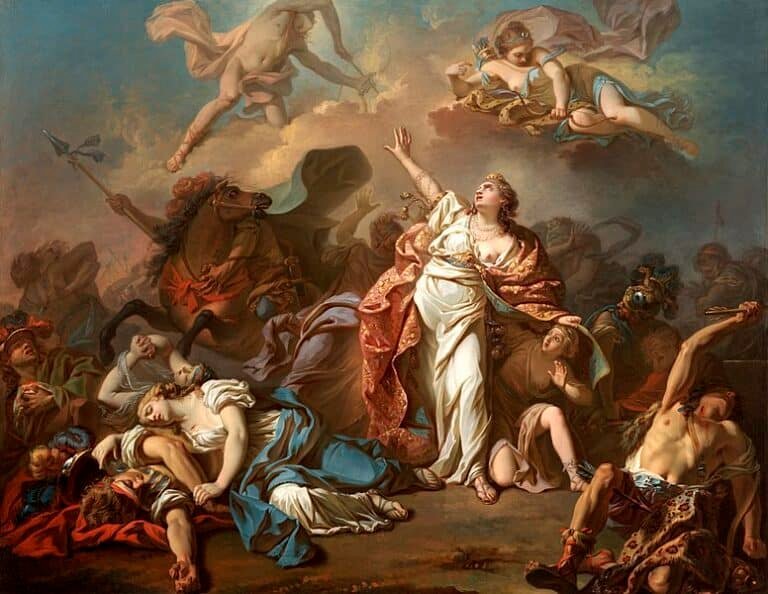
Older summaries often divide the victims by sex, assigning sons to Apollo and daughters to Artemis. Yet the vase itself resists tidy partition by foregrounding collaboration, serial method, shared ease. In that image the brother draws as the sister reaches back for the next arrow, a sequence that carries more weight than genealogical bookkeeping, for the scene translates household massacre into procedure. Viewers encounter little frenzy and scant gore-drunk triumph; the twins’ attention settles upon accurate performance, each gesture exact, each placement across the rising ground chosen for interval, rhythm.
Formal arrangement intensifies that chill. Smarthistory notes that Apollo keeps hard profile; Artemis also retains profile poise, whereas the dying children turn outward in frontal or three-quarter exposure. Profile serves emblems, seals, repeatable signs, while frontal vision belongs to pain. Through form indifference enters the scene before any commentator names it as theme, for the gods preserve the serenity of type at the very moment when human flesh loses command of itself.
Within Greek myth, divine indifference rarely feels cold in the modern bureaucratic sense; more often it feels domestic, as though household order had been restored by a light movement of the wrist. Human beings name the event calamity, yet the gods seem to handle it as routine adjustment. One scale receives catastrophe. Around that difference of measure the whole question of duality turns.
Every version of this story remains haunted by counting. In the Iliad Apollo counts through sequence, within cult Artemis counts through season and breeding, across Niobe’s speech the mother counts the children who advertise her triumph. The bow translates quantity into subtraction with frightful speed. The hand returns to rest, a boast dwindles into a diminished house, the camp thickens into a cemetery, while the hillside turns into a place of spoor, blood, flies. Once repose settles upon the wrist, arithmetic has entered flesh.
Even so, the paired emblems resist flat opposition. Apollo heals the very plague he sends when rite, restitution, song appease him. Artemis presides over childbirth even as her arrows haunt young lives. The duality of the string therefore lies in accent and habitual theatre more than in simple contrast: Apollo brings the sky’s remoteness into civic life, whereas Artemis carries scrub, cliff, lair into ritual life. Both retain care folded within hurt, cure beside wound, praise beside dread.
Modern readers often seek emotion upon celestial faces, as though justice required visible anguish from the executioner. Greek art offers a harsher theology. Apollo’s still profile declares that city, army, household fall within a view larger than grief, while Artemis’s composed reach declares that blood spilled in leaf-mould or labour-room enters a cycle older than plea. Mortal life begs for reciprocity; Olympian archery answers with range.
A further wrinkle deepens Apollo’s side of the emblem. Ancient readers already sensed a kinship between bowstring as killer chord and lyre-string as healing chord, a relation later scholarship has pressed with care when reading the first book of the Iliad. With Artemis the acoustic register stays barer, closer to bark, hoof-beat, or a cry from brush. Before full understanding arrives, mortals hear the twins. The ear enters doom earlier than the mind.
Greek religion thus places slight trust in the partitions through which mortals seek peace. A mother’s boast, uttered within civic cult, summons a response that feels at once epidemic, familial, ceremonial. The twins demonstrate that Olympian range passes freely across palace, camp, thicket, altar, nursery, each lying within shot. Such breadth helps explain why the vase feels colder than a battle-scene, for battle joins equals within shared risk, whereas the Niobid field receives force from elsewhere, already perfected, already sanctioned, already calm.
With terrifying finesse the Niobid Painter grasps this merger. In place of symposium ease the vessel presents silent twang and familial eradication arranged with exquisite poise. Drinkers lifting it at feast would have seen divine siblings convert household abundance into scattered corpses, then turn the pot to meet Herakles amid a calmer heroic company on the reverse. Clay thereby becomes a moral trap: mixed wine comes into the hand, while a doctrine of measured slaughter rises before the eye.
Substance rather than sphere finally binds the emblem. Apollo’s bow marks death cast across civic space, sudden as fever and impersonal as decree, bright with the cruel cleanliness of a deity who ‘strikes from afar’. Artemis’s bow marks the frontier where life persists through selected death, where beast, maiden, mother, cub, hound share a sacred economy of pursuit. Yet the Niobid krater discloses their secret accord. Greek myth thereby offers a severe lesson on divine ease: heaven feels according to scale, rank, rite, count, season, placing the trembling centrality each human creature grants its own pulse deep within a larger measure.
I return, at the close, to the taut line itself. Drawn tight, it stores pause; released, it turns pause into flight. Between those moments lies the whole theology of the twins: Apollo shows that distance may kill through sheer reach; from the sister comes the lesson that wild continuance depends upon disciplined wounding; both powers govern life through the placing of the cut. Beneath that judgment the human creature feels shock, vacancy, fresh blood, the stunned glance cast upward after impact. From Olympus another angle appears, one from which the bow lies light in the hand, almost graceful, a household tool lifted from its peg for seasonal use. Such grace grants the krater its enduring chill, for the child falling upon painted clay feels like an irreplaceable universe, while the divine wrist feels a minute correction in the order of things, and the string hums once, then rests, still taut for the next demand.
Scholia:
- Athenian Red Figure Vases: The Classical Period, John Boardman, Thames and Hudson, London, 1989, pp. 110–13; The Archaeology of Ancient Greece, James Whitley, Cambridge University Press, Cambridge, 2001, p. 288. The Louvre calyx-krater, G 341, carries the name by which the Niobid Painter is commonly known, yet the vase exceeds the narrow labour of attribution. Boardman’s account stresses the widened field, broken ground-line, elevated placements, together with the relation between figure dispersal and a larger ambition often linked to monumental painting. Whitley sharpens that point by setting the vessel within early classical experiments in recession, staggered terrain, visual interval. Those formal observations sustain the present reading. Slaughter here acquires its force through arrangement before narrative detail finishes its work. Raised ground, screened limbs, lateral spacing, along with the twins’ composure, give archery the air of sanctioned distance, which suits a theology of ranked removal far more than the hot mutuality of hand-work in battle.
- The Iliad of Homer, Homer, trans. Richmond Lattimore, University of Chicago Press, Chicago, 1951, Book I, pp. 62–68. Book I furnishes Apollo’s emblem in a form almost too clean for comfort. Chryses prays, Apollo hears, the silver bow sounds, then ruin advances through the camp in ordered sequence. Lattimore preserves the acoustic force of the scene, where rattling quiver and twanging string reach the ear before plague acquires full civic scale. That sequence grounds the argument pursued above: pestilence behaves like missile-work translated into collective affliction. The movement through mules, hounds, then men also deserves emphasis, for it grants the plague the gait of a hunt passing through lesser targets before settling upon the human body politic. Later in the same book, restitution, sacrifice, choral praise ease divine wrath, which grants Apollo’s bow a double office: punitive distance first, ritual repair after. One string therefore carries both verdict and release.
- The Homeric Hymns, trans. Apostolos N. Athanassakis, Johns Hopkins University Press, Baltimore, 2004, pp. 81–82; Hymns and Epigrams, Callimachus, trans. A. W. Mair and G. R. Mair, Harvard University Press, Cambridge, MA, 1955, pp. 80–89. Artemis enters Greek verse through pursuit, elevation, animal life, youthful power, threshold passage. The short Homeric hymn grants movement, cry, woodland echo, lethal precision in compressed form. Callimachus enlarges that portrait by presenting the goddess as a child already selecting the apparatus of office: bow, arrows, dogs, mountain dwelling, virgin company, ritual range. Through that enlargement the hunt ceases to look like appetite in motion. A sterner economy appears. Artemis kills within an order that preserves breeding, season, ripeness, passage, limit. That is the hinge on which the essay turns: her shaft belongs equally to cull and care, to frontier plenty and frontier wound. Such doubleness makes the Niobe tradition especially bitter, for a protectress of growth enters the house in the role of pruner.
- The Iliad of Homer, Homer, trans. Richmond Lattimore, University of Chicago Press, Chicago, 1951, Book XXIV, pp. 499–500; The Library, Apollodorus, trans. Sir James George Frazer, Harvard University Press, Cambridge, MA, 1921, I, pp. 352–57. Niobe’s census varies. Homer gives six sons with six daughters; later mythography often expands the house to seven pairs, while retaining the punitive link between maternal boast and twin retribution. The argument above rests less upon a definitive tally than upon what tally itself accomplishes. Number turns maternity into arithmetic; arithmetic turns pride into exposure; exposure invites subtraction. The vase heightens collaboration more than partition, for Apollo draws while Artemis reaches back for another arrow and the children tumble across rising ground in shared peril. That painterly choice matters. Plague-logic and hunt-logic act side by side in a single domestic purge. Niobe’s house becomes the place where divine bookkeeping enters flesh.
Views: 329


