

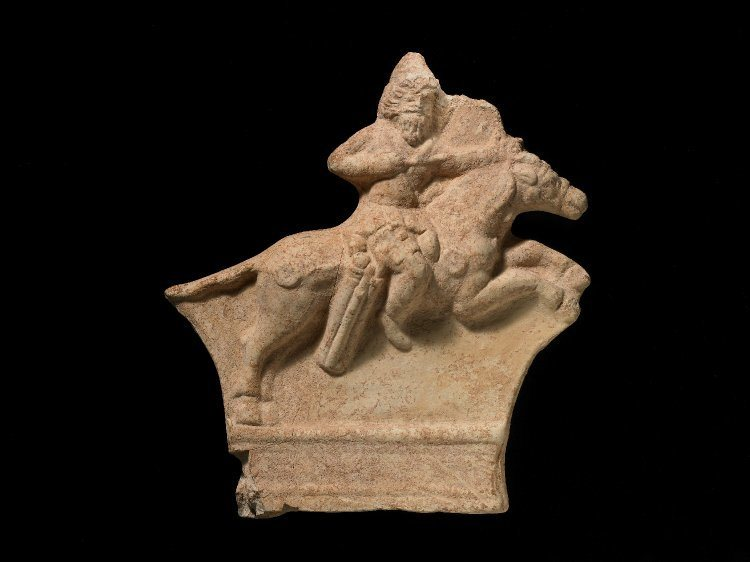
What does an arrow know of the polis that a spear leaves in shadow? I begin with a broken Attic plate from Vulci^1, a shard whose red surface carries a youth turning through the vessel’s curve, one palm resting at the gorytos, the other drawing near the string, his calves gripped by patterned anaxyrides, his skull gathered into a soft cap, his whole frame fixed at the twist where motion takes form. Clay keeps the image with pitiless thrift; red burns through black, incision scores the glaze, patterned cloth bites the eye before the hoplite has taken full possession of thought. From that wound in the ceramic skin I read a civic grammar. Greek art found one path for the spear-bearer at the civic centre, another for the bowman at the rim, useful in crisis, bright upon the surface, edged with foreign cloth, estrangement, distance.
Attic painters give the archer a body of turning. Hoplites enter as weight through shield, greave, cuirass, planted stance, a square pressure that suits the city’s desire for frontal legibility; the bowman enters as line, spine bent to the cup’s curve, knees crossing, torso winding toward release. Incision on black-figure ware scratches foreignness into the vessel’s hide, whereas red-figure painters let checked cloth or zigzagged sleeves carry the labour of distinction. A figure wrapped in signs arrives as a problem for civic reading.
That visual distinction bears civic consequence. The hoplite body serves the polis through touch. Bronze closes over chest or shoulder with hard sentence; the aspis tutors flank in the fact of a neighbour; the spear presumes interval, shared pace, mutual cover, a ranked nearness within which courage acquires public shape. Citizens learn one another through shove, breath, leather, splinter, bruise, heel-sting, helmet sweat. From such pressure the city gathers a dream of itself.
The phalanx therefore acts as civic allegory before philosophy gives the allegory polished speech.^2 One shield overreaches a little, sheltering the next man by lateral gift; one gap travels through the file like rot through wet timber. Private latitude shrinks, collective survival thickens, masculine worth enters public measurement through endurance inside a shared machinery of risk. Greek ethical language later names these values with finer precision, yet the first schooling lies in shoulder-strain, ankle-lock, weight borne for more than oneself.
From that tactile schooling archery appears under a different moral light. A bow kills beyond the intimate exchange of shield-boss, glance, thrust, counterthrust. Aristotle’s handling of courage in the Nicomachean Ethics belongs to a civic world already trained by proximity; noble action gathers around steadfast exposure, around fear borne in sight of peers, around the acceptance of death within a public field.^3 The spear suits that theatre with grim ease. The arrow travels by another arithmetic, dealing harm from a span where reciprocal danger thins, so distance itself begins to look like ethical slippage.
Material substance sharpens the suspicion. The composite bow comes from a workshop ruled by horn at the belly, sinew along the back, wood in the core, glue raised from animal residue, months of curing, a patient lore of humidity, curvature, fracture. Hoplite gear also requires expense with skill, yet bronze or ash still present themselves with a directness that suits civic display. Composite construction stores force in a layered body whose strength depends upon joined substances held in strain. Greek eyes could admire such knowledge in hunting or heroic exception; civic affection settled more readily upon weapons whose logic stood open to the gaze.
Drawn tension then turns discipline upon the frame itself. Shoulder, wrist, breath, scapula, cheek, fingertip must enter one measured consent before release arrives. Phalanx discipline lies in a visible line; the archer carries the line within muscle, pulse, balance, small corrections felt in private. Greek admiration could attach itself to such poise in selected scenes, chiefly the hunt, yet civic esteem sought deeds whose excellence ripened among companions. Hence the bow makes mastery feel self-contained, so the polis grants praise with a tightened mouth.
Horse archery deepens the trouble. The backward-turning rider who looses during retreat embodies everything hoplite ethics strain to master by frontal advance. Infantry honour favours visible persistence, chest offered forward, spearpoint leading the frame; the mounted marksman makes yielding fruitful, converts withdrawal into trap, leaves death travelling from an apparent ebb. Such movement reads as cunning from one martial code, yet from the civic code of the heavy infantryman it smells of fraud. Posture itself enters judgment.
The arrowhead carries its own theology of pain. A spear-thrust often kills within the witness of comrades or gods, yet an arrow may work by delay, hidden depth, lingering penetration; barbs or flanges enter flesh, catch upon tissue, tear during extraction, keep battle alive after the line has broken. Camp then inherits the field. Cot, fever, surgeon’s knife, suppuration, stench, sleepless turning: each stage extends the wound’s jurisdiction. Greek disgust at archery grows partly from medicine, partly from temporality, for the arrow denies the clean closure promised by heroic exchange. Iron remains within the frame like foreign law.
Acoustics press the distinction further. Hoplite combat fills hearing with shield-rim on shield-rim, haft upon wood, shouts driven from the chest like blows against panic. Bow-work gathers force in hush, then breaks it with a taut snap before flight thins into air. A victim may grasp the wound only after iron has already begun its labour. The spear declares presence in full theatre; the arrow arrives from an edge, almost spectral, like judgment carried by a hand the eye has yet to find.
Vase-painters answered that moral unease by thickening the archer’s visible difference.^4 Gorytos at the hip, kidaris, fitted sleeves, riding boots, patterned trouser-cloth, all these marks form a costume of alterity that an Athenian viewer could read at once. On the François Vase eastern dress carries the charge of distance even inside mythic action. Later cups press the bowman into crouch or twist, using the circular field to accentuate torque, whereas spearmen elsewhere keep a steadier verticality. Through costume, contour, pose, the painter teaches the eye to treat archery as civic deviation.
Anaxyrides do heavier labour than a first glance admits. Greek male self-fashioning often grants the leg either bronze tied to citizen warfare or exposed anatomy within the heroic nude. Trouser-cloth covers the limb with textile thought, replacing musculature with stitch, pattern, coded belonging. Once the leg becomes sign in place of civic flesh, the wearer enters the image as someone from elsewhere. Attic painters occasionally press the point through script itself, setting beside foreign figures strings of letters that hover between naming, parody, sound-play, graphic estrangement.^5 Dress, utterance, weapon, movement: each medium pushes the archer toward the perimeter of civic intelligibility.
Epic or tragedy keep that perimeter from settling into simple contempt. Homer’s Teucer kills with force, yet he shoots from the shelter of Ajax’s shield; efficacy reaches him through borrowed frontage, so the bow works beneath the public courage of a heavier man. Sophocles presses the paradox harder in Philoctetes, where the weapon becomes filthy relic, food-source, inheritance from Herakles, instrument of victory bound to pain, smell, rage, abandonment.^6 Then the Odyssey folds the shaft into kingship itself. Odysseus reclaims Ithaca through the stringing of his bow, proving household sovereignty by an action Greek civic speech habitually placed at honour’s rim. Contempt therefore carries desire within it.
Scythian imagery intensifies the charge. Herodotus attaches to Scythian custom a grisly traffic in skins, trophies, quivers, open-air violence; whether every hearer granted each report full credence bears less weight than the work such tales performed inside Greek imagination.^7 The gorytos joined bow-case with arrow-store in one portable economy of distance, a civic anti-emblem fashioned for speed across grassland. Steppe ornament of stag, griffin, cat, horn, haunch drew war back toward the hunt. Then the Amazon gave Greek art a sharper instrument. Rider meets archer, foreigner meets woman, trousered mobility meets armed female force, so male order answers with serial defeat upon the vase wall.^8 Each painted correction betrays the fear that gave rise to it.
History drives the deepest irony home. Athens, for all its pictorial scorn toward the barbarian bowman, employed Scythian archers inside civic order as public slaves attached to policing functions.^9 Foreign dress entered democratic practice; distance-tainted weaponry served assembly management, arrest, controlled movement, urban discipline. A city that praised citizen speech thus leaned upon outsiders whose bodies marked the edge of Greekness. Ideology cast the bow toward the margin; administration drew the margin into the centre. Here the plate from Vulci begins to speak with a harsher clarity than any civic boast.
So I return to the shard itself. The youth still turns, gorytos hanging at his side, patterned cloth flickering across fired clay, his body caught between motion, pose. He remains alien through Greek hands, Greek kiln, Greek looking. From him I learn that an arrow knows the polis through its seams. A spear teaches the city how men hold together in public risk; the arrow teaches the city what it must exile, hire, costume, feminise, medicalise, desire, then fear in order to keep that public image bright. The civic centre stands upon such exclusions. Each shaft crossing the painted field tells the same hard truth: the margin keeps rescuing the centre, while the centre keeps dressing rescue in borrowed skin.
Scholia:
- Scythian Archers in Archaic Attic Vase-Painting, M. F. Vos, J. B. Wolters, Groningen, 1963, pp. 63–68; ‘“Scythian” Archers on Archaic Attic Vases: Problems of Interpretation’, Askold I. Ivantchik, Ancient Civilizations from Scythia to Siberia, Brill, Leiden, 2006, pp. 93–114. The Vulci plate in the British Museum has long drawn readers into a fertile ambiguity. Costume fits eastern archery with striking clarity, yet the smooth face opens a second path toward Amazonian reading. Such sliding among sex, ethnicity, function, pose gives the object rare force for the present argument. A civic boundary takes strongest form when classification itself grows labile under the viewer’s hand.
- Greek Warfare: Myths and Realities, Hans van Wees, Duckworth, London, 2004, pp. 47–76; Courage in the Democratic Polis, Ryan K. Balot, Oxford University Press, Oxford, 2014, pp. 111–140. Scholarship on hoplite battle oscillates between lived practice, civic ideal, retrospective political meaning. My use of the phalanx leans upon that middle term. The formation operates here as moral image carried through art, civic speech, funerary memory, masculine pedagogy, even where battlefield variation complicates any tidy equation between tactic, constitution.
- Nicomachean Ethics, Aristotle, trans. Terence Irwin, Hackett, Indianapolis, 1999, pp. 111–120. Book III keeps courage close to fear mastered in the face of death, civic shame, honour, bodily pain. That moral texture helps explain why archery could appear efficient yet ethically cooler than spear-work.
- ‘Making Sense of Nonsense Inscriptions Associated with Amazons and Scythians on Athenian Vases’, Adrienne Mayor, John Colarusso, David Saunders, Hesperia, American School of Classical Studies at Athens, Athens, 2014, pp. 447–493. Kimmerios on the François Vase gives a prime instance of eastern dress entering mythic action with enough precision to invite ethnic reading. Costume here serves as iconography with civic bite.
- The Language of Greek Vases, Rudolf Wachter, Oxford University Press, Oxford, 2001, pp. 191–203; ‘Making Sense of Nonsense Inscriptions Associated with Amazons and Scythians on Athenian Vases’, Adrienne Mayor, John Colarusso, David Saunders, Hesperia, American School of Classical Studies at Athens, Athens, 2014, pp. 447–493. Letter-strings beside Scythian or Amazonian figures may register parody, attempted foreign phonetics, painterly sound-play, or several of these at once. I treat them as graphic estrangement with contact folded inside it.
- Iliad, Homer, trans. Richmond Lattimore, University of Chicago Press, Chicago, 1951, pp. 200–203; Philoctetes, Sophocles, trans. David Grene, University of Chicago Press, Chicago, 2013, pp. 201–260; Odyssey, Homer, trans. Robert Fagles, Penguin, London, 1996, pp. 425–437. Greek poetry keeps reopening the place of the bow. Teucer’s success under Ajax’s shield gives the weapon lethal force framed by heavier public courage. Lemnian exile in Sophocles binds archery to smell, wound, hunger, injured honour, prophetic necessity. Ithacan vengeance finally lifts the bow into royal proof. Each scene refuses any easy civic demotion of the shaft, for the weapon keeps reappearing at the very instant when Greek order requires rescue from a figure pressed to the edge.
- Histories, Herodotus, trans. Aubrey de Sélincourt, rev. John Marincola, Penguin, London, 2003, pp. 279–281; ‘Human and animal skin identified by palaeoproteomics in Scythian leather objects from Ukrainian archaeological contexts’, L. Ø. Brandt et al., PLOS One, Public Library of Science, San Francisco, 2023, pp. 1–16. Herodotean ethnography supplied Greek readers with a fierce image of steppe practice; recent laboratory work on two quivers has given that tradition a disquieting material echo.
- ‘Amazons, Thracians, and Scythians’, H. A. Shapiro, Greek, Roman and Byzantine Studies, Duke University, Durham, 1983, pp. 105–116; Amazons in Greek Art, Dietrich von Bothmer, Clarendon Press, Oxford, 1957, pp. 151–170. Early Amazons often stand closer to hoplite iconography, whereas later painters dress them more fully in eastern signs. That shift lets gendered fear travel through ethnic costume.
- ‘The Archers of Classical Athens’, David M. Pritchard, Greece & Rome, Cambridge University Press, Cambridge, 2018, pp. 53–69; The Ideology of the Athenian Metic, David Whitehead, Cambridge University Press, Cambridge, 1977, pp. 149–158. The civic police corps of Scythian archers gives the essay its closing twist. Democratic Athens used foreign bowmen as public slaves for crowd control, arrest, guard duty, movement through civic space. Vase-painting had already taught viewers to see such figures as marginal, trousered, ethnically marked. Administrative practice then pulled that margin into the daily operation of the city. The polis, in other words, staged Greekness by means of a body it also hired, housed, commanded, displayed.
Views: 122


