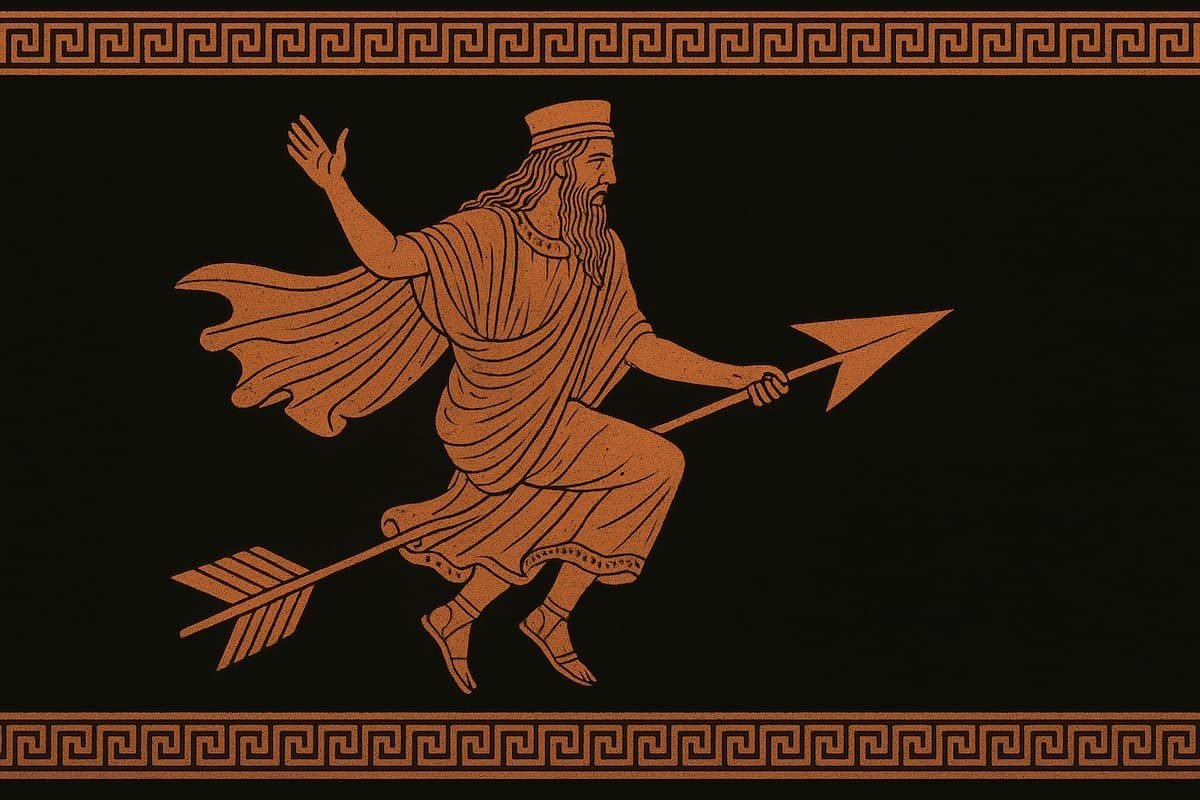
What burden rests in Abaris’ hand when Herodotus grants him an arrow, a road about the earth, a fast carried to its furthest pitch? Does the object keep the bite of a weapon, settle into a pilgrim’s staff, speak as Apollo’s warrant, or turn hunger into an engine: that small northern axis through which Greek thought feels philosophy before philosophy receives its name?
An arrow rests clean against the palm. Iron at the tip solicits flesh; the cut of the shaft desires flight, while feathering keeps the elder faith that motion submits to incision married to balance, with sinew behind both.
After rain I once lifted a spent shaft from black mud, grit clinging near the nock like dark sealing wax. Wet fletching gathered water in its small barbs. A tool meant for piercing had turned into a register of weather pressed by a hand that had spent distance into aim, then shame. Through that door Abaris enters.
Herodotus offers the tale with flint economy: Abaris the Hyperborean bears his arrow across the full earth, drawing food from a source outside the meal of common mouths.¹ The sentence lies beside geography as a thorn lies in wool. Its brevity has the shape of a charm, the edge of a travel note, the cold gleam of witness admitting marvel into a measured chamber before setting the latch.
Greek myth keeps many arrows steeped in death. Apollo’s shafts strike the animals first at Troy, then men, before the Achaean camp reads divine anger through pyre-smoke. Sudden death reaches women through Artemis’ touch as Apollo dispatches it among men, while Heracles drives venom through point-work, leaving Eros to lower reason into fever with a thorn-sized dart.
Abaris’ arrow comes from that same family of straight implements, yet its labour bends elsewhere. Blood lingers behind the object as functional memory, while the tale grants a sanctioned passage. In story the shaft travels as mark. It gives a body leave to move from one people to another, from altar to dialect to court, until shrine receives him as story makes room.
Hyperborea lent Greek imagination a northern mass: a country beyond Boreas, past common weather, past the civic horizon where boundary stones hold law. Herodotus handles it with suspicion shaped like courtesy; he records offerings sent to Delos as maidens remain borne in sacred memory, while gifts are wrapped for passage through people after people before the island receives them.³ During that ritual relay, distance gains texture. Objects move by palm, by cloth, across frontiers, until a sanctuary becomes the mouth of a route.
Abaris appears after those Delian accounts like a knot tugged tight from the same cord.
His arrow may therefore be read beside those wrapped offerings. Both make distance touchable. Sacred geography enters ritual handling through cloth in transit, a shaft in the palm, a road beneath both. A scholar at a desk may flatten the arrow into “symbol,” then leave it polished, harmless. My own reading follows its rougher substance. Length gives the shaft its pointing power; lightness allows carriage, hardness preserves strike, straightness grants measure. These properties suit a traveller whose identity gathers around passage.
Abaris enters view as a man arranged by extension. He stretches cult across the earth. Within his hand, Apollo contracts to miniature.
Even the fast carries tool-like precision. Food would bind him to hearth through market debt, host obligation, vessel price. Fasting draws his frame into another circuit. The arrow feeds him by giving hunger a sacred shape.
Herodotus’ restraint carries weight. He tells us the tale exists, then places it aside. That gesture has grain of its own. A writer who gathers marvels with appetite chooses here to touch marvel with a fingertip. Such handling feels stronger than ample narration. Abaris becomes a splinter lodged in the historical undertaking itself.
As Herodotus turns to maps, continental scale, the arrow remains at the margin, mocking compass-circles from within their own geometry. A shaft carried about the earth makes a rival map. The geographer draws. Holy travel bears the line in the hand, where measurement upon tablet gives way to charisma carried as wood.
Plato catches another face of Abaris in the Charmides, where Socrates invokes him beside Zalmoxis during speech of charms in which the head enters the grammar of healing beside body as soul.⁴ Here the arrow itself has slipped from sight, yet its work persists through the logic of cure. Socrates reports a medicine whose efficacy requires care for the soul alongside the afflicted part. Into philosophy the northern healer enters by way of incantation.
Abaris thus helps stage a problem central to Greek intellectual inheritance: knowledge arrives as treatment before it arrives as proposition. Cadence belongs to the charm. A patient brings posture; trained touch, the waiting voice, tactful diagnosis fold into the healer’s work.
Spoken formula enters the frame by hearing. Philosophy begins with the old difficulty every healer knows: the head aches, yet pain belongs to a life. That Platonic moment keeps Abaris close to the threshold where healer brushes seer, where sage beside sophist shares one narrow passage with the philosopher. Later shelves of discipline have yet to harden.
Abaris stands among figures whose authority comes from regimen steeped in travel, song-kept memory, purifying diet, with the capacity to tell a community that its sickness has moral weather. Philosophy before philosophy belongs to that mixed, tactile zone. Smoke grips wool there as sweat enters laurel, while wet sandals cling beneath a truth tested by endurance in a living frame. The arrow, carried while the mouth lives by fasting, says thought can become an ordeal of transport.
Later Pythagorean tradition makes the hidden charge open. Iamblichus presents Abaris as a Hyperborean priest of Apollo who comes into Pythagoras’ orbit bearing sacred gold as a sign of plague-cleansing authority. Divinatory art clings to him there; the god’s dart serves as vehicle before Pythagoras grants a numerical purification of his practices.⁵ There the old arrow meets the Pythagorean way of life. Wonder recognises wonder. Pythagoras, in that telling, draws the northern relic into a philosophy where number orders diet with discipline, music with cosmic relation.
Abaris’ shaft changes from traveller’s token to proof of hierarchy. The Apolline sage from afar acknowledges the Samian master as manifestation of the god he serves. Under that strain, the relic yields to a living man whose body has become doctrine.
Porphyry gives the scene a harder shine. Pythagoras shows Abaris his golden thigh, confirming the Hyperborean priest’s recognition of him as Hyperborean Apollo; nearby, the tradition also names Abaris as walker in air, borne upon Apollo’s arrow across water through closed thresholds.⁶ Flesh gleams like metal. The golden thigh answers the arrow point, as metal authorises flesh through a shared grammar of credential.
Through this exchange, Pythagoras’ body becomes a relic verifying divinity, while Abaris’ arrow becomes the witness that has travelled far enough to judge the mark. Philosophy here has yet to become a classroom topic. It appears as a contest of holy objects.
Such tales can summon embarrassment in modern rooms trained to sever thought from marvel. Yet embarrassment often marks the place where a culture hides one of its bones.
Early Greek wisdom carries many bodies like this, from Epimenides in his sacred sleep to Aristeas in the northern poem, from Pythagoras’ remembered lives to Empedocles’ later mastery of winds. That company receives him. These figures lean upon the clean story in which philosophy rises by scraping away ritual skin. The skin stays. Scrubbed by later prose, dressed in Attic perfume, that skin stays in place. Abaris’ arrow is one of the pins holding it there.
Sparta gives the wanderer a stone setting. Pausanias records a shrine of Saviour Kore in Lacedaemon, attributed by some to Orpheus, by others to Abaris after his arrival from the Hyperboreans.⁷ The detail carries weight as a change of posture. A man who moves about the earth becomes a possible founder.
Kore descends, returns; local cult receives imported sanctity, so the arrow’s wandering enters the grammar of place. Abaris can anchor as well as travel. His authority passes from motion into foundation, from lifted hand into built shrine. At last the portable axis touches ground; ground remembers.
The Suda later gathers Abaris as author, attaching to his name a shelf where Scythian oracles sit beside Hebrus lore as purifications, prose theogony, a metrical arrival of Apollo among the Hyperboreans.⁸ Its catalogue feels like a shelf of ghost-wood. Writings gather around a name that may have begun as a travelling mark. Around that name, the arrow becomes a bibliography.
What once moved from hand to horizon now moves through titles into scholia, lexicon into fragment, wary attribution into learned caution. Yet the pattern holds. Oracle gives one path, purification another, while theogony beside Apolline travel returns to sacred knowledge carried across borders. Abaris names the transfer of authority from north to Greece, from object to speech, from speech to book.
Modern scholarship has often read Abaris through the category of shamanism. Dodds made the “Greek shamans” famous by gathering Abaris with Aristeas, Epimenides, Pythagoras under a pattern of fasted soul-travel joined to healing speech. Burkert refined the field by placing these wonder-tales beside a Pythagorean order where purity governs diet, discipline, archaic religious expertise.⁹ The category has value when handled like a flint edge, carefully, with respect for local grain. It cuts away a smug tale of reason rising cleanly from superstition.
Another risk appears when every northern marvel wears the same borrowed coat. Abaris requires closer handling. His arrow carries Greek form under Apolline charge, with Hyperborean aura with later Pythagorean adoption held inside the same shaft. The point lies in mixture.
Leonid Zhmud’s sterner reading gives necessary grit here, urging caution about simple northern genealogies for Pythagoreanism, especially where late sources have swollen earlier hints into broad systems.¹⁰ I take that caution as a whetstone. Evidence arrives in layers. Herodotus gives a terse arrow with fast. In Plato, healing charms take the place of the object. Later writers swell the note into flight, Pythagorean recognition, sanctuary memory, books.
Each layer carries its date, purpose, strain. Mythic accretion itself becomes evidence for how Greek memory wanted Abaris to function. Over time he became increasingly serviceable as a bridge between holy distance joined to philosophical authority.
That bridge has a shape. One end stands in Hyperborea, a northern country of sacred surplus, where Apollo receives special honours in several ancient accounts. Another rests in Greek civic space, from Delos to Athens, Sparta to Croton, then written collection as philosophical biography. Across that span travels the arrow. Renaud Gagné’s work on Hyperborea as cosmographic thinking clarifies the larger stakes: the far north served Greek texts as a device for composing worlds, testing edges, staging exchanges between cult, knowledge, distance.¹¹ Abaris’ shaft belongs within that world-making. Through it, the far edge becomes mobile.
Calling the arrow a portable axis mundi sharpens the point. An axis joins the sky to earth, depth to divine region, with human settlement bound to both. Abaris demands a smaller, more restless form than temple, mountain, tree. His axis travels with feathers steadying the shaft, the hand gripping its centre, the gate receiving it as staff.
Such portability suits an age in which wisdom often arrives as a person carrying a regimen. The object says: here rests a centre you can hold, a north you can bring into a Greek street, an Apollo you can bear at walking pace.
Hunger gives the shaft its darker engine.
A fast exceeds a marvel attached to the travel tale. In common life, eating places the person within season as kinship, under harvest discipline, market cost, vessel heat. Abaris’ total fast releases him into another circuit. He feeds through mission under Apollo; the arrow’s authority sustains his passage as later fame gathers to his name. The body becomes lean doctrine. Its cleared chamber is active, shaped, willed, fragrant with purification. Thus the arrow becomes a hunger-engine, the tool through which appetite converts into motion as sanctity gains credibility.
Here the weapon question returns. A weapon sends damage outward. Abaris’ arrow gathers authority back, then redistributes it as recognition. It pierces geography more than flesh. Social distance opens. From the far north into Greek sanctuary, through fasting body as speaking authority, a passage is cut into philosophical biography.
The point remains sharp by virtue of memory, yet its killing purpose has been lifted into ritual carriage. Held power often proves stronger than spent power. Killing purpose ends in a body. A carried arrow can cross a world.
A range teaches this distinction through the palm. The same shaft may leave the boss for a palm’s inspection before it returns to the quiver, carrying memory of the last shot in its grain. Ritual objects work in a related way. Use leaves trace: finger-return darkens a polished staff, pilgrim badges lose brightness near the clasp, bowstring remembers each draw through slackening fibres. Abaris’ arrow belongs to that class of handled continuities. It carries charge from act to act, yet its meaning thickens through preservation. Tradition keeps it in motion by keeping it from common impact.
Materially, an arrow teaches alignment. Point requires shaft, nock, feathering to hold one intention, or flight strays. Abaris translates that technical fact into a discipline of personhood. Appetite is trimmed as speech narrows, while travel straightens around a sacred commission. Greek philosophy will later praise a soul ordered through measured desire, harmonious faculties, care of the full life. In him, those themes travel in pre-conceptual form, as though doctrine had chosen wood before grammar. The arrow says with its own body that life can be tuned.
Such tuning also bears political meaning. A traveller with a weapon commonly enters a city as risk; Abaris enters as envoy whose healing, purifying, oracular burden changes the weapon’s reading. The city must decide how to read the object in his hand. One guard reads point, priestly sight finds Apollo, while philosophical attention sees portable proof that habit can alter nature.
The same ambiguity keeps the figure durable. Abaris can stand at the gate of many discourses at once, where medicine touches cult as geography takes ethical weight as biography gathers wonder. Throne, school both recede; the shaft itself supplies office.
I think of the arrow, then, as a small archive that resists flattening. It stores a fasted route from a northern origin marked by the god, then gathers later Pythagorean claim, Spartan foundation memory, the paper shadow of books. Each layer touches the next like growth rings in yew. My hand knows that a shaft gives little mercy to careless handling. Splinters rise at the grain while the point pricks the fingertip; feathering cuts the thumb with a fine, papery sting. Abaris’ relic keeps that tactile sternness; even as mark, it remains capable of hurt.
That capacity carries bite. Philosophy before philosophy arrives sweetly in few tales. More often it comes through hungry distance, discipline pressed into flesh, proof carried under the strain of a thing whose meaning outruns the carrier. Abaris’ arrow therefore becomes a school before a school. Curriculum takes the shape of a road disciplined by fasting, cultic cure, measured recognition. Earth itself becomes the classroom, as Herodotus lets us glimpse before closing the door.
Such a reading also changes Apollo. The god keeps the archer’s cruelty beside the healer’s touch, the musician’s measure, the prophet’s mouth, the purifier’s smoke. Abaris gathers those provinces into one travelling splinter. At Troy, Apollo’s arrow kills; in Abaris’ hand, the same divine form accredits a healer whose fast marks purity; Pythagorean legend then makes it a vehicle of aerial passage, before philosophical memory receives it as proof that wisdom travelled as sacred object before settling as doctrine.
The same god governs distance by measure, song through incision. Abaris carries distance in a form fit for the palm.
What, then, does Abaris carry when Herodotus gives him an arrow, a world-road, a total fast? He carries a weapon-form whose violence has been turned into axial service, portable Apollo in his grip, Hyperborea riding within the palm as a touchable line. Hunger becomes authority. Above all, the hand bears a credential that later Pythagorean memory can read as philosophical kinship. The wandering shaft is a small axis mundi, yes, but one with mud on its feathers, moving through Greek imagination like bone through a wound, teaching that thought first learned to travel in the hand before it learned to sit in a system.
Scholia
¹ Herodotus, Histories III–IV, trans. A. D. Godley, Cambridge, MA, Harvard UP; London, William Heinemann, 1920, IV.36.
I begin with Herodotus due to the severity of his phrasing. He gives Abaris almost as a withheld tale, Hyperborean by origin, armed with an arrow carried through the earth, marked by a fast so total that eating recedes into sacred rumour. That economy bears weight. Herodotus places Abaris beside Hyperborean reports, the Delian relay, cartographic dispute. My reading follows the arrow through that arrangement, as a rival device of world-measure. The historian’s drawn earth meets the holy traveller’s carried line. Godley’s Loeb text remains a traceable base for the passage, while the book’s motion from ethnography into cartographic correction lets Abaris stand at a hinge between wonder, inquiry. Restraint gives the note its charge: Herodotus’ sparse sentence gives the later tradition a hard seed, one able to sprout into flight, purification, Pythagorean recognition, authorship, yet retain the austere first burden of carried object with disciplined appetite.
² Homer, The Iliad, trans. Richmond Lattimore, Chicago, University of Chicago Press, 1951, I.43–52; XI.381–395.
Homer supplies the killing grammar of Apolline arrows: plague, divine offence, distance, bright violence. I set Abaris against that older grain, so the carried shaft can be seen as a conversion of deadly function into sacred travel.
³ Herodotus, Histories III–IV, trans. A. D. Godley, Cambridge, MA, Harvard UP; London, William Heinemann, 1920, IV.32–35; Diodorus Siculus, Library of History II.35–IV.58, trans. C. H. Oldfather, Cambridge, MA, Harvard UP; London, William Heinemann, 1935, II.47.
The Delian material gives Abaris a ritual climate. Herodotus records Hyperborean offerings moving from people to people as Delos receives them, while Diodorus preserves a later, richer picture of a northern Apolline sanctuary. I use these passages to keep the arrow among handled things: wrapped gifts, temple goods on routes, songs under priestly service. Abaris gains fuller company beside such traffic. His shaft is one item in a wider Greek habit of imagining the far north through sacred objects that travel into recognisable cultic hands. Diodorus makes visible what Herodotus leaves taut through spherical temple, daily hymns, Apollo-centred Hyperboreans. In concert, the passages deepen the reading of the arrow as relay more than projectile. Cult-object journey carries equal authority with the named bearer, for the Greek sanctuary receives distance in material form.
⁴ Plato, Charmides, trans. Rosamond Kent Sprague, Indianapolis, Hackett, 1992, 158b–c.
Plato gives a decisive turn from object to therapy. In the Charmides, Socrates names Abaris beside Zalmoxis while discussing charms linked to treatment of the head within the body as soul-work. The arrow has vanished from the dramatic surface, yet the Abaris-name carries the same northern authority into philosophical speech about cure. Sprague’s translation gives a clear modern text for the scene, while the Stephanus reference anchors the passage across editions. My treatment makes the passage central evidence for philosophy before philosophy, as Socrates frames wisdom through healing procedure shaped by spoken charm as embodied diagnosis. Such threshold-work gathers medicine into moral formation, incantation into dialectic. Charm-work prepares the later argument of the dialogue: health of the part depends upon ordering of the whole person. Into the Platonic room, Abaris enters as a remembered specialist whose magic exposes philosophy’s therapeutic root.
⁵ Iamblichus, On the Pythagorean Life, trans. Gillian Clark, Liverpool, Liverpool UP, 1989, §§91–93, 140–141, 215–221.
Iamblichus supplies the richest late architecture. Abaris appears as Hyperborean priest who collects sacred gold, purifies plague, walks the air, addresses Pythagoras, then enters confrontations with tyranny. Clark’s translation is valuable in that it renders the Life as a shaped late antique programme of philosophical holiness, in place of a simple biographical storehouse. I read Iamblichus as evidence for reception as much as for Abaris. His treatment draws the arrow into Pythagorean hierarchy: Apollo’s northern servant meets a sage whose body bears doctrine, whose number governs psychic mastery beyond common humanity. Episodes of plague purification with divinatory correction shape my reading of the shaft as credential. With power, Abaris arrives; Pythagoras absorbs, redirects, refines that power. The arrow therefore becomes an instrument by which late antique philosophy stages its descent from archaic sanctity.
⁶ Porphyry, Life of Pythagoras, trans. Kenneth Sylvan Guthrie, in David R. Fideler (ed.), The Pythagorean Sourcebook & Library, Grand Rapids, Phanes Press, 1987, pp. 117–131, §§28–30.
Porphyry’s account sharpens the object-play joining arrow to body. The golden thigh of Pythagoras meets Abaris’ priestly recognition, while the air-walking tradition makes Apollo’s arrow a vehicle over rivers, seas, closed places. I use this pairing to argue that philosophical authority appears through marks carried on flesh or in the hand. Guthrie’s translation, gathered in Fideler’s sourcebook, has long served readers seeking the Pythagorean dossier in compact form; the exact sections let the reader locate the golden thigh beside aerial passage. Compressed marvels in Porphyry show how the late tradition makes charisma verifiable through material display. Abaris can recognise Pythagoras as Hyperborean Apollo by virtue of his own Apolline credentials. A travelled arrow can validate another token. Philosophy here resembles a reliquary exchange, with proof passing through metal into skin, from shaft into memory.
⁷ Pausanias, Description of Greece, vol. 2: Books III–V, trans. W. H. S. Jones & H. A. Ormerod, Cambridge, MA, Harvard UP; London, William Heinemann, 1926, III.13.2.
Pausanias gives Abaris a Spartan footing through the shrine of Saviour Kore. The mobile northern figure can become a founder attached to stone, cult, local claim.
⁸ Suda On Line: Byzantine Lexicography, s.v. Ἄβαρις (alpha 18), trans. David Whitehead, revised by the Suda On Line editorial board, Lexington, KY, Stoa Consortium, 2000–, accessed 14 May 2026.
The Suda’s entry carries charge through its titles: oracles, purifications, theogony, Apolline arrival. I read the catalogue as the arrow’s later paper-body, a bibliography formed around a travelling sacred name.
⁹ E. R. Dodds, The Greeks & the Irrational, Berkeley, University of California Press, 1951, pp. 135–178; Walter Burkert, Lore & Science in Ancient Pythagoreanism, trans. Edwin L. Minar Jr., Cambridge, MA, Harvard UP, 1972, pp. 141–149.
Dodds with Burkert remain necessary stones in the shoe. The phrase “Greek shamans” gave modern classicists a language for figures such as Abaris, Aristeas, Epimenides, Pythagoras: fasted soul travel, healing speech, ecstatic authority. Burkert gave that field firmer historical texture by placing Pythagorean lore beside ritual practice shaped by purity, dietary rule, archaic expertise. I use both with gratitude tempered by caution. Their scholarship helps resist a sterile tale in which Greek philosophy purges ritual residue before achieving thought. At the same time, the term shamanism can spread too widely when every northern marvel receives the same label. Abaris requires a more local touch: his arrow is Apolline in charge, Greek in form, Hyperborean in aura, later Pythagorean, then lexicographic. Comparative gates open through Dodds; Burkert adds discipline; the object itself keeps the reading from floating away into category alone.
¹⁰ Leonid Zhmud, ‘Pythagoras’ Northern Connections: Zalmoxis, Abaris, Aristeas’, The Classical Quarterly, 66.2, Cambridge, Cambridge UP, 2016, pp. 446–462.
Zhmud gives the corrective edge. His source criticism keeps the late Pythagorean bloom distinct from earlier testimonia, a discipline I preserve while reading the bloom as reception.
¹¹ Renaud Gagné, Cosmography & the Idea of Hyperborea in Ancient Greece: A Philology of Worlds, Cambridge, Cambridge UP, 2021, pp. 266–319; Mircea Eliade, The Sacred & the Profane: The Nature of Religion, trans. Willard R. Trask, New York, Harcourt, Brace & World, 1959, pp. 36–48; Pär Sandin, ‘Famous Hyperboreans’, Nordlit, 33, Tromsø, Septentrio Academic Publishing, 2014, pp. 203–222.
Gagné’s Hyperborea helps me treat Abaris as a world-making figure, in place of an isolated curiosity. His study follows the far north across genre into cult, through prose inquiry into lyric memory, then historiography, showing how Greek texts composed possible worlds by placing sacred value at the edge of the known. Eliade supplies axis language; I keep that language small, mobile, feathered, fitted to the hand. Sandin gives useful catalogue-work for Hyperborean figures, which steadies the wider field around Abaris. I draw especially on Gagné’s discussion of classical economies of knowledge, where Abaris’ arrow belongs to a broad contest over maps, authority, distance, marvel. That approach deepens the axis reading. Hyperborea is less a dot on a map than a textual operation: a way for Greece to imagine a beyond that can return bearing cultic power. Abaris carries that operation in one shaft.
Views: 191