What price may peace set in flesh when a border takes its measure from an arrow? On my desk rests a cedar shaft from my field kit, fletching rubbed soft by thumb, nock scored by string, point dulled by straw, a small instrument of distance teaching the hand how far intent travels after release leaves skin. Years inside a case leave resin in cedar; old paper carries lamp-smoke; a thumbprint keeps the oil of one spent day. Such a shaft looks plain, yet any archer knows its hard instruction: release turns touch into consequence.
In the Arash tradition, the arrow passes beyond sport, hunt, heroic adornment. It becomes a legal implement, a maker of lines, a treaty written in flight. The Avestan Tishtar Yasht grants the archer archaic radiance: Erekhsha, “the swift archer,” shoots from Mount Khshaotha to Mount Hvanvant, while divine aid opens sky for the shaft.¹ Liturgical brevity places the human act inside a cosmic pattern, so the shot enters Tishtrya’s rain-bearing order, Mithra’s watch, the wide way.
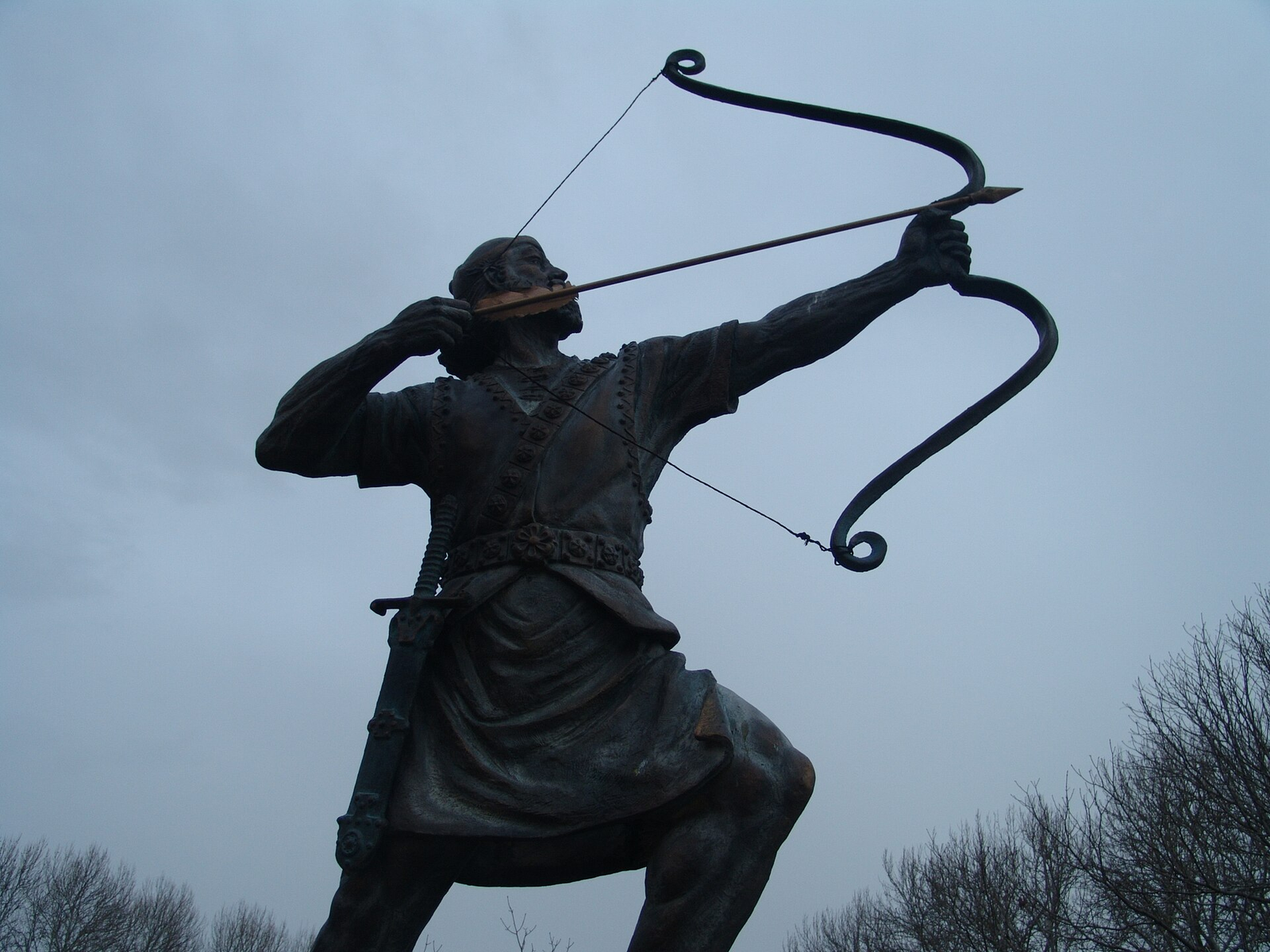
Bīrūnī gives the tale its severest ethical bone. Afrāsīāb has pressed Manūchihr into Tabaristan, leaving peace to hang upon a single shot. At Isfandārmaḏ’s command, an appointed bow with its arrow comes forward. Arish opens his frame to view before kingly sight as witnesses gather; his mouth declares health, then names dissolution. With power granted by God he draws, releases, then falls asunder while wind carries the shaft to the furthest frontier of Khurasan. A border arrives through torn flesh. Treaty ink rises from a body broken open.
From that wound my first claim grows. Arash acts as a philosopher of borders through his body, inasmuch as his shot forces sovereignty to confess appetite. Frontier usually trusts clean marks, from ridge or river to ditch, clause, peg. Persian legend places another measure beside those devices—ribs, sinew, breath, skin exposed before witnesses. The line across country gains peace only after a human frame enters the arithmetic.
Older strata of the tradition already bind the shot to motion across an eastern horizon. Encyclopaedia Iranica shows the tale shifting through variant names, geographies, feast dates, endings, political tastes carried by each version. Variation acts like weather on a boundary stone. Several maps live inside one arrow, so each teller handles a country by handling a flight.
Close reading begins with Arash’s self-display. He removes clothing before the shot, a gesture often softened into heroic purity, yet the scene bears courtroom weight. That body offered to view becomes testimony. Witnesses receive his skin as evidence; the coming rupture can therefore be read as cost in place of trickery. Flesh stands where a seal might stand, while nakedness becomes the last document available to a kingdom pressed to the edge.
Archery practice gives the gesture its physical charge. Drawing a bow begins at the soles; the back opens; string bites the fingers; breath narrows as sight fixes. Training teaches modest forms of that expenditure. Arash turns ordinary mechanics into an ultimate grammar; stored life moves into the arrow as seed enters furrow, wax enters flame.
The shot’s violence therefore sits at the centre of its peace. Boundary legends often hand a founder a rope, plough, spear, or circuit of feet. Arash measures by self-spending. His arrow does the work of a surveyor, yet the surveyor’s chain has entered muscle. Geography becomes corporeal expenditure, in narrative mechanism as much as metaphor: the territory recovered equals the life consumed.
Political theory helps here, though the myth presses theory back into mud. Carl Schmitt’s account of nomos treats order as primal taking, dividing, apportioning of earth; law begins in a cut made across ground. Arash revises that harsh origin. The dividing cut exists, yet its blade enters the volunteer before it touches the map. Through him, sovereignty learns that a boundary worthy of peace can ask for sacrifice, while conquest asks for bodies by seizure.
Stuart Elden’s study of territory sharpens the issue from another angle, tracing territory as a political technology, a produced form of rule grounded in earth.⁵ The Arash tale anticipates that insight in mythic idiom. Through arrow, wind, landing point, motion hardens into jurisdiction. Personhood remains inside the apparatus. Here, technology begins warm in the hand, charged by breath, bow, divine command, communal need, exposed skin.
A practical archer also hears the moral danger in distance. At close range, the target answers the hand with speed. Long range thickens imagination; the point flies past the eye’s governing comfort, crossing fields the shooter can scarcely police. Arash sends an arrow across the world of the story. Such distance tempts rulers: violence can be launched from a safe hill while others bleed at the far end. Myth answers by placing the wound at the origin. Whoever sends the line pays first.
Here lies the ethics of sacrificial distance. A clean border drawn from a chamber can hide the bodies it rearranges. Arash’s border begins with a visible body whose fate everyone sees. That spectacle forbids easy innocence. Peace enters as a measured gain, yet the gain carries a residue of torn sinew. Sovereignty becomes wound, which means political order inherits a scar it must touch whenever it speaks of homeland.
Tabaristan carries weight beyond a launch site. South of the Caspian, mountains press settlement into narrow routes, lending the story a pressured sense of enclosure. Siege compresses the Iranian king so severely that hunger reaches grain before ripeness. People grind what has yet to mature. In Bīrūnī’s calendar lore, Tīragān remembers water play, cooked wheat, shattered vessels, the clay taste of release. A boundary shot rises from the kitchen: early grain beneath stone, a clay pot by hearth, bread waited for.
Domestic grain alters the hero’s stature. Arash stands among kings, angels, enemies, yet the story preserves the stomach. Trapped people eat early grain. The body politic chews its own prematurity. When Arash releases, he buys time for ordinary ripening. His arrow draws more than territory; it restores the calendar, the capacity for wheat to finish its work, for river with field to re-enter their season.
Mythic cartography often hides behind splendour, so I trust the small signs. A walnut trunk receives the point. Wood answers wood: shaft from one living substance finds another, the border pinned in bark. Landing has a rude solidity. Treaty language can sound airy; courtly phrase can behave like perfume, yet a nut-tree gives bark, sap, shade, roots, crop. Country receives its line through a wound in a tree after a wound in a man.
Scholars have traced Arash’s troubled place in the Persian epic canon. Saghi Gazerani follows the tale through Avestan allusion, Middle Persian memory, Islamic-period historiography, later political recensions, while reading Firdowsi’s Shahnameh as a poem that grants Arash a marginal glow in place of full narrative blaze.⁶ Such placement deepens the philosophical interest. A hero who draws Iran receives a strange sideways life in the most celebrated poem of Iranian kings.
That sideways life may suit him. Kings require lineages, thrones, combats, speeches, revenge cycles. Arash offers a solitary act: release, dispersion, measure. The figure resists narrative possession through sheer expenditure. Once the arrow flies, the hero becomes less a character than a measure. Tradition reaches for him, yet the hand closes on distance. His fame has the form of the shot itself: a path with a vanished centre.
Kamangir, bow-holder or bow-master, gives him an identity rooted in use before rank. I find that important. A bow in the hand creates a temporary office, a severe little sovereignty of stance with draw. Yet Arash’s mastery culminates in surrender of mastery. Release is the archer’s discipline: fingers open, string escapes, stored power leaves the body. Ethical archers know ownership ends at the nock.
Modern culture returned to Arash when the old tale could speak to national injury. Sīāvaš Kasrāʾī’s 1959 Āraš-e Kamāngīr reshaped the archer into a charged figure of collective hope, with the hero’s life entering the arrow for the sake of a people.⁷ That modern poem shows how the myth lives whenever borders become moral wounds. The old shot crosses into a century marked by coups, parties, prisons, classrooms, exile, state grammar, public longing.
A modern reader can misuse Arash easily. Sacrifice can become a banner beneath which leaders send others to die. The chosen scene resists that misuse: the shooter absorbs ruin. Arash authorises a border by carrying cost into himself, while nameless ranks stand outside the honour he takes upon himself. Before witnesses he stands as a man with skin, health, breath, decision. Myth grants honour to self-offering, while orders issued from safe rooms carry thinner moral metal.
Persian myth here converses with other foundation tales, though it keeps its own grain. Against Romulus’s fratricidal furrow, biblical boundary curses, medieval wax, modern cadastral survey, Arash offers a stranger instrument. He binds border to vow through ballistics. The arrow replaces plough, seal, patrol. Its authority comes from mortal expenditure, while administrative distance stands morally thinner.
For that reason, Arash also exposes the poverty of a purely strategic reading. Strategy might praise the outcome: vast territory restored through one shot. Ethics asks about the exchange rate between body with ground. Legend answers through extremity. One body can be spent for many lives when the act ends siege, hunger, humiliation, war. Such an answer remains costly, solemn, perilous. The feathered shaft keeps inspiration close to intoxication.
I have watched arrows disappear beyond the first screen of trees during field rounds, then heard the muted knock of impact arrive late, like a verdict from a room I could barely see. That delay teaches humility. Distance separates action from result; sound returns after sight has spent itself. Arash lives inside that delay at cosmic scale. The arrow travels farther than ordinary witness can follow, while his body makes the result morally present at release.
Hence dawn in Bīrūnī’s tradition carries more than scenic beauty. Bodies regain outline at that hour; labour begins; night’s fears receive names. Arash fires then, in a first light fit for civic re-founding. A country reappears as the archer disappears into fragments. Morning writes a border by taking a man out of human continuity. The light has teeth.
The feast of Tīragān softens the aftermath through water, play, cooked grain, communal release. Ritual turns terrible cost into repeatable memory. Water on skin, wheat in pots, vessels cracked, old pain dated by the calendar: liberation passes into household touch. Such ritual action protects the myth from mere militarism. Peace becomes a household practice.
That household practice also answers the problem of scale. Terms such as nation, empire, frontier, Khorasan, Oxus, Tabaristan can grow huge enough to crush the person beneath them. Arash’s story reverses the scale by making one body heavier than a map. He proves that a country deserving love must remain answerable to the flesh that draws its line. The arrow enlarges Iran, yet the archer’s broken body judges the enlargement.
Witnesses give the scene its civic edge. Their eyes transform the shot from private ardour into public exchange between one life with a wounded commonwealth. The archer’s body, presented before cloth returns to skin, becomes an archive of consent. Such consent remains grave due to the crowd’s benefit; everyone gains from what one person bears.
Wind alters the moral geometry. Divine breath carries the arrow past ordinary capacity, yet it keeps royal mastery small. Bīrūnī’s God grants movement, while Arash grants life, so the border grows from cooperation between heaven, body, tool, weather. Royal hands receive the result as gift, burden, warning.
Peace in this tale carries splinters. Its line spares armies from another clash, yet every spared life rests against the archer’s scattered body. Memory has a duty here: cost must remain visible after relief arrives. Communities often polish founding stories so thoroughly that ritual handling makes gore slide from the surface; Arash demands a rougher polish, one that leaves the metal dark in the groove.
Border-making usually claims sobriety, but Arash returns it to ritual danger. A measurement can look harmless on parchment, with ink travelling along a ruler’s edge, yet that calm surface may carry buried cries. Here, measurement screams at the start. The map learns shame before it learns shape.
Folklore carries such knowledge through images that hold against easy reduction. The naked archer, dawn release, divine wind, walnut trunk let political theory touch bark, skin, feather, iron. Academic language gains discipline when it kneels beside those signs. I trust the myth at precisely that point, where argument must lower its voice before evidence of a hand on a bow.
An Irish magazine devoted to archery may feel the tale close in the wrist. Field archers learn distance in muck, leaf-mould, rain, slope, misjudged light, the small humiliation of a shaft found deep in bracken. Such practice gives scholarship a corporeal gauge. Myth enters best through fingers, for the hand knows release before the tongue finds doctrine.
Portlaoise has taught me that small towns measure belonging through paths worn by repeated feet. A gate after Mass, a parish wall warm at evening, a club marker tilted in grass, a lane after flood: each tells where belonging can breathe. Arash makes that humble knowledge immense, then returns it to the palm.
My reading settles on a paradox held in the bow. A border can end violence, yet its origin can carry violence inside it. In Arash, the good boundary is scarred, solemn, chosen. Peace bears the scar; order carries the body inside its first measurement, while law keeps splinters of bone in its founding tale. Such a myth trains a people to distrust painless maps.
What price may peace ask of a body when an arrow gives a border its measure? Only a freely carried price can answer this myth: cost borne in full sight of the community, meant to end siege, restore bread, return fields to season, placing distance between armies. Arash-e Kamangir makes his body the measure of the country. Aftermath leaves sovereignty wounded, geography shaped by expenditure, myth turned into political cartography with blood at its scale mark. The arrow draws a nation only after the archer has made the map answer to flesh.
Scholia:
¹ The Zend-Avesta, Part II: The Sīrōzahs, Yasts & Nyāyis, translated by James Darmesteter, Sacred Books of the East, vol. 23, Oxford, Clarendon Press, 1883, pp. 92–109. My reading takes Yasht 8 as the oldest textual surface available for the archer’s flight, where the later border myth appears in concentrated form. Within the hymn, Tishtrya’s star-course receives Erekhsha’s arrow as an image of speed through heavenly space, with divine aid opening the path. That setting lets Arash stand before the treaty story hardens around him, already bound to rain, water, plant, Mithra, sky. Ancient brevity has weight here, for a few liturgical lines carry centuries of later memory. Such evidence deepens my argument by giving the archer a sacred weather before he becomes a political measure.
² Abū Rayḥān Muḥammad ibn Aḥmad al-Bīrūnī, The Chronology of Ancient Nations, translated by C. Edward Sachau, London, W. H. Allen & Company, 1879, pp. 205–206. Bīrūnī sits at the centre of my argument due to the exact cruelty of his account: Arish displays his body, announces the cost, shoots, breaks apart, while God’s wind carries the shaft across country. Sachau’s translation preserves the calendar setting of Tīragān, the siege by Afrāsīāb, Isfandārmaḏ’s command, the vast flight, the walnut tree, the treaty, feast. These details give me the ethical architecture: witness, fleshly proof, voluntary loss, divine assistance, boundary, ritual return. Calendar lore with broken flesh keeps the argument close to kitchens, grain, clay vessels, water rites. Ritual memory, for me, begins with those hard domestic traces.
³ Aḥmad Tafażżolī, William L. Hanaway, “Āraš,” Encyclopaedia Iranica, vol. II, fasc. 3, London/New York, Routledge & Kegan Paul, 1986, pp. 266–267. The entry serves me as a scholarly clearing house for the tale’s variants, from Avestan Erekhsha, Middle Persian Ēraš, Islamic-period tellings, Caspian launch sites, eastern landing points, feast calendars, death or survival. Tafażżolī with Hanaway help me keep the line between textual evidence, later elaboration, geographical variation, modern reception. Their gathering of variant landing sites strengthens my claim that the myth carries several maps inside one shot. Variant geography also lets me treat the arrow as a moving archive, a shaft that carries place-names the way a reliquary carries bone. Confirmation of the Bīrūnī tradition—nakedness, declared fate, dawn release, fleshly rupture—supplies the central ethical nerve.
⁴ Carl Schmitt, The Nomos of the Earth in the International Law of the Jus Publicum Europaeum, translated by G. L. Ulmen, New York, Telos Press, 2003, pp. 42–49. Schmitt enters my reading with caution, as his account of nomos ties law to land-taking, division, allocation, spatial order. Arash lets me test that theory through myth before state doctrine. In Schmitt, order begins with a cut across ground; within Arash, the cut first enters a willing body. That difference carries ethical weight: the tale grants the border a founding wound that remains visible, making sovereignty answerable to the body that pays. Voluntary exposure changes the legal image, for the archer presents himself as the first site of division. Public sight makes the cut legible.
⁵ Stuart Elden, The Birth of Territory, Chicago, UCP, 2013, pp. 322–330. Elden’s account of territory as political technology clarifies what Arash’s arrow does. The shaft becomes measurement, communication, projection, jurisdiction, public proof; it converts motion into a line that rulers accept. His historical study gives language for seeing territory as a produced form, assembled through legal, technical, military, cartographic practices. Arash offers an older mythical equivalent: bow, hand, breath, divine wind, witness, landing point. My argument depends on that meeting between political theory in contact with tactile archery. Myth makes technology feel warm to the touch, for the measuring device contains a life. Territorial thinking, in this light, begins as a touchable sequence before it becomes an abstract noun.
⁶ Saghi Gazerani, “Why Was the Story of Arash-i Kamangir Excluded from the Shahnameh?,” Iran Nameh, vol. 29/2, Summer 2014, pp. 42–63. Gazerani guides my sense of the tale’s historiographical life: Avestan allusion, Middle Persian traces, Islamic-era narratives, political recensions, Parthian genealogical claims, the strikingly partial place of Arash in Firdowsi’s epic world. Her account keeps the legend from becoming a single smooth inheritance. Arash travels through rival houses, epic genres, dynastic memory, political use. Such a scholarly map strengthens my claim that each version handles sovereignty by handling distance. The hero’s sideways life in the Shahnameh tradition also suits my reading: a man who spends himself in one release becomes hard to domesticate inside royal narrative. Epic quiet here behaves as evidence in its own right.
⁷ Sīāvaš Kasrāʾī, Āraš-e Kamāngīr, Tehran, Andīše, 1959; Iraj Soon, trans., “Arash the Archer,” Intralinea, vol. 20, 2018. Kasrāʾī shows me how the old archer re-enters modern public feeling. His poem makes Arash carry the hope of a people in the bow-hand, turning ancient sacrifice into a twentieth-century language of collective endurance. Reception here serves the argument in place of primary evidence for the early myth. Border legends wake during political injury, especially when a community seeks an image of costly restoration. In the later poem, Arash intensifies the fleshly transfer already visible in Bīrūnī: life enters the arrow, the person becomes distance, flight becomes national repair. Such modern strain confirms the tale’s continuing ethical danger with its continuing power. For that reason, modern reception belongs to the ethical spine.
Views: 368