

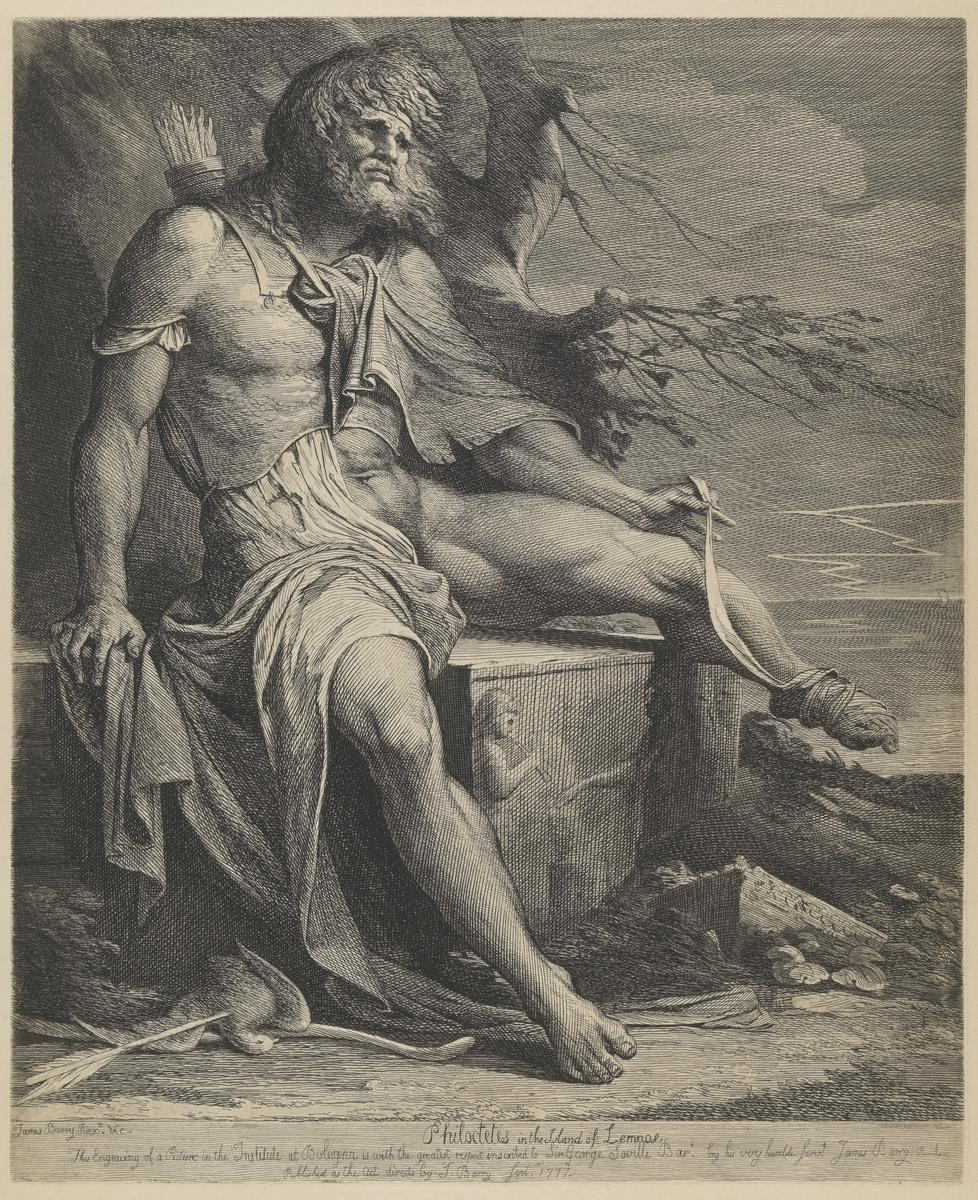
1777–1808, James Barry
A limestone abdomen tightens beneath a carved rib cage; the navel sinks into a hard cup, the chest turns off its axis, the left knee bites the pedimental floor. What form of self comes forward when a hero folds around a bow at the instant before flight? Across the field at Aphaia^1 the archer fixes his gaze along a line joining eye, thumb, string, imagined wound. Stone holds fast to a figure gathered into one severe inquiry: how does a man send death outward while keeping his own soul from splintering within the same pull? Within that compressed stance, civic shame, sacred election, mortal fear meet inside a single frame, as though sculpture had found the exact contour through which the human creature bears destiny in muscle.
Epic song grants the spear a civic warmth; shield strikes shield, dust mingles with breath, fame rises through closeness. The bowman stands farther off. He kills through span, angle, concealment; hoplite renown ripens through contact, mutual gaze, public risk. For that reason the archer carries a civic taint^2 within much Greek thought, even when epic grants him skill. His weapon cuts a gap between citizen, victim; the shaft crosses air that the spear would cross with feet. Suspicion therefore enters the archer’s very posture. Bent around the stave, he already resembles a man half withdrawn from the compact of equal danger that polis combat prizes.
Yet the same curvature belongs to gods. Apollo sends plague from afar; Artemis governs the kill first seen by the eye, then by the sudden puncture; Heracles bears a weapon soaked in labour, lion-hide musk, pyre-smoke. A bow within Greek imagination holds a radius wider than civic law can carry with ease. It reaches across walls, across ranks, across the span dividing mortal flesh from divine ordinance. Sacred prestige thus adheres to the very implement that public ethics mistrusts. The hero who bears such a weapon enters battle already split between two tribunals: one civic, measuring proximity, reciprocity, masculine candour; another divine, measuring efficacy, election, fatal reach.
That split finds script in the Aeginetan archer. Shoulder rises, abdomen coils, thigh braces, neck extends; every part bends relation to every other region through the arc of the bow. The statue offers far more than athletic display. Torsion travels from calf through flank into wrist, as though intention itself had turned anatomical. Within Hellenistic statuary this older pose ripens into sharper psychic legibility: later sculptors deepen the tremor at the mouth, cut the pull across the ribs with greater acuity, let strain travel farther across the skin. Aphaia furnishes the seed-form; Hellenistic art presses that form nearer pain, nearer solitude, nearer the threshold where heroic agency begins to resemble self-wounding.
Sculpture cleaves to the instant before release^3 due to that interval swelling with two times at once. The arrow still rests, yet every surface already carries its flight. Across the back, muscle gathers what the future wound will spend. Fingers hold more than wood, sinew, feather; they hold an event whose course will outrun recall. The figure thus inhabits aftermath during present strain. Such double time grants the archer his psychic depth through a compact duration that holds action, consequence, foreknowledge within one bodily measure. He lives, within one breath, as killer, victim of fate, vessel of inherited obligation, creature feeling his own limit in the act that seems to extend him.
I read the drawn bow as a second skeleton. Wood curves like a rib case carried outside the chest; string hums like a nerve drawn taut across the world. When the hero lifts it, he lifts a visible image of composure under trial. The stave stores what his frame stores: patience, dread, resolve, fleshly reckoning with the cost of action. For that reason the bow serves less as tool than as exterior psyche. One arc lives in the hand, another in the spine. Release joins them for a flash, then sunders them again; the shaft departs, yet the archer remains pinned within the knowledge that each deed carries a remainder lodged back in flesh.
Heracles brings the bow into heroic legend through a grim transfer of labour into distance.^4 Every labour had tutored him for grip, wrestle, choke, immediate collision; the bow gives him a colder extension. Arrows tipped with Hydra venom make range itself lethal. Within that altered economy, heroism acquires contamination. The hand that saved cities also sends poison beyond embrace. Through that shift the Heraclean bow becomes more than victorious equipment; it becomes a relic saturated with flesh-memory, each shot carrying lion-pelt sweat, blood from monstrous hides, smoke from Oeta. When later myth places this weapon in another hero’s palm, inheritance arrives already charred, already heavy with a dead man’s toil.
Philoctetes lives inside the afterlife of that inheritance. Lemnos marks him through ulcer, smell, cry, abandonment, hunger for return. Each attempt to draw the bow drags wound, memory, need into one act. Shoulder must obey the weapon while the foot throbs, gut clenches, voice roughens. Release here arrives as torn mastery, as a victory wrung from flesh that longs to curl around pain. Sophoclean drama gives this condition words, though sculpture often goes farther: a bent torso, a face creased around restraint, a hand still faithful to its task can bear the whole tragedy of a man kept alive by the very emblem of his exclusion.
Later images of Philoctetes linger over that divided frame. A seated hero twists his trunk away from the diseased foot even as the bow arm reaches outward; royal lineage occupies the chest while carrion misery grips the ankle. Pain pulls one way, duty another. The eye seeks Troy, fame, exchange with comrades; the body remembers rot, cave-shadow, salt on cracked skin. Hellenistic taste relishes this visible contradiction. Pathos enters through anatomy itself, through a figure asked to perform heroic function while bearing a private ruin that every contraction awakens.
Odysseus offers a sibling drama. His bow waits in the hall like a stored biography. Suitors laugh; then the old curve settles into his palms as though scar tissue had found its twin. At release each arrow writes identity through slaughter. Homecoming therefore arrives through a posture of isolation: one man set apart from feast, wife, son, servants, city, even from his former name, before bow-speech completes the recollection of self. Rule returns first in the frame, next in the hand that can bear ancestral weight, later in speech, bed, sceptre.
Heracles, Odysseus, Philoctetes share a lonely grammar. Spear-fighters press shoulder to shoulder; archers compose a private geometry. Each hero bears a gap between communal praise, communal suspicion. Eye, wrist, string, breath must align within one frame. Thus the bow mirrors a split self. It grants potency through distance while teaching the hero that distance enters the soul as well as the battlefield. City-life desires his efficacy, yet shrinks from the means through which he secures it. Divine favour selects him, yet selection itself removes him from common measure.
Mortality enters through the very mechanics of release. A drawn bow stores life in expenditure. Arrow-flight therefore becomes a small rehearsal of dying: tension gathers, limit arrives, substance leaves the frame, result travels where recall cannot reach. Back hardens, fingers burn, lungs hold measured air; then the letting-go spends a portion of the archer himself. Sculpture, by fixing the instant just before that departure, keeps mortality suspended like a taste of metal on the tongue. The hero gleams there with utmost power, yet his gleam rises from nearness to depletion.
Greek myth makes that expenditure fated. Heracles passes bow, venom, fame like a sentence moving through bloodlines. Once the string slips from finger, the hero steps into a corridor where choice has ripened into event. The released arrow resembles fate made visible: straight, swift, irrevocable. For the archer, then, agency carries a tragic shape. He must choose the shot; after choice, the shot carries him. Fate in these images therefore feels less like a cloud above the head, more like a line drawn through tendon, gaze, shaft.
For that reason the Aphaia archer remains so haunting. Knee presses stone, torso corkscrews, mouth keeps its hard calm; within that muscular knot the later history of Hellenistic pathos already sleeps. Viewed in this light, Hellenistic sculpture does far more than adorn heroic legend; it studies how human interiority leaks across skin when a figure must carry public duty, divine charge, mortal fear in one searing posture. Flesh speaks most clearly when strain drives form near its limit. Pergamene giants, dying Gauls, wounded hunters, grieving mothers prolong the same lesson. The bowman offers pathos stripped to engineering. Within that formal economy, each tendon begins to carry the office of thought; every twist assumes the contour of moral reckoning made visible.
Yet heroic archery also grants lucidity. Amid exile, prophecy, civic slander, the hero feels one clean vector pass through his frame. That gift explains why the bow clings to these figures even while it wounds them. Philoctetes keeps it like a last companion; Odysseus reclaims it like a buried name; Heracles leaves it behind like a fiery relic still warm from his hand. Here pathos acquires dignity. He remains torn, yet the weapon gives his tornness shape, measure, outward direction. A life that might otherwise fray into cries, disguises, rage finds temporary coherence in the severe curve of wood.
Here political shame meets divine election in muscle. The polis distrusts the bowman due to distance; the gods favour the same instrument for its reach across mortal spacing. Within the hero’s frame those verdicts clash. Arm, shoulder, jaw draw civic reproach, sacred burden, private grief into one trembling arc. Marble carries silence, yet flank, clavicle, bent knee, tightened mouth perform a psychology fiercer than lament. Thus the hero’s frame becomes a tribunal where culture judges itself: proximity against reach, fellowship against solitude, human finitude against the glamour of weapons that seem to exceed it.
Philoctetes perhaps discloses the deepest wound in this tradition. His bow sustains life, sets him apart, fastens him to a heroic economy fed by pain. Odysseus, by contrast, feels the bow as recollection after dispersal; Heracles feels it as labour transmuted into lethal reach. Across these figures one truth abides. Every release promises survival, while the same motion renews the destiny that prolonged exile. The archer lives in reciprocity with the bow. He enters it, bends with it, carries its curvature into nerve, reputation, fate.
I return, then, to the kneeling archer in stone. He bends around the bow as a man bends around his own allotted shape. The moment before release becomes the truest emblem of heroic life, for the hero dwells there always: stretched between fame, abandonment, doom, survival. Within Hellenistic sculpture the bow serves as the self made visible, curved by fate, strung by isolation, sentient through mortal strain. Stigma from the city gathers on one side, splendour from the gods on the other; between them the human frame holds, shakes, chooses. When the fingers open, the arrow flies outward; the hero remains behind, lighter by one shaft, older by one instant, nearer his death through the very act that gives his name its brightness.
Scholia:
- Greek Sculpture: The Archaic Period, John Boardman, Thames and Hudson, London, 1978, pp. 156–157; the Aphaia pediments stand earlier than the Hellenistic ateliers that govern the later stages of this argument, yet the kneeling archer already stores the formal grammar that later sculptors would draw out into greater pain. Boardman’s discussion of Aegina places the temple at the hinge where archaic pattern yields to a bolder handling of torsion, anatomical pressure, and spatial turn. That historical placing matters here. The statue bears frontal clarity in part, though the body also drives laterally through space with a ferocity that gives the figure prophetic force. One sees an ancestral shard of later pathos: the tightened abdomen, the braced thigh, the line of sight that seems to harden fate into posture. Aphaia thus enters the essay less as museum chronology than as a seed-form for heroic interiority made visible through strain.
- The Iliad, Homer, trans. Robert Fagles, Penguin Books, London, 1990, pp. 255–256; Greek martial honour gathers its public warmth through reciprocal exposure, shared dust, visible endurance, and the civic theatre of men meeting each other at close range. Teucer complicates that ethic. Sheltered by Ajax’s shield, he kills brilliantly through measured distance, a mode of combat whose efficacy epic cannot deny and whose civic fragrance remains troubled. Archery here carries admiration folded together with reserve. The bowman secures the army while standing slightly aside from the compact of equal risk that hoplite ideology later prized. Such pressure explains the moral bruise that follows archers through myth, drama, and sculpture alike. Their skill serves the community, yet the means of service introduces angle, concealment, and delay between act and wound; the shaft arrives before the body can answer it in kind.
- Laocoon: An Essay on the Limits of Painting and Poetry, G. E. Lessing, trans. Edward Allen McCormick, Johns Hopkins University Press, Baltimore, 1984, pp. 7–91; Lessing’s argument about the visual arts presses hard upon the issue at stake here: sculpture chooses a single suggestive moment, a point in action whose force depends upon what the imagination can still supply. Climax closes that imaginative corridor. The held instant before climax opens it. Such reasoning clarifies why the drawn bow carries richer psychic voltage than either slack preparation or spent aftermath. A poised archer allows prior cause, present tension, and future wound to coexist in one visible knot. The body becomes an archive of what has gathered and a prophecy of what will follow. For that reason the bowman serves sculpture so well. He inhabits a temporal pressure-chamber in which muscle, foresight, and consequence bind themselves into one compact measure.
- Sophocles II, Sophocles, trans. David Grene, University of Chicago Press, Chicago, 1957, pp. 242–244; the Heraclean bow reaches Philoctetes as a gift already blackened by pyre-smoke, labour, and pain. Grene’s translation of the closing movement keeps that inheritance under the sign of command as much as honour: the weapon grants heroic value, though it also fastens its bearer to a destiny fed by suffering.
Views: 455


