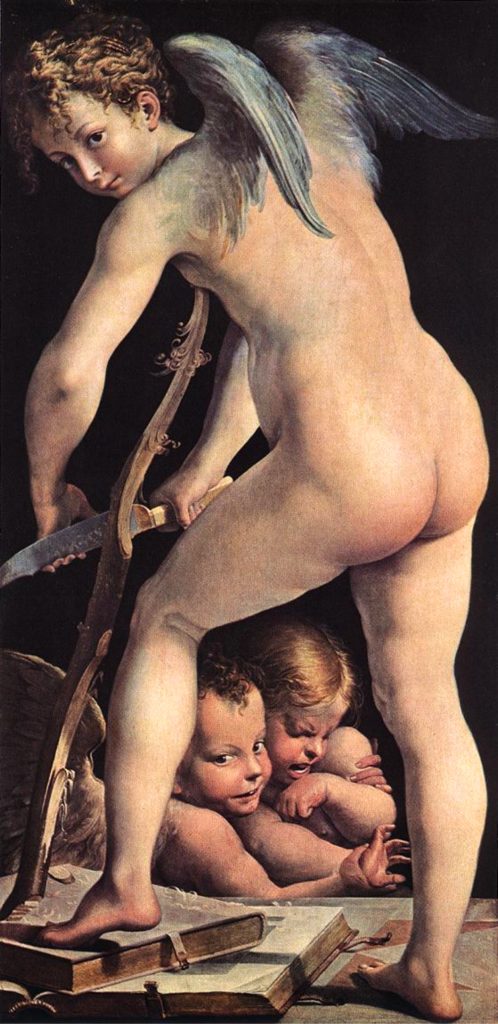
Whoever strays out of the long Habsburg corridor in Vienna and slips into the quieter Italian room meets, almost immediately, a child who commands the air like a small vertebra of living stone. On the tall, narrow panel that bears the title Cupid Making His Bow, Parmigianino sets the god of love to work. Wings fold back as if for convenience, feathers ruffled by movement; a bare heel presses down on two closed volumes; the boy leans over a pale stave and draws a blade along its grain. Shavings tumble in tight curls across leather and parchment, the knife catches a sharp thread of light, the spine twists, and then the head swings round so that a sidelong glance hooks the newcomer with something between mischief and acknowledgement. The whole event feels less like myth than like a half-seen corner of a small bottega, caught when the door opens a finger’s width and the apprentice at the bench realises someone watches. Only here the apprentice carries wings, and the implement he shapes will send pain through chests rather than produce furniture. In that suspended instant, love appears as something made, calibrated, sharpened by hand; the weight of an age’s anxiety about desire, learning, and authority now rests quite literally on the shoulders of a boy. The man who summoned that boy into paint first breathed Parma’s fogged winter in 1503, in a modest house where colour already inhabited cupboards and corners. Girolamo Francesco Maria Mazzola—whom the city would later baptise afresh as Parmigianino, its “little one,” with a blend of pride and familiarity—grew in rooms where brushes soaked beside jars of oil and vinegar, and where scraps of panel leaned against flour sacks. His father, Filippo Mazzola, left saints and donors scattered across parish churches around the duchy before a pestilence erased him from the household. Two brothers, Michele and Pier Ilario, both painters, stepped in as guardians and masters, drawing the child into their shop a few streets away from San Giovanni Evangelista. There, beneath the measured arches of that great church and the chalky breath of drying gesso, the boy acquired gestures that shaped his entire career: grinding azurite until it yielded a very specific Po-valley blue, stretching linen so tight that a fingertip drew a faint drum-note, redrawing the bone-structure of a damaged tempera face with charcoal until its features could live again. Above him, in those formative years, Correggio climbed into the domes of Parma, where apostles tumbled out of cloud-banks and light spilled across shoulders and knees with an intimacy usually reserved for halos; the young Mazzola walked repeatedly beneath that vortex and stored in his eye a sense of bodies seen from below, whirling and foreshortened, suspended between earth and heaven.¹
By his early twenties, that eye and hand moved through the city with a new assurance. Around 1523 he painted his own likeness in a convex mirror, taking a barber’s glass in his hands, studying the swollen and receding planes of his own face and fingers, and then transferring those distortions to a rounded wooden support.² The little panel, both joke and demonstration, made an ideal calling card. He carried it to Rome in 1524 along with a large Vision of Saint Jerome, where the Christ Child sprawls across the Virgin’s lap in a way that stretches proportion almost to the point of dream. Once in the papal city, the young Parmigianino pursued a long apprenticeship of looking: repeated journeys up the Vatican stairs to stand under Raphael’s frescoes, silent sessions under the Sistine vault while his eyes learned the weight and torque of a Michelangelesque limb, days drawing in the Belvedere courtyard from Laocoön and the Belvedere Torso. Gradually his own figures lengthened, their joints tightened and then softened again, their hands multiplied like pale birds in air. The harmony that had governed the generation of Leonardo and Raphael yielded, in his practice, to a more nervous elegance. Then imperial soldiers broke that rhythm in 1527. When the troops of Charles V poured through Rome and the Sack filled its churches with smoke and scream, Parmigianino fled north with rolled canvases, sketchbooks, and a new understanding that every civic and ecclesiastical order could shatter in a single campaign.³
Bologna received him and gave him work. In that university city, where jurists and humanists argued late into the night under painted ceilings, he devised altarpieces whose saints seemed to hover between devotion and daydream, bodies elongated like instruments, fingers so refined they almost dissolved into light. Patrons attuned to subtle rhetoric of grace and pleasure recognised a kindred sensibility. Even so, Parma exerted a pull. Around 1530 he returned to his birthplace, drawn by the grand undertaking at Santa Maria della Steccata. The confraternity that presided over that shrine demanded a programme worthy of their zeal and their treasury; Parmigianino answered with designs of Virgin martyrs and sibyls perched on cornices, youths entwined with volutes, every figure arranged along coils and spirals that extend Correggio’s inventions into a more rarefied realm. Progress faltered. Witnesses spoke of the painter absorbed in furnaces and flasks, coaxing new varnishes and strange metallic mixtures in search of colours that behaved with fresh subtlety.⁴ Studio and laboratory began to overlap in mood: in each, base matter promised transformation through attention and fire. Disputes with the Steccata brethren over delays led to summons, confinement, eventual exile along the Po at Casalmaggiore, where a sickness ended his life in 1540 while he still possessed the energy of a much younger man. He left behind paintings, drawings, and prints that never sit entirely still, as if every figure continued, quietly, to adjust its posture.⁵
The Vienna Cupid rose from that unsettled decade of return, litigation, and chemical experiment. An inventory drawn up after the death of Francesco Baiardo, a cultivated lawyer in Parma and friend to the painter, records among his goods “a Cupid who fashions a bow with his own hand,” which aligns closely with the panel now in the Kunsthistorisches Museum.⁶ Baiardo moved in a world where legal commentaries, Petrarchan lyrics, and sermons on grace passed from table to table; his shelves held glossed law codes beside classical poets, and his walls carried both sacred pictures and allegories of Fortune, Time, and Love. In such a house, Parmigianino’s winged carpenter would have stood as a finely tuned enigma, a painted proposition about the relation between affection and judgement. From Baiardo the work travelled to Antonio Pérez, the powerful secretary of Philip II in Madrid, who, according to later accounts, hung the panel behind a silk curtain so that viewing it became a managed unveiling. Eventually, after Pérez’s fall, an envoy of Rudolf II acquired the picture for Prague. That emperor, whose castle brimmed with automata, astrolabes, rare stone vessels, and mythological canvases steeped in alchemical imagery, recognised at once a small cousin of his own obsessions and welcomed Cupid Making His Bow into the crowded intimacy of his Kunstkammer. Only in the seventeenth century did the painting settle for good among the Habsburg holdings in Vienna.⁷
The years between the Sack of Rome and the Council of Trent formed a kind of hinge for Italian belief. North of the Alps, Lutheran polemic had already sunk its teeth into indulgences and priestly power; pamphlets crossed frontiers tucked into baggage and bales. South of the mountains, papal authority staggered under the memory of mercenary boots lodged in holy places. In that climate, renewed Catholic energy pushed through new confraternities, new preaching orders, and new images that sought to win hearts through beauty while guarding orthodoxy through learned allusion. Parmigianino’s Madonna with the Long Neck, painted for a Baiardo chapel, shows a Virgin slender as a white column, enthroned over a clutch of angels whose faces drift toward the erotic; the saints and virgins in the Steccata vault curve with similar languor, even as their placement asserts very clear doctrinal hierarchies.⁸ Balance in the old sense, with its calm geometry and stable triangles, yielded to compositions in which grace appeared fragile, colour hovered between flesh and marble, and space folded around the viewer. A later age would gather such tendencies under the single name “Mannerism,” though for those who first stood in front of these altarpieces the sensation likely resembled listening to an accomplished speaker whose sentences advance with unexpected turns, veiled quotations, and elaborate suspensions. Mythological figures, especially those harvested from Ovid and Greek epigram, offered an especially fertile stage for such performance, since a Venetian or Emilian patron could keep a Cupid or Venus in a private room where theology entered through allegory, veiled and therefore safe.
The Vienna panel answers that environment with remarkable precision. Cupid fills almost the entire height of the painting, seen in three-quarter view, thigh thrust forward, torso spiralling away, neck arched so that the head swings back toward the onlooker. His skin carries the faint chill of unglazed porcelain, yet under that pale casing a slow current of blood comes through at the cheek, along the sharpness of the elbow, over the round of the knee. From the upper right a single wing swings out, its barbs stained with greyed green and a blue like thinned milk, every quill holding a whisper of light, while its partner folds back into the dusk behind his shoulders so the whole body hangs in an in-between moment, poised as if it could stay anchored to the stone ledge or slip, with one small decision, into the air. Around him stretches an indeterminate darkness, a warm, brownish dusk that offers little hint of architecture. Only a narrow ledge underfoot, the books at his heel, and a faint floor beneath supply place. A low left-hand light source skims across skin and paper, climbs from ankle to hip, catches the steel of the knife and the rib of a leather spine, and leaves the right side of the face in soft half-shadow. Out of the gloom on the left edge crouch two smaller winged children. One has his arms locked round the other, half embrace, half scuffle; their mouths hang open, brows arch, and both sets of eyes tilt toward the boy intent on his work. The drawing steers your own gaze in the same slow arc, along the pale rod of the bow, over the tightened forearm, through the turning hinge of shoulder and neck, until it comes to rest in that slanting look which, once encountered, keeps you there with a quiet, insistent grip.
Traditional commentary has long remarked that the bow’s pale wood derives from Hercules’ club, an emblem of brute courage and territorial force. Under Cupid’s hand, the hero’s heavy cudgel thins into a reedlike weapon that sends invisible shafts through air into yielding flesh. Sheer impact yields to trajectory; mass transforms into direction. Beneath the heel, two solid books lie shut, their gilded edges and chunky bindings suited to law treatises or philosophical summae of the type that crowded Baiardo’s cupboard. Shavings litter their covers and fall between their pages, fragile evidence of an ongoing sacrifice of old forms to new instruments. Such details invite an allegory in which desire cuts through systems and commentaries, leaving delicate curls of surplus argument in its wake. At the same time, the two attendant putti beside Cupid recall ancient descriptions of Eros accompanied by Himeros and Pothos—love itself flanked by yearning already awake and yearning yet unsatisfied. In Parmigianino’s staging, one child acts, two witness and wrestle; affect surrounds fabrication, complicating it, offering both encouragement and interference. Yet the panel begins to speak in an even more intimate register once one reads it through the curve of Parmigianino’s own life. The boy’s elongated limbs, smallish head, and liquid S-shaped stance echo the Virgin in Madonna with the Long Neck and the mysterious young woman known as Antea.⁹ His sketchbooks teem with similar figures: adolescents twisting as they lean on window-sills, saints who angle their torsos away from the viewer while their faces turn back in invitation, women whose forearms extend so far that their hands appear almost detached, drifting in space like separate thoughts. In that graphic world, line always negotiates between obedience to bone and the desire for arabesque. The activity that occupies Cupid—shaving a weapon out of a stubborn piece of wood—mirrors the labour of drawing itself. The blade that moves along the stave repeats, in miniature, the movement of an etching needle across a copper plate, a tool Parmigianino used with uncommon freedom.¹⁰ Both instruments incise, subtract, refine; both ask the hand to feel resistance and to trust in the revelation that arrives as material falls away. Hercules’ club, in this sense, stands for the massive heritage of High Renaissance anatomy, all that muscular weight learned in Rome from Michelangelo and the antique; the carved bow represents the new, sleeker armature of grace that the younger painter carved out of that inheritance.
Alchemy, which coloured his Steccata years and eventually threatened his contracts, presses into the image as well. Texts devoted to the magnum opus speak of raw matter passing through sequences of whitening, reddening, and final perfection, with residues at each stage that testify to change. In Cupid Making His Bow, the club has already left its coarse form; knots have vanished, contour has acquired a supple curve. The curls of pale wood scattered on vellum and calfskin resemble the waste from an alchemical retort, material now emptied of purpose except as proof of what occurred. Cupid’s own skin possesses that soft, diffuse glow often described in connection with Parmigianino’s late manner, an effect born from thin veils of translucent paint that allow warmer underlayers to breathe through. The boy appears lit from within, as if the same mysterious energy that will race along his arrows already inhabits his flesh in a latent state. When Rudolf II looked upon this small god in Prague, surrounded by alembics and furnaces, he surely recognised a visual cousin to his own dream of turning earthbound substances into power that acts at a distance.¹¹
The painting also meditates quietly on descent and succession. Parmigianino spent his childhood under a double lineage: a father who vanished early, leaving memory of a serious, small-scale master, and towering figures of the previous generation who still loomed over every commission. The Italian High Renaissance had produced paternal giants whose vocabularies of body and space filled churches from Milan to Naples. Hercules’ abandoned club, lying useless until the winged boy picks it up, may be read as a token of that heavy legacy. Cupid chooses neither to leave the weapon on the ground nor simply to swing it in old fashion. He subjects it to a new measure, cuts away surplus, bends it to a more tensile form. In parallel, Parmigianino absorbs the muscular idiom of Michelangelo and the harmonious volumes of Raphael, then treats them as so much rough timber, shaving, stretching, and twisting them into lines suited to an age accustomed to fracture and ambiguity. The books underfoot complete this image of inheritance and reconfiguration. The god stands secure on texts—law, theology, classical authority—yet his gaze fixes elsewhere, on the pale curve under his hands. Tradition supports him, yet his attention zeroes in on the present act of making, on the edge of the blade, on the emerging instrument. In the museum room today, that act still involves whoever pauses before the panel. The vantage point hovers low, almost at the level of the books; a visitor finds their own eye close to the child’s thigh and directly in the eventual flight path of the yet-unstrung bow. The backward glance that Cupid sends engages individual presence in his calculation. The tool he shapes will one day stretch, string, and release; already, in compositional terms, it guides the spectator’s gaze, sending it upward and inward toward the face and wing. In both senses the arc cuts through human space. The panel therefore stages the origin of an unseen influence—call it eros, call it artistic persuasion—that travels from a secret place of preparation toward a vulnerable chest. Parmigianino, painting in an Italy riddled with dispute and shaken faith, condenses into this boy at his bench a sober insight: every power that enters hearts begins with a hand moving along resistant matter; every refinement of technique carries within it a decision about how that power will fall; and every onlooker, whether jurist in Parma, councillor in Madrid, emperor in Prague, or wanderer in Vienna, already stands in the quiet, luminous path of an arrow yet to be loosed.
Notes:
1 Sydney J. Freedberg, Painting in Italy 1500–1600, Yale University Press, New Haven, 1993, pp. 471–490.
2 A. E. Popham, Catalogue of the Drawings of Parmigianino, Phaidon, London, 1953, pp. 9–15.
3 Giorgio Vasari, Le Vite de’ più eccellenti pittori, scultori e architettori, ed. Gaetano Milanesi, Sansoni, Florence, 1878–1885, vol. IV, pp. 479–483.
4 David Ekserdjian (ed.), Correggio and Parmigianino: Master Draughtsmen of the Renaissance, British Museum Press, London, 2000.
5 Mary Vaccaro, Parmigianino: The Paintings, Umberto Allemandi, Turin, 2002, pp. 57–76.
6 Mario Di Giampaolo and Elisabetta Fadda, Parmigianino, Keybook, Sant’Arcangelo di Romagna, 2002, pp. 142–147.
7 Kunsthistorisches Museum Wien, Gemäldegalerie. Italienische Malerei, latest ed., entry on Parmigianino, Amor schnitzt seinen Bogen.
8 Edward J. Olszewski, “Parmigianino Paints Madonna with the Long Neck,” Research Starters, EBSCO, 2022.
9 Cecil Gould, Parmigianino, Abbeville Press, New York, 1994.
10 The Art Story Foundation, “Parmigianino Artist Overview and Analysis,” online resource.
11 Thomas DaCosta Kaufmann, The Mastery of Nature: Aspects of Art, Science, and Humanism in the Renaissance, Princeton University Press, Princeton, 1993, pp. 209–230.
Views: 60