

In sanguine martyrum regna Christianorum radicantur¹—in the blood of martyrs the realms of Christians take root. For a medieval mind that line had the weight of a weather proverb. It described how power settled into the soil. A grave that held a martyr’s bones drew law and custom around it the way a fire on a winter road draws travellers. Kings looked different once they had one of these dead beside them. Their charters carried a heavier ink, their oaths felt closer to heaven. In England, that truth condensed around a boy from East Anglia whose life closed early beneath Danish steel. Edmund’s death fed more than a private devotion. It fed an abbey’s appetite, a kingdom’s imagination, a church learning how to speak of kingship through the mouth of a severed head.
If you drift into Suffolk and let your boots find the paths in among the oaks, the story comes on you slowly, as if it had caught in the bark and in the lichens and stayed there. The land in that corner of Suffolk keeps its head down.² It has no cliffs to strike poses with or showpiece peaks to point at; it stretches itself out instead in long, slack rolls and shallow hollows, keeping easy company with its slow rivers and with hedges that lean into one another like neighbours trading news over a wall. Villages tuck themselves close around their churches, flint and thatch pressed so deep into the soil that the whole cluster feels bitten into the ground, teeth set in a dark jaw. Between those little knots of houses lie scraps of woodland a parish map hardly bothers to mention: strips along old estate-boundaries, leftover wedges from some once-broader wild, pockets that give the odd impression of being older than the lanes that now twist between them and lose their own sense of direction. Step off the grit or the farm-track and let the trees draw in around your shoulders, and the temperature falls by a notch almost before you notice. The air brings damp and leaf-mould, a shy thread of smoke from a cottage you cannot quite place, and buried under all of that, if you stay still and let your mouth think about it, a faint suggestion of iron at the back of the tongue. People say woods are quiet; this one never quite signs that agreement. There is always some small hum in it, a feeling that once a crowd stood in the clearing, spoke hard words, moved off in haste, and for reasons of courtesy or simple forgetfulness left its breath hanging there behind them.
In the year 869 that murmur thickened into dread. The Anglo-Saxon Chronicle,³ no lover of embellishment, writes in its dry Old English of a micel hæþen here, a great heathen army, which had already torn Northumbria apart and gnawed at Mercia before it settled in East Anglia for the winter, coiling itself at Thetford like a snake in the king’s own lap. Names have come down with that host: Ívarr inn beinlausi, Ivar the Boneless, his brother Ubba, Halfdan.⁴ They rode English horses taken as tribute four years earlier when their ships first beached on East Anglian shore. They knew now which rivers took their keels, which tracks ran dry in summer, which abbeys held plate and books worth ransoming. Along the low coast from Dunwich to the Wash, fishermen watched the horizon with a new tension, because the clean line between sea and sky had begun to carry the ghost of carved prows in every shift of light. Inland, men looking up from plough and mill-stone listened for the rumble of hooves under the usual chatter of village life.
In the middle of that tightening circle stood Edmund. He comes to us in a handful of surviving traces: a date of accession remembered as Christmas Day 855, perhaps at Bures on the Stour;⁵ a few charters with his name stitched into their Latin; bright silver pennies stamped EADMVND REX and passed from hand to hand in markets.⁶ The coins show a disciplined face, hair arranged in stylised curls, a cross somewhere in the design. Behind that flat profile lived a young man who stood in timber churches and heard Latin sung over bread and wine, who sat with ealdormen at long tables weighed down with meat and winter ale, who listened while his reeves reported rent and his thegns spoke of men fit for the fyrd. Edmund ruled a people steeped already in Christian story. Augustine’s mission to Kent, Bede’s learning at Jarrow, the missionary webs that had run to East Anglia from both Rome and Ireland had long ago drenched this soil in psalms. Yet the same churches whose walls carried painted apostles now kept half an ear cocked toward the sea. To be king there meant living with a prayer-book in one hand and the thought of longships in the back of the mind.
When the hour finally arrived, the Chronicle spent almost nothing on it. Three short strokes of the quill and Edmund was gone: he fought against the army, the Danes took the victory, they slew the king. That is all it cares to say. Yet behind those spare words the whole clumsy machinery of ninth-century war creaks into motion. You can almost see how the shield-wall settles itself along a low ridge or at the shallow rim of a marsh, boards pressed edge to edge until they make a timbered front, spearheads pricking out ahead like a travelling thorn-hedge. In the thick of that line, under whatever scrap of cloth passes for a banner, the king stands in among his picked men, so close they taste one another’s breath and last night’s ale. Noise rises—half prayer, half jeer—the first hammering together of wood and iron, the first shove, the second, the long, dull heave of bodies leaning into bodies. For a while the wall holds and men believe it will hold; and then some piece on the flank buckles, almost quietly, and the tremor runs through the whole mass so that what had looked like a single creature begins to ripple and then come apart into clumps of panicked movement and small groups running for the ditch. A ruler who chooses that middle space seldom finds a clean path out once the breaking starts. He tends to drop where his oath-men drop. The Chronicle, for once, matches life exactly: no omen, no last sermon, no friendly oak. Only winter light, a trampled field, and a young king lying on some unmarked slice of East Anglian turf.⁷
A hundred years later, in a narrow cell at Ramsey where the fen-mist pressed its soft fingers against the window, that blunt little sentence began to grow stories around it. Abbo of Fleury, sharp-eyed guest from across the Channel, let his attention snag on the name of the local king-saint and decided the tale deserved a full Latin Passio Sancti Eadmundi.⁸ Abbo liked to say the story was never his to begin with. He had it, he swore, from Archbishop Dunstan, and Dunstan in his fierce, half-wild youth had picked it up from an old armour-bearer of Edmund’s, some grizzled man who had buckled the king’s mail with his own fingers and knew the sound of Edmund’s breathing in those thin, tight seconds before the horses went in. Warrior to abbot, abbot to archbishop, archbishop to wandering scholar – the chain looks a bit too neat when you write it down, almost arranged, yet bad memories often travel in just that crooked, family way, like a brooch handed along a row of hands on a winter night, thumbed for its pattern, the tale told again over it, the setting changed when the old metal starts to lose its shine.⁹ By the time he set his pen down on parchment to begin, England had watched monks driven out of their cloisters and coaxed back again, had seen kings lifted to thrones and shoved off them with weary speed, had bent the knee to Danish princes who took baptism and then wore the chrism with the easy air of men born to it. In such a climate the realm needed a different kind of entry for Edmund: a story in which a Christian king met pagan steel and, somewhere beyond the arid ledger of the Chronicle, refused to come away defeated.
Abbo’s Edmund stands inside a hall bright with firelight and noise. Messengers bring word of the host. Counsellors suggest accommodation, tribute, some smart negotiation that might preserve people and altar. Edmund listens, prays, refuses. In the Latin he speaks with an almost carved clarity: he will not bind himself to heathen leaders; he will not break faith with the Christ whose name he bears. Politics, for him, bends around a single axis. He chooses martyrdom instead of client kingship. That choice drives the narrative. The Danes seize him. A few rough words pass between victor and captive, yet the real argument has already been settled. What follows plays out as consequences.
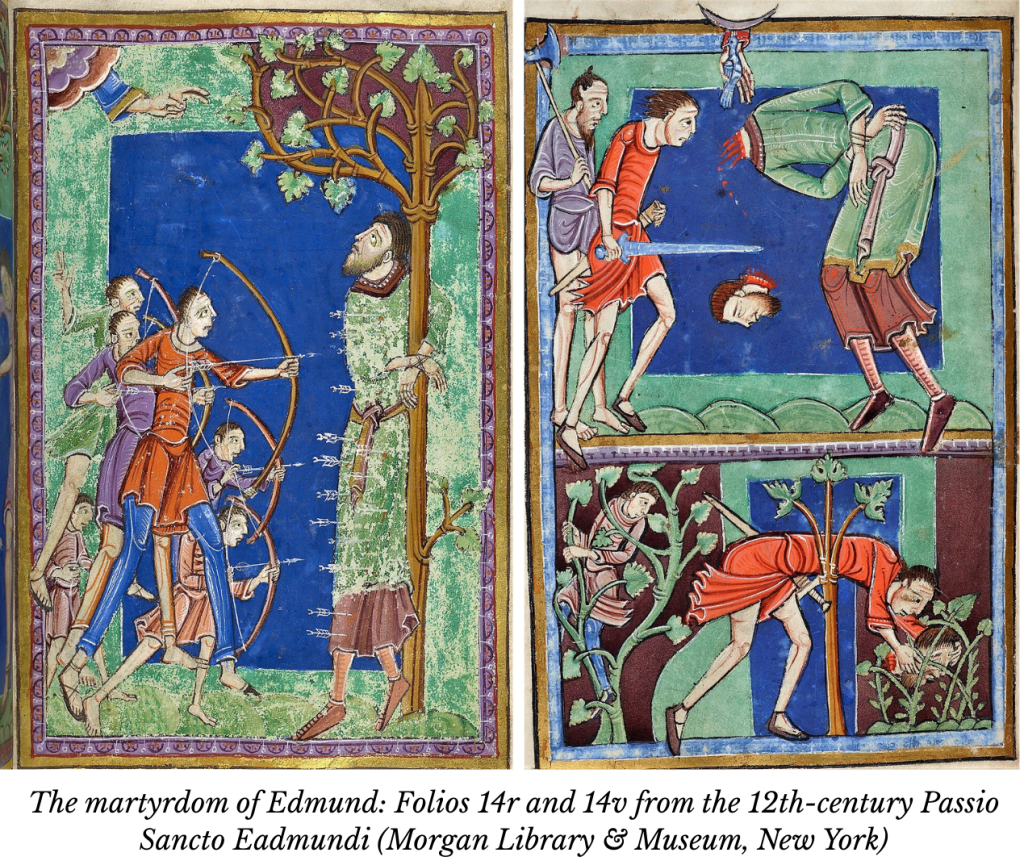
They push him out of the hall while jokes and curses still bounce off the rafters. Cold air closes around him with the shock of water. The smells in his nostrils change: less smoke and roasted meat, more wet soil and horse. Men with axes and swords crowd close, their mail whispering at each step, their boots slapping mud. Houses and byres fall away behind. Ahead lies the dark edge of the wood. Anyone who has left a lit room at night and walked beyond the last lamp knows that sensation: the human world shrinks to a little knot of bodies and torch-flame; the rest belongs to something older. Branches creak above. Somewhere small feet scurry through last year’s leaves. At a place where the oaks stand broader and their roots swell out of the ground like knotted knuckles, they stop. One of the escort chooses a trunk with the familiarity of habit. Edmund’s shoulders meet the bark; a chill rises up through his back. Rope circles wrist and wood together, tightens until the hands that once blessed and commanded sit useless against ridged grain.
The archers come forward in no particular hurry. A man who works with bow and arrow learns to husband his strength. The first shots test distance, crack into the bark beside Edmund’s head, tug linen along his ribs. Then the rhythm builds. Shafts bite into arm, thigh, flank, shoulder. Fletchings quiver. Abbo, reaching for something his readers would grasp, likens the king to a hedgehog bristling with spines. A later age, already in love with images of Saint Sebastian, would think of that Roman guard propped against his pillar. Somewhere between the two pictures stands the reality: a twenty-something East Anglian with arrows flowering out of him under a grey English sky. Abbo repeats that Edmund called on Christ with each strike, as if the name itself stood as the last thing he had left to throw back. When the men at the edge of the scene grow bored of the sport, one steps forward, sword already in hand. A single cut, perfected in a hundred anonymous killings, severs neck and sinew. Body sags; head tips. Someone grabs hair, lifts the face once for the others—proof of work done, a gruesome little triumph—and then swings the arm and sends that weight spinning into the undergrowth. There the head disappears into bramble and shadow. Kingship and skull go together into the low dark of the wood.
The army does not stay forever. Great hosts never do; they eat through their surroundings and move on. When the last of the Danes has led his horse away and the smoke from their fires has thinned, Edmund’s own men begin to search. They cross the chequer-board of ruined fields, where charred beams lie in heaps and pigs nose among fallen thatch, and they follow rumours of where the king fell. At the edge of a stand of trees they find him. The body lies stretched as though sleep had come mid-stride. Mail hangs in tatters. The wounds speak at once of the archers’ patience and the final stroke. Yet fox and crow have left this meat alone. The face, turned a little to one side, keeps a strange calm, and the hands lie open on the churned ground. The men who kneel there take in the violence and the untouchedness together, and the sight works on them like a puzzle whose answer they feel more than understand.
The head is missing. So they fan out between the trunks, pushing bracken aside with spear-shafts, calling the king’s name with the plain Old English frēond—friend—as if the intimacy of the war-band might call him back. Then, in Abbo’s narrative, a voice answers. Hic, hic, hic: here, here, here. Latin, the language of altar and Mass, comes out of the hedge like birdsong. They stumble through the briars and find, in a small clearing, a grey wolf sitting beside the head. The animal has every excuse to behave as a wolf behaves. Yet its muzzle rests close to the blood-caked hair; the jaws stay closed. Eyes follow the men without real alarm. It resembles a hound on watch more than a scavenger. They lift the head, perhaps murmur thanks, perhaps cross themselves with blood-wet fingers. The wolf, Abbo says, trails them a little way and then melts back into the trees, leaving guardianship to human hands.¹⁰
They carry body and head to a little church at Beodericsworth and lower them into the soil under a simple roof. That act—men with mud on their boots, shoulders aching, eyes raw from grief, lowering their king into a Suffolk grave—stands as the hinge. Around it grows everything that later centuries knew as Bury St Edmunds. Stories begin small: a crew caught in a storm off the coast cries to Edmund and feels the sea calm; a sick child in a hamlet inland recovers after a relative brings home a scrap of cloth that has touched the coffin; neighbours reconcile a bitter boundary dispute by swearing fresh oaths at the king’s grave. Word travels. Pilgrims arrive, first in handfuls, then in processions. The wooden chapel makes way for stone. New walls climb; aisles extend; towers rise. Markets cling to the abbey’s skirts. At last the great shrine stands inside a church whose bells hang high over half of Suffolk. Within, candles smoke, painted panels gleam, and somewhere in the heart of that blaze of colour lies the box that holds Edmund’s bones, once pierced by arrows, now dressed in silver and gold.¹¹
Put that rich, embroidered story beside the Chronicle’s spare line, and the mind feels a jolt. On one side, winter, battle, loss. On the other, oak and wolf and miracle. Yet the two belong to each other. The annal preserves the hard event. The Passio and the shrine record what that event came to mean. English people had done something similar before with Oswald of Northumbria and Æthelberht of East Anglia, kings whose deaths under a cloud gave rise to cults that fed both piety and law. Edmund joins that pattern, yet his case carries a special charge because his killers came from across the sea with different gods on their tongues. Through him the old warrior virtue of steadfastness learned to bend itself fully toward Christ. His courage in story takes place less in the clash of shield on shield and more in the single decision to refuse terms in the hall.
Across from him, the Danes and Norwegians brought their own death-imagination: Valhalla’s feasts, the honour of falling in battle, the grim theatricality of torments that saga-writers relish describing.¹² Abbo answers that with a quiet, firm inversion. The pagan rage that turns Edmund’s body into a target becomes, in the Christian telling, the means by which grace blazes out. The wolf who ought to belong to the wild aligns itself with the saint. Violence does its worst and walks away; what remains in the ground turns, slowly, into healing for sailors and ploughmen, into authority for abbots, into a touchstone for kings who come barefoot to the shrine to ask favour from a dead boy.
For us, far down the centuries, Edmund’s story asks two questions at once. First: what likely happened on that East Anglian day when a young ruler faced the Great Heathen Army and failed to hold them back? Second: what did his people need that death to mean in the years when new fleets appeared and churchmen tried to pull their world back together? The Chronicle answers the first briskly. Abbo labours over the second with all the tools of his training. Between them stretches the living space where memory works—where grief reshapes fact, where fear teaches imagination to build strong places, where a king who died in mud and cold becomes, through prayer and story, the iron in the Suffolk wind.
Notes:
1 Apologeticum, Tertullian, trans. T.R. Glover, Harvard University Press, Cambridge (MA), 1931, pp. 146–153.
2 The Making of the English Landscape, W.G. Hoskins, Hodder & Stoughton, London, 1955, pp. 194–205; The Origins of Norfolk, Tom Williamson, Manchester University Press, Manchester, 1993, pp. 1–27.
3 The Anglo-Saxon Chronicle, ed. and trans. Michael Swanton, Routledge, London, 1996, pp. 60–69; English Historical Documents I: c. 500–1042, ed. Dorothy Whitelock, Eyre & Spottiswoode, London, 1955, pp. 202–209.
4 The Viking Great Army and the Making of England, Dawn M. Hadley and Julian D. Richards, Thames & Hudson, London, 2021, pp. 15–51; From Pictland to Alba, 789–1070, Alex Woolf, Edinburgh University Press, Edinburgh, 2007, pp. 84–103.
5 “The Cult of King Edmund in Anglo-Saxon England,” Simon Keynes, in The Cult of St Edmund: Patron Saint of East Anglia, ed. Anthony Bale, Boydell & Brewer, Woodbridge, 2018, pp. 15–36; Legends, Traditions and History in Medieval England, Antonia Gransden, Hambledon Press, London, 1992, pp. 87–96.
6 “The Coinage of East Anglia in the Ninth Century,” Mark Blackburn, in Anglo-Saxon Monetary History, ed. Michael A.S. Blackburn and David Dumville, Leicester University Press, Leicester, 1986, pp. 211–230.
7 Alfred the Great: War, Kingship and Culture in Anglo-Saxon England, Richard Abels, Longman, London, 1998, pp. 129–153; Warfare and Society in the Barbarian West, 450–900, Guy Halsall, Routledge, London, 2003, pp. 158–175.
8 “Passio Sancti Eadmundi,” Abbo of Fleury, in Three Lives of English Saints, ed. and trans. Michael Winterbottom, Pontifical Institute of Mediaeval Studies, Toronto, 1972, pp. 67–97; Memorials of St Edmund’s Abbey, Vol. I, ed. Thomas Arnold, Longman, London, 1890, pp. 3–22.
9 “The Career of St Dunstan,” Nicholas Brooks, in St Dunstan: His Life, Times and Cult, ed. Nigel Ramsay, Margaret Sparks and Tim Tatton-Brown, Boydell & Brewer, Woodbridge, 1992, pp. 1–23; “Memorializing the Anglo-Saxon Past: St Edmund in the Twelfth Century,” Alan Thacker, in The Cult of St Edmund: Patron Saint of East Anglia, ed. Anthony Bale, Boydell & Brewer, Woodbridge, 2018, pp. 37–60.
10 “Passio Sancti Eadmundi,” Abbo of Fleury, in Three Lives of English Saints, ed. and trans. Michael Winterbottom, Toronto, 1972, §§13–14, pp. 86–89; Gods and Myths of Northern Europe, H.R. Ellis Davidson, Penguin, Harmondsworth, 1964, pp. 95–106.
11 Ecclesiastical History of the English People, Bede, ed. and trans. Bertram Colgrave and R.A.B. Mynors, Oxford University Press, Oxford, 1969, pp. 252–267; The Royal Saints of Anglo-Saxon England: A Study of West Saxon and East Anglian Cults, Susan J. Ridyard, Cambridge University Press, Cambridge, 1988, pp. 179–213.
12 The Poetic Edda, ed. and trans. Carolyne Larrington, Oxford University Press, Oxford, 1996, pp. 15–35; The Viking Road to Byzantium, H.R. Ellis Davidson, Allen & Unwin, London, 1976, pp. 11–32; The Scandinavian Character of Anglo-Saxon England in the Pre-Viking Period, John Hines, British Archaeological Reports, Oxford, 1984, pp. 125–142.
Views: 93


