

2026
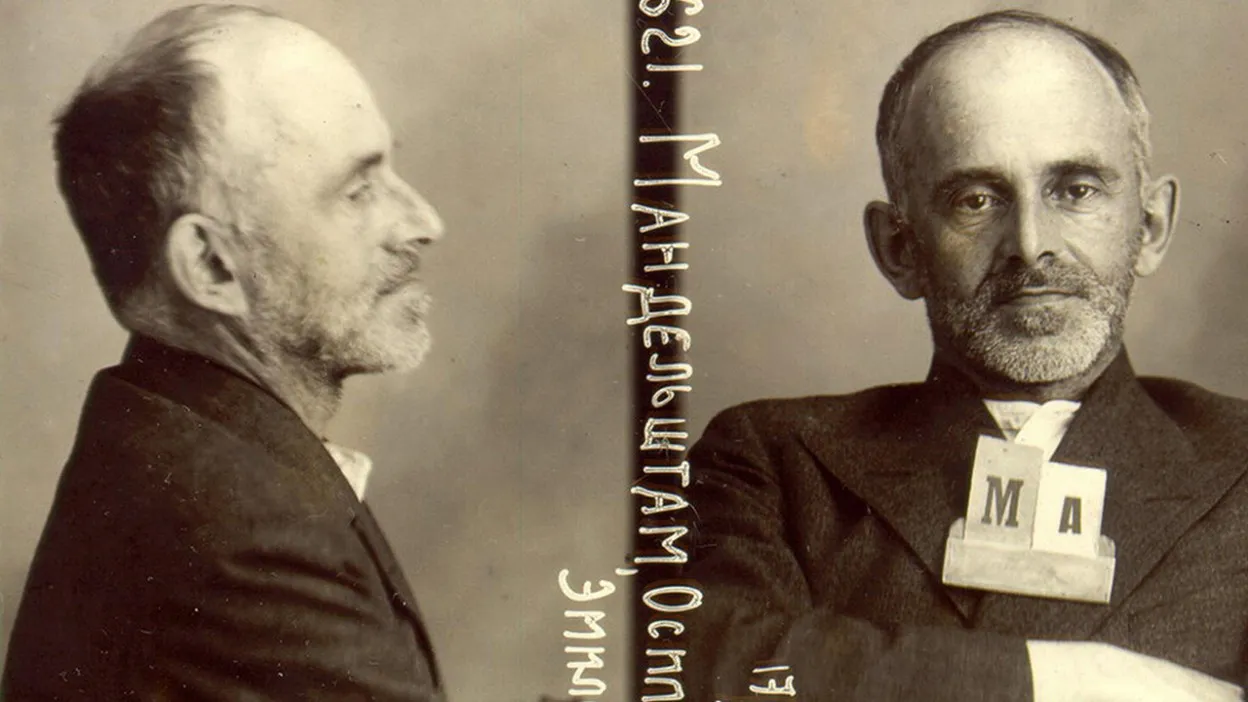
How does Osip Mandelstam make compression carry distance, so that a line stores force like a drawn bow before releasing its charge into image? Beside the Russian text I place a horseshoe, an old piece of iron whose curve receives the thumb easily, whose nail-holes keep their dark mouths after hoof, road, smith, rider have passed into other days. Across the desk lies a bowstring, waxed fibre carrying a different memory of force, where draw weight enters the forearm before flight enters the arrow, effort gathers through a narrowing interval, then release turns held strain into travel. Mandelstam’s poems reach me through a related economy in which consonants thicken the approach to an image while cadence measures the interval through which history recedes before a sudden visual opening spends what the preceding line has stored. Within “Tristia,” composed in 1918, separation acquires measured gait inside pentameter; “The Horseshoe Finder,” dated 1923, loosens regular metre while increasing rhythmic strain through broken lengths, weighted consonantal groupings, strategic pauses, dactylic falls. My guiding claim rests upon that apparent contradiction: Mandelstam carries distance most fiercely when language contracts around it.
At the opening of “Tristia,” parting receives the status of learned discipline: “Я изучил науку расставанья / В простоволосых жалобах ночных.”¹ Five iambic feet govern the movement, four eight-line stanzas giving departure a structure that the heart can enter through recurrence. Across the first line several hard contacts enter the mouth through изучил, науку, расставанья, with the velar density of науку meeting the clustered consonants of расставанья so that departure acquires phonetic resistance before its vowels extend the sound. Beneath interpretation, my tongue discovers labour first, which places parting in the mouth before the poem grants it a horizon; separation begins as work performed among teeth, palate, breath.
Behind the title stands Ovid with the authority of an exile whose road led from Rome to Tomis on the Black Sea.² Through Tristia, Mandelstam receives an ancient instrument for temporal distance, for Ovid’s poetry turns removal from one city into a continuing rhythm of recollection. During the third poem of Ovid’s first book, his final Roman night returns through household rites enacted under the knowledge of departure, while Mandelstam transfers comparable ceremonial weight into the slow chewing of oxen before cockcrow gives the journey its hour. Robert Tracy places Mandelstam’s collection amid the convulsions surrounding revolution, civil conflict, travel through Crimea, the altered civic life of Petersburg, reading the classical world as a means through which recent history enters durable poetic form.³ Through Ovidian inheritance, distance acquires ancestry: a Roman departure reaches a Russian poem across nearly two millennia, yet cadence makes the crossing resemble one road continuing beneath changed boots.
Oxen establish the pace with severe economy: “Жуют волы, и длится ожиданье,” where the animals chew while waiting lengthens inside the same measured span. Through repeated mouth-work the line converts chewing into a prosodic figure for time consumed slowly, so that city vigil approaches its final hour as cockcrow gathers at the rim of the scene beneath the traveller’s burden. What holds my attention lies in the relation between force carried inside the verse form and the image released after its labour. Pentameter brings each statement home through an expected count, while feminine endings lengthen certain closures by one syllabic after-step, giving cadence a slight overspill beyond the main measure. Such departure therefore receives a form capable of containing continuation: the traveller leaves while rhythm keeps walking, just as the horseshoe beneath my thumb retains motion through curvature after the hoof has gone.
Publication deepened that temporal character, for Tristia, the 1922 collection, gathered poems written through years when imperial Petersburg had become revolutionary Petrograd, while civic borders and institutional loyalties acquired altered names or force. Gregory Freidin shows how the Berlin volume emerged through difficult conditions of communication, with Mandelstam exercising limited control over its final form; the title itself entered through editorial mediation associated with Mikhail Kuzmin, while Mandelstam had envisaged another name for the gathering.⁴ Such history suits a book governed by displacement, for even the collection’s identity travelled through other hands before reaching print. Through that bibliographical journey the Ovidian name gathered fresh aptness, turning ancient exile-song into a casing for poems whose own era moved beneath the poet’s feet. Compression here belongs to history as much as metrics, as Rome contracts into Petersburg while Black Sea exile enters Crimea, private farewell bearing the impress of civic fracture.
Midway through the title poem, another rhythmic machine appears: “Снует челнок, веретено жужжит.” The shuttle runs while the spindle hums, Russian turning household motion into acoustic form through the clipped челнок beside the prolonged buzzing of жужжит, whose repeated voiced fricative makes the mouth imitate the spindle’s sound. I read that line as a miniature theory of Mandelstamian cadence, since the shuttle crosses space through return while the spindle converts repeated turning into thread, allowing poetic recurrence to travel back across what has already passed before carrying a filament into the present. Several lines later Delia enters “словно пух лебяжий,” like a fleck of swan’s down, where visual lightness arrives after the machinery of thread has accumulated force. Heavy domestic consonants thus yield to air as whiteness enters running movement, permitting compression to open into flare.
Views: 118


