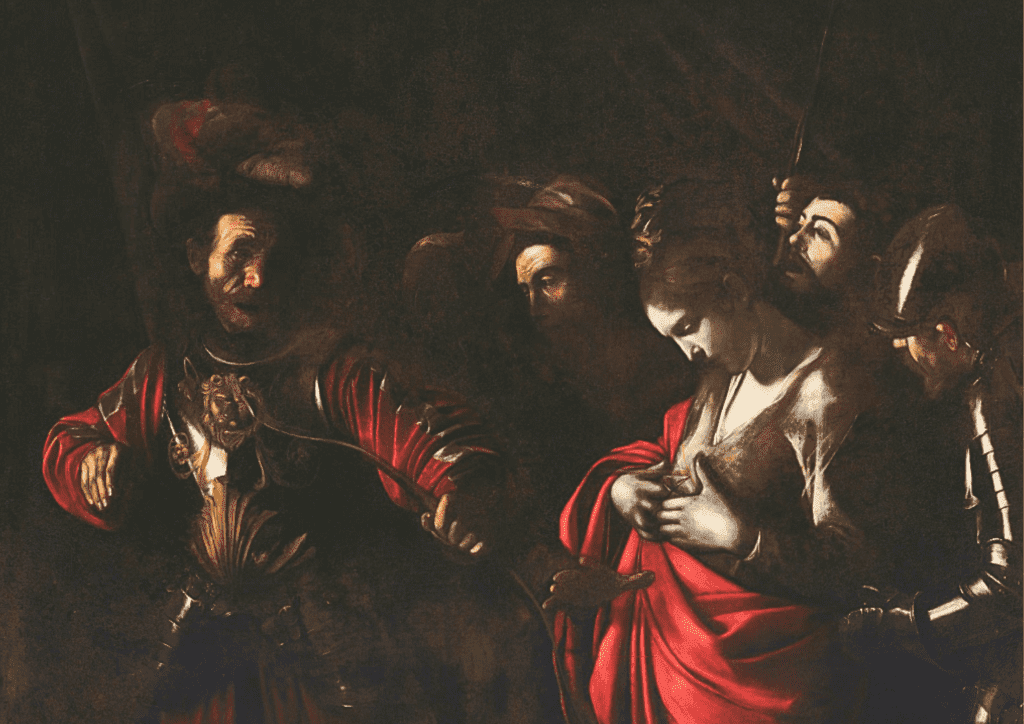
I climbed the marble stair while a red weather gathered over my head, since Jacopo Foggini had wrapped the well in a suspended nuvola—a cloud with shadow sewn through it—and the stair rose as if the city itself breathed upward toward a wound that waited on the landing.¹ The attendants kept a courteous pace that granted the room its hush; a narrow corridor bent once, then opened into the chamber that holds Il martirio di sant’Orsola (the martyrdom of Saint Ursula), and the air accepted the picture the way a chapel accepts a relic, with a held inhalation before the organ draws its first chord.² The canvas spread wider than memory—breadth set against breath—so that the painted bodies pressed forward with the authority of those who know the floorboards under one’s soles and the lamp above one’s shoulder. Three heads glimmered from darkness where an earlier visit had recorded fewer faces, since the recent cleaning had coaxed sleepers back into daylight; a hand lifted from shadow between tyrant and saint as if a last appeal could slow the string’s recoil.³ The light entered from the left in a controlled flare, touched a cheek, gripped a bow, caught the wet crimson of a cloak, then folded itself into a black hanging that served as both curtain and shroud. The room stood in league with that light, and I allowed the shock of first sight to carry me across the short span between breath and speech.
The arrow had found its chamber, and the saint’s palm hovered to meet it in a gesture that fused defence with welcome, so that amazement learned poise and pain accepted grammar. The king’s mouth clenched to a snarl of realisation while his left hand, which still owned the bow, showed fingers that had released a heartbeat earlier, and the instant preserved that small tremor that runs through the body when an action completes and conscience begins. The company behind Ursula leaned into their discovery; a man raised his face from behind her shoulder with an expression that gathered pity and witness on one plane. A tradition keeps that upturned face as the painter’s own, and my eye answered with assent, since the brow carried the fatigue of flight and the mouth measured a vow.⁴ That gaze travelled into the wound as if the painter submitted to the same arrow through the safer medium of oil, and the picture adopted the form of a confession delivered in light.
I stepped forward until the breath from the varnish met the breath in my chest, since Caravaggio had pressed his actors toward the front with the urgency of a man who paints in a room where time—like a hound—keeps a steady pant at the door. The pigment skirts carried grit from the ground; a quick drag of the loaded brush created the wet thread of blood that marked the entry point; the shadow under the king’s sleeve thickened where oil sat on oil with the haste of a man who carried flight inside his ribs. The path of the light reduced everything behind the bodies to a cloth whose weave surrendered to darkness, so that the world narrowed to one interval between a choice and its price.
Her story, which smells of saltwater and bone when told beneath the arches of Cologne, rose in the room as a river rises behind a sluice, since Ursula had asked for time and for a circuit of holy places before any alliance, and the sea—compliant for a season—carried her company toward a river city where a horsehair bow waited with iron patience. A leader demanded possession as the pledge for peace; the maidens approached with a discipline that later pages inflated when scribes read XI M as thousands where earlier voices had read martyrum, which fed a golden ossuary with arithmetic as wild as spring freshet.⁵ I remembered the bright reliquary script in that chamber—the ribs and femurs arranged into Latin letters, the skulls crowned in gilt caps—and I measured how Venetian masters had loved Ursula as a traveller who sleeps before a voyage or dreams of angels along a quay.⁶ Caravaggio came late to her legend, and yet he tightened it into a single breath that held refusal and glory together as if the breath itself formed the hinge that turned desire into sanctity.
My marchand’s habit stirred, since a dealer’s eye steps out whenever a masterpiece stands within an arm’s reach, and the habit walked the wall text and the ledger inside my head as one would crosscheck a jewel against its certificate. Oil on canvas; height and width that carry authority, one hundred and forty-three by one hundred and eighty centimetres; Naples, Gallerie d’Italia, Intesa Sanpaolo Collection; second Neapolitan period; 1610.⁷ The pleasure that follows such confirmations arrives as an appetite for condition, and the surface answered that appetite with a lucidity that follows careful cleaning, since the blacks shed their amber fog and the reds recovered their pulse, while small heads once veiled now sang again because cotton and solvent, guided by nerves steadier than any prince’s bow hand, had walked the picture for months. A climate frame held the air with priestly discipline, and the hush in the case matched the hush in the room.⁸ Along the lower edge minute abrasions traced the old tack, while a gentle bloom lingered where varnish once lay too fat, and a field of micro-craquelure spread like laugh lines across an elder’s cheek. A letter speaks of sunlight and haste: Lanfranco Massa informed his master in May that he had set the canvas in the sun to speed the drying, and the varnish—heavy by the maker’s habit—softened, so that a consultation with the author would follow at once.⁹ That clumsy afternoon mixed harm with gossip, since a rumour in Genoa whispered of facial wounds upon the painter, and the witness behind Ursula arrived as a disproving answer with a steadiness that pride recognises as kin.
Naples filled the margins of the canvas with its own history, since Caravaggio’s last months folded the city’s heat and its knives into every pigment. He had left Rome after a fatal quarrel that set the law upon him; he had sought a habit and a sword among the Knights of Malta and held both for a season; he had painted a beheading whose gravity loosened priests’ tongues into praise; he had crossed to Sicily and returned with pursuers near; and then a gang took their revenge outside a tavern, so that bruises and fever carried themselves into the studio and lodged on this canvas.¹⁰ In London, in a recent spring, a room offered one painting only and dressed the floorboards and the wall to receive Ursula as a final page torn from a life that ran hard, and the city’s critics read the work as both omen and mirror, since the arrow aimed at the saint’s breast travelled along the same corridor of fear that the painter felt inside his own sternum while he waited for ships and letters.¹¹ A few weeks later the sea bore him toward pardon, and the Tuscan coast offered a strand where fever interrupted a plan; Porto Ercole closed his eyes, and a workshop gathered its brushes. The picture in front of me held the pulse of that schedule, since the month of May touched its ground, the middle of June touched its journey, and July folded itself into the oil as a scent folds itself into cloth.
Dates enter a legend with the authority that receipts carry in a ledger, therefore I allowed the record of transit to sound like a bell through the chamber. Completion before 11 May 1610; receipt in Genoa on 18 June; death in July. The commission arose from a prince whose pleasure followed saints and horses with equal zest: Marcantonio Doria ordered the work to honour a girl’s vows, since the stepdaughter Livia Grimaldi had entered a Capuchin house and taken Ursula’s name, and the subject followed that new signature as a crosier follows a bishop into choir.¹² Inventories place the canvas among names that generals and bankers pronounce with softened breath—Raphael and Leonardo—while family papers record the carriage south in 1832 to the Palazzo Doria d’Angri, where the painting settled for a long interval with the ease of a noble who prefers a side room to a balcony.¹³ An attribution to Mattia Preti then covered the canvas like a travelling cloak, until a scholar opened the Doria papers in 1980 and found the letters of Massa that restored the author’s voice and set the work back into the last chapter of the Neapolitan book.¹⁴ Naples drew the picture beneath a bank’s wing and housed it in the Gallerie d’Italia with the care that a palace reserves for a widowed queen who carries royal blood.
While I stood there with ledger and chest aligned, a question about value raised its head in the customary way, and I answered it through witness, leaving the column of prices to its own cold measure. since state and bank and law enfold this object with chains of duty and affection. An autograph canvas with late hand and late thought, with a commission that names patron and occasion, with a shipment fixed to dates and a procurator fixed to a signature, with correspondence that speaks of sun and varnish and pride, with a self-portrait folded into the crush of bodies, secures a category that eludes ordinary valuations. A technical report from 2003–04 recorded the emergence of an arm and a right hand between king and saint—an attempted interposition of flesh between iron and flesh—and that disclosure sealed the intention of the image while thinning the pasture for copyists.¹⁵ The more recent cleaning revived three heads at the flank of the scene and lent still more authority to authorship, since sleeping heads rise with original paint more readily than with later hands; press photographs aligned with the conservators’ statements, and the room itself carried the fragrance of a workshop that understands patience.¹⁶ If a private soul, moved by romance and audacity, sought a number, then any serious negotiation would begin where ministries start to speak in low tones, while attention—measured in minutes before the frame—would travel far beyond any cheque’s ink.
The moment in paint demanded the same obedience from me that the painter demanded from his company, and I traced it as one traces a coast at dusk. The armour drank the light and held a dim answer that served rage better than jubilation; the brow furrowed in a theatre where recognition entered like a bailiff; the arrow cut across the air with a fletcher’s accuracy; the red cloak held iron and wine the way an altar cloth holds both sacrifice and feast. The witnesses on the right arranged themselves in a shallow relief of grief and astonishment; a man pressed his cap to his temple as a sailor presses a rope into a cleat; another drew the lips tight with a line that spoke of long practice; the familiar face behind the saint inclined toward the shaft as if that last breath of air could soften a blow. The black cloth behind them, pinned to darkness, formed a stage that freed the action from any city, so that the march of banners and walls receded into hush and the drama of assent filled the chamber. Ursula read her wound with the calm of a woman who had trained her mind to lead her body; the painter selected the instant where that training reaches its apex and grants the body a discipline that matches the mind.
A grazed whisper ran along the varnish when I shifted position, and the raking light yielded further confession. The Neapolitan preparation—dark as coal settled in oil—pushed flesh forward with a velocity that Roman earth seldom grants, and the high points along cheek and knuckle rose like ropes drawn tight by a strong hand. The bowstring carried a precise highlight laid with the narrow edge of a loaded brush; the wet thread at the wound owned a viscosity that suggested lac joined with earth and moved across the skin while the idea still burned hot. A conservator walked past with a coil of keys and said under his breath, as one speaks in church to a friend across a pew—vedrà, signore, la pulitura ha rimesso in voce tre teste—and I assented, since the choir had expanded and the harmony now held a richer undertone.¹⁷
Debate arrived as the companion of love, since trade breeds scepticism even in a chest that rises for beauty, and I let both voices keep company beneath the same rib. One school places these late surfaces under suspicion and points to broken touch and thin veils as signs of fatigue; another school reads the same textures as urgency shaped by command and claims that the compression of stage and cast heightens the voltage of mind. I tested both schools before the frame as a coachman tests a horse’s mouth, and Ursula issued the deciding cue, since her palm, raised with a composure that joins surprise with assent, offers the painter’s own credo in shorthand: the sufficient gesture that answers excess with exactness. London’s one-picture room pressed the same claim, since the architecture withdrew everything that might dilute the current and offered only the saint’s breath for weather.¹⁸
Across the span of an afternoon Naples widened into Europe through the path of the legend, and I walked that path with memory as my lantern. The basilica in Cologne still carries the Goldene Kammer, where bones spell Latin words and skulls wear crowns, and where docents describe XI M with a civic brightness that pleases pilgrims who love number, while scholars note that scribes of different centuries read milia and martyrum with different ears.¹⁹ Venice still cradles Carpaccio’s cycle in a light that pours like milk through shutters; Ursula sleeps beneath an angel’s counsel or stands upon a quay in a dress that gathers the rhythms of oarlocks and bells.³⁰ Naples accepts another mode and another pitch; the city draws drama within arm’s reach and asks for a stage two feet from the viewer’s breath. Caravaggio answered with a drape and a crowd crushed into the foreground, and the saint lifted her hand into a grammar that Naples understands without catechism: consent shaped as poise.
In such rooms biography gains the strength of a scene, so I followed the painter along the stations that left their fingerprints on this canvas. A Lombard boy bent over a board and learned to grind pigment in Simone Peterzano’s shop, where Venetian flesh hung in the air as an ideal as present as bread on a table; a young man arrived in Rome with fruit and flowers under another man’s command and soon found patrons willing to venture saints; Del Monte opened a palace door that led to instruments and wine and conversations where light on shoulders and light on crystal decanters shared a language; success entered with cardinals and musicians and swordsmen at the threshold; a quarrel beneath moonlight crossed a line that judges recognise within a heartbeat; a sentence pushed the painter south; Naples found uses for his fierce grammar; Malta handed him a sword and a red cross and an honour that sat well upon him until an offence unseated it; Sicily offered harbours and an archipelago of shadows; Naples again received him, along with blades that found his face; a pardon beckoned from Rome; sails caught him toward it; a fever met him near shore; a summer closed its hand over him as quietly as a mother’s palm settles a child to sleep.²¹²² Each bend in that path chimes within Ursula, since the witness behind the saint holds remorse and resolve in the same mouth, and the bow along the tyrant’s arm stretches like the string of law that ran across the painter’s life for years.
I eased across to the right and met that witness full on. A self-portrait inside a martyrdom offers a fierce draught, and I drank it with awareness of salt and iron, since the painter here occupies the sole station that grants truth its privilege: far enough back to witness the action entire, near enough to breathe the saint’s air. He keeps silence, and his gaze holds its line with a soldier’s discipline, which answers Ursula’s poise with an echo drawn from a life that learned obedience late and held it hard. Paint here serves confession and plea together, since the act of recording a sanctified refusal allows the author to lay his petition for mercy upon the altar that he himself illuminates. A reader of faces may drive autobiography too hard into witnesses; nevertheless, the family likeness between this visage and known self-portraits grants licence to receive him as he offers himself, and Naples blesses the audacity through a room designed to educate attention through light.²³
On my knees—since long looking teaches the body to agree with reverence—the correspondence that sealed the commission ran like a fluent hand across the page of memory. Massa’s letter, economical and contrite, recorded the accident as a sign: “I placed it in the sun… the varnish… thick,” and that thickness—born from a maker’s love for a wet sheen at delivery—continued to speak in the bloom that conservators later coaxed into equilibrium.²⁴ The old dossier from 2003–04 then stepped forward; a hand, reaching between tyrant and saint, pressed a theology into pigment: human intercession enters where celestial crowns often descend in other cycles, and Caravaggio, faithful to Naples, kept heaven out of view while allowing a mortal to attempt the first rescue.²⁵ The most recent cleaning under Laura Cibrario and Fabiola Jatta returned three heads to the choir and the room installed a clima frame that holds atmosphere with the steadiness of a sacristan who lives for his gate.²⁶ A bank’s bulletin in March carried the promise of a summer loan to Rome, and photographs from London the year before testified to a single-work presentation that set the saint’s pulse against the city’s hum.²⁷ The itinerary pleased the part of me that loves ships’ logs; safe passage, careful framing, and curators who favour clarity over varnish all form a chain of custody worthy of a last canvas.
Two sentences resolved inside me while I watched the saint consider her wound. First, the picture stages a doctrine of consent that exceeds pious formulae, since Ursula chooses a death that follows refusal, and the painter honours her agency by selecting the instant where mind still governs body. Second, the painter writes his plea within the saint’s law and accepts her tribunal, since he enters the image as a disciplined witness instead of a fugitive, and he adjusts his breath to her measure. Counter-arguments gathered with scholarly speed, since some viewers taste resignation where I taste composure, and some read compression born only from speed, yet the pulse in the paint—steady at knuckle and string—tells where the brush fixed its loyalty, and the saint’s hand supplies the final syllable. The string hummed; the bow rose; the arrow set its whistle; the face behind the saint recorded that report with the acceptance of a magistrate who recognises a verdict when it arrives.
Provenance asked for one more circuit and I granted it in the cadence that dealers teach their apprentices, since chronology brings reassurance in the presence of beauty. Doria’s commission carried by a Neapolitan agent; completion before the eleventh of May; shipment to Genoa in mid-June; residence among princely pictures; carriage south to the Doria d’Angri palace in 1832; storage and confusion; a season of attribution to Preti; a scholar’s discovery of Massa’s letters in 1980; Pacelli’s announcement and the chorus of confirmations afterward; adoption under a bank’s care; restoration in 2003–04; a renaissance of details; the London single-work stage; the Roman summer; the return to via Toledo under a red cloud that tells each pilgrim to lift the head.²⁸ Each station within that chain chimed against the canvas with the persuasion that only documents possess, and the work wore its papers with the grace of a traveller who keeps passports in an inner pocket sealed by habit.
On my third approach I gave the saint’s right hand the long attention that a jeweller gives a facet. The left accepts the arrow with incredulous poise, while the right joins in a gesture that can be read as presentation joined to protection, and that doubleness grants the painting its doctrine: Ursula guards the heart while she offers the wound as seal. The anatomy of the hand accepts a minute distortion at the knuckle so that expression may govern geometry; the wrist swivels with the ease of a dancer tuned by long rehearsal; the half-moons of the nails catch flicks of light where flesh thins, and those crescents keep a time that the rest of the scene obeys. I traced the movement of red across the cloak until it resolved near the waist in a triangular fold that answers the arrow’s angle with quiet rhyme; the archer’s forearm, still taut after release, speaks with a fidelity to bodies that connoisseurs trust as quickly as they trust an honest patina; the bow’s curve echoes the shoulder’s arc so that compassion and physics embrace within inches.
Cologne rose within me while Naples stood around me, and the Golden Chamber returned with its beeswax and stone and the calm that attends arithmetic in bone. Guides there, efficient and proud, explain the number with a smile, while Benedictine scholars speak of scribes and of the ways numerals and nouns trade places across centuries, and both schools offer gifts to the same saint.²⁹ Venice floated in after Cologne: shutters part; river light enters; a girl sleeps; a page turns; dawn teaches mercy in sentences as clear as lagoon air; yet Naples insists upon a different grammar that compresses centuries into a single intake of breath at arm’s length. Carpaccio sets a bed and a dream; Cologne arranges ribs into script; Caravaggio chooses a hinge of air and iron and allows the hinge to hold.
Genealogy extended its hand, and I took it with the seriousness that such hands deserve. I examined the canvas for the habits that Preti would bring—swell and flourish—and the surface answered with Merisi’s Neapolitan discipline at every stroke: the chiaroscuro shears like a blade; flesh lifts from a black ground with the authority of a knife sharpened on a priest’s stone; the tenebrism serves psychology with a severity that leaves swagger to others. A small pentimento under the saint’s left knuckle—revealed when the compass of light slid across the panel—proposed an earlier angle, and such changes in the life of a line favour the original hand where copies tend to freeze ideas into immobility. The accounts that house the picture’s travel carry the dryness that professionals savour: a commission note, a shipment, a receipt, a transfer, a misreading, a recovery.³¹ London’s appetite in the spring of 2024 converted all that dryness into breath in a room where bodies queued for the privilege of silence; Rome’s summer set the canvas against palaces seasoned for conversation; Naples installed the work again under Foggini’s ember cloud, and the stair instructed the foot to lift with care.³²
Across these passages a thesis formed and held, since action and reflection agreed upon a single flame. The Martyrdom of Saint Ursula judges the male will through a woman’s gaze that accepts death while guarding the mind, and the painter acknowledges the justice of that gaze by placing his own face beneath it. The king plays force; the painter serves witness; the saint occupies law. The arrow stands like a stylus planted in flesh and inscribes a signature across Europe at the turn of a century that altered both court and parish. A counter-thesis advances alongside and argues for a narrower reading: that the painter served a patron’s requirement and included his head as a vain token among witnesses. I accept the fact of a commission that celebrates a vow and the likelihood of pride in a self-portrait, while I hold to the claim that the composition submits to Ursula’s sovereignty, since each brush-decision bends toward interior assent and keeps compulsion in check through stiller means.
I left the room for a short while and allowed Naples to wash over the palate like wine, then returned to the frame with the same appetite I bring to a second taste when a dish keeps its promise across courses. A school group drifted in and settled into semicircles that formed and re-formed; the guide found a pitch that neither scolded nor flattered; the children tried on silence the way they try on a jacket a size too large. One boy lifted his palm to shoulder-height and then higher, as if his body had floated a question into the air near the saint’s hand; a girl tucked a strand of hair behind one ear and mirrored the witness’s tilt with an accuracy that owed nothing to instruction. The guard at the door shifted weight from one heel to the other, then found still balance again and offered the room a watchfulness that suited its character. I counted those gestures in the ledger that matters most, since value migrates from paintings into bodies and then returns richer to the painting again.
Evening found me in the courtyard with coffee set upon warm stone, and the legend lengthened as the light lowered. A father granted a voyage to a daughter who asked for time; captains agreed to a schedule that slipped through harbours and past river mouths; a company acquired a rhythm of prayer and bread that steadied their sleep; a city along the Rhine raised its gates; a chieftain made his demand; a girl shaped her syllable and the syllable settled Europe’s law more surely than decrees. The basilica at Cologne arranged bone; the Venetian cycle arranged light; the Neapolitan canvas arranged breath and iron; and the three arrangements together taught my mouth a sentence that the painting had already formed in my eye: freedom spends itself fully when a hand rises with poise and receives its wound as seal.
I stepped inside again before closing time, since dusk drapes Naples with a kindness that galleries understand. The leftward light fell lower and warmer; the armour answered it with a hunger proper to iron; the red deepened toward clotted wine at a fold near the waist; the curtain revealed a hint of linen grain before it withdrew into darkness again. The saint’s gaze remained upon the wound with a fusion of amazement and assent that kept the spirit alert, and the witness behind her continued his vigil, and I kept mine, and the room held the three watches as if an unseen sacristan had set the time. When the attendants drew the rope across the door, I drank a last measure of red from the cloak and carried it into the stairwell where Foggini’s cloud pulsed with its own ember.
Morning returned me to via Toledo with a friend whose eyes serve value as scales serve a goldsmith. He greeted the frame with a silence that held for a full minute; the loupe came to the socket with a movement learned over years; his breath slowed into the rate required for steady seeing; the raking light betrayed the pentimento at the knuckle and earned his smile. He traced the arm that reaches between king and saint and nodded, since that limb creates the first human bridge inside the drama, and bridges satisfy those who read cities and artworks through the same grammar. We allowed questions to appear, as professionals must do—speed, stamina, authority, care—and the saint’s palm resolved them again by setting our hearts into the tempo she governs. We walked the provenance aloud for our own pleasure and fidelity, since names and places live through saying: Doria and Grimaldi; Genoa and Naples; Doria d’Angri; archives and scholars; bank and palace; raking lamps and cotton cooks; loans tested by handlers and clouds; the cadence of the list carried ritual weight although we gave it in a low voice. We left price unspoken, and our silence signalled respect for the covenant that presently encircles the canvas.
Across the afternoon I allowed Caravaggio’s own path to breathe in scenes that entered the room through memory’s doors. Malta’s hall echoed with boot-heels and the ring of medal on breastplate; a sword tilted light across a cheek; vows walked alongside ambitions there, and each claimed the heart for a season. Sicily whispered through narrow streets where shadows hold counsel; a barque nudged the quay with ropes creaking like old knuckles; a commission arrived on parchment that creased when folded; a workshop lit lamps against damp air; a patron approved. Naples thrummed with scooters in my day and with hooves in his; the scent of frying oil and sea carried through an alley; voices traded rumours that sometimes took the form of threats; a face wore fresh bruises; a canvas drank that indignity and transformed it into witness. Porto Ercole, which I visited some years ago with a local fisherman, still gives a sill of stone to the Tyrrhenian, and the water there presses an even beat upon the wall as if to reteach breath to those who overreach; a small church keeps the colour of weathered bone; a lantern hangs like a guardian of names that visitors whisper for luck. All these places leaned quietly within the frame as I watched the saint meet the arrow.
I stood once more before the painting and let a final layer of inquiry burn into shape, since scholarship thrives when flame meets precision. The compositional vectors sketch a triangle whose vertices anchor the drama: the saint’s gaze settles upon the wound; the king’s stare slides along the same line as if the arrow had tethered his sight to its mark; the witness’s eye receives both with a gravity drawn from self-knowledge. Those three currents establish a tribunal in which the law favours consent, power attends the consequences of its own action, and vision accepts the duty to remember. The colour orchestration deepens that law: the red cloak supplies a sacramental register that links flesh to altar; the armour’s dim reply carries the metallic taste of coercion; the black drape grants theatre while withholding distraction, and the flesh tones rise from a ground so dark that every value above it reads as grace. The brushwork supports the same order: swift, exact, economical, with small ropes at knuckles and in cheeks that betray a hand trained to resolve with dispatch what another hand would dilute. Technical documents and eyes trained in laboratories have caught that economy with reflectography and raking light and paint-cross sections, and those dry pages hum behind the visible surface like organ pedals behind a soprano line.²⁵
As the hour for departure approached, I widened my gaze to accept the whole installation once more. The room’s temperature, the calibrated light, the case, the platform before the frame, the angle that allows a child to feel her own height meet the drink of the picture: these material attentions collaborate with the painting’s interior law. Foggini’s cloud over the well below throws a slow ember into the approach, so that the stair rises toward the canvas as a rite rises toward its climax; the palace by way of via Toledo sustains a civic manner that still honours the banker’s prudence while it grants the pilgrim’s delight; Naples carries that double life on its tongue and in its step, and the painting drinks from both cups with appetite. I stepped back until my shoulders met the reassuring fact of the wall, and I let a last sentence form upon the palate: Ursula teaches courage as a posture that the hand can learn, and the painting writes that lesson into bodies with a clarity that survives across centuries because figures in rooms teach better than formulae across desks.
I descended under the red cloud as children arrived in clusters for the midday wave, and a small boy—no older than seven—attempted the saint’s gesture with a gravity that would have made a bishop smile. A woman with a market bag paused and pressed her palm to her own chest for a heartbeat; a guard leaned toward the banister as if to listen, then straightened again; a docent passed with a binder and a pencil and an expression that told of timetables that had already slipped and of a deep loyalty that keeps timetables from ruling the soul. Naples outside kept horns and gulls and conversations that run like streams; inside my chest the hand that had learned its lesson held the line. I carried that posture into the street as one carries a coin under the tongue, and the city answered with a wink of sun off a wet flagstone and a scent of coffee that settled many ambitions into one: to return, and to stand again in front of that red and that black and that irrefutable hand.
Notes:
- “La Nuvola e l’ombra” (The Cloud and the Shadow), Jacopo Foggini, site-specific installation for the Caravaggio Room, Gallerie d’Italia—Napoli, 2025.
- Il martirio di sant’Orsola, Michelangelo Merisi da Caravaggio, oil on canvas, 143 × 180 cm, Intesa Sanpaolo Collection, Gallerie d’Italia—Napoli (1610), collection room text and institutional catalogue.
- Denise Maria Pagano (ed.), Caravaggio a Napoli: dalle Opere di Misericordia alla Sant’Orsola trafitta. Tecnica e restauri (Electa Napoli, Napoli, 2005), pp. 56–63.
- Gallerie d’Italia—Napoli, collection label and gallery guide for Il martirio di sant’Orsola (updated 2025).
- Basilica of St. Ursula, Cologne, Goldene Kammer guide (Cologne Cathedral Treasury, current ed.); William Granger Ryan (trans.), The Golden Legend: Readings on the Saints (Princeton University Press, Princeton, 1993), vol. II, pp. 283–289 (“Saint Ursula”).
- Peter Humfrey, Carpaccio (Phaidon, London, 2004), pp. 128–149; Gallerie dell’Accademia, Venice, room texts for the St Ursula cycle.
- Intesa Sanpaolo—Gallerie d’Italia, “Il martirio di sant’Orsola by Caravaggio,” institutional entry (Naples, 2022; rev. 2025).
- Gallerie d’Italia—Napoli, conservation highlight on installation and clima frame (1 August 2025).
- Lanfranco Massa to Marcantonio Doria, Naples, 1–11 May 1610, Doria d’Angri Archives; transcription in Vincenzo Pacelli, Il martirio di sant’Orsola di Caravaggio per Marcantonio Doria (Paparo, Napoli, 2011), pp. 9–12.
- National Gallery, London, artist biography for Caravaggio (2024–25 updates); Andrew Graham-Dixon, Caravaggio: A Life Sacred and Profane (Penguin, London, 2010), pp. 423–457.
- “The Last Caravaggio,” National Gallery, London, exhibition room text and press materials (April–July 2024); reviews in The Guardian and Financial Times.
- National Gallery, London, “Immunity from Seizure” dossier for The Martyrdom of Saint Ursula (2024), pp. 1–2; Google Arts & Culture, Capodimonte feature on the Doria commission (accessed 2025).
- National Gallery, “Immunity from Seizure,” pp. 1–2 (Doria provenance); Intesa Sanpaolo, Naples entry notes.
- Vincenzo Pacelli, “Caravaggio, 1610: La ‘Sant’Orsola confitta dal Tiranno’ per Marcantonio Doria,” Prospettiva 23 (1980), pp. 24–30.
- Pagano (ed.), Caravaggio a Napoli…, pp. 58–63 (raking-light documentation of the interceding arm and hand); technical appendix.
- Gallerie d’Italia—Napoli, conservation bulletin (Laura Cibrario; Fabiola Jatta), summarized in the 2025 highlights page; Jo Lawson-Tancred, “Restoration of Caravaggio’s Final Work Reveals Shocking Hidden Details,” Artnet News, 4 April 2025.
- Gallerie d’Italia—Napoli, gallery guide (2025 edition), conservator’s note on the emergence of three heads during cleaning.
- Jonathan Jones, “Who killed Caravaggio and why?,” The Guardian, 12 April 2024; Jackie Wullschläger, “The Last Caravaggio,” Financial Times, 16 April 2024.
- Cologne Tourism Board, St. Ursula and the Golden Chamber brochure (2022); Sherry Reames, The Legenda Aurea: A Reexamination of Its Paradoxical History (University of Wisconsin Press, Madison, 1985), pp. 197–212.
- Gallerie dell’Accademia, Venice, St Ursula cycle, room panels; Humfrey, Carpaccio, pp. 128–149.
- Encyclopædia Britannica, “Caravaggio—Early life and training,” online edition (updated 2025).
- David M. Stone, “Caravaggio’s Exile,” in Caravaggio: Realism, Rebellion, Reception, ed. Genevieve Warwick (Routledge, London, 2006), pp. 113–142.
- Howard Hibbard, Caravaggio (Westview Press, Boulder, 1983), pp. 275–281; National Gallery, London, 2024 exhibition texts on the late style.
- Pacelli, Il martirio di sant’Orsola… (2011), pp. 9–12 (Massa letter).
- Pagano (ed.), Caravaggio a Napoli…, pp. 56–63; technical essays on Neapolitan grounds and paint structure.
- Gallerie d’Italia—Napoli, conservation highlight (Cibrario; Jatta), 2025.
- Intesa Sanpaolo newsroom, “Loan of Martyrdom of Saint Ursula to Rome,” 10 March 2025; National Gallery, London, “The Last Caravaggio,” 2024.
- National Gallery “Immunity from Seizure” dossier; Gallerie d’Italia institutional entries and press notices (cited above).
Views: 319