

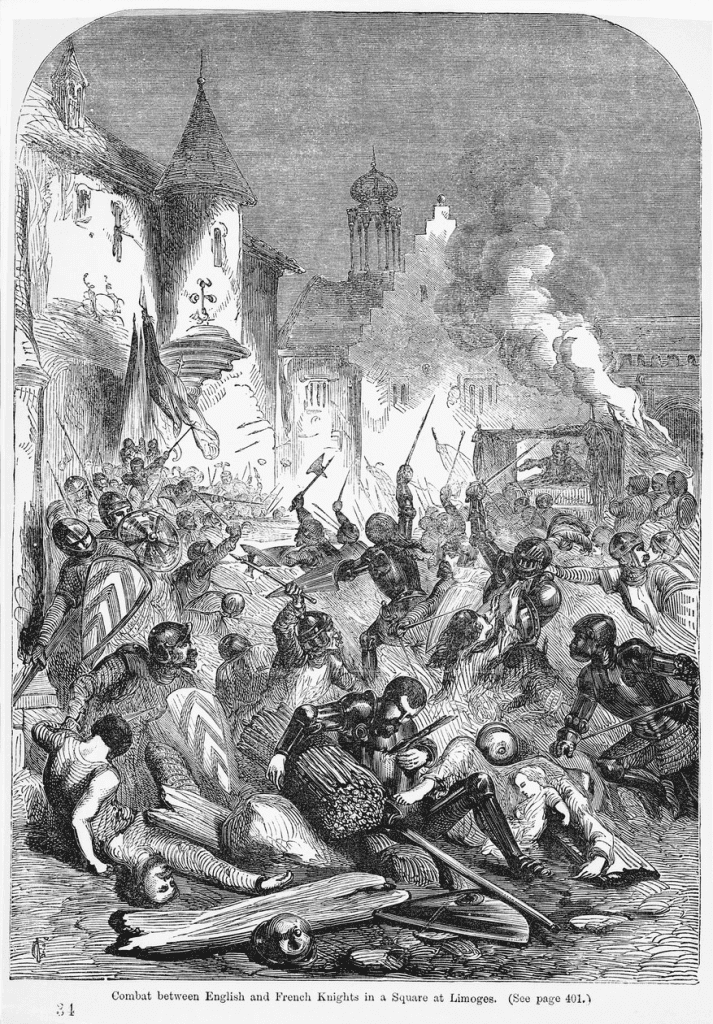
Dust deepened within the breach while heat raised a chalky veil from crushed ashlar, and a litter advanced in a long, breathing sway as four shoulders moved with choir-like discipline and the poles sang against their leather slings. Fever pressed a fine edge along the prince’s sightline, which guided his attention across the ragged seam where props had burned and mortar had yielded, so he read the fracture as a joiner reads a wounded joint and weighed the angle that would admit men and consequence. Edward of Woodstock came up to that gap in September 1370 with a name already weighted by Crécy and Poitiers, with a principality whose coin rang beneath his seal at Bordeaux, and with a frame that demanded bearing hands while his will traveled a half-pace ahead of the men who carried him.¹
Years of campaign and council had laid down habits stronger than sinew, which meant that each choice on the field already bore the shape of assemblies and ledgers. In Aquitaine he gathered Estates at Angoulême and at Saint-Émilion, where breath warmed wax and parchment while fouage rose through argument and assent to feed garrisons, bridges, and castles; in those rooms he learned how fiscal speech binds a province with a grip equal to that of spears. He impressed authority upon letters that named towns, dates, and obligations with a clerk’s exactness and a captain’s cadence, so every courier carried policy as well as paper. Triumph in Castile delivered laurel and debt in the same moment and carried an inland consequence into the chamber, since a flux in the gut and a swelling of the limbs demanded draughts from physicians and altered command into a rhythm that joined an hour on horseback to a day upon the litter. The office therefore hardened even as the body softened, and that exchange sharpened judgment, since private endurance drove public resolve.²
Across the valleys a second intelligence answered with patience that favored sieges, withdrawals, and councils over sudden shock. Charles V governed through ordinance and measured pressure, so his war moved by charters, oaths, and garrisons that watched roads and rivers, while Bertrand du Guesclin schooled captains to spend time as coin and to win through conservation. Inside that temperature, Jean de Murat de Cros—jurist by training, bishop by dignity, brother to Pierre who held the papal chamber’s keys—stood as a hinge between cathedral and court, since kinship with Avignon widened a man’s reach across frontiers. The duke of Berry entered Limoges under that canopy of counsel, and the gate yielded with a turn that cut deeper than mere alignment, since the prince had advanced Jean de Cros in former years and had counted trust as a currency inside his Aquitanian house. A gate that opens by friendship teaches a harsher lesson than one opened by force; the message spreads along valleys faster than heralds.³
The city itself approached the army as a double body that kept two hearts in one ribcage until policy forced a discord. Around Saint-Étienne, the bishop’s Cité gathered lanes, stalls, and courts under ecclesiastical jurisdiction that traced its own arc of custom and revenue; around Saint-Martial the Château quarter sustained a market’s older pulse and the memories of viscomital and royal right. A short walk linked the two while a gulf of law divided them, so the breach of September gaped chiefly inside the bishop’s precinct—the very fabric that had swung to Valois counsel—while the market-city across that brief distance continued under the prince’s orbit into the following year. Geography therefore shaped meaning, since ruin gathered in one jurisdiction more than the other, and the map supplied a gloss that readers often mislay when a single flame appears easier to remember than paired embers that smoulder at different heats.⁴
Siege-work moved beneath those walls with the calm of a craft that teaches men to listen to stone. Sappers slid into clay with low lamps and short iron, then propped the roof with squared trunks whose grain a man reads with his palm, while a listening trumpet and a cheek against timber taught him the pressure growing overhead. Each cut rephrased the wall until it spoke release, and each wedge of fire rewrote the gallery into a fuse. When the props failed in flame, the curtain folded with a convulsion that drove smoke outward and sent pebbled grit across armor and teeth, so the breach formed a throat through which purpose advanced. Custom then stepped forward, since a summons refused and an entry by storm placed life and goods inside the assailant’s grace, and a commander weighed mercy as policy for the next town that watched the same banners along its own battlements. Edward understood that grammar through long practice and shaped an answer that would swing the pendulum toward fear at a speed equal to the treachery that had swung it toward revolt.⁵
Froissart would later cast the hour as a theater of judgment in which pity and wrath entered the street together and refused to part. He seated the prince upon his litter inside a tide of flame and cinders while householders knelt in ash and lifted hands that wore soot like gloves; he set three French captains—Jean de Villemur, Huc de la Roche, Roger de Beaufort—inside the wreckage with such tenacity that courage itself gained a face, so the prince, seeing in them the quality he prized in himself, called for capture and thereby preserved the chivalric thread amid blaze and crash; he offered John of Gaunt as intercessor at the bishop’s side when a rope stood ready and a sentence hovered; and he raised the number of dead beyond any count a clerk might tally, since magnitude underwrites tragedy in his art and stretches grief across a stage built for memory. Froissart spoke to noble ears trained for valour joined to moral consequence, and he knew how spectacle, once tied to a famous name, can teach at a speed that statute seldom achieves.⁶
Documents answer with a cooler light that deepens the relief of the stone. From the camp before Limoges the prince addressed Gaston Fébus three days after the entry, and the letter moved with the clipped breath of command, since it recorded the capture, counted prisoners by the hundred, and set routes and precautions with an eye for the next move. The annals of Saint-Martial reckoned the dead in the hundreds and threaded householders among men-at-arms, while a share of the slain belonged to the garrison that had occupied the precinct and had fought in the breach. French pens close to the event wrote with a bureau’s restraint when a subject advanced policy, so their pages mention the storm yet avoid Froissart’s scarlet tide. Modern synthesis that follows the paper trail—the dispatch from the tents, the local book, the administrative habit of Paris—lands upon a scale near three hundred civilians and a fierce yet brief sack that punished a treasonous quarter and warned a province. Arithmetic alters the moral geometry while sorrow keeps its weight.⁷
Policy breathes through each motion of the prince’s train during that month, so the scene’s cruelty enters a wider calculus. A household schooled by ordinances, musters, and public ceremony instills a sense that justice works as performance joined to rule, so he measured deterrence alongside capture and weighed pardon as a coin that could purchase quiet in one valley while severity bought obedience in another. He rode when strength allowed and surrendered to the litter when the body demanded bearing hands, so the column’s pace answered the man as well as the moment. Petitioners entered beneath canvas with bowed heads and folded papers, and the prince heard them within an economy of gesture that braided courtesy to severity, so the air in that chamber carried a gravity equal to the weight of the poles outside. Limoges, viewed in that light, offered a stage wide enough for law and spectacle together, and the order that followed the breach therefore announced rule in fire and then set survival inside borders drawn by advantage.²
The man at the center grows more legible when his signs and monuments accompany the march, since emblems reveal a theory of life. Houmout—the proud spirit he claimed as a private device—paired in public with Ich dien, and the two, kept together on jupon and seal, braided service to edge and lectured the eye before the mouth spoke. The ostrich feathers, carried upon crests and surcoats since his youth, opened a heraldic trail that linked his chamber to tournaments, embassies, and fields, while a later legend tied the badge to the blind King John of Bohemia at Crécy and sent romance into the margins of record. His effigy at Canterbury, with hands in mail and a jupon cast in bronze folds across the chest, preserves the harness-belt and the fall of the shoulders with craftsmanly fidelity, so a visitor who steps beneath the chantry’s arch enters a hush where a life of service continues unbroken into ritual. The commander who crossed the breach at Limoges therefore acted inside a discipline of vows and devices that authenticated mercy toward fierce foes even as policy required severity elsewhere in the same hour.¹,⁸,⁹
Faces around him assert their own trajectories and color the judgment. Jean de Murat de Cros rose to the College of Cardinals in 1371 and folded his city’s drama into the larger turbulence that soon split obedience; Pierre de Cros, seated as papal chamberlain, read Europe through ledgers and petitions and thereby shaped the daily grain of a court that moved crowns by pen and seal; John of Gaunt, who walked beside the litter while men called out for mercy and for order, formed in that season the habits of siege, quarter, and reprisal that later armed a Lancastrian claim and trained a court to his measure; and the three French captains, rescued from the flame of battle and granted the dignity of captivity, bore witness to a code that treated courage as a portable nobility across banners. Each name binds law, kinship, or heraldry to the stones overturned at the breach and draws the episode out of abstraction into gesture and wrist.³,¹⁰
Gaston Fébus aligns the hour with borderland instinct and princely theatre. Recipient of the prince’s dispatch, he governed Foix and Béarn with parade joined to prudence, while his Livre de chasse later fixed his taste for control inside the analogies of fieldcraft. His exchanges with both crowns reveal a preference for equilibrium that kept his mountains supplied and his honor sharpened, so the Limoges letter traveled into a mind that weighed every rumor as carefully as a hunter studies fresh spoor along a creek-bed. Through such couriers the event already began to transform into lesson, since the route of a message builds the first history of a deed.⁷,¹¹
Trade within the city records a ledger of loss that parchment alone cannot carry to the full. Limoges enamel—champlevé raised on copper beds, fired with glass powder that drew light into saints, vines, and beasts—had fed treasuries and endowed altars since the twelfth century; taste and competition had already narrowed commissions, yet the sack overturned benches, scattered tools, and sent masters along roads where their skill breathed through other workshops. Generations later the name returned through a new technique, since painted enamel reclaimed patrons and dazzled courts beneath an altered sky. A hand remembers its schooling even when a kiln falls silent, and a city learns endurance through art as surely as through stone. Ovens and anvils therefore carried the episode across decades in a language of color and shine.¹²
Casual figures who often glide through narrative gain weight when their smaller histories connect to the main current. The duke of Berry, receiver of Limoges under Valois policy, worked from the lesson that towns obey most durably when custom and office remain in place under a changed banner; his later tenure in the city confirms that program, since continuity persuades with a subtler force than purge. Miners inside the sap carried a fellowship of risk and household honor, since an ear against timber claims a courage that rivals a shield upon a parapet while offering fewer songs, and yet their wage fed children who counted that hearing as patrimony. A single sap’s silence across an hour can decide a city’s fate more cleanly than a trumpet’s flourish, so their craft deserves a line in every history of the breach.⁵
A thesis rises from ash with clarity for any reader who allows legend and record to speak in turn. Froissart’s narrative offers temperature, color, and a moral chord tuned to the fall of a hero who enters rage as he once entered battle, so memory clings to his sentences as ivy clings to dressed stone. The letters from the tents, the abbey’s tally, and the topography of the two-hearted city correct the scale and adjust the focus, since they show an exemplary sack directed chiefly at a precinct that had revolted and a death-toll in the hundreds. The prince therefore stands neither as angel of pity nor as fiend beyond measure, since he appears as a commander schooled in ceremony and law who punished betrayal through storm conducted under custom and tempered the hour with selective pardons that strengthened a message aimed at other walls. The image of a martyr-city survives through poetry, while the archive steadies a hand that writes numbers beside names.⁶,⁷
Earlier campaigns already carried that fusion of display and ledger, so Limoges reads as culmination. At Poitiers he granted life to worthy prisoners whose ransoms fed policy with a quiet force equal to any levy, and whose release taught Europe that English victory could pair edge with grace; in Aquitaine he funded authority through assemblies that permitted debate inside limits set by purpose and need; in Castile he pursued a cause forged through alliances and knightly obligation and returned with fame twinned to illness. Each scene enacts a balance between spectacle and account, and Limoges, framed by treachery issuing from a trusted prelate, tipped that balance toward terror in order to recalibrate obedience across a province grown uncertain.²,⁶
The historian’s craft enters at the end as a second siege conducted with quieter tools. A breach opened long ago within the wall of the legend, and through it stepped a series of modest documents that avoid flourish while they preserve routes, numbers, and offices. A chronicler’s great scene then stands beside a clerk’s dry line, and the two perform a dialogue that serves human need for shape and human need for measure together. Scholars who return to the ground—who walk the short distance between Cité and Château, who feel foundations with a palm, who read municipal registers with fingers as well as eyes—add weight to that dialogue, since the street corrects the page with a fidelity that resists fad. The prince, viewed through this double lens, regains agency joined to mortality, while the city regains complexity worthy of any place that keeps two hearts inside one wall.⁴,⁷
The last image keeps its force after arithmetic settles. Carried upon the litter’s sway, the prince passes a rent ashlar that still sheds dust like flour, while a file of archers steps across rubble and lowers their strings at a sign that travels down the line as a murmur travels through a nave. The bishop, ring bright against ash, stands between glove and reprieve while Lancaster steadies the hour with a presence that carries both kinship and calculation; a clerk bends to count prisoners into lists where ink will darken and survive; a mason, breathing through the mouth against grit, smooths a fresh crack with the wet of his thumb and judges where the next stone must seat. The date fixes itself—19 September 1370—and the mind drinks from two vessels, since one holds a poet’s fire and one holds a captain’s dispatch. Together they reveal a body that yielded and a will that held; together they reveal a city with paired hearts that suffered a single wound; together they invite a judgment informed by pity and steadied by evidence, so that the breach within the wall teaches measure within the reader.
Notes:
1 Richard Barber, Edward, Prince of Wales and Aquitaine, Boydell, Woodbridge, 1978, pp. 12–14; Michael Jones, The Black Prince, Head of Zeus, London, 2017, pp. 61–67.
2 Richard Barber, Edward, Prince of Wales and Aquitaine, pp. 178–203; Michael Jones, The Black Prince, pp. 214–233.
3 Konrad Eubel, Hierarchia Catholica Medii Aevi, Vol. I, Libreria Regensbergiana, Münster, 1913, p. 24; Guillaume Mollat, Les Papes d’Avignon (1305–1378), Letouzey et Ané, Paris, 1912, pp. 349–352.
4 Guilhem Pépin, “The Sack of the ‘City’ of Limoges (1370) Reconsidered in the Light of an Unknown Letter of the Black Prince,” The Journal of Medieval Military History, XXI, Boydell, Woodbridge, 2023, pp. 161–180.
5 Philippe Contamine, Guerre, État et Société à la Fin du Moyen Âge, Mouton, Paris–The Hague, 1972, pp. 196–205.
6 Jean Froissart, Chroniques, ed. and trans. Thomas Johnes, J. Barfield, London, 1803–1805; selections in J. C. Holt (ed.), Froissart in England, Boydell, Woodbridge, 1968, II, pp. 61–68.
7 Jonathan Sumption, The Hundred Years War: Divided Houses, Faber & Faber, London, 2009, pp. 82–85.
8 Adrian Ailes, “The Origins of the Royal Arms of England,” in Adrian Ailes & Malcolm Mercer (eds.), The Heraldry, Politics and Identity of Late Medieval England, Shaun Tyas, Donington, 2000, pp. 1–24.
9 Barbara Harvey, “The Black Prince’s Chantry at Canterbury,” Journal of the British Archaeological Association 131 (1978), pp. 73–97.
10 Anthony Goodman, John of Gaunt: The Exercise of Princely Power in Fourteenth-Century Europe, Longman, London, 1992, pp. 19–42.
11 Gaston Fébus, Le Livre de chasse, ed. Gunnar Tilander, Paris, 1936, Introduction and Book I, for princely ethos and method.
12 John P. O’Neill (ed.), Enamels of Limoges 1100–1350, The Metropolitan Museum of Art, New York, 1996, pp. 3–15, 226–231.
Views: 129


