

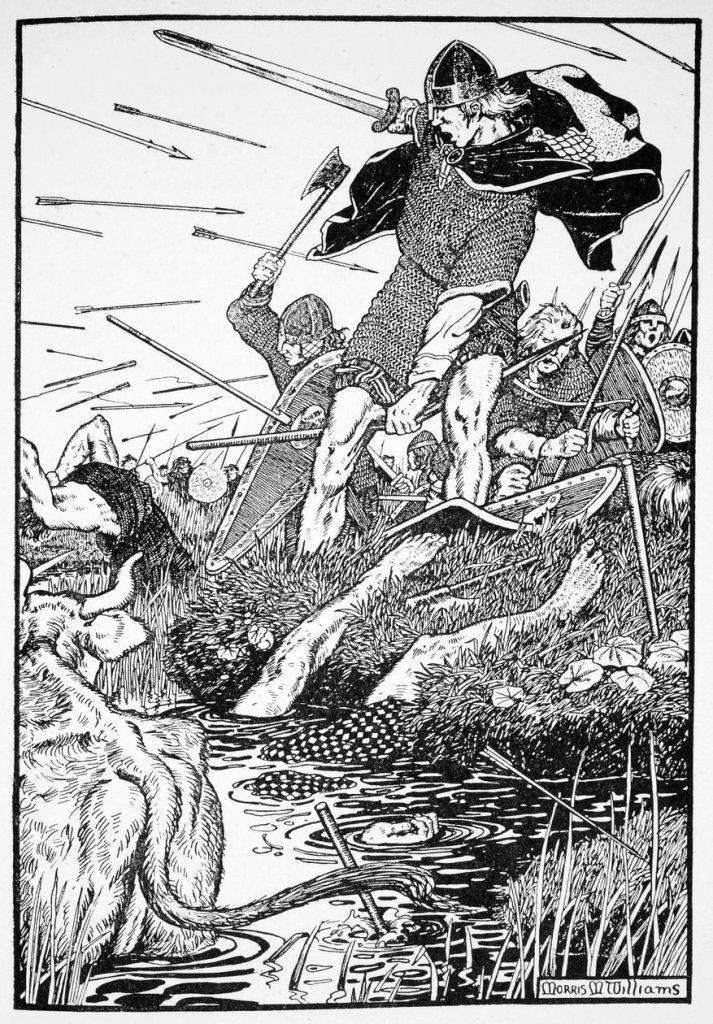
Wind comes off the Irish Sea with a brisk salt that pricks the lip and lifts the gull-cry over the lough, and the ground in Down remembers. The turf keeps a grain of hoof and boot, a thin echo of rivet and ring, a smear of iron where a spear kissed air and then rib. That shore speaks in two voices at once: a skald’s bright song of a king who answered with steel, and a colder whisper carried through rush and reed of a bargain strained to breaking, of a hand offered and a knife palmed beneath the cloak. Both voices meet in a single summer day in the year 1103, when the green of Ulaid watched a sea-king measure his fate with the length of a stride.
Magnus III of Norway stood inside that day’s light as if born from it. The Irish and the Scots named him Barelegs—Magnus berfœttr—because he wore the short Gaelic tunic, shins bright to the weather, a style chosen like a pennant of kinship with the western isles. He carried more than the repute of a raider. He moved as the last great sea-king in a lineage that had sounded every firth and sound from the Skagerrak to Dublin Bay. He held Norway by right, and the Orkneys by habit, and the Hebrides, Man, and the long Norse ward of Áth Cliath. He charted the Irish Sea like a private court and ruled its islands as beads of a single rosary threaded by hulls and oars. His wake drew allies and rivals in equal measure, and his name fitted the game of Irish kingship like a key that opens two doors.
Magnus made and unmade thrones. In the years before his death he cut a pact with Muirchertach Ua Briain of Munster, High King in claim and in will, who met resistance along the northern rim where Domnall Ua Lochlainn and the Uí Néill gathered their strength. Together, the sea-king and the high king formed a joined instrument: timber, sinew, sail, and horse; Norse oars and Irish spears; a pair whose aim bent toward mastery over all the island’s crowns. The bargain spoke with crisp clarity: the fleets of Norway would carry Muirchertach through the choke-points of opposition until one voice answered for Ireland entire; in return, Magnus would receive open acknowledgement of his overlordship in the Isles and the Hiberno-Norse gates, Dublin most of all.
The pledge tightened through kinship. Sigurd, Magnus’s young son, bound his future to Muirchertach’s daughter, Biadmuinia—one household joining another across salt water. A prince met a princess, and two peoples imagined a braided line of descent, a chain strong enough to yoke a sea to a plain.
Summer of 1103 moved with harvest warmth and clean weather. Magnus and Muirchertach campaigned with discipline, drove back their counters, raised standards on headlands and market greens. In Iceland a century later, Snorri Sturluson captured that year with a poet’s ear and a chieftain’s measure. He set down how Magnus, season spent, prepared to ride the winds home, keels trimmed for Norway’s winter. The fleet sheltered in a lough along Ulaid’s coast—Strangford or the Downpatrick waters—while the king awaited a provision of cattle for the voyage, due from his ally’s herds. Herds would mean hides and tallow, salt meat, spare sinew, a margin of comfort against December seas.
Days tipped forward. Hooves failed to drum the lanes. Magnus, brisk by nature, felt the leash tug. On the feast of St. Bartholomew, the sun carried a generous heat and rolled gold over the hills. The saga shows the king choosing action: a shore party, quick feet, a look to the hinterland, and a plan to draw cattle by his own hand if errands lagged. He left the main body near the ships and pressed inland with a smaller knot of men, standards trimmed close and shields slung for speed.
A sharp scene rises from Snorri’s page. The column crosses hedged paths and stone stiles, air smelling of crushed gorse and sweet grass. A low hill offers a view. From its crown the men see dust boiling up, a pale cloud that thickens against the sky’s blue plate. Relief loosens shoulders. Cattle drive, surely, with munstermen at the point. Helm-crests tilt; jokes pass; leather sighs.
The cloud swells and hardens. Horn points do not show. Instead, spearheads wink. The line resolves into men—many men—moving with the quick order of local ground-knowledge. The warriors of Ulaid come on, leaping the folds of earth, rising from scrub and hollow, a host drawn by wire and rumor to a single rendezvous. The Norse measure the truth with their eyes. Ease calcifies into resolve.
Then the saga’s glory ignites. Magnus collects his people with the steadiness of a master aboard a deck in heavy sea. He calls for the ‘Hel-Destroyer’ to fly and plants its shadow as fulcrum. He draws a ring of shields—a burg as hard as a millstone—faces outward, spear-points breathing. He fights as if sprung from iron, beard wet with sweat, blade singing. Irish charges crease the ring and rebound; gaps open, arms reach, quick knives work, the circle tightens again. Numbers pour in without end. A spear drives into the king’s chest above the mail’s rim. An axe kisses the leg with a strike that shears through muscle. Magnus drops upon grass the color of emerald glass. His men fold around him, and the ground drinks. The saga holds him upright even in falling—a figure cut for song, whose name carries across feasting boards in Bergen and Nidaros for generations.
Such grandeur fills the lungs. Yet the Irish annals place a cooler hand on the scene. Monastic script, steady and spare, enters the year 1103 with few strokes: “Magnus, king of Lochlainn, and the king of the Gall-Gaeidhil, came with a great fleet to Ulaid to raid, and he was killed, with the crew of eight ships around him, by the men of Ulaid, in a foray.” A ledger line. A fact. A dead sea-king in a corner of Ulster during a raid. In twelfth-century Ireland, violence arrived often enough to earn a clerk’s brevity.
Between the saga’s blaze and the annal’s cool ink lies a space where strategy breathes. There, one discerns the logic of power. Magnus had swelled in reach and daring. He served Muirchertach as ally and instrument, yet his fleets, his Dublin purchase, his habit of landing and marching, pressed upon Irish sovereignty like a thumb upon a bruise. A partner fills the room until partnership turns into supremacy. A master of currents may crack a calm harbor with wake alone.
Muirchertach, shrewd to the bone, likely read his board. He had lifted his authority with Norse oars. He had bruised his northern adversaries under a gale sent from fjord and island. With that work accomplished, he faced the weight of gratitude, and the greater weight of future dependence. An overmighty friend carries tomorrow’s claim inside today’s embrace.
Through that lens the delayed cattle acquire shape. Delay buys time: for whispers to cross hedgerows; for Ulaid’s war-band to gather at fords and ring-forts; for routes to be scouted by men who know each field wall’s gate-stone. A quiet message travels northward—place, hour, strength—while Munster’s spears hold position at an eloquent distance. The lough becomes a bowl; the shore, a funnel; the hill, a signal tower for those who wait with knives wrapped in wool.
From such angles, the encounter reads as a sprung design rather than a loose hazard. Ulaid provides the hand and the blow, and a southern king receives the advantage. Use a friend to strip your enemy, then open a path for that enemy to unhorse your friend. Two impediments vanish, and your own saddle sits easier. Statecraft rides with that kind of economy.
Two literatures serve two aims. Snorri Sturluson shaped his Heimskringla for memory’s fire and courtly appetite. A king of Magnus’s stamp demands an exit with pageant, with blade, with a standard that refuses to lower. The Icelandic prose builds a hall for that image and seats it high. The Irish monastic habit favors clean record over colored scene. A foreign ruler dead in a raid earns a single sentence, sufficient for a chronicle that trusts God to weigh men and does not court audience pleasure. In that script, the invader departs as any violent man departs: entered, dated, closed.
Yet Magnus’s fall swung a great door. After his body cooled in Ulster grass, Scandinavia ceased to cast an imperial net across the western seaways. The age of concerted Norse kingship over the Isles receded. Dublin, Wexford, Waterford continued with their Norse wards and markets, though their houses grew steadily more Hiberno-Norse, braiding names and laws and marriage-beds until Norway felt like sailcloth folded in a chest—kept, honored, used in stories, while daily life leaned into Irish grain and Irish law. A line of sea power loosened; a new weave of townspeople took purchase and sent root downward.
Certainty rarely attends such junctures. Maybe the king’s shore-party moved a step beyond prudence. Maybe a drover miscounted head and a guarantee slid across a table and into tall grass. Maybe design shaped everything from the first soft promise of cattle to the final raise of the axe. The earth keeps its pact with silence; the body of Magnus lay under the sod that he had saluted by adopting a Gaelic hem, and the sod closed over him with the patience of peat.
Yet the paired stories endure: the ring of shields and the clerk’s clause; the hall-song and the marginal note. They stand together on the same ground by the lough, where gulls wheel and the wind brings iodine and rain-scent across the water. One memory lifts a hero into bright company. Another records the removal of a danger with a single line. Between them, a third meaning steadies: ambition speaks one language at sea and another on land; friendship bends under sovereignty’s weight; and a king who walks ashore inside a bargain may meet men who serve a larger calculation than any toast can bind.
Walk that shore with eyes up and one hears the craft of reins and rudders. A banner once snapped there, a spear once gleamed there, a hill once offered a view that turned from hope to measure. The story opens its two faces and permits a reader to hold both in the same hand. The breeze moves over the lough as it moved then. The ground still remembers the stamp of men who carried mail and faith and hunger. The king they called Barelegs remains present in that memory, a figure caught between oath and advantage, bright sun on his calf, blade in his hand, watching a dust-cloud resolve into points of iron. The scene stands, and the question breathes through it: when power smiles and invites you inland, which path carries you home, and which path leads you to the circle of shields from which songs and ledgers both will rise?
Views: 117


