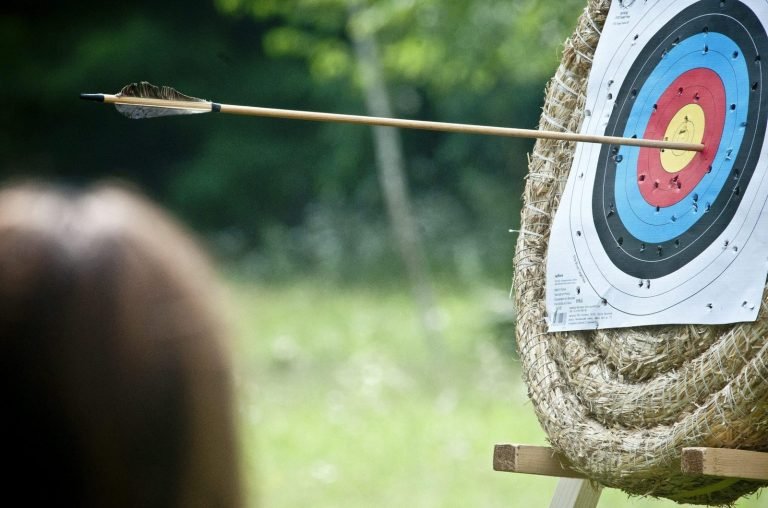
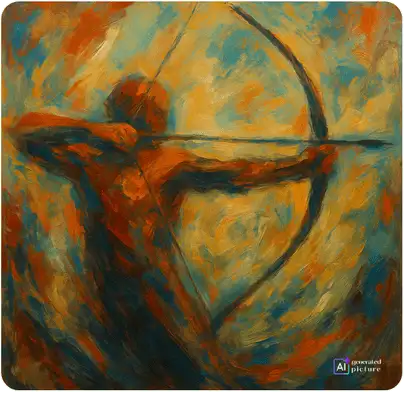
To draw the bow is to gather the world into your hands. Just before the first arrow flies, a hush settles—the kind that fills the chest with something heavier than air. The body enters its stance, feet firm, spine aligned, and the outer world withdraws. Only you remain, bound to the line between your heart and the heart of the target, humming with intention. That line travels beneath sight—it runs from the centre of your chest to the exact point you’ve chosen, binding everything within a slender, deliberate tension. The entire day inclines toward that breath. In that pause, the moment blooms. Every detail—the bow’s weight in your hand, the rise of grain beneath your fingertips, the breeze brushing your sleeve—presses forward with clarity. Each sense sharpens. Each element affirms your presence.This is the archer’s space. Less silence than a kind of waiting—like the world itself drawing breath. The body itself becomes what the philosophers call a dative of manifestation, a receiver of presences, open and attuned to the imminent event.¹
This state of pure, unadulterated presence, however, is born of a profound and deliberate act of violence. The drawing of the bow is an existential gesture, a conscious application of force that brings a stable system to the precipice of rupture. The groaning of the limbs, the tautness of the string against the fingers, the stored energy trembling to be released—these are the sensory data of a contained cataclysm. This act is the will made manifest, a striving that finds its meaning, its very joy, in the overcoming of resistance.² To be fully present with the bow is to be fully present with the force required to bend it, a force that promises both flight and destruction. This intense presence, this feeling of being utterly and completely here, is defined and deepened by the constant hum of its opposite. The world of the archer is one where presence and absence are locked in a dynamic embrace. The arrow, nestled against the riser, is intensely present, yet its very being is defined by its potential absence from the string, its future state as a streak of motion across the sky.
The target, whole and still, is present, yet it vibrates with the possibility of its own violation, its transformation into something pierced and irrevocably altered. The archer’s own calm is a presence held against the coming storm of the release. This is the truth that phenomenology reveals: we appreciate the presence of a thing precisely as other than absent; the horizon of its possible absence must be there for its presence to gain its full meaning.³ The lack itself becomes a palpable force, a presence of absence that charges the air.⁴
The drawn bow is the perfect vessel for this truth, a physical embodiment of potential energy that holds both being and its imminent dissolution in a single, unified form. The arrow, as the great poet-philosopher of space Gaston Bachelard might say, is an object of dynamic imagination, a thing we cannot conceive of as static. To imagine the arrow is to imagine its flight; its essence is its movement.⁵ In the moment of full draw, the archer gives the arrow its potential being, its “sudden salience on the surface of the psyche,”⁶ and in doing so, manufactures a reality where the interplay of presence and absence is brought to its most acute pitch. The price of this heightened state, this incandescent presence, is the introduction of controlled violence into the world.
The modern archer, standing on a manicured lawn and aiming at a foam target, holds an object that is a palimpsest of a deep and bloody history. The pacified ritual of sport is a form of cultural amnesia, a forgetting of the violence that is embedded in the very materials of the bow and the symbolic weight of the arrow. Consider the Mongol composite bow, a marvel of engineering and a testament to a brutal economy of creation. Its core is wood or bamboo, its belly is horn sliced from the skull of a water buffalo, and its back is a laminate of sinew harvested from the tendons of deer and elk, all fused together with glue rendered from animal hides and fish bladders.⁷ It is a weapon built from the repurposed bodies of the dead, a violent assemblage of organic matter that takes months, sometimes years, to cure into a unified whole.⁸ Its power is born from the tension between materials that resist compression and materials that resist stretching—a constant, internal war that gives the bow its ferocious strength. The violence is there in the object’s essence, long before it sends its first arrow toward a living target. This material violence is amplified by the bow’s historical legacy as a weapon of war and an instrument of social revolution. The English longbow, a simple stave of yew, became in the hands of common yeomen a tool that could dismantle the feudal order. At Crécy and Agincourt, the “cloud of arrows” loosed by these archers felled the flower of French nobility, their armor, the very symbol of their social and military superiority, pierced by bodkin points.⁹ The bow democratized death on the battlefield, disrupting the established hierarchy of combat and announcing a new era of warfare.¹⁰ Across the Eurasian steppe, the Mongol horse archers became a force of nature, their composite bows allowing for tactical innovations like the feigned retreat and the Parthian shot, which spread terror across continents.¹¹ Theirs was a total synthesis of human, animal, and weapon, a fluid and deadly form of presence that redrew the map of the world. This martial history haunts the modern sporting bow; every recurve inherits the design genius of the Mongol horseman, every longbow the legacy of Agincourt. To be truly present with the bow is to be present with this lineage of conflict. The arrow, too, carries a violent symbolic charge in our collective unconscious. It is the chosen instrument of Cupid, whose golden-tipped shafts inflict the beautiful violence of love, while his leaden ones inflict the cold violence of aversion.¹² It is the agent of divine will in the hands of Arjuna, whose celestial bow, Gandiva, is a symbol of his sacred duty, his dharma, to engage in righteous slaughter.¹³ His legendary feat of shooting the fish’s eye while looking only at its reflection is a myth of absolute, violent focus—the willed exclusion of all reality save the point of impact.¹⁴ And in the hagiography of Saint Sebastian, the arrow becomes an instrument of martyrdom, his body a canvas for ritualized punishment, a testament to the bow’s power to transform flesh into sacred text.¹⁵ The modern archer, in their quiet pursuit of sport, participates in this long story. The violence is always there, a resonant echo in the wood and sinew, a ghost in the graceful arc of the arrow’s flight.
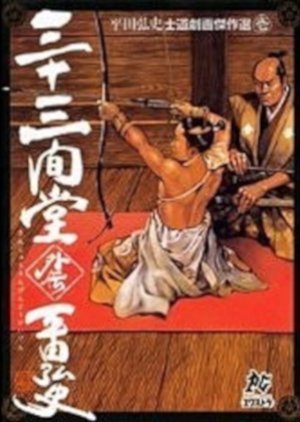
The archer’s own body becomes the crucible where this legacy of violence is internalized, disciplined, and transformed into a new kind of power. The long, arduous process of training is a form of productive violence inflicted upon the self. The struggle to master the bow—to overcome its physical resistance, to still the trembling of the mind, to perfect the intricate sequence of the shot—is a quintessential expression of what Nietzsche called the will to power.¹⁶ It is the life-affirming drive to seek out and overcome resistance, the understanding that happiness is found not in a state of rest, but in the very activity of overcoming.¹⁷ The archer’s pain, the burn in the shoulders, the ache in the back, the sting of the string on the forearm, is the necessary suffering that forges a stronger, more capable being. As Eugen Herrigel’s master describes it, the art of archery is “a profound and far-reaching contest of the archer with himself.”¹⁸ This Nietzschean perspective finds a powerful echo in Michel Foucault’s analysis of discipline. The archer willingly submits their body to a meticulous, repetitive, and exacting regimen, a system of power that produces what Foucault termed a “docile body.”¹⁹ Yet this docility is a paradox, for the body that is subjugated by this discipline is also the body that becomes liberated in its capacities. It is a “positive economy” of power, where submission to a form leads to a new kind of autonomy.²⁰ The archer’s posture, so rigid and seemingly unnatural, is the architecture of this productive violence. This process is further illuminated by Pierre Bourdieu’s concept of symbolic violence. The specific techniques of a given archery school, such as the eight stages of shooting (hassetsu) in Japanese Kyudo, represent a cultural standard, a doxa, imposed upon the novice’s body.²¹ This “correct” form is a type of cultural capital that, through endless practice, becomes internalized as habitus—a set of deeply ingrained dispositions that feel like second nature.²² he violence here is subtle, the quiet imposition of a system of norms that the archer’s body accepts as legitimate, thereby participating in its own restructuring. The archery range itself becomes a modern agon, the ancient Greek field of contest where individuals are forged in the fire of ritualized conflict.²³ The agon is a struggle for excellence, or arete, where one’s moral and physical character is tested against oneself and against others.²⁴ The archer’s body, then, is a site of convergence. The will to power provides the drive, the disciplinary techniques provide the method, and the agon provides the stage. The effortless grace of the master is the final product of a long, slow, grinding violence, a price paid willingly in the currency of discipline for the prize of a more potent and luminous presence.
When we zoom out from the individual body to the social field, archery reveals itself as a profound ritual, a mechanism for managing collective tensions and for engaging in sacred expenditure. The theories of René Girard and Georges Bataille, though seemingly divergent, offer two complementary perspectives on the violence at the heart of this ritual. For Girard, human desire is fundamentally mimetic: we learn what to want by imitating the desires of others.²⁵ On a shooting line, every archer desires the same scarce object—the center of the target. This convergence of desire inevitably creates mimetic rivalry, a subterranean current of competition and potential conflict.²⁶ This tension, Girard argues, is resolved through the scapegoat mechanism. The target becomes the perfect surrogate victim. All the aggression, all the frustration, all the mimetic rivalry simmering between the archers is channeled and discharged onto this inanimate object. The violent piercing of the target is a unanimous act that purges the collective tension, restoring social order to the line and allowing the ritual of competition to continue peacefully.²⁷ The target is sacrificed so that the community of archers may remain intact. Where Girard provides the social logic for this ritualized violence, Georges Bataille provides the existential and metaphysical one. For Bataille, all economic and social systems produce an excess of energy, an “accursed share” that cannot be productively reinvested and must therefore be expended, either gloriously or catastrophically.²⁸ The immense energy poured into archery—the years of training, the physical exertion, the expensive equipment, the focused attention—is squandered for a fundamentally “useless” purpose: to put a small hole in a piece of paper or foam. This is a perfect example of sovereign, non-productive expenditure, a magnificent waste that defies the modern logic of utility and provides a necessary outlet for life’s superabundance.²⁹ The act of loosing the arrow, in Bataille’s terms, is a transgression³⁰ It is the crossing of a limit, a violent rupture of the profane world of work and reason. In that explosive moment of release, the archer touches a “limit-experience,” a point where eroticism, violence, and the sacred converge.³¹ The archer is a discontinuous, separate being. The arrow, as an extension of their will, is sent forth to violently merge with the target, another separate being. This act is a search for continuity, a momentary dissolution of the isolated self in a sovereign act of expenditure.³² It is, in Bataille’s famous phrase, an “assenting to life up to the point of death.”³³ The violence of the shot is the very thing that generates this sacred, ecstatic feeling of connection and rupture. Girard and Bataille thus illuminate the same event from different angles. The target is a scapegoat that absorbs the violence of mimetic rivalry, and the act of sacrificing it is a transgressive, sovereign experience for the individual. Violence is the price of both social harmony and existential intensity.
All these streams of violence—the kinetic, the material, the historical, the psychological, the symbolic, the social, the sacred—converge in the archer’s presence and are consummated in the flight of the arrow. And here rises a final paradox, glowing quietly at the edge of all this effort—a contrast shaped between two ways of holding the bow, two ways of being in the world. One path follows the Western archer, driven by will, drawn by precision, shaping each shot with intention like a craftsman pressing form into clay. The other follows the Eastern tradition, where mastery flows from surrender rather than control. In the Zen way of archery, as Herrigel describes, the truest shot comes not from striving, but from a deep release—a letting go so complete it surprises even the archer. Presence, in this form, grows not from domination, but from dissolving into the act itself, until only the arrow speaks.The perfect shot is one that “takes the archer himself by surprise.”³⁴ The master instructs the pupil to become purposeless, to leave the self and all its strivings behind, until nothing remains but a pure, unthinking tension.³⁵ This state of
mushin, or “no-mind,” appears to be the very antithesis of the striving, dominating, will-to-power archer. Yet, it is the culmination. The egoless release is the final, most profound expression of the will to power: the power to overcome the will itself. One must first forge a powerful, disciplined self through years of violent effort before one has a self that is strong enough to be let go. The decades of self-inflicted, productive violence are the necessary foundation for the moment of serene, effortless presence. The vessel must be painstakingly built before it can be emptied. The myth of a pure, pacified sport, of a presence achieved without cost, is a comforting illusion. Real presence—whether you find it through sport, through art, or through the simple grit of living—isn’t soft or fleeting. It burns. There’s a kind of brightness to it, fierce and alive, because it rises from something deeper than ease. There’s a fire in it—quiet, held in the bones—a fire made of the force we carry when we choose, when we act, when we dare to shape the world around us. That force isn’t gentle, though it needn’t be cruel. It creates, and it changes, and sometimes it breaks. The arrow, once loosed, flies clean through that mystery—from the moment you draw it back with care, to the instant it strikes home and leaves its mark. In that one gesture, something timeless unfolds. A truth without disguise: that presence costs something, and the cost is what makes it real.
Footnotes:
¹ Sokolowski, Robert. Introduction to Phenomenology. Cambridge University Press, 2000, p. 151. Sokolowski uses the term “dative of manifestation” to describe the human subject as the recipient to whom things appear.
² Reginster, Bernard. The Affirmation of Life: Nietzsche on Overcoming Nihilism. Harvard University Press, 2006. Reginster argues that for Nietzsche, the will to power is best understood as the “desire for the activity of overcoming resistance.”
³ Sokolowski, Robert. Introduction to Phenomenology. Cambridge University Press, 2000, p. 37. Sokolowski states, “When we appreciate the presence of a thing, we appreciate it precisely as not absent: the horizon of its being possibly absent must be there if we are to be aware of the presence.”
⁴ Sartre, Jean-Paul. Being and Nothingness. Translated by Hazel E. Barnes, Washington Square Press, 1992. Sartre’s example of looking for his friend Pierre in a café illustrates how an absence can become a palpable presence, a “nothingness” that defines the scene.
⁵ Bachelard, Gaston. Air and Dreams: An Essay on the Imagination of Movement. Translated by Edith R. and C. Frederick Farrell, Dallas Institute Publications, 2011, p. 58. Bachelard writes, “one cannot imagine a sphere without having it turn, an arrow without having it fly.”
⁶ Bachelard, Gaston. The Poetics of Space. Translated by Maria Jolas, Penguin Books, 2014, p. 1.
⁷ A typical Mongol composite bow was made from a wooden or bamboo core, with horn glued to the belly (the side facing the archer) and layers of sinew glued to the back. These materials were chosen for their properties under compression (horn) and tension (sinew).
⁸ The curing process for the animal glue used in composite bows could take many months, sometimes over a year, to allow the materials to fully set and bond.
⁹ The Battles of Crécy (1346) and Agincourt (1415) are famous examples where English longbowmen decimated French forces, including heavily armored knights.
¹⁰ The effectiveness of the longbow allowed common soldiers to defeat aristocratic knights from a distance, challenging the existing social and military hierarchies of feudal Europe.
¹¹ Mongol horse archers were renowned for their mobility and tactical prowess, using maneuvers like the feigned retreat to lure enemies into traps and the Parthian shot (firing backward while retreating).
¹² In Roman mythology, Cupid (or Eros in Greek myth) possessed two types of arrows: one with a golden tip to inspire love and another with a lead tip to cause aversion.
¹³ In the Mahabharata, the divine bow Gandiva is given to Arjuna by the god Agni. It symbolizes his power and his duty (dharma) as a warrior to fight in the Kurukshetra War.
¹⁴ In a famous test of skill, Arjuna was able to shoot the eye of a fish target by looking only at its reflection in water, a story that highlights his supreme focus and mastery.
¹⁵ The martyrdom of Saint Sebastian, who was tied to a post and shot with arrows, is a recurring theme in Christian art, depicting the bow as an instrument of both punishment and the creation of a sacred figure.
¹⁶ Nietzsche, Friedrich. The Will to Power. Translated by Walter Kaufmann and R.J. Hollingdale, Vintage Books, 1968. Nietzsche posits the will to power as the fundamental drive in all beings to expand their force and overcome resistance.
¹⁷ Nietzsche challenges the idea that life’s goal is the avoidance of suffering, suggesting instead that the struggle and the overcoming of obstacles are integral to a meaningful and affirmed life.
¹⁸ Herrigel, Eugen. Zen in the Art of Archery. Translated by R.F.C. Hull, Pantheon Books, 1953.
¹⁹ Foucault, Michel. Discipline and Punish: The Birth of the Prison. Translated by Alan Sheridan, Vintage Books, 1995. Foucault describes how disciplinary practices create “docile bodies” that are both obedient and highly capable.
²⁰ Vigarello, Georges. “The Life of the Body in Discipline and Punish.” Sociology of Sport Journal, vol. 12, no. 2, 1995, pp. 158-177. Vigarello explores the paradox in Foucault’s work where the subjugation of the body through discipline also leads to its autonomization and the liberation of its forces.
²¹ Bourdieu, Pierre. Outline of a Theory of Practice. Translated by Richard Nice, Cambridge University Press, 1977. Doxa refers to the taken-for-granted, common-sense beliefs of a social field, which are perceived as natural and self-evident.
²² Habitus refers to the system of ingrained dispositions, skills, and ways of acting that individuals acquire through their life experiences, which shapes their perceptions and actions without conscious thought.
²³ Agon (ἀγών) is the ancient Greek term for a contest, struggle, or conflict, encompassing everything from athletic competitions like the Olympics to warfare and philosophical debates.
²⁴ Arete (ἀρετή) is a Greek concept signifying excellence of any kind, particularly moral virtue and the fulfillment of one’s potential, often demonstrated and proven through the agon.
²⁵ Girard, René. Things Hidden Since the Foundation of the World. Translated by Stephen Bann and Michael Metteer, Stanford University Press, 1987. Girard’s central thesis is that desire is mimetic, or imitative.
²⁶ When two or more individuals desire the same object, which cannot be shared, mimetic desire leads to rivalry and conflict. This is a core theme in analyses of sport through a Girardian lens.
²⁷ Girard, René. Violence and the Sacred. Translated by Patrick Gregory, The Johns Hopkins University Press, 1977. The scapegoat mechanism functions by uniting a community in unanimous violence against a single victim, thereby purging the internal conflicts caused by mimetic rivalry.
²⁸ Bataille, Georges. The Accursed Share: An Essay on General Economy, Vol. 1: Consumption. Translated by Robert Hurley, Zone Books, 1991. Bataille argues that every system produces an excess of energy that must be expended uselessly.
²⁹ Activities like art, non-procreative sexuality, ritual, and war are, for Bataille, forms of this necessary, non-productive expenditure.
³⁰ Foucault, Michel. “A Preface to Transgression.” In Aesthetics, Method, and Epistemology, edited by James D. Faubion, The New Press, 1998, pp. 69-87. Foucault’s essay on Bataille famously explores transgression as an act that affirms the limit it crosses, relating it to the sacred.
³¹ Bataille, Georges. Inner Experience. Translated by Leslie Anne Boldt, State University of New York Press, 1988. The “limit-experience” is a moment that pushes beyond the boundaries of rationality and the profane world of work and utility.
³² Bataille, Georges. Erotism: Death and Sensuality. Translated by Mary Dalwood, City Lights Books, 1986. Bataille posits that individual beings exist in a state of “discontinuity.” Eroticism, like death and sacrifice, is a violent transgression that aims to dissolve this separation and attain a state of “continuity.”
³³ This phrase, central to Erotism, defines the erotic impulse as an affirmation of life so total that it embraces its own dissolution in death.
³⁴ Herrigel, Eugen. Zen in the Art of Archery.
³⁵ Herrigel, Eugen. Zen in the Art of Archery. The master urges Herrigel to let go of his willful will and achieve a state of “purposeless tension.”
Bibliography
Bachelard, Gaston. The Poetics of Space. Translated by Maria Jolas, Penguin Books, 2014.
Bataille, Georges. The Accursed Share: An Essay on General Economy, Vol. 1: Consumption. Translated by Robert Hurley, Zone Books, 1991.
Bataille, Georges. Erotism: Death and Sensuality. Translated by Mary Dalwood, City Lights Books, 1986.
Bourdieu, Pierre. Outline of a Theory of Practice. Translated by Richard Nice, Cambridge University Press, 1977.
Foucault, Michel. Discipline and Punish: The Birth of the Prison. Translated by Alan Sheridan, Vintage Books, 1995.
Girard, René. Things Hidden Since the Foundation of the World. Translated by Stephen Bann and Michael Metteer, Stanford University Press, 1987.
Girard, René. Violence and the Sacred. Translated by Patrick Gregory, The Johns Hopkins University Press, 1977.
Herrigel, Eugen. Zen in the Art of Archery. Translated by R.F.C. Hull, Pantheon Books, 1953.
Nietzsche, Friedrich. On the Genealogy of Morals. Translated by Walter Kaufmann and R.J. Hollingdale, Vintage Books, 1989.
Nietzsche, Friedrich. The Will to Power. Translated by Walter Kaufmann and R.J. Hollingdale, Vintage Books, 1968.
Vigarello, Georges. “The Life of the Body in Discipline and Punish.” Sociology of Sport Journal, vol. 12, no. 2, 1995, pp. 158-177.
Views: 102