‘That record shows those who come after how far a human being can go through effort.’¹
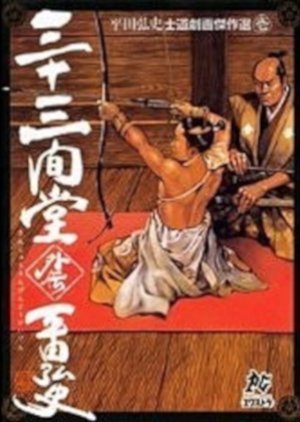
Hoshino Kanzaemon speaks these words to Wasa Daihachirō when the younger archer buckles beneath the inherited burden of Sanjūsangendō, while the sentence gives Mikio Naruse’s A Tale of Archery at the Sanjusangendo its governing moral measure. Japanese accounts quoting the scene preserve the line—「あの記録は人間が努力すればここまでやれるということを、あとから来る者に示すものだ」—where Hoshino interprets achievement as something transmitted to later hands, its purpose extending beyond private glory. What, then, does Naruse make of an accomplishment whose highest purpose lies in enabling another person to exceed it? Through my reading, the film answers that question beneath the long western eaves of Sanjūsangendō, where reputation passes through grief while skill enters care, leaving inherited duty to settle into each release. Each successful passage acquires a number whose survival turns exertion into memory, yet Hoshino’s conduct steadily alters the meaning borne by the count. By teaching the man capable of taking his title, the older archer converts mastery from possession into transmission.
Beneath accumulated force the bow bends, while its purpose arrives through release, when stored energy crosses from the archer’s hand into a course governed by distance. Naruse builds his finest argument from the same movement, placing value in knowledge a skilled hand can send beyond its own keeping.
History gives the drama a severe piece of timber against which to work, for Sanjūsangendō makes architectural form participate directly in athletic ordeal. During the Edo period, tōshiya contests used the western veranda as a test of archery in which shafts travelled beneath the eaves from one end of the hall to the other across roughly 120 metres. Rengeōin records several forms of the practice, with shorter fixed-arrow trials preceding the celebrated ōyakazu, whose duration stretched from evening through the following day. In 1669 Hoshino Kanzaemon of Owari sent 8,000 arrows through the required passage from 10,542 attempts, establishing the measure later generations would inherit. Seventeen years later, Wasa Daihachirō of Kii achieved 8,133 successful traversals from 13,053 shots, performing the feat at about eighteen years of age.² Clean numerals now carry that history with archival efficiency, compressing an ordeal into figures that sit quietly upon a page. My shoulder aches merely imagining their production, for each total grew through fingers drawing cord while attendants placed shafts within reach, disciplined breathing sustaining repetition as timber received every flight whose course ended against the building. Arithmetic preserves achievement through compression; Naruse returns flesh to the count.
Along the western side of the hall, architecture participates in every shot as an active condition of success, shaping the archer’s choices before the string moves. Rebuilt in 1266, Sanjūsangendō extends along a remarkable north-south line whose exterior corridor seems almost to draw the eye through its own measure. Under those eaves, however, length acquires an answering severity, for a generous ballistic curve would meet the roof while successful passage demands a flatter flight carrying speed through a restricted vertical allowance. I imagine a church aisle whose rafters have become a second law of motion, each beam schooling strength through exactness while the archer works below. Every release therefore enters negotiation with carpentry already centuries old when the bow rises into position. Roof, pillar, ground become active conditions of passage, leaving distance itself to complete the judgment imposed by the building.
Repeated framing reveals Naruse’s understanding of that relation through movement before exposition has finished naming it. Daihachirō carries himself like a youth pursued by a number long before he reaches the shooting line, for his father’s ritual suicide after defeat has turned archery into inherited debt while Okinu has raised him beneath the expectation of restoring the family name. JFDB’s surviving synopsis establishes this dramatic premise clearly: five years earlier the father died after losing to Hoshino, leaving the son to train under Okinu’s vigilant care. Fiction presses grief into the joint of an authentic rivalry, giving historical arithmetic a wound capable of speaking through character. Eight thousand therefore reaches Daihachirō as accusation as well as sporting measure, turning an archival total into a force that inhabits his training.
Practice acquires moral danger when a dead man’s reputation governs the hand of the living, for repeated effort now carries family grievance through every movement. Within Daihachirō’s agitation, Naruse gives that burden a visible pulse, as the youth flares against counsel before doubt drives him back into disciplined labour. Ichikawa Senshō plays the part with an exposed volatility that can initially appear broad beside the director’s quieter later work, though the excess gives reputation a physical habitation. Such agitation makes honour feel lodged in muscle, where inherited expectation tightens before the contest itself begins. Filial duty consequently travels along the shaft before architecture ever judges its passage, binding private grief to public performance.
Okinu holds the other portion of that labour within the inn, where preparation for public glory depends upon repeated acts of care. Kinuyo Tanaka gives her watchfulness the weight of years spent feeding, sheltering, persuading, managing a young man whose future has occupied her private days. Public remembrance will attach itself to Daihachirō should he succeed, whereas the conditions supporting that success have accumulated through meals set before him while clothes remain ready, discouragement met across another morning. Domestic work thus sits beneath heroic arithmetic like joists under floorboards, carrying weight while public attention rests upon the archer. Accordingly, I read Okinu as keeper of the human cost attached to the attempt, for her care restores scale to a story already moving into legend.
Karatsu Kanbei enters this household carrying an ease Daihachirō has yet to acquire, allowing Naruse to make comportment itself into evidence. Hasegawa Kazuo moves through conflict with a looseness that exposes prior discipline, for the stranger inhabits danger like a man whose training has already survived judgment. Amid encounters with hired swords, composure gives the director a different image of mastery from the younger man’s clenched striving, with muscles remaining available as attention moves quickly from threat into consequence. When Kanbei begins guiding the aspirant, instruction arises first through stance, timing, the quality of a glance held upon another person’s movement. Technique therefore appears as a manner of inhabiting one’s own limbs, while biography arrives later to explain authority already legible in gesture.
Views: 107