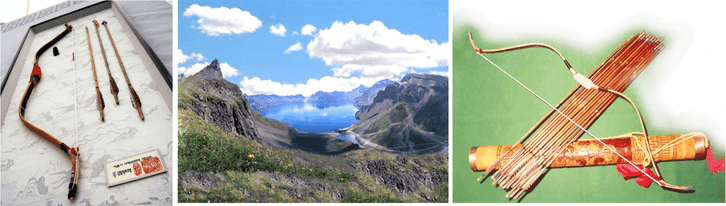
Wind travels down from Baekdu’s crater lake in thin blue bands, crosses volcanic scree, the larch forests, the rice fields, and enters the peninsula with a faint taste of stone and snow; along that wind, for millennia, arrows have flown. Korea remembers itself as a country of the bow: mythic kings such as Jumong and Bak Hyeokgeose receive their first aura through extraordinary marksmanship, while later dynasties expect every soldier, and many scholars, to prove themselves with horn bow and bamboo shaft. Language itself bears the imprint; old texts gloss hwal as the native word for bow, explain that “to shoot” becomes hwal-sswae, and record how Chinese chroniclers, gazing eastward, joined the characters for “great” and “bow” to name the peoples they called Dongyi, those eastern archers whose short powerful weapons fed both tribute and fear. In modern Seoul, composite horn bows hang in archery clubs, children learn Olympic recurve technique at school, and the state treats traditional hwal-ssogi as a form of living heritage, a martial art that still sends bamboo-string twang over glass and concrete toward the surrounding hills.
Out of that long, wind-bruised habit of bows and arrows, two figures step forward with very different weather walking at their shoulders. One of them, Bae Sang-yeol, came into the world by way of Dalseong in the early nineteen-sixties, a small boy whose first lungsful tasted of river fog and the sour-sweet breath of orchards. Soon enough he trailed behind his father up toward Seoul, watching as furrowed fields and stone-stitched paths slid away behind the bus window and the world tightened itself into concrete alleys, squat roofs, a factory light that pretended to be a second, sleepless sun. In that city he slipped down into the technical belly of a big newspaper, among steel ribs and humming ducts, air-conditioning that came cold along his shoulders, presses below that hammered their iron heartbeat so steadily that, on some nights, the whole building felt like a single tired animal breathing ink. Little by little those machinery rooms bent sideways into his own half-secret library. While colleagues dozed between shifts on plastic chairs with their jackets over their faces, he stayed awake, fingers blackened with pencil dust, following war chronicles, envoy journals, reports of fleets edging along winter coasts, embassies inching over snow passes, columns dragging themselves through river-cold mud. He kept redrawing the peninsula in the margins until his notebooks looked like weather charts of invasion and retreat. Years of that hidden, half-paid work straightened him into the line of an independent historian: the man who later sent out thick volumes on Yi Sun-sin, on Goryeo embassies, on forgotten forts and sea walls, all driven by the same stubborn nerve that keeps a press line thudding through the small hours—an instinct that machine and destiny share one wired nervous system.
The other, Choi Yun-jung, arrived almost a generation later, carrying school satchels through Jinju streets and shuffling exam papers across desks before she ever imagined herself as anyone’s “author.” She passed through university lecture rooms as a history student, taking notes on dynasties and half-erased tribes, then stepped, quite simply, into marriage and then into motherhood in Ulsan, that shoreline city where shipyard cranes and petrochemical towers stand up like huge, steel calligraphy against the sea-mist. Daylight filled itself around her without needing to ask permission: pots muttering on the hob, small socks turning on the washing line, children’s workbooks spread across the table, a doorbell that kept finding new excuses to ring. Yet when evening slid in and the apartment thinned down to quieter household noises, the same table grew longer somehow. The exercise books would close, and a different paper opened—library loans, second-hand finds, glossy new volumes. She read through those hours with a steady, hungry patience, pulling toward her a private hoard of books on Gojoseon, Buyeo, Goguryeo, and on the half-visible forest peoples who flicker in the margins of Chinese chronicles. The stack beside her chair grew higher; the map inside her chest grew more intricate, like fine grain revealed when you cut into seasoned wood. In the end, silence itself began to feel too tight. The hand that had turned pages for years edged sideways, almost sheepish at first, and closed around a pen.
Bae’s long discipline in the service corridors of that newspaper gave his eyes a particular tilt. He had learned how a system holds together, how a single cog jam and an entire edition tremble, how cold air, ink, paper reels, human timing, all must fall into step just so for the illusion of effortless daily news to roll out onto breakfast tables. That training seeped into his history-thinking. In the naval books, ships never appear as scenery; they move like large, deliberate instruments, gathering wood, iron, rope, tide and weather into one frail pattern of survival. In Hwal (The Bow), that love for devices shrinks down and hardens around an earlier machine: the composite bow that stretches the reach of a Stone Age community and, with that stretch, changes how those people feel their own size. He chooses a time before any named kingdom, a season when the peninsula has yet to step into written record, and fills it with a band of river people along the northern waterways, ancestors-in-waiting of later Koreans. They grind grain on stone, twist fibre into cloth, shape plain pottery with thumb and palm, and speak soft and serious of Baekdu as a promised “bright land” that hangs just beyond their line of sight. Fires throw their orange skins along the riverbanks; elders lean in to tell stories; children fall asleep against dogs and against baskets of tools. Hunger and weather keep a close hand round every throat. Into that tender, precarious circle, one day, a new curve of wood arrives.
Bae’s long discipline inside the back corridors of a newspaper shaped a particular kind of gaze. He learned how systems hold together, how a jammed cog halts an entire edition, how ventilation, ink, paper, and timing produce the illusion of effortless daily news. That training folds into his historical imagination. In his naval epics, ships function as elaborate instruments that gather wood, iron, rope, and weather into a single pattern of survival. In Hwal (The Bow), that fascination with devices condenses around one early machine: the composite bow that transforms a Stone Age community’s reach and therefore its sense of itself. He chooses a time before any named kingdom, before the peninsula even enters written history, and populates it with a band of people around the northern rivers, ancestors of later Koreans, who grind grain, weave fibre, shape simple pottery, and speak of Baekdu as a promised “bright land” that hovers beyond their horizon. Fires burn along those riverbanks; elders tell stories; children sleep against dogs and baskets. Hunger and weather hold every life in a close grip. Into that intimate fragility enters a new curve of wood.
At the centre of Hwal stand two figures: a hunter with the patient curiosity of a technician and a woman already marked within the clan as someone through whom unseen powers speak. The hunter notices that a bent branch, when released, snaps back with startling force. He experiments with simple self bows, cutting young saplings, stringing them with twisted plant fibre, trying to send short arrows against birds and small beasts. Failure follows failure: wood warps, limbs splinter, strings fray, shafts fishtail through the air. His persistence gradually teaches him that seasoned wood yields cleaner force, that sinew glued along the back of a stave endures strain, that horn fixed along the belly permits shorter yet stronger curves. Under his hands, the first lamination of horn, wood, and sinew emerges, and with it the principle that stored energy in a frame can leap into a narrow shaft many times a day without breaking the archer’s arm. Around him polished stone arrowheads pile up on mats; each point carries hours of grinding, the ache of shoulders, the faint ringing in a worker’s bones. When the new bow hurls those points in clean arcs toward deer on distant slopes and fish in shallows beyond spear reach, the clan’s diet and risk begin to change. Successful hunts provide surplus, surplus permits longer migrations, and longer migrations require leaders who master range, timing, and intimidation.
Bae threads that material development into a delicate web of kinship and belief. Before the bow acquires central importance, descent and ritual run along maternal lines. Grandmothers recite genealogies, keep in memory who married whom, whose death required which offerings. Women preside over planting rites and funerals, and a female shaman falls into trance beside the fire, carrying voices from river and mountain into the hearing of the group. With the bow’s rise, the definition of excellence tilts toward bodies that endure repeated heavy draws, eyes that track targets across distance, minds that calculate angles in the split breath before release. Young men who train daily along the tree line carry meat and defence back to camp; their prestige increases with every successful raid and every repelled incursion. The shaman’s visions bend toward sanctioning this new practice; in possession she speaks of a god who blesses arrows, of a totemic presence lodged within horn and string, of a path toward Baekdu that the clan must follow under divine archery. Through her trances and her lover’s experiments, a new social order crystallises. Ritual authority and ballistic skill fuse, elders reinterpret ancestral legends to place the bow in chosen hands, and a form of patriarchal command coalesces without any decree, simply through repeated association between survival, male archers, and heavenly favour.
Choi Yun-jung, sitting at her kitchen table centuries later with a pen beside a cooling teacup, turns her attention toward a different edge of the same long arc. A line in an old Chinese chronicle mentions Dongye, a people in the forests and coastal plains of the north-east, and remarks that short bows used in the Lelang commandery come from that region. From this single remark she begins to imagine forests rimed with frost, salt caravans winding along narrow paths, and small polities balancing between larger powers. Her study of history supplies the names: Gojoseon fallen, Buyeo and Goguryeo in ascendance, Han commanderies clinging to strategic points, Dongye and other tribes caught between tribute and resistance. Her daily life in Ulsan supplies the texture: neighbours greeting one another on stairways, gossip carried through markets, the weight of a child on a mother’s back during errands. Through that convergence she gives birth to Hwaryeo, a Dongye community hemmed in by woods and war roads, and to Geomeun Hwal (Black Bow), a novel that listens for voices behind that chronicle line about short bows and origins.
In Hwaryeo, the girl Suri walks at the soft centre of things, granddaughter to the samro, the old man whose word steadies the village, so that her days first run along easy rails: sunlit courtyards that smell of rice and ash, festival nights where drums push against her ribs from inside, grown hands pressing sweets into her small palm, the same grown mouths already weighing which household will one day claim her. The elders fold her away from heavy work as if she were a lacquer bowl, precious, kept from rough fingers. Yet her gaze keeps slipping sideways, away from the courtyard brightness, drawn downhill to the bowyer’s shed, that half-shadowed box of a place where curls of wood lie underfoot like a pale tide, where strips of sinew hang near the hearth and dry into nervous strings, where glue and smoke thicken the air until breathing feels close to chewing. Sogeunge lives there most hours, the master bow-maker with speech that comes out in stumbling pieces, words catching on the teeth so that some villagers hear only the breaks in his voice and walk past, blind to the exact, fox-like intelligence in his wrists. He watches Suri watching him: the way her eyes drag along the length of a limb, measure the bend of it, follow a string in its lazy arc even when he pretends to speak with other visitors. Something in that steady stare—hungry and shy in the same heartbeat—tells him she fits at the bench more than in the circle of marriage-chatter. So he begins to call her in on the softer afternoons, when shadows grow long and the village feels half-asleep; he lays her hands straight onto raw wood, lets her learn the drag of the grain under the knife, shows her how a stave swells or narrows toward its own voice, how length, width and curve mutter and quarrel together until one clean line of strength finally stands up. Her apprenticeship stretches itself like an extra skin over the day’s ordinary work: mornings she sews, stirs pots, carries bowls into the smoke of ceremonies, listens with one ear to the gossip of aunts and cousin-sisters; then, as conversations sag into the usual counting of husbands and dowries, she discovers small excuses to slip away, drifting back down to the shed to tame a stubborn edge, to lash horn along a bow’s warm belly, to leave in the pale dust at her feet a thin bright trail that gives her secret allegiance away.
Everything tightens when a salt merchant named Lee-su enters Hwaryeo. His pack frames him as a simple trader, yet he carries with him a dark, compact bow whose colour and form differ from local weapons. Suri’s first touch of its limbs reveals a deeper tension than any she has felt before, as if the bow held distance inside itself. When bandits strike Hwaryeo during a period when younger men march away on external service, panic rips through the village. In that rupture Lee-su reveals his second life: he moves with a calm urgency, positions himself behind cover, and sends arrows from the black bow that tear through attackers with startling velocity. Bodies fall before many villagers even see where the shots originate. Suri watches in a shock that mingles fear and exultation, for she recognises in each arrow the culmination of every principle she has studied in Sogeunge’s shed, now raised to a level beyond her experience. Desire to grasp that design ignites within her; in an impulsive, clear-eyed act she steals the black bow. That theft fractures trust and yet opens a new channel between her and Lee-su. Their exchanges, part quarrel and part workshop, carry them from hostility through grudging respect toward partnership, as they dismantle, measure, and gradually replicate the weapon’s structure. Through their hands the black bow ceases to belong solely to an enigmatic outsider and becomes embedded in Hwaryeo’s fate.
Choi aligns this technical drama with a widening political storm. Hwaryeo sits between the Han commandery in Lelang, the ambitions of Goguryeo, and the demands of larger Dongye groupings. Short bows from these forests command high value; rulers beyond the mountains speak of them as tribute, covet them for elite troops, send emissaries or raiding parties to secure their supply. As Suri and Lee-su perfect their understanding of the black bow, they realise that each improvement in range or durability carries implications for alliances and survival. Warriors who carry such weapons alter the balance between small polities and empires. Choi’s scenes move from intimate workbenches to war councils where elders debate submission or resistance, and further to battlefields where Dongye archers stand beside allies from Buyeo or under banners raised by Goguryeo kings. Through it all, the bow shaped in Suri’s shed links the safety of her grandparents’ house, the integrity of her village, and the strategies of distant generals. The short, dark stave becomes at once a tool of love, a sign of Dongye identity, and a hinge-point where imperial ambition bears down on a forest community.
Placed side by side, Hwal and Black Bow sketch a broad span between origin and refinement in Korean archery. Bae sets his narrative at a moment when a community first discovers that bent wood and string can hold energy and send stone points across a ravine; every shot feels like a step into fresh territory. The bow appears as a threshold, an invention hardly distinguishable from magic in the eyes of those who see a deer fall at a distance for the first time. Choi chooses a later stage, when archery already defines Dongye’s reputation; Chinese officials speak of short bows from that region with a mixture of admiration and anxiety. Her story focuses on incremental advances: a particular lamination method, a precise curvature, a choice of glue or horn that yields an advantage in speed or penetrating power. Bae prefers migratory scale—bands moving toward Baekdu under guidance of new weapons and new spirits—whereas Choi concentrates on one frontier corridor, a handful of villages and fortresses where decisions about bow design ripple outward into treaties and campaigns. Through both works, the title image of “Dongi fires” and “Dongye storms” gains depth: the glow of early hearths where a first bow leans against a wall, and the later tempests of war clouds where refined short bows flash like dark birds between trees and fortifications.
Their treatment of gender within this technical history enriches the field even further. In Bae’s prehistoric camp, women carry memory, ritual, and early decision-making; they control the rhythms of food storage and burial, they serve as the mouth of the unseen in trance. As composite bows demand regular training and reward upper-body strength, men who commit to that practice climb the ladder of prestige. The female shaman’s role shifts toward blessing their raids and interpreting omens around their hunts, and in that movement the novel hints at a slow transfer of power from maternal councils toward male-led war parties. The bow there appears as an engine of social reconfiguration, an artefact through which one can trace the rise of a patriarchal pattern. In Black Bow, a woman steps directly into the technical heart of the matter. Suri refuses to confine her curiosity to the domestic sphere; she seeks mastery of materials and trajectories with the same intensity that later ballisticians might give to gunpowder and cannon. Lee-su’s eventual willingness to teach her, even at cost to his own strategic advantage, grants her a form of authority that many in Hwaryeo struggle to recognise. Her path mirrors Choi’s own life in Ulsan: hours given to household tasks, yet mind and pen engaged in large historical designs, a movement from implied support role toward authorship in both senses of the word.
Beneath these two novels the ground keeps an older story of soil and stone humming away by itself. Archaeologists worry the earth with trowel and brush and their hands come up full of arrowheads from Neolithic graves, thin blades of polished rock tucked in beside the ribs of the dead like last, hard feathers. Later layers swell with bronze: socketed points, squat daggers, small metallic mouths that already began to bite into the shape of weapons and, with that bite, into the way quarrels thickened and turned themselves into killing. Later layers yield iron arrowheads and written manuals, then scrolls that praise compact horn composite bows as the pride of Korean armies. Archery grounds beside city walls once rang with practice aimed at moral cultivation; magistrates and scholars took pride in steady aim and disciplined breath. In modern times, national archers stand upon Olympic podiums with carbon shafts and fibreglass limbs, yet behind their confident posture lies an inheritance of form and feeling that reaches back toward Suri’s forest and Bae’s riverbank. The bow remains a line through Korean memory, a device linking the hand of a single archer to the fate of many, an emblem of distance bridged through discipline.
Seen through this lens, Bae Sang-yeol and Choi Yun-jung appear as archers of another kind, each standing on the edge of forgetfulness. Bae, raised between countryside and city, seasoned in the humming dark of mechanical rooms, sends his arrow deep into prehistory, toward a people who exist only in shards of stone and whispers of myth, and imagines the first instant when a clan believes that its survival depends on a bent stave and a string humming in the air. Choi, seated in an Ulsan apartment while children sleep, sights along the narrow line between a few Chinese characters and the lived reality of Dongye’s men and women, then releases her story into a field filled with chronicles that once overlooked such lives. Their novels teach that technology never arrives as a mere object. A bow reshapes kinship, leadership, ritual, and even the stories a people tell about origin and destiny. From Dongi fires near Baekdu to Dongye storms along frontier forests, Korea meets itself at the mark: in the drawn breath before release, in the hand steady upon the grip, in the arrow that arcs outward carrying the weight of hunger, hope, memory, and choice.
Views: 95