

Rome Learns Distance
The arrowhead rose from the Mesopotamian soil like a small dark tooth, green under its rust as though it had grown there with the barley. A man in a fluorescent vest and cracked boots—whatever name his century gave him—kicked at a clod near Harran, saw the metal wink, and bent. His fingers rubbed away dust that had drifted since June of 53 before Christ. Under that dust waited a fragment of one decision: a Parthian horseman had drawn a horn bow to the ear, under a sky like hammered tin, while seven Roman legions crouched inside a square of shields and thirst. Somewhere in that square a man from the Sabine hills had lowered his scutum and glimpsed the incoming arc for half a breath, as a farm boy glances at a hawk, and then the arrowhead that now lay in this stranger’s palm had searched for somebody’s ribs. The wind passed over the field again; the barley whispered around his knees with the same rhythm as those swarms of shafts that once fell from Parthian hands upon Roman iron.
He felt more than weight.
Bronze lay in his palm, yet the century pressed through it. The point carried a question that Romans in the last age before their Christ had begun to taste with unease: how long could a state founded upon the intimacy of the sword compel obedience in landscapes that rewarded the long reach of the bow.
Inside their own stories, Romans stood inside a rectangle.
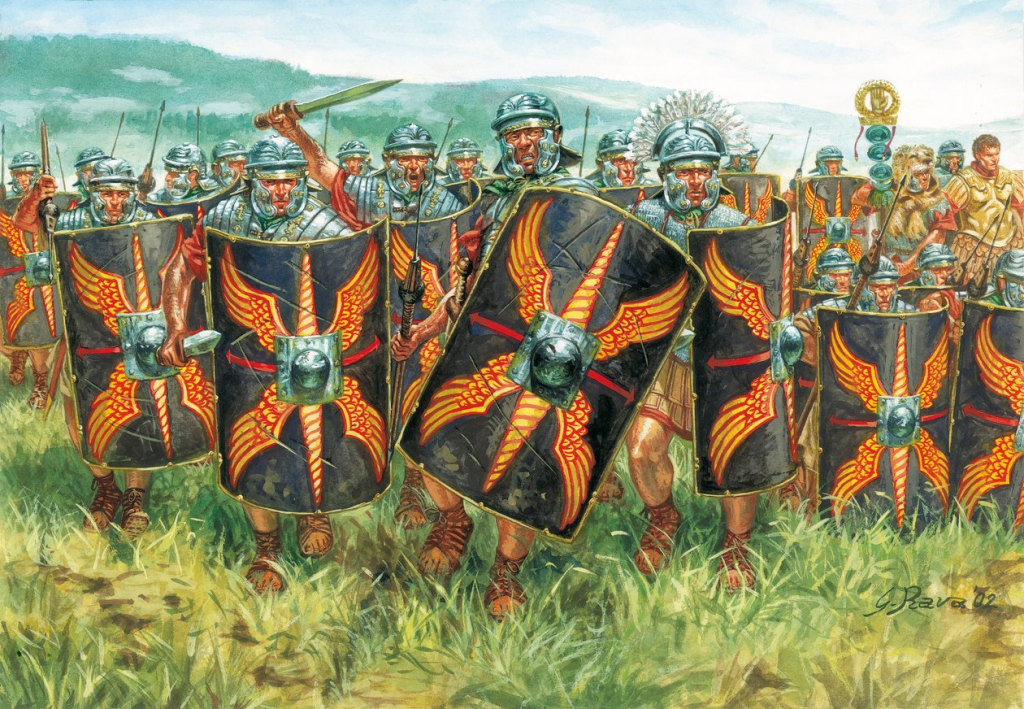
Polybius, the cool Greek historian who walked among their commanders, drew that figure with surveyor’s patience. He described the triplex acies, three lines of heavy infantry arranged in maniples like teeth in a wolf’s jaw, with young men in the front rank, seasoned fighters behind, veterans in the rear; he described light-armed velites skirmishing ahead, and allied cavalry supporting the flanks.¹ The legion in his account resembled a moving hillside, terraced and deliberate. Every citizen who afforded armour imagined himself enclosed somewhere in that grid, breastplate pressing on lungs, pilum shaft abrasive in the hand, short sword waiting as final argument. Training hardened that imagination into habit. Men learned to advance with measured steps, to raise shields on command, to throw their heavy javelins in a single wave, and then to close until another man’s sweat touched their own lips.
Arrows spoke a different language.
Greek songs had long filled Italian minds with images of Apollo sending plague through shafts, of Odysseus bending a great bow among the suitors. On islands such as Crete, boys grew up with recurved bows of layered horn and wood that stung the fingers yet promised meat on the table. By the third and second centuries before Christ, Roman magistrates had begun to approach such men with contracts. Cretan archers entered Roman pay as specialists, hired for campaigns among Macedonian ridges or Aetolian ravines where javelins lost much of their use and close-order infantry moved with difficulty.² They fired from rocky shoulders, from gullies that flanked the main road, from paltry scrub that still offered concealment. They wore Greek cloaks, spoke Greek words, and carried a reputation that preceded their arrival. The Latin tongue often reduced them to a type—simply Cretans—since the island’s name itself had hardened into a guarantee of accurate shooting.
Even so, the bow never fully stepped inside the inner circle of Roman honour during that age. The city loved nearness.
Walk away from battle and follow a narrow track above Praeneste in late autumn. Mist tightens among the olive trunks; the air carries smoke from burnt vine cuttings and the faint vinegar of crushed grapes. A senator in plain tunic and good boots turns aside from the road, followed by two freedmen and a dog with one torn ear. One servant draws from a leather case an object wrapped in linen and unfolds a composite bow that gleams under its sheen of oil. The other bears a quiver whose fletchings spill over his shoulder like the tails of small birds. The senator takes the bow with that particular half-smile of a man who sips his own youth. He places the tips against the earth, strings it in a quick practiced arc, and feels his spine answer.
The first shaft streaks upward into mist and vanishes among invisible twigs. The second clips a bush and startles a pheasant that bursts from cover with a rattle of wings. By the fourth, his hands remember; breath and draw and release align once more. For him, under those grey Italian clouds, the bow suits the landscape and his self-respect. It belongs to the world of estates, of hunts, of cultivated recall of Homer and Xenophon. Etruscan tomb frescoes had earlier carried such scenes—hunters, archers, hounds—among painted banquets and dancers. In that gentle theatre the bow acquires elegance and pleasure; it thins the boar population; it accompanies poetry.
The same object, carried from those hills onto a line of battle, unsettled the conscience.
Roman reflection on honour in war, from early annalists through statesmen such as Cicero, often linked glory with visibility. An enemy deserved warning; courage demanded a recognised opponent; the combatant needed an identifiable adversary for his own death to carry meaning. Hidden blades, poison, little devices that killed in silence troubled these writers, since such tools obscured person from person. An arrow, shot from a distant ridge or from behind a line of shields, altered that relationship. The bowman saw a colour, a standard, a cluster of shapes; the victim felt only a blow from nowhere and collapsed among comrades. The ethical discomfort rarely formed a systematic doctrine, yet it coloured attitudes. So missile troops seldom stood in central narratives of republican victory, even where their actions had opened a path for infantry.

Carrhae carved that hesitation into flesh.
Picture the columns that had marched east with Crassus: seven legions of heavy infantry, cohorts of light troops, contingents of Gallic horse, a handful of archers and slingers attached according to habit. The general himself, enriched by proscriptions and tax contracts, sought a glory that would match that of Pompey and Caesar. Parthian Surena advanced to meet him with a contrasting instrument: near ten thousand mounted men, among them armoured cataphracts whose limbs shimmered under scales of metal, and far more horse archers whose small composite bows could cast shafts over long distances with murderous force.³
They met near ancient Carrhae on flat ground that favoured speed and range over weight. The Parthians opened with volleys from beyond pilum reach. Roman front ranks, drilled into discipline by generations of centurions, raised shields and thickened their formation until bodies and wood and iron formed the box of the testudo. Arrows fell along the curve of the sky, struck oak and bronze, slipped into the gaps at shoulders, thighs, faces. Each impact shook muscles already dry with heat. Men who had grown used to movement found themselves pressed in on all sides, legs cramped, backs complaining, ears full of a continuous drumming on wood. A formation that in Italian valleys had resembled a patient advancing wall now turned into a crouched animal unable to strike.
Plutarch draws the scene of Publius, the general’s son, with an almost theatrical pity. Crassus, distressed by Roman immobility, sent the younger man forward with Gallic cavalry, archers, and cohorts to break the encirclement.⁴ The Parthian horse archers feigned retreat; their horses trotted away with an air of exhaustion that lured Romans into pursuit. Once the pursuing force had moved far from the main square, the eastern riders wheeled, closed their ring, and renewed the storm of arrows from every side, while armoured lancers advanced at the moment of Roman fatigue. Publius’ troops sought a low rise, planted standards, and fought until horses fell and men gasped among corpses. When hope dissolved, the young commander, according to Roman taste, offered his throat to his own sword. Later, Parthian hands raised his severed head before the father’s line; fresh volleys followed; the square of legionaries absorbed each shaft as an accusation.
The bow across that day altered the moral arithmetic of killing.
A legionary who pushed a short sword beneath an enemy’s ribs accepted consequences in full intimacy: his hands slid along the other man’s blood, his eyes met another gaze at close distance, his lungs filled with shrieks and the breath of the dying. Responsibility and survival fused in a single spasm. A horse archer who released from four hundred paces felt something colder. He aimed at a unit, a colour, a silhouette. The arrow found a particular throat or eye that he rarely saw clearly. Carrhae made that division visible to Roman observers, and through them to later readers. A state that had built its self-image upon disciplined advance now faced a civilisation that fought by eroding, by harassing, by transforming space itself into weapon through constant motion.
Poetry carried the bow back into a different register.
Virgil, writing under Augustus, offered in Book V of the Aeneid a funeral games for Anchises upon Sicilian shore. Among chariots and boxing he staged an archery contest. An old archer, Acestes, took part with a weathered bow. When his turn arrived, he aimed not at the target so carefully as at the heavens, drew with calm, and loosed. The shaft climbed until it caught fire in mid-air, leaving a line of flame across the sky. Aeneas read the sign as the dead father’s approval; the old man received a special gift.⁵ In that scene the arrow joins earth to heaven instead of warrior to warrior. The bow becomes an instrument of omen. Fire wraps the shaft that once brought only iron. The Romans of Virgil’s audience could recognise both realities: battlefield wounds in Armenian ravines, and sacred contests where archery honoured the dead.
Centuries later, Vegetius, a Christian bureaucrat and concise theorist of war, looked back across that long experience and proposed a discipline that earlier ages had only approached in practice. In his Epitoma rei militaris he urged generals to teach the bow to recruits from youth onwards. He desired that a sizable fraction of the strongest men in each levy should practice daily with arrows against posts, on foot and on horseback, until the movement of draw and release sat inside their muscles as firmly as the parade step.⁶ He described masters of archery within each unit, the building of ranges, the issue of equipment destined only for training, separate from combat gear. The legionary in his account carried a more varied armoury than Polybius’ citizen, with ranged skills integrated into his virtue.
Between those two writers—Polybius in the second century before Christ, Vegetius perhaps in the late fourth after—stretched an imperial history in which archery moved from periphery toward centre, from auxiliary to assumption.
The Latin word sagittarius began its existence among the stars. On winter nights a centaur with bow lifted glowed above the Campus Martius, marking seasons for astrologers and augurs. As the imperial army expanded, that name passed from heaven to earth. Units of sagittarii appeared in inscriptions and diplomas: cohorts of Syrian foot archers along the Euphrates; mounted archers from Emesa or Ituraea attached to cavalry alae; Cretan bowmen whose older mercenary tradition now merged with a broader eastern archery culture.⁷ Men in these formations often wore lighter armour; they moved faster than the heavy infantry; they understood the flex of horn and sinew under varied climates. Rome in turn gave them pay, regular supply of arrows, barracks, commanders with Latin titles.
Gravestones along the Rhine and Danube speak of such soldiers. A man carved in relief holds a bow and a bundle of shafts; the epitaph names him as sagittarius of a cohort from Commagene or Palmyra. His son, born near the frontier, might speak Latin with his comrades and Aramaic at home. The distance weapon that once came from contract islands and distant Steppe now belonged to families who lived under Roman law and paid Roman taxes. Scholars of the Roman army estimate that by the second century after Christ, archers formed a significant proportion of auxiliary forces, especially in the East, with a fair number fighting from horseback.⁸
That green arrowhead from the Harran field therefore speaks in several registers at once.
It remembers the Parthian who loosed it, hips following his horse’s stride, thumb locked around the string, attention narrowed to a small gap in a moving wall of shields. It remembers the dust around Surena’s camel trains, burdened with bundles of spare arrows so that quivers never emptied while legionaries still stood. It remembers Latin curses that rose within the testudo as each storm of iron shook shields and armour. It remembers earlier Cretan archers on Greek slopes, accepting Roman silver while still singing island songs. It remembers Acestes’ blazing shaft above Sicilian water and the roar of the onlookers. It remembers Vegetius scratching letters on parchment, commanding emperors and generals of a beleaguered age to trust distance as much as impact.
Across my own eastern borderlands an old man once leaned upon a hoe and told his grandson that an arrow always departs from its master. The boy, who hunted sparrows with a hazel rod and string, had asked why commanders feared the bow. The grandfather tapped the shaft and said that power abandons the hand at release, enters wind, and listens to other laws than the archer’s will. Empires learn this with pain. Rome learned in Greek passes that light infantry with missiles could unpick heavy formations; Rome learned at Carrhae that horse archers with ample supply could bleed legions white without ever closing; Rome learned along the Danube that archers who spoke Syriac or Greek could hold a snow-bound watchtower as faithfully as sons of Latium.
The senator near Praeneste, loosing his fourth arrow toward a hillside boar, lived inside one stage of that learning. He had absorbed Homer and perhaps some half-understood mention of Cretan bowmen; he hunted with a composite weapon that his ancestors would have considered exotic. The legionary under the desert of Carrhae, shielding his face while shafts beat upon oak, lived inside another stage, when the price of earlier complacency fell upon his bones. The imperial sagittarius, buried along the Rhine with his bow carved above him, embodied a later synthesis, where Roman power extended through skills that once belonged to enemies.
The arrow in the archaeologist’s palm condenses those stages into one sharp edge. Its original shaft vanished long ago. The hand that sent it has passed through dust to God. Yet the question that hardened around that metal still flies through our own air: how far can any state persist on the strength of intimate courage alone, and at what point must it welcome the cold, impersonal intelligence of distance. Rome walked that line between sword and bow for centuries. In the end, the empire that accepted eastern archers into its pay endured far longer than the proud rectangle that marched toward Harran without them. The little green tooth that rose from the soil among barley therefore judges both Roman pride and Parthian skill, yet it sides with neither fully; it points only toward the sky, where Sagittarius still raises his bow and writes, in his own silent language, that every centre finally depends upon the gifts of its edge.
Notes:
1 Histories, Polybius, trans. Robin Waterfield, Oxford University Press, Oxford, 2010, pp. 288–325 (Book VI on the Roman constitution and army).
2 John K. Davies, “Cretan Archers: Mercenaries of the Ancient World,” in Mercenaries of the Ancient World, ed. P. Cartledge, Duckworth, London, 1981, pp. 65–82.
3 Gareth C. Sampson, The Defeat of Rome: Crassus, Carrhae and the Invasion of the East, Pen & Sword, Barnsley, 2008, pp. 112–147.
4 Plutarch, Parallel Lives: Crassus, trans. Ian Scott-Kilvert, Penguin Classics, London, 1972, pp. 128–164.
5 Aeneid, Virgil, trans. Robert Fagles, Penguin Classics, London, 2006, pp. 142–150 (Book V, funeral games and archery contest).
6 Flavius Vegetius Renatus, Epitoma rei militaris, trans. N.P. Milner, Liverpool University Press, Liverpool, 1993, pp. 20–27 (Book I on recruitment and training, including archery).
7 M.P. Speidel, “The Roman Army and the Near Eastern Archers,” Aufstieg und Niedergang der römischen Welt II.8, Walter de Gruyter, Berlin, 1977, pp. 687–703.
8 Adrian Goldsworthy, The Complete Roman Army, Thames & Hudson, London, 2003, pp. 95–124.
9 Federico Biglino, “The Roman Army between Polybius and Marius,” Studia Universitatis Cibiniensis 17, University of Sibiu Press, Sibiu, 2020, pp. 53–79.
Views: 135


