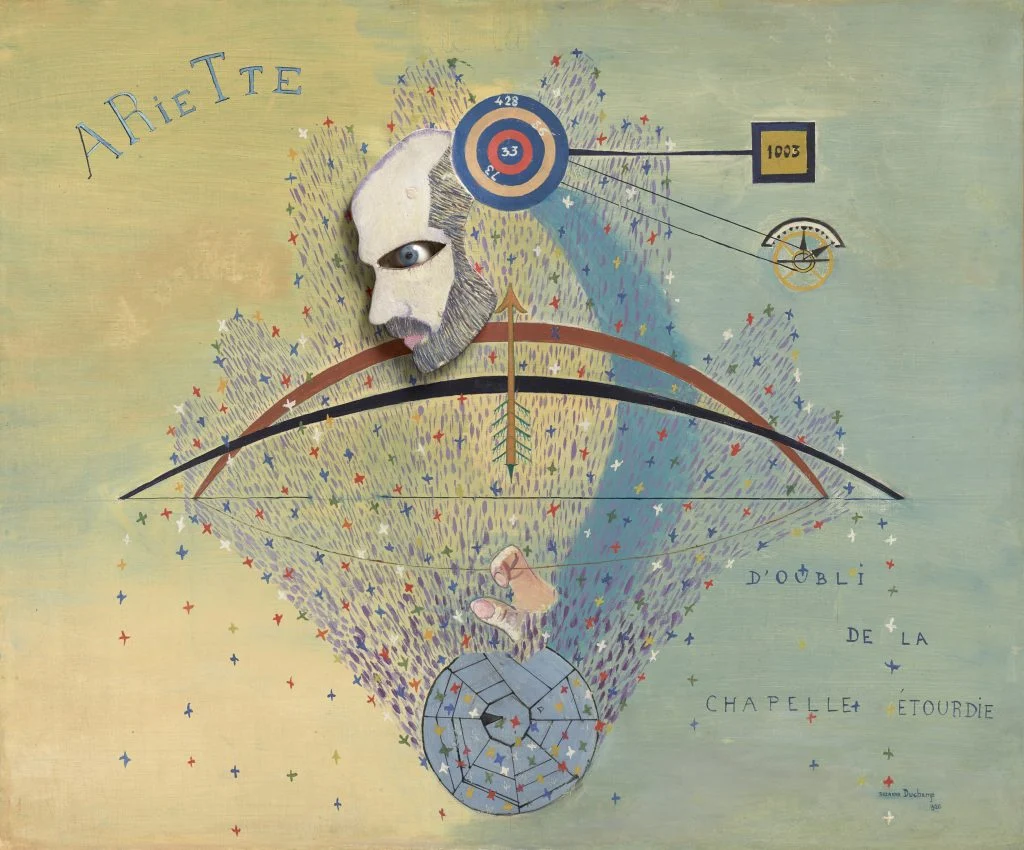
A pale field, washed like chapel plaster after incense has settled, holds its own weather, and in that weather a severed head—half mask, half reliquary—floats as if a saint had been converted into an instrument, while the word Ariette (petite aria) arcs at the upper left with the airy confidence of a tune that enters the ear before doctrine can marshal its arguments.¹ The eye, painted an impossible blue, stares past us with the fixed attention of someone hearing a melody inside a room that has lost its organ, and the beard, drawn in fine hatchings, feels like a curtain of wire through which speech must pass. Around the head, coloured crosses and flecks fall like confetti after a civic parade, though they also read as particulate matter suspended in air, and beneath them two broad arcs—one dark, one reddish—span the width like a bent stave, like a vault sprung from wall to wall, like the bow of a ship whose prayer has turned into measurement.
Suzanne Duchamp worked in a family where invention carried the force of inheritance, and where each sibling, by choosing a medium, chose also a mode of dissent, since the Duchamp household offered both craft discipline and a sly impatience with pieties of finish.² Marcel’s provocations and Raymond Duchamp-Villon’s sculptural engineering created a horizon in which objects could become arguments, while Suzanne, trained in painting’s habits, learned to make images that behave like diagrams of feeling, so that lyric and apparatus share a single breath.³ When she moved through the Parisian circles that braided Cubism into Dada’s anti-heroic laughter, she inhabited a milieu where the studio smelled of glue, ink, and cigarette ash, and where salons and cafés carried a special kind of fatigue, since the Great War had trained every conversation to expect interruption.⁴ Her marriage to Jean Crotti brought an intimacy with a parallel strain of spiritualized mechanism—an attempt to grant the machine an aura—yet her own work retained a sharper domestic intelligence, as if she watched the grand gestures of avant-garde men and kept a smaller, more precise score for how history lodges in the body.⁵
Ariette d’oubli de la chapelle étourdie (little aria of forgetting of the dizzy chapel) arrives in 1920, when Europe’s air still held the aftertaste of trenches and influenza, and when Paris, eager for dancing and speed, also carried an undertow of bereavement that required disguise.⁶ In such an ether, memory became an unstable currency: too much remembrance and the nerves seized; too little and the dead turned into decor. The title stages that instability as music, since an ariette belongs to breath and phrasing, and as architecture, since a chapel implies ritual enclosure, yet the adjective étourdie gestures toward vertigo, intoxication, dizziness under shifting pressures. In this painting, forgetting behaves as a song composed for a sacred space whose equilibrium has altered, and the altered equilibrium, once perceived, starts to look physical, meteorological, measurable.
The surface presents a choreography of linkages. A concentric target—blue and red rings with small white numerals—sits above the head like a halo converted into calibration, and from that target two black lines travel rightward toward an instrument dial and a square panel marked “1003,” the whole ensemble resembling a flight board, a scientific chart, a clandestine console assembled from fragments.¹ The central axis, a vertical pointer tipped with an arrow, pins the arcs together, while a field of tiny coloured marks swarms around it, conferring on the image the tremor of a crowd, a snowfall, a nervous system. At the lower centre, a faceted sphere, drawn like a geodesic globe, supports a small hand that emerges with tender absurdity, as if the painting itself were offering a gesture of blessing or pleading. The text at right, spaced in quiet capitals, refuses the drama of typographic shout; it drifts like a refrain heard through a wall.
Interpretations have tended to treat Suzanne Duchamp’s painted-and-collaged enigmas as witty hybrids of Dada play and personal lyric, where the “song” and the “chapel” signal a feminine counter-register to the masculine theatrics of shock, and where the head functions as a theatrical mask that mocks portraiture’s claims.³ Such readings carry force, yet the canvas holds an element that invites a more literal, and therefore more radical, turn: the square marked “1003,” when read alongside the semi-circular dial with its needle and tick-marks, behaves as a barometric readout, a pressure value written in the language of meteorology.⁷ That single detail—easy to file away as a whimsical number—reorients the entire scene, since the chapel’s dizziness begins to resemble the dizziness of bodies under low pressure, and the ariette becomes an atmospheric score in which faith, memory, and the postwar psyche appear as weather systems whose shifts can be charted.
The barometric inference gains strength when the eye lingers on the dial at right, which carries the look of an aneroid gauge: a half-circle of graduations, a pointer, a small circular housing like a brass instrument mounted on a wall.⁷ The connecting lines from the concentric “target” create a circuit, as if the halo were also a sensor, and the sensor feeds the gauge and its numeric report. “1003” sits close to values used in pressure measurement, and even for viewers unfamiliar with meteorological units, the pairing of needle-and-number evokes a regime of reading, a discipline of attention, a demand that feeling submit to scale. Once that demand enters the image, the chapel’s condition transforms: architecture becomes an atmosphere chamber, a place where inner weather registers, and where forgetting occurs as a pressure drop that makes the head light, the world tilted, the song thin.
Such a thesis does more than identify a clever reference; it pulls Suzanne Duchamp into the period’s broader effort to translate trauma into instrumentality. After 1918, bodies and minds bore symptoms that medicine, psychiatry, and politics attempted to classify—shell shock, neurasthenia, nervous collapse—yet classification itself carried violence, since it promised control where grief insisted on its own tempo.⁶ Dada’s tactics, born from disgust with the rationalities that had justified slaughter, often attacked the very notion of measurement, yet measurement returned in new guises: statistics of the dead, bureaucratic forms, passports, gauges of productivity. Suzanne Duchamp, who moved close to Dada without surrendering to its loudest gestures, painted a quieter paradox: the chapel, emblem of unmeasured grace, receives an instrument panel, and the song of forgetting becomes a reading taken from the air.
Her lineage matters here in a particular way. Marcel’s readymades had declared that selection could suffice, that designation could overturn craft hierarchy, and Raymond’s mechanical sensibility had shown how form could embody force.² Suzanne took from these impulses an ethics of choice, yet she kept the painterly field as a place where ambiguity could remain sensuous, where allegory could keep its skin. The head in Ariette looks like a cut-out or a papier-mâché mask inserted into the painted ground, and that insertion echoes the family’s shared taste for the hybrid, while the surrounding marks—tiny crosses in red, blue, yellow—suggest a patience with repeated gesture that belongs to the hand trained in brushwork. The barometric “1003” therefore reads as both inheritance and refusal: inheritance, since it speaks the modern language of apparatus; refusal, since it relocates that apparatus into a chapel of the mind, where any reading becomes unstable under the pressure of lived experience.
The chapel itself, as an idea, enters French modernity with a complicated aura. It carries Catholic residue in a republic that had wrestled church power, it carries private devotion in a culture enthralled by public spectacle, it carries the memory of candles and confession in a decade that would soon worship speed and cinema.⁸ Suzanne Duchamp’s title, by locating forgetting inside a chapel, suggests that amnesia occupies sacred space, and that sanctity, once its rituals falter, can drift into dizziness. When barometric pressure becomes part of the chapel’s equipment, spirituality begins to look like climate: dependent on air, vulnerable to fronts, subject to invisible forces. The head, suspended beneath the target-halo, becomes a sensor, a body whose eyelid and inner ear register shifts that theology used to attribute to grace or temptation.
The arcs spanning the canvas intensify that atmospheric reading. They resemble a vault line, yet they also resemble isobars on a synoptic chart, curving bands that map pressure gradients. The central arrow, rising like a weather vane, divides the field into asymmetrical halves, and the coloured flecks behave like windblown debris, pollen, sparks from a festival that has turned anxious. Under these arcs, the faceted sphere at bottom reads as a globe, a world reduced to geometry, while the small hand above it gestures with ambiguity—part beckoning, part blessing, part grasping at balance. If the chapel has become dizzy, the dizziness belongs to a world whose coordinates have shifted, and the barometer, by recording “1003,” gives the dizziness a measurable face.
In the creative milieu of 1920 Paris, such hybridization between lyric and diagram would have resonated with contemporaneous experiments in typography, collage, and mechanomorphic imagery, yet Suzanne Duchamp’s work retains a specific tonal modesty, as if she sought a form of modernity that could contain intimacy.⁴ Francis Picabia’s machine portraits turned human relations into comedic engines; Tristan Tzara’s manifestos turned syntax into a battlefield; Hannah Höch’s photomontages spliced politics into the body. Suzanne Duchamp, by contrast, compresses her argument into a small ensemble: head, halo-target, gauge, number, arcs, globe, hand. The reduction brings consequence, since every element carries weight, and “1003” becomes a hinge through which the entire painting swings from symbolic chapel to atmospheric chamber.
This hinge also shifts the work’s gendered resonance. Scholarship has long observed that women in Dada networks often navigated between participation and marginalization, since the movement’s rhetoric of liberation coexisted with habits of masculine performance.³ Suzanne Duchamp’s chapel, coded as interior space, and her ariette, coded as a smaller musical form, could be filed under a “feminine” register by a careless eye, yet the barometric apparatus refuses diminishment. Measurement enters the chapel as an intrusion, and that intrusion parallels the historical intrusion of modern systems—bureaucracy, medicine, surveillance—into private life. If the chapel stands for the interior life of a woman artist living amid louder male gestures, then the barometer stands for the external world’s insistence on reading that interior through scales it controls. The painting, through its quiet precision, stages a contest over who gets to interpret dizziness: the self, the priest, the doctor, the state.
The “previously unobserved” force of the barometric “1003” emerges most sharply when one considers the relationship between music and weather. An ariette depends on breath, and breath depends on air pressure; a chapel depends on resonance, and resonance depends on air density; dizziness depends on inner ear equilibrium, and equilibrium depends on pressure gradients. In such a chain, the painting converts metaphors into physiology, and physiology into history. After war, after pandemic, bodies carried fragility that felt atmospheric, as if the very air had changed. Suzanne Duchamp paints that feeling with a poet’s economy: a number, a dial, a head suspended in particulate drift. The chapel becomes a place where air itself carries memory, and forgetting becomes a pressure system passing through.
Once the viewer accepts this meteorological infrastructure, the concentric “halo” shifts meaning. Its rings, marked with numerals, begin to resemble a target, and a target suggests violence, practice, and the habit of aiming—an echo of war’s training. Yet targets also resemble gauges, and gauges resemble halos when modernity replaces sanctity with data. The head beneath this halo becomes a witness to a century’s substitution: grace gives way to calibration; prayer gives way to reading. Such substitution, enacted inside a chapel, carries a faint blasphemous sweetness, as though Suzanne Duchamp sang a litany to a new god whose commandments arrive as tick-marks. The painting’s humour survives, though its humour turns grave, since laughter in 1920 often served as a mask for tremor.
The hand above the faceted globe offers a final inflection. It seems to rise from the world as if from a trapdoor, and it holds a pose that recalls blessing, though it also recalls the gesture of turning a knob, adjusting a dial, seeking steadiness. If the barometer records “1003,” then the hand may belong to the one who reads the instrument and attempts correction, as if the chapel’s dizziness could be cured through adjustment, as if forgetting could be regulated by turning the world a fraction. The gesture becomes tragic in its gentleness, since the twentieth century offered countless devices for measurement while offering fewer rituals for grief. Suzanne Duchamp’s painting, by placing a hand in this position, proposes an ethics: a desire to steady the world through touch, while the atmosphere continues to shift.
The work’s power, therefore, grows from the way it holds competing regimes—song and gauge, chapel and console, halo and target—inside a single, airy field. It belongs to an epoch in which modernity promised clarity and delivered vertigo, in which the private room became an observatory, and in which the artist, by assembling a small machine of signs, could register the weather of collective consciousness. “1003,” read as pressure, converts the picture into a barometric hymn, a devotional instrument that records not saints and sins, yet fronts and drops, so that the sacred becomes a climate and the psyche becomes a sky. Since the chapel’s dizziness receives a number, the painting begins to whisper an austere consolation: forces that feel metaphysical also press on the body, and the body, by learning to read its own air, may learn a form of survival.
Uncountably Shaped End—so the eye returns to that square “1003,” which sits like a modest verdict beside the dial, and the mind begins to sense that forgetting, in 1920 and in every year that follows, drifts through rooms the way weather drifts through streets, entering lungs, altering song, tilting chapels, while the hand above the faceted world keeps rising, as if it sought a pressure knob hidden in the air itself.
Notes:
- Philadelphia Museum of Art, collection entry for Suzanne Duchamp, Ariette d’oubli de la chapelle étourdie, 1920, mixed media/painting with collage elements (catalogue and object record; credit line and rights statement as issued by the museum), consulted in the museum’s published and digital materials; see also the rights notice “© Suzanne Duchamp / 2025, ProLitteris, Zurich,” as transmitted in institutional reproductions.
- Calvin Tomkins, Duchamp: A Biography (New York: Henry Holt, 1996), pp. 17–52.
- Amelia Jones, Postmodernism and the En-Gendering of Marcel Duchamp (Cambridge, MA: Cambridge University Press, 1994), pp. 1–44, 101–156; Jennifer Gough-Cooper and Jacques Caumont, “Ephemerides on and about Marcel Duchamp and Rrose Sélavy, 1887–1968,” in Duchamp (various exhibition editions), pp. 1–60; and Gillian Perry, Women Artists and the Parisian Avant-Garde: Modernism and “Feminine” Art, 1900 to the Late 1920s (Manchester: Manchester University Press, 1995), pp. 137–178. These studies, though often oriented toward Marcel, provide tools for perceiving Suzanne’s position inside a familial constellation that could grant access while it also cast a long shadow. Jones’s method remains especially fertile for Suzanne, since it demonstrates how gendered expectations can shape reception even when an artwork refuses overt declaration. Perry, by tracking how women artists navigated the Parisian network of salons, galleries, and journals, helps explain why Suzanne’s mixture of lyric titling and diagrammatic imagery risks misclassification as “minor,” a category that frequently followed women’s production regardless of conceptual density. Within such a context, the identification of the “1003” panel as barometric or instrument-like carries interpretive consequence: a work that might be filed as poetic caprice reveals itself as a compact meditation on measurement regimes entering interior life, a theme aligned with broader avant-garde critiques of technocratic rationality, while it also discloses a specifically gendered tension, since the interior “chapel” could be read as coded private space that modern systems—medical, bureaucratic, ideological—attempt to quantify.
- Leah Dickerman (ed.), Dada: Zurich, Berlin, Hanover, Cologne, New York, Paris (Washington, DC: National Gallery of Art, 2005), pp. 215–263.
- Francis M. Naumann, New York Dada: 1915–23 (New York: Abrams, 1994), pp. 146–173; see also commentary on Jean Crotti’s circle and spiritual-mechanical motifs in related exhibition literature.
- Mark S. Micale and Paul Lerner (eds.), Traumatic Pasts: History, Psychiatry, and Trauma in the Modern Age, 1870–1930 (Cambridge: Cambridge University Press, 2001), pp. 1–29, 77–122; Stéphane Audoin-Rouzeau and Annette Becker, 14–18: Understanding the Great War, trans. Catherine Temerson (New York: Hill and Wang, 2002), pp. 169–214; and Alfred W. Crosby, America’s Forgotten Pandemic: The Influenza of 1918 (Cambridge: Cambridge University Press, 1989), pp. 247–292. A viewer who approaches 1920 as a “postwar” year alone risks missing how war and pandemic together altered the sensed quality of air, breath, and communal proximity. Medical and psychiatric discourses of the era repeatedly attempted to name bodily disorientation—fatigue, dizziness, trembling, nightmares—within classificatory frames that promised manageability, yet those frames often collided with grief’s persistence and with social pressures that demanded a return to normalcy. In Paris, the urge toward entertainment and speed cohabited with the presence of amputees, widows, and commemorative rituals, so that public life acquired an undertone of forced composure. Within this ether, Suzanne Duchamp’s use of an instrument-like dial and a pressure-like number can be read as more than a playful borrowing from scientific imagery; it can function as an image of modern regimes of diagnosis entering the inner chapel, where memory and the body’s equilibrium intertwine. The term étourdie gains historical texture here, since dizziness can arise from physiological disturbance, from shock, from grief, and from atmospheric shifts, and a barometric reference offers a bridge between literal sensation and metaphorical condition.
- W. J. Humphreys, Physics of the Air, 3rd ed. (New York: McGraw-Hill, 1940), pp. 1–20, for historical conventions in pressure measurement and the cultural dissemination of meteorological instrumentation; and Scott Huler, Defining the Wind: The Beaufort Scale and How a 19th-Century Admiral Turned Science into Poetry (New York: Crown, 2004), pp. 23–61, for the broader poetic life of measurement devices.
- Caroline Ford, Divided Houses: Religion and Gender in Modern France (Ithaca: Cornell University Press, 2005), pp. 201–246.
- Linda Dalrymple Henderson, The Fourth Dimension and Non-Euclidean Geometry in Modern Art (Princeton: Princeton University Press, 1983), pp. 241–290; Bruno Latour, Science in Action: How to Follow Scientists and Engineers Through Society (Cambridge, MA: Harvard University Press, 1987), pp. 1–17, 215–257; and Briony Fer, David Batchelor, and Paul Wood, Realism, Rationalism, Surrealism: Art Between the Wars (New Haven: Yale University Press/Open University, 1993), pp. 19–54. Although Suzanne Duchamp’s 1920 canvas sits at the decade’s threshold, the period’s fascination with diagrams, instruments, and quasi-scientific iconography had already permeated avant-garde practice, since modernity’s authority increasingly arrived through visual forms of data and calibration. Henderson’s account of geometry’s migration into modern art demonstrates how scientific vocabularies could become metaphysical resources, enabling artists to picture invisible dimensions of experience. Latour, by treating instruments and inscriptions as social actors, provides a lens for reading the “1003” panel and the adjacent dial as devices that reorganize relations between viewer and world: a gauge does not merely record; it trains attention, establishes thresholds, creates a language of legitimacy. When such a device enters a “chapel” of forgetting, it suggests a transfer of authority from sacramental ritual to quantified inscription, and it implies that interior states can be governed through external scales. Fer, Batchelor, and Wood help situate this transfer within interwar culture’s oscillation between rationalizing impulses and dreamlike resistance, an oscillation that Suzanne Duchamp compresses into the marriage of ariette and instrument board. The long-term implication becomes stark: modern societies often treat memory as a variable to be managed, and Suzanne’s quiet number, lodged in a lyrical painting, anticipates that managerial horizon with a mixture of wit and unease.
- Arturo Schwarz, The Complete Works of Marcel Duchamp, rev. and exp. ed. (New York: Delano Greenidge Editions, 2000), pp. 566–575, for contextual cross-references within the Duchamp constellation and its reception history.
Views: 44