

You can feel it in the land still, if you’re quiet enough. The way the past breathes up through the soil. We talk of the great warriors, the high kings, the men who stood shield to shield with sword and spear, their names ringing in the old stories. We see the gallowglass, that great foreign warrior, the gall-óg-laoch, with his two-handed axe, a figure of might and terror, a rock in the tide of battle. His shadow is a long one, and it has covered much. But there’s another figure standing in that shadow, a quieter man, a man whose story is told in whispers, in fragments of iron pulled from the river mud, in the grain of a yew stave preserved for a thousand years in the peat. This is the archer, the saighdeoir. His story is one that begins in silence, is reborn in the clamour of a Viking raid, and finds its true voice in the rustle of leaves in a wooded pass. It’s a story of a weapon forgotten and found again, a tool that changed hands and changed purpose, a thread that runs through the heart of how men fought and lived on this island. To understand him is to look past the gleam of the axe and listen for the sound of a bowstring in the rain.
Before the sharp tang of the Norseman’s arrowhead bit into Irish soil, the air held a different kind of threat. For the better part of two millennia, the bow was a ghost, a memory from a time of stone circles and bronze daggers. The earth itself shows this strange quiet. Go back far enough, to the Neolithic or the Early Bronze Age, and you will find the sharp, leaf-shaped flint points that flew from ancient bows. There is a man in Poulnabrone, his bones resting in the earth for thousands of years, with just such a point embedded in his hip, a final, silent testament to the bow’s old power. Then, around 1500 B.C., the trail goes cold. For two thousand years, the archer vanishes from the archaeological record. It is a profound and telling absence, a broken tradition. The skill of fletching an arrow, of tillering a bowstave, of feeling the tension in the string, all this seems to have faded from the collective hands of the people. The warrior’s world became a place of close work. The heroic ideal, the one captured in the ink of later manuscripts, celebrated the man who could look his enemy in the eye. Honour was found in the clash of bronze on a wooden shield, in the heft of a spear. The missile of choice was the one that came directly from the warrior’s own arm: the thrown dart, the javelin, cast with a wonderful facility and nearness, as one English writer would later observe. Or it was the sling, a simple and ancient tool, its power born of a spinning motion, its ammunition gathered from the stony beds of rivers. The bow, in this world, became a thing of lesser importance, a tool for hunting birds and small game, its use in war a distant echo. To strike a man from afar was a thing apart from the true business of battle. The culture of war had shaped itself around a different kind of courage, a different measure of a man. This long forgetting is the key. It meant that when the bow returned, it came as something new, a foreign craft that had to be learned again, a piece of technology that had to find its place in a world that had already decided how a warrior should stand, and fight, and fall.
Then came the longships, their dragon prows cutting through the grey sea. The Vikings brought with them fire and the sword, but they also brought a sound that had been absent from the island for generations: the hum of a taut bowstring and the whistle of a fletched shaft. They established their longphuirt, their ship-camps, at places like Dubh Linn and Linn Dúachaill, fortified harbours that became the arteries for a new kind of warfare. And it is in the soil of these places, in the dark, wet earth beneath modern Dublin, Waterford, and Limerick, that the story of the archer is reborn. The ground has given up hundreds upon hundreds of iron arrowheads from this time. They are the most common weapon found from the period, a fact that speaks volumes about the archer’s constant presence. They tell a story of tactical purpose. Some are leaf-shaped or triangular, designed to cut a wide, bleeding wound. Many more, though, are of a different sort. They are narrow, solid, spike-like points, what would later be called bodkins. These were tools made for a specific job: to punch through the protection of the day, the leather jackets and shirts of mail worn by warriors. The sheer prevalence of these armour-piercing heads, making up over 65% of the Dublin finds, reveals a sophisticated understanding of the battlefield. You only make a key if you have a lock to open. These arrowheads are the hard evidence of an arms race, a testament to the fact that Hiberno-Norse archers were facing armoured opponents and were equipped to defeat them. This physical evidence provides a powerful corrective to the tales of the elite. While later art and story might focus on the hero with his axe, the dirt tells the story of the common soldier, the man whose job was to shoot, and shoot well. His importance was practical, tactical, and undeniable. The deepest mark of this change is found in the language itself. The Irish word for a bow today is bogha, a word borrowed directly from the Old Norse tongue. The old words, if there were any, had been lost. The weapon was so thoroughly reintroduced that it brought its foreign name with it. And the weapon itself was formidable. From the Ballinderry crannog in County Westmeath, a waterlogged site that preserved what dry land would have consumed, came one of Europe’s finest early medieval longbows. Found amongst a classic Viking warrior’s kit of sword, axe, and spearheads, it is a magnificent piece of yew, originally measuring around 190cm, or well over six feet. This was a true war bow, powerful and of Scandinavian design, a weapon that shatters the simple story of the longbow being a purely English or Welsh invention of a later age. The Ballinderry bow is the physical proof of the new standard of military archery that had arrived in Ireland. It was a technology of killing that would, in time, be taken up by the native Irish, learned, adapted, and woven into their own unique way of war.
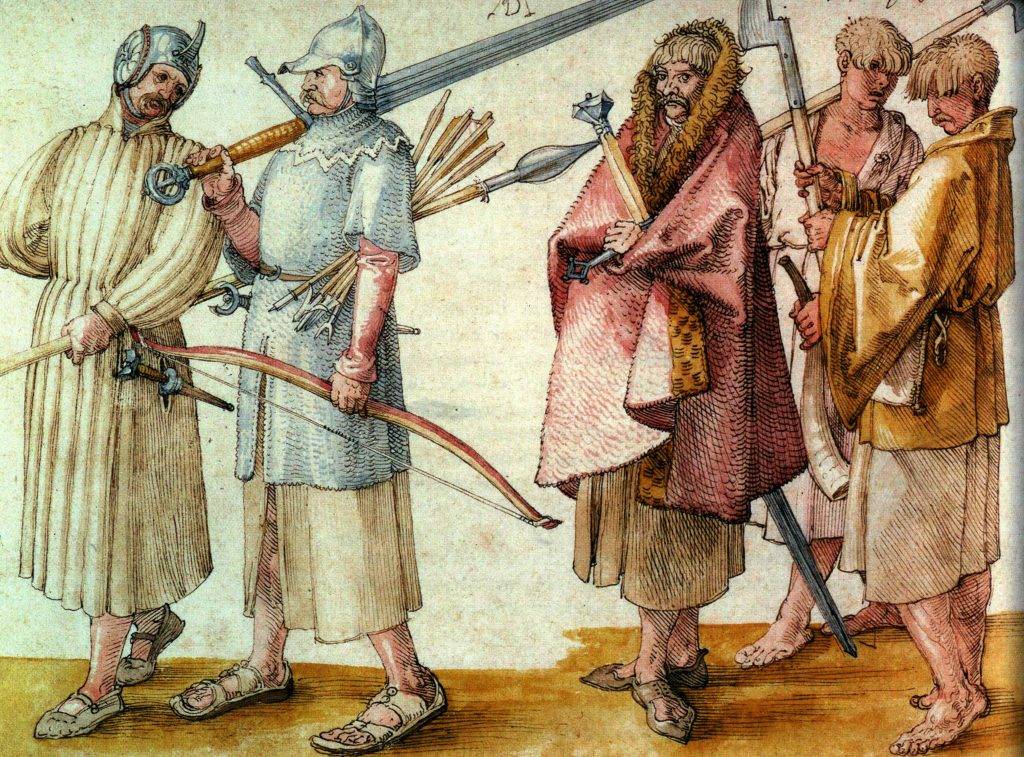
The Gaelic warrior, the ceithernach or kern, took this foreign weapon and made it his own. He was a figure born of the Irish landscape, a light infantryman whose greatest assets were his speed and his knowledge of the terrain. He fought with light gear, a loose tunic, perhaps a small round shield of wood, and an array of weapons suited to his fluid role. He carried the long dagger, the scian, and the sword, the claideamh, for close work. For fighting at a distance, he had his javelins. And now, he had the bow. The kern was the heart of the Gaelic host, the man who did the harrying and the skirmishing that defined Irish warfare. The great business of war in Gaelic Ireland was often the creach, the cattle raid. This was more than simple theft; it was a form of political and economic warfare, a way for a new king to prove his power or for one chieftain to force the submission of another. This kind of conflict, based on quick strikes, ambushes in difficult country, and rapid retreats with the captured herds, was the perfect environment for the archer. The kern archer was a creature of the woods and the bogs. His tactics were shaped by the ground beneath his feet. He used the bow to harass a marching army from the cover of the trees, to disrupt an enemy’s formation with a sudden volley from an unseen position, to make the landscape itself a weapon. This was a world away from the great, formal battles of continental Europe, with their serried ranks of men standing in open fields. The Irish way of war was one of movement and surprise, and the bow became a perfect tool for it. For the Gaelic Irish, the bow was an addition to their arsenal, an improvement on what they already did so well. It supplemented the javelin, offering greater range and the ability to carry more ammunition. It was integrated into a system of light infantry skirmishing that was already ancient and effective. The kern was a missile trooper before he had the bow; the bow simply made him a more deadly one. It was an evolution, an adaptation. This is why the introduction of the bow, while significant, did revolutionize Gaelic warfare. The fundamental tactics of the kern, the rapid onsets and retreats, the use of war cries and the terrain to create confusion, all these remained. The system was flexible enough to absorb this new technology without breaking. It bent, it adapted, it incorporated the new tool, and it endured. The Irish archer, therefore, became a different kind of soldier from his English counterpart. He was an individual skirmisher, a master of the terrain, his effectiveness measured in disruption and harassment, a vital part of a resilient and ancient way of fighting.
As the centuries turned, the Irish battlefield grew more complex. Two new forces arrived, each bringing their own way of war, and each reshaping the world in which the Irish archer fought. From the west, from the Norse-Gaelic islands of Scotland, came the gallowglass, the gallóglaigh. These were elite mercenary warriors, heavy infantry clad in mail shirts and iron helmets, wielding the massive two-handed sparth axe. They were the anchor of the Gaelic army, a solid core of professional soldiers who could stand and fight, who chose to die rather than yield. They were a response to the armoured knights of the Anglo-Normans, a Gaelic solution to a new kind of threat. And in the shadow of this great axe-man stood the archer. The gallowglass warrior was typically accompanied by two attendants, a man and a boy, who carried his provisions and his throwing spears. These attendants, often called “knaves,” frequently served as archers. They were the essential partners to the heavy infantry. Their role was to screen the advance, to protect the flanks, to pepper the enemy with a constant, stinging fire of arrows and darts. They were the skirmishers who broke the enemy’s cohesion, who created the openings that the gallowglass would then exploit with his devastating charge. The kern archer was the prelude to the axe-fall, the quiet whisper before the roar. Then, from the east, came a different kind of storm. The Anglo-Norman invasion of 1169 brought a new military doctrine to Ireland, one built on the power of the massed bow. The chronicler Giraldus Cambrensis, who witnessed the invasion, recorded that the initial forces were overwhelmingly composed of archers, many of them the famed bowmen of Wales, making up more than 85% of the total host. This was a tactical shock. The Irish had never faced anything like the coordinated firepower of hundreds of bows loosing their arrows in a single, disciplined volley. This was the arrow-storm, a method designed to shatter an enemy’s will and his formations before the heavy cavalry ever lowered their lances. Here, then, was a clash of two different worlds of archery. The Irish style was fluid, individualistic, and tied to the landscape. The Anglo-Norman style was collective, drilled, and designed for the open field. The Gaelic response was to lean into their own strengths, to refuse the pitched battle where the arrow-storm would be most deadly, and to use their knowledge of the woods and bogs to ambush and neutralize the invaders’ advantage. The way these different cultures used the archer tells us everything about who they were. The Hiberno-Norse archer, defending his walled town with armour-piercing arrows, speaks of a settled, mercantile society. The Gaelic kern, flitting through the woods with his bow and javelins, speaks of a decentralized, clan-based world of raids and shifting alliances. And the Anglo-Norman archer, standing in disciplined ranks, loosing his volleys on command, speaks of a centralized, feudal state that could raise, train, and deploy a professional military machine. To look at the archer is to see a reflection of the society that armed him.
The story of the Irish archer fades slowly, like the light on a winter’s evening. Through the later medieval period, the connections with Scotland remained strong. New waves of mercenaries, the Redshanks, came from the Highlands and Islands, bringing their own traditions of war, including the use of a shorter bow, adding another layer to the composite nature of Gaelic archery. The English Crown, for its part, tried again and again to impose its own military system on the Anglo-Irish lords of the Pale. Parliaments passed laws requiring every man to own a longbow and practice at the butts, hoping to cultivate a class of yeoman archers on the English model. These efforts mostly came to little. The realities of Irish warfare, the endless cycle of raids and skirmishes, rendered the English system of pitched battle archery largely irrelevant. A man was better served by a weapon he could use on the move, in the broken ground of his homeland. The final change came with the smell of sulphur and the crack of gunpowder. Through the 16th century, the firearm, the musket and the caliver, began to appear on the battlefield. The bow was a weapon that required a lifetime of practice to master, a skill that built strength into the very bones of the archer. The musket, for all its clumsiness, required far less training. A lord could equip a company of men with firearms and have an effective fighting force in a fraction of the time it would take to train a company of archers. By the 1570s, the bow was being replaced by the gun in English forces in Ireland, and the Gaelic lords, ever adaptable, were quick to follow. The age of the bow was ending. And so the archer returns to the shadows, his story told in the things he left behind. His legacy is not in the grand carvings on the high crosses or in the illuminated pages of the great books, for the art of the elite had little time for the common soldier. His legacy is in the earth. It is in the long, dark stave of yew from Ballinderry, its wood still holding the memory of tension. It is in the hundreds of small, sharp, iron points pulled from the Dublin mud, each one forged with a deadly purpose. And it is in that single, ancient flint arrowhead, lodged in the bone of a man who fell long before the Vikings, long before the Normans, a quiet reminder that the story of the archer in Ireland is as old, and as enduring, as the land itself. His was a vital role, a constant presence on the shifting landscape of war, a story written in iron and wood, and preserved in the memory of the soil.
Views: 450


