There are many films and series with archery; Vikings and The Last Kingdom carry the standard for today’s historical action. Both draw big audiences, both shape how viewers picture Dark Age war, and both bring bows into rain, firelight, and crowd-roar. A plain question guides the reading: how closely each production honours early-medieval archery—equipment, method, battlefield role—while still serving pace and spectacle. Screens teach the eye and, by habit, the body. One sharp image often walks from sitting-room to club range, where a beginner repeats what a hero performed the night before.
I arrive as archer and editor, palms warm with beeswax, desk spread with excavation notes and soil-smudged photographs. Nydam, Vimose, Illerup Ådal, Hedeby—each name rings like a mallet on seasoned timber. Tool marks rise under the mind’s thumb; patient bowyers coax ash and yew into honest, serviceable staves. The record breathes through them: straight or lightly reflexed self bows; plant fibre or sinew strings burnished with wax and fat for a clean release; birch or pine shafts shaved to steady weight and repeatable cast; goose feathers trimmed for governing authority rather than theatre. You read those choices as character—craft serving use. A field hand reaches for a stave, checks the grain, lifts the bow to the light, and a clear lineage steps forward: wood, string, feather, and a calm breath drawing all of it toward purpose. Grave goods and images favour hip or belt carriage, planted sheaves for volleys, and workmanlike heads for meat, cloth, and the little gaps where mail opens under stress. West of the Elbe a three-finger release rules; thumb release belongs to horse cultures of the steppe. The Bayeux embroidery, though later than the decades often staged on screen, still offers a grammar that fits: archers kneel, reload from the hip, and send a steady rain before infantry closes.
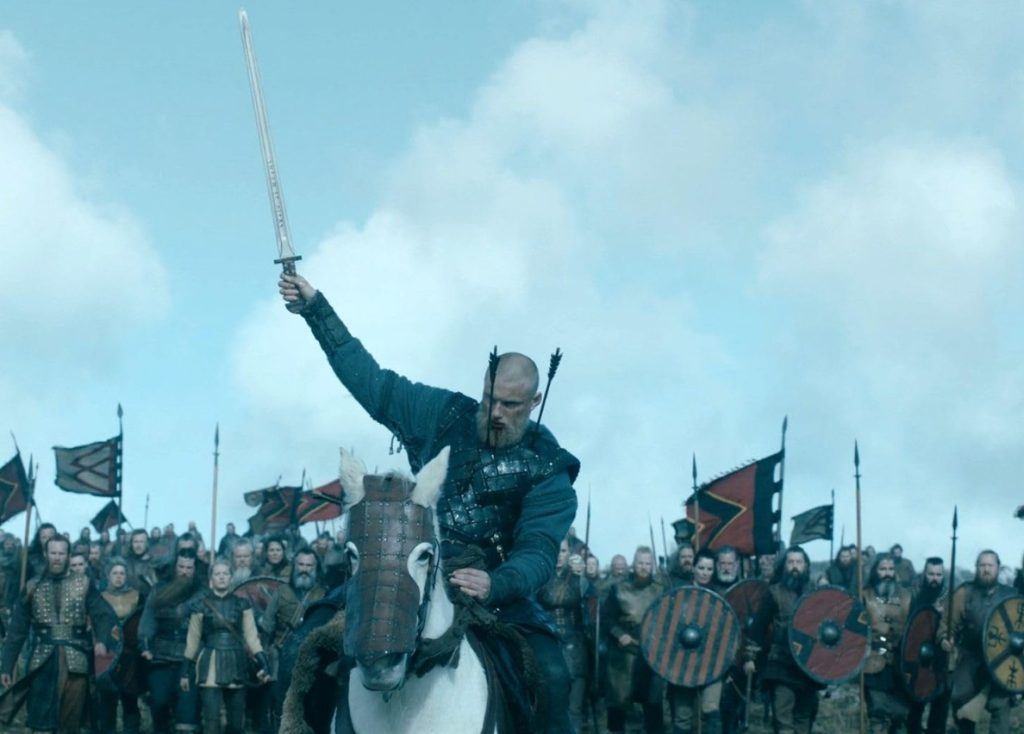
Set that picture beside the screen and patterns appear. Vikings pursues theatre. Moonwash across a longship’s sail, tar pitch gleaming on rigging, oar-wood breathing in its sockets—the imagery carries heat and salt. Within that world the bow serves as rite and strike. The camera frames shoulders and cheekbones; a star turns to the lens; a short draw flies because dialogue requires a clear face. Back-quiver silhouettes stand in alley ambushes and on open beaches because they cut a handsome outline. A raider snatches a shaft over the shoulder, wheels, and sends it at close range; the shot thrills; the moment sings. Field practice across the North leans another way—hip carriage for quick nocking in tight space, or a planted sheaf at the feet for volley rhythm—yet the show awards the shoulder reach to the hero, and the stamp lands cleanly. Worth praising too: leather creak under cloak, rope burn across palms, wool heavy with sea spray, iron rings that spit sparks under flint. Prop arrows often carry credible fletch height and sensible heads. The aggregate effect builds a high-contrast myth of the sea-wolf’s world.
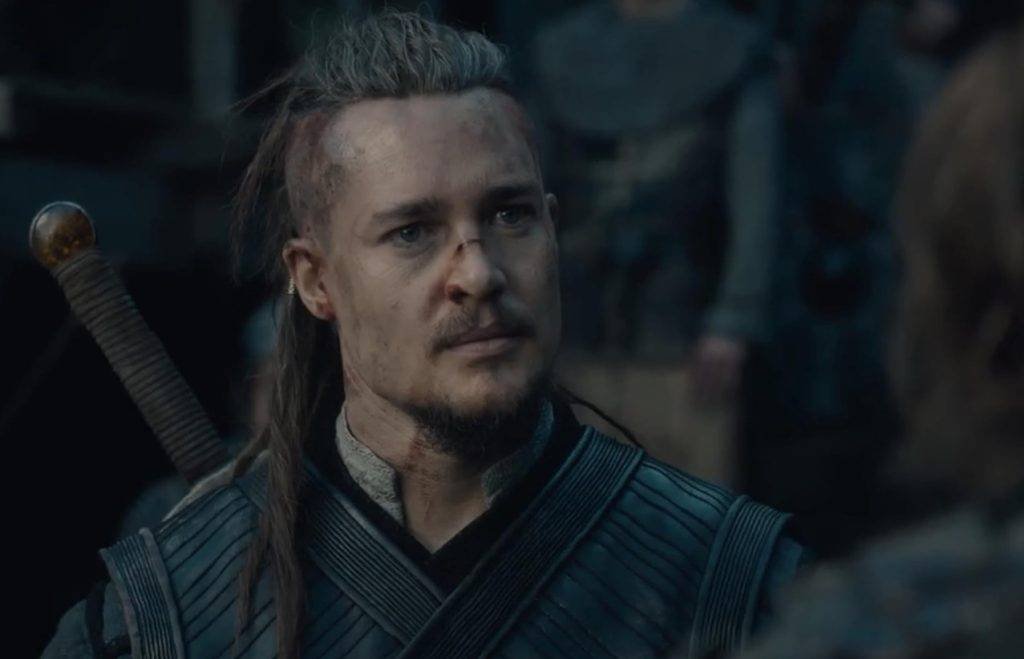
The Last Kingdom leans toward discipline. The bow appears as a soldier’s tool rather than a conjuror’s wand. In many set pieces the archers sit behind a forming wall or hold a flank, and the rhythm of loading and loosing arrives in readable waves. A captain calls a beat; a file draws in sequence; three arrows land, and then three more. Hip quivers turn up often, and the camera lingers on useful gestures: a palm checking brace height by habit, a thumb finding the serving by feel, a waxed string glinting at the nocking point. When the story shifts to sieges or set battles the distance between archer and melee reads as convincing, and the lens allows a quick look at footwork, shoulder alignment, anchoring at jaw or cheekbone. The imagery prefers turf to cliff edge—yards, lanes, wet fields, ditch lines—so the bow speaks in a practical register.
Technique draws the line between romance and craft more sharply than costume ever will. Draw length governs energy; anchor governs repeatability. Many TV shots favour abbreviated draws because stars speak as they shoot, and quick cycling tightens a scene. A workshop eye reads that choice immediately. A self bow in ash or yew delivers its promise when the draw opens the back and lands the string at a consistent point—jaw hinge, cheek corner, or a clean touch to the lips. A short draw serves alley ranges; an army thrives on anchors that match across a line. Vikings often sets the hero inside knife-range with the bow as companion weapon; in that register the quick snap follows sense. The Last Kingdom keeps more of the long-range grammar: arrows arcing over friendly helmets, volleys timed to shake a levy, close work directed at faces, thighs, and mail gaps when the lines meet.
Carry method signals training as clearly as accent. Manuscripts and graves favour hip quivers and ground sheaves; back quivers bloom in later romance art and in cultures with different signatures. Vikings chooses the back silhouette because it frames a performer in torch-smoke and sea haze; The Last Kingdom grants the diagonal lift from belt to string, a small movement that reads as learned habit. Reload behaviour completes the picture. Shoulder grabs please a lens; belt draws win speed in cramped ranks; planted sheaves lend the cadence of volley work—draw three, loose three, reset. When a scene lets the drumbeat of nock against string sound clearly, range coaches everywhere nod.
Grip and release add another point of contrast. A three-finger hold—split or under—appears frequently in The Last Kingdom and aligns with western European practice. Thumb release visits Vikings in a few glamour shots tied to pronounced reflex and horn-sinew lore; those curves photograph beautifully and carry a pan-Eurasian aura, while Scandinavian finds from the earlier centuries speak more often of self bows. Both series stage the clinch where a bow becomes a hand-spear and an arrow point drives in close; deck fights and alley raids invite that energy and the screen earns it. Range claims stay within human measures. Arrows work at credible distances against unshielded flesh, and that restraint deserves credit.
Mounted archery tempts every lens. Speed, horizon, flying plumes—a feast for editors. Horse shots appear in both series as flourishes rather than settled doctrine. Scandinavia and Anglo-Saxon England raised infantry first and last; horse archery belongs chiefly to steppe cultures and their heirs. A war-band may pick up tricks through service abroad; a chieftain may show off against a tree stump; the big fights on these shows meet on foot behind shields. The Last Kingdom balances cavalry and infantry in a way that matches that picture; Vikings assigns the saddle shot as accent and status flash.
Materials and maintenance succeed on screen whenever a character treats a bow as a living tool. Beeswax rubbed into serving, a string inspected by touch, a stave warmed at the hearth after rain—these seconds of care transform credibility. Both productions deliver such pleasures here and there. A boy planing a stave in a yard under slate sky; a veteran rolling the shoulder to open the back before a long volley; a fletcher checking spine by flex and ear—moments like these anchor battles more firmly than any monologue.
All that invention and all that research carry an ethical edge because television trains bodies. A young archer copies what a hero performs. A club coach greets a new member who loves a back quiver because a favourite raider wore one by the fjord. An instructor then offers hip carriage and planted sheaf and explains the advantages: faster nocking in tight quarters, fewer spills, a cleaner line in a wall. Showrunners share that conversation. Accuracy satisfies specialists, certainly; accuracy also teaches efficient, safe movement and invites beginners into a lineage with honour.
A fair ledger respects each production’s aim. Vikings excels at image and mood: sailcloth snap, wake churn, torch-smoke in the beard, moonlight on tar pitch. Its archery often reads as ritual violence at arm’s length, arrows loosed as quick sigils. The Last Kingdom finds strength in craft: measured volleys, sensible carriage, anchors that hold under pressure, the steadier sense of unit practice. Both swerve away from wild armour myths; both deliver flesh-credible kills and lean on timing rather than superhuman feats. When either series plants archers behind friendly lines and lets the lens witness a two-or-three-volley phrase with controlled breath and footwork, the screen begins to teach the old grammar.
A single invented scene shows what lies in easy reach for future seasons. Picture a river bend at first light. Frost rims the reeds. A levy captain scores a line with his boot and speaks soft and clear. Six archers kneel behind wicker, two planted sheaves between them, hip quivers full. Breath clouds; fingers find serving; shoulders set. On the captain’s hand the first wave draws; anchor lands at the jaw; strings hum; the volley drops among men who splash across shingle. A brief, human pause follows, then the second wave lifts, then the third. No acrobatics; steady geometry; courage to show hands rather than cheekbones. Veterans would feel seen; newcomers would feel welcomed; drama would tighten because cadence under fire always raises the stakes.
Connoisseurs keep score, and affection colours the totals. Vikings offers bright hallucination that stirs salt hunger. The Last Kingdom serves bread-and-meat method. Viewers deserve both: a kick of glamour and the marrow of practice. Producers gain as well. A well-researched bow sequence reads fresh even for audiences saturated with swords and shields. Workshop truth builds suspense; shoulders pay the price on screen and the audience feels it; tension rides the breath. Editors gain structure for cross-cutting—volleys as beats, anchors as phrases, movement as syntax. Performers gain choices that read as competence: a habitual grip, a check of nock fit, a small nod before the loose.
Cinema loves a clean emblem, and both series deliver it in different keys. Vikings gives the bright vision—spray off the oar, torch-smoke in the beard, a shaft loosed at arm’s length like a charm spoken into wind. The Last Kingdom gives the steady habit—hip carry, anchors that repeat, volleys that arrive in even phrases as a captain measures breath for the file. Each carries power. One feeds appetite for legend; the other feeds confidence in craft. Viewers live on both.
The afterglow tells the rest. Credits roll; kettle steam curls in the kitchen; an idea lingers in the corner: a bow lives through attention to small rhythms. Wax warms between fingers. A thumb finds the serving by feel. Feet settle on turf with a patient regard for distance. When a show captures even two such moments, audiences lean closer without effort. A club coach smiles on Saturday morning because muscle learns faster when images honour practice.
I think of a young archer at the mirror before school, sleeve rolled, mouth corner touched by an imaginary string, eyes steady. A scene from Vikings provides courage; a scene from The Last Kingdom provides method. Between the two, habit forms: elbow lifted cleanly, shoulder opened, scapula guiding the draw. Entertainment turns into a gift, and the gift travels farther than any single kill-shot or splashy flourish.
Archery marries breath to measure and returns an old lesson: attention creates freedom. Screen storytellers chase urgency; range work cultivates timing. The bow sits between those aims like a hinge on a well-used door. When a production invites viewers to notice hands, wax, brace height, nock fit, and the quiet beat before the loose, suspense deepens without racket and spectacle gains weight without blare.
So a closing thought suits these two franchises. Keep the grandeur—the moonwash on sailcloth, the wake churn, the clangour—and pair it with five human beats: hip carriage for speed, anchors that repeat, a three-finger release where it belongs, planted sheaves when earth allows, a glance at care in poor weather. Each beat reads clearly on camera. Each beat breeds trust. Each beat sends a young archer home with a sharper sense of how breath meets line.
Then the rest follows. A lane opens on the range, frost lifts, gulls wheel over a harbour wall, and a first end leaves the string with the mild hum of hemp and the neat kiss of feather. Television holds eyes for an hour; good habits hold a lifetime. The bow repays both series when treated as partner rather than ornament, and the audience answers with loyalty—the kind that passes from sofa to field, from field to memory, and from memory to the next story that rises from salt, timber, wool, and firelight.
Views: 86