

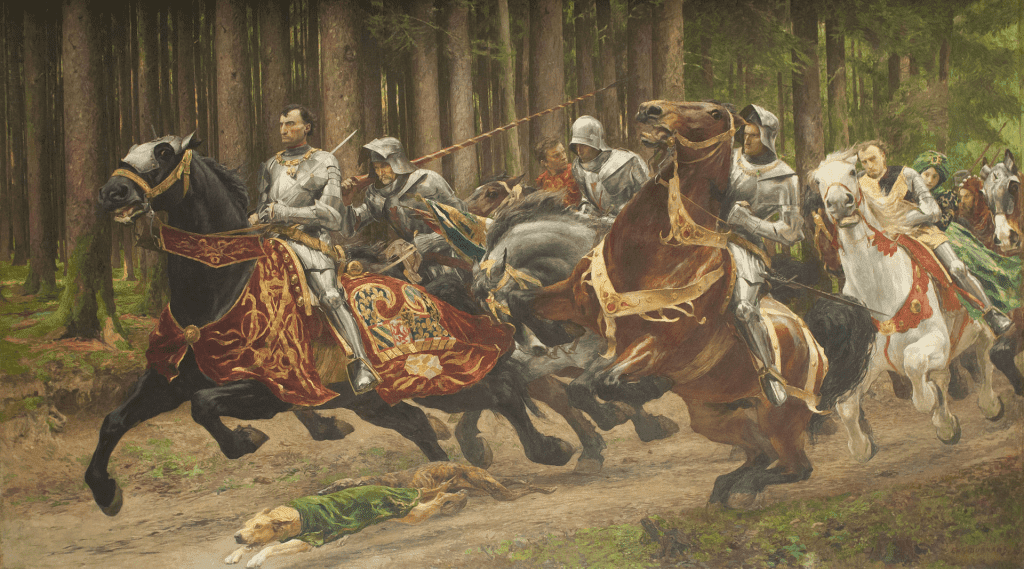
Some men arrive larger than their birthplaces. They carry a heat that pushes maps outward, seeks new borders, stamps a name into the grain of years. When such a figure drops, ordinary endings jar the ear. An unassuming death jars even more. So stories wake and walk. So with Charles, last great Duke of Burgundy, known as the Bold. Winter 1477 set its teeth in the fields outside Nancy. The official account names a soldier’s fall in battle. Another account—soft-spoken, persistent—leans toward a different end. It pictures the body away from the main crush, half-sunk in a frozen stream. It names the cause with surgical economy: an arrow through the skull, a clean, professional shot. The whisper reorganises everything. An archer in the flurry, an order from a distant chamber, a single shaft sweeping a king-maker from the board—assassination as policy, snug as a glove around the calculations of men like Louis XI, the Swiss magistrates, or the Emperor’s circle. Cold, geometric logic and a feathered signature. To feel the pull of that story, a reader first enters the man’s ambition. Charles governed a middle realm that dazzled the late medieval eye: dykes and counting houses in the Low Countries; rich cloth towns across Flanders and Brabant; Burgundian vineyards under winter light. His court glittered—Jan van Eyck’s quiet gaze; Rogier van der Weyden’s tender iron; collars of the Golden Fleece flashing flint and gold. He sat at the centre with a will that never slackened.
His project reached backward toward Lotharingia and forward toward a crown. He sought to join north and south, absorb the hinge between them, and win a royal title from the Emperor. He pictured a third power standing shoulder to shoulder with France and the Empire. Pride fed him. Piety steeled him. Rage moved through him like an iron rasp. French tongues named him le Téméraire—rash, headlong, a verdict tucked inside a title. Such appetite created its own weather. Louis XI crouched in draughty towers like a patient spider, working cords of gold and sticky threads of promise. Charles advanced in the open, breastplate shining; Louis preferred the slow coil of influence. The King’s sharpest instrument gathered in the Alps and across the lakes.
The Swiss Confederacy, young and flinty, rose from farm, smithy, guildhall, and market square. Foot soldiers built a wall of pikes that met horses and mailed nobility without blinking. A bristling geometry of ash poles and courage shattered old habits. Money from the King moved quietly; weapons and resolve moved with it; the Confederates marched. The road to Nancy carried the taste of pride. In 1476 Charles thrust into the Swiss hum. Grandson broke him, treasures and artillery left glittering and heavy in enemy hands. Fury set the jaw; he raised another host and met the Swiss again at Morat; the square of pikes opened the Burgundian body like a seam. Few escaped. Charles did. He kept his gaze on a single hinge: Nancy, capital of Lorraine—geographical key between scattered holdings. With it, a whole realm; without it, pockets of wealth. Against wise counsel he ringed Nancy in October, winter stepping closer every week. His army wore out its strength. Veterans stooped at the fires. Italian mercenaries counted their coins and watched the sky. Cold gnawed. Meat thinned. Coughs grew harsh. A ghost-legion pressed a city while a real storm gathered on the march.
News came of a vast relief force—Swiss and Lorrainers moving as if the cold sharpened them. Advisers urged a lift of the siege and a live army in spring. Charles planted his feet. Retreat never sat in his mouth. He chose the field.
January 5, 1477, opened with a sky packed with snow. Wind drove white into armour joints and lashes. Charles drew up his smaller host and waited. Guides slid the Swiss through woods and drift lines. They came on at a slant, raking the Burgundian flank. The effect arrived at once: ranks sloughed away, men broke formation, a flight began through a blown world where breath stung the teeth and hoofbeats lost their rhythm.
Here the mind scans for an archer—one man in a hood, a yew bow bending, a knotted string rasping the pad of three fingers, a clean release into a skull. Chronicles carry a reader to Philippe de Commynes with his ice-bright sentences and court-honed judgment. The search moves through parchment, through gossip taken down by clerks, and through memories of men who outlived that day. What rises from the page carries a different weight entirely. Chaos pressed close and left marks. Charles, Grand Duke of the West, pushed for a frozen channel of the Meurthe in the company of loyal nobles. Swiss foot closed around them with the purpose of men who lived beside frost and stone. No pause for ceremony. No chamber order riding a single goose-feather. An edge-to-edge rout and a fight at breath distance. Commynes, leaning on survivors’ words, sets the scene with the steadiness of a ledger. A Swiss halberd came around—axe, spear, hook in one length of ash—and met the Duke’s helm with a stroke that bit through and carried on. Pike points pressed in. A horse went from under him. The water received a body and the dream of a new crown folded with it. Two days passed before proof. The victors posted reward. An Italian page versed in his master’s features, Campobasso, led the searchers to a cut in the ice. Men broke the crust and hauled up a noble who once gleamed across Europe. The scene bites. Looters had eased off armour and finery. Winter had hardened flesh. Wolves from the churned fields had already taken their tithe. Recognition faltered until a physician—the one who had traced old wounds through years—went to work. He read scars with a practised touch. He remembered the length of the nails. He placed a finger through a gap where a tooth once stood. A court, a treasury, an army, and a vision of kingship reduced to particulars under a grey sky: scar tissue, nail crescents, a missing tooth.
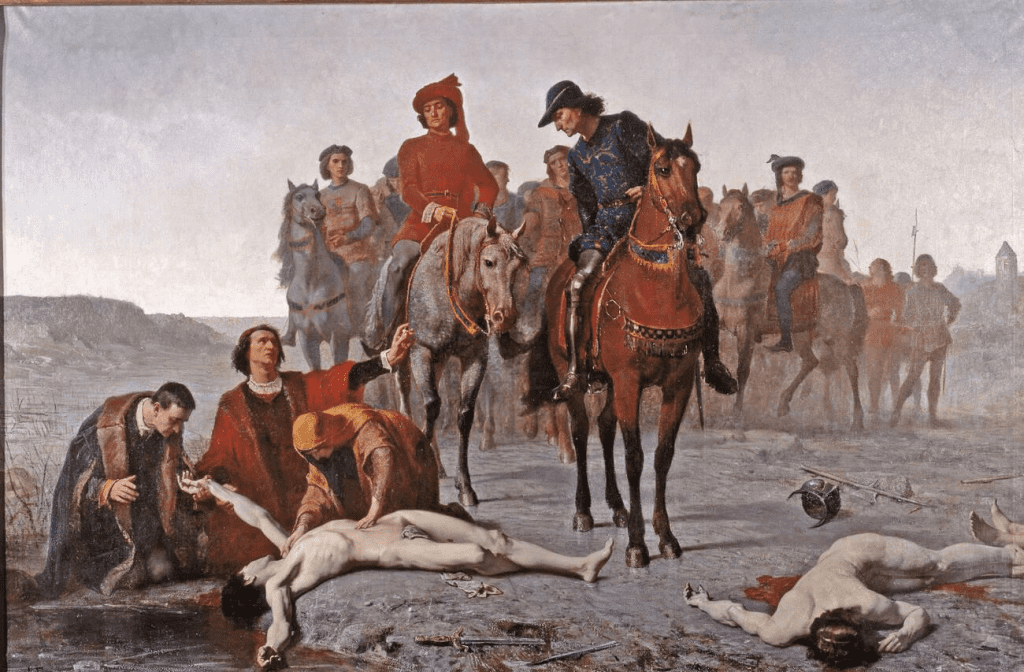
An arrow never signed that death. Later mouths may have trimmed the tale into a neat line to suit a grand life, yet the day’s labour points toward another truth. A halberd dealt the final measure; common infantry—new masters of the field—completed it. Greatness met a tool made for leverage, hooking and hewing amid slush, and the ice took the rest. Maps shifted in a single winter breath. With no male heir, Burgundian cohesion loosened at once. Louis XI reached for the Duchy of Burgundy and Picardy and drew them in. Wealth in the Low Countries moved through Mary, Charles’s daughter, into a Habsburg marriage with Maximilian. That union yoked treasure to dynasty and primed three centuries of continental rivalry—France and the Habsburgs testing each other from Flanders to the Pyrenees, from Milan to the sea wind along the Channel. The arrow remains a seductive ghost because it offers a design—one archer, one gesture, one answer. The halberd in the skull speaks more plainly about ambition’s limit. A kingdom envisioned at a desk of vellum and brass met winter and the geometry of pike and axe; the world replied with consequence. A court of gold and song narrowed to a body stiffened by frost, a face chewed at the edges, identity proven by the small ledger of scars. The lesson walks out of the stream with the corpse: a dream of a third crown carries grandeur until weather, hunger, and a new kind of soldier claim the field, and the most magnificent prince in Europe takes his place among ordinary dead under a lid of ice.
Views: 98


