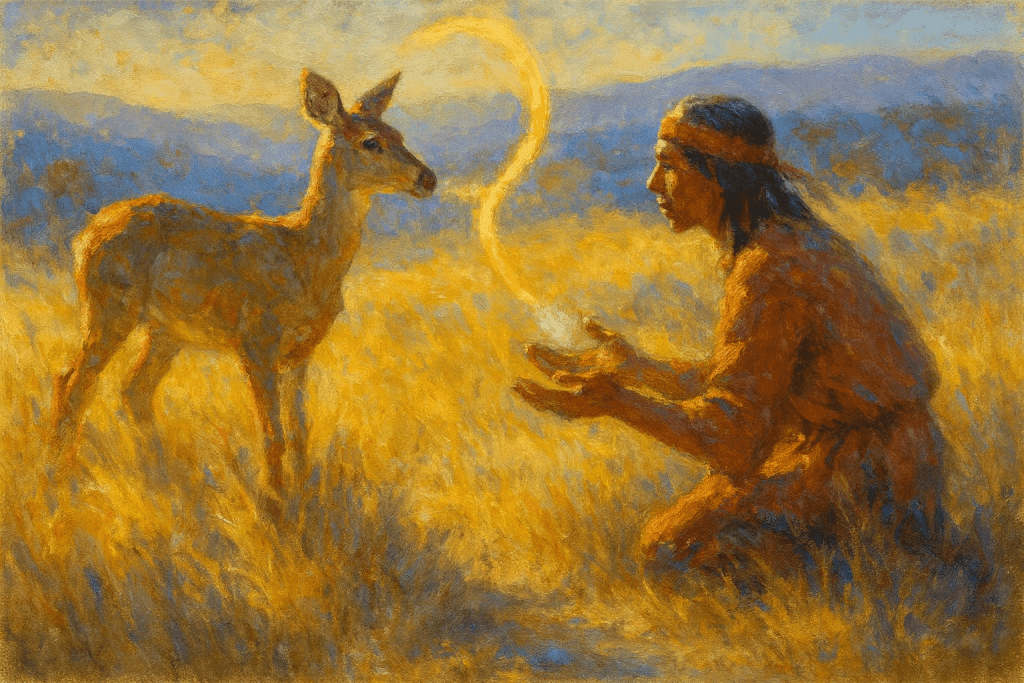
Elders share a winter story from the northern woods. Frost wrote its fine script across alder and birch, and a young hunter walked a corridor of blue light where breath rose like white birds. A doe stood in the hush and faced the hunter with calm eyes that held a country of knowing. The hunter lifted the bow, and the deer spoke across the space in a voice that sounded like river over stones: “Choose kinship or hunger, and shape hunger through kinship.” The hunter lowered the bow, set palm on the ground, and offered a strand of hair, a button, a pinch of meal from a pouch. The doe stepped forward, breathed into the hunter’s hand, and left one slender rib beside the offerings. From that bone came the first whistle for calling, and from that calling came a covenant—the people would eat through an agreement that carried respect in both directions. The deer would give, and the people would give in return, and the land would carry the memory of that exchange in grass, in hoofprint, in human song. Every archery season rises from that early promise: power serves when consent guides it, and meals carry honor when gratitude leads every step.
A writer stands at daybreak and watches an archer along a hedgerow where alder leans toward a field. Cold creeps through wool with sharp gentleness, and the light carries that silvery hue a person feels in the ribs. The archer’s palm slides along the riser as memory guides it; years of habit bring skin and wood into one patient handshake. Breath lifts and turns to milk-white wisps that fold back into the trees, each one a small messenger returning to its sender. Waiting gathers around the body like a cloak. Hearing widens. Sight learns long patience. A faint twig-snap expands into a paragraph, and the light brush of wind across the cheek announces a drift of scent toward the lower meadow. Meaning arrives through every small sign, each one a bead that threads toward a fuller understanding. The whole scene moves with old rhythm, the sort of rhythm that carried families through winters and kept songs alive beside peat fires.
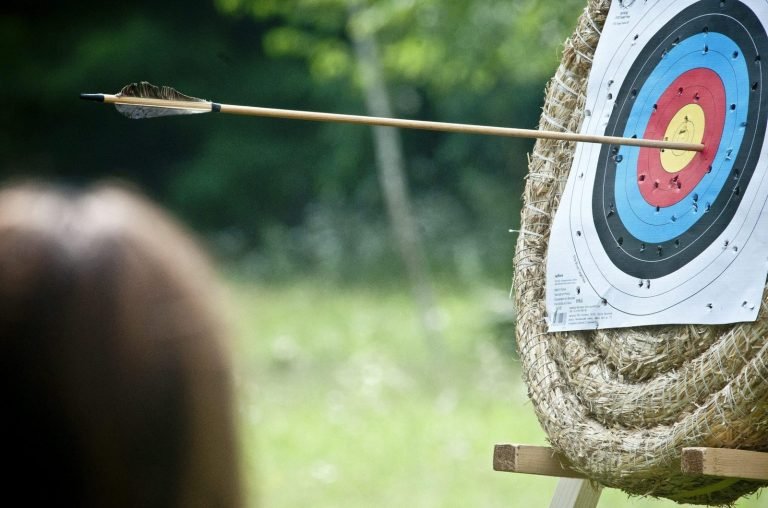
Rifles stretch the world to arm’s length; a bow invites a nearer covenant. This archer steps inside the animal’s sphere and breathes the same cold air, stands in the same frost-glitter, hears the same crow-call. That step changes the nature of the work. Release arrives as a hush, a soft hiss that belongs in this wood alongside wren chatter, stream murmur, and bark creak under thaw. Muscle holds true form; spirit clears to a still pool. Time loosens its tight weave and hangs with spacious generosity. The archer stands within that enlarged hour, present as flame in a lamp. A seasoned power begins to move—steady, unshowy, anchored in craft and long practice—and it carries a gentle authority. Many give that state a contemplative name; woodsfolk speak of the quiet turn inside where mind and place walk together. Peace rises here with a clean pulse, far from roads and rushing talk. The body absorbs a lesson through these hours, a lesson of rightful belonging, and thought later builds sentences around that embodied truth. Physical discipline leads first and lays foundation; understanding follows with weight underfoot and grace in the shoulders.
The circle widens from the drum of individual breathing to the entire life of the grove. Trees, moss, soil, insect, fungus, feather—all join a living council. Aldo Leopold named the land a community, a living order with citizenship. That vision lifts a person from possession toward participation. Hunters accept their place among the members—the rooted, the furred, the winged, the scaled, and the track-reader with a bow. Leopold drew an energy circuit: soil to plant, plant to grazer, grazer to hunter, flesh and bone returning to soil, and the circle continuing with bright resolve. Every creature marks a link in that radiant chain. A deer browsing acorns under oak, a fox cleaving the grass toward a mouse’s heartbeat, an archer at full draw as dawn widens—each one stands inside the same transfer and return. To hunt means stepping into the circuit with consent and clarity. The act welcomes a role, affirms a lineage, and declares accountability in the movement of life from one being to another. Recognition of that role matures into what Leopold called an ecological conscience—a responsibility felt as surely as hunger, as surely as the weight of a haunch across shoulders during a long walk home. Philosophy climbs down from the page and stands ankle-deep in leafmould; thought carries mud on its boots and a lawful joy in its chest.
Responsibility fills the pack now with honest heft. These hills carry a different music from the days of our grandparents. Wolves once framed ridge lines with their amber gaze, and tawny cats threaded ravines where dusk settled early. Their departure reshaped the choir of the place, and deer multiplied beyond the appetite of the ground. A browse line rings the thickets like a tide mark, as precise as a muzzle’s reach. Understory thins where hooves return too often. Spring ephemerals invite longer searches, and low-nesting birds shift their songs to altered shelter. Saplings lift themselves and meet eager mouths. A balanced world once relied on fang and claw for constant editing; present fields call upon a different editor with a two-legged stride and a mind tuned to community health. Each bioregion—these waters, these stones, these hedges of hawthorn and ash—reveals a specific arrangement. Living as a native of place means embracing the role that local conditions ask from residents who cherish continuity. Bowhunting rises as a steward’s craft within this context, a tool shaped for renewal as surely as for harvest.
A license fee travels beyond paperwork and enters the woods as trail cameras, population studies, and careful counts by biologists who love these groves with a scholar’s patience. The modern human predator occupies a conscious station. A wolf answers its gut with honest vigor; a person carries an ethical map across the ribs and hunts for the good of neighbors who wear hoof, wing, and bark. That mindset asks for restraint, placement, season, and scale. The decision to draw, the decision to hold, the decision to lower the bow—this triad forms a civic practice as much as a personal one. Integrity of habitat, stability of populations, and beauty of living order rise together as a triad worthy of loyal service. Service to that triad defines a wild ethic.
Service asks for a language, and gratitude offers the grammar. Ecology speaks in reasons; ceremony gives those reasons a soul. Robin Wall Kimmerer writes of gift, and the word enters marrow straightaway. The deer arrives as a gift from the land’s generosity, a life offered so that other lives continue in health. Gifts ask for reciprocity rather than ownership. Thanks forms the first return. Care forms the second. Maintenance of the circle forms the third. A gift economy carries its own law—take with consent, take with purpose, take with humility, and give beyond the taking.
Teachings from many nations articulate those laws through the Honorable Harvest, a code carried across generations by memory and rite. Hunters enter the woods with clear names and honest intent. Presence itself becomes a request. A quiet greeting passes to the grove, and accountability follows through every step. The second deer receives the arrow when the first reveals itself as teacher. The final deer moves on to seed future seasons. Plenty remains for others—the fox, the coyote, the goshawk, and the soil that sings through a trillion small mouths. A moment arrives that yields the cleanest end; training over months prepares a single humane breath that releases a shaft true to its mark. The art of archery—stance, form, line, anchor, release—becomes an ethical vow, a promise to animal, forest, and self. After the work, gratitude follows through kneeling and words, through small offerings to ground and stream, through yearly commitments to brush, to plantings, to removal of invasives, to letters that defend hedgerows. Ceremony stitches body to valley. A modern hunter steps into an ancestral role with reverence, and reverence grants the act a soul strong enough to carry sorrow and necessity together.
The arrow’s path begins a longer chapter. Tracking gathers the senses into one keen instrument. A story writes itself across leaf and moss with subtle ink. Scuffed earth sketches a leap. Bright, airy blood speaks of lungs and mercy, and relief rises like steam from a kettle. Following this script creates a kinship with the animal’s final journey. The trail pauses, turns, straightens, and the tracker reads those choices like a letter addressed in cedar smoke. Humility enters as a steady companion. Field dressing follows—careful, quick, clean. Elders teach with palm on the shoulder and few words. Every edible part receives purpose; reverence governs each gesture. Hands learn chambers and textures: the heart’s smooth weight, the liver’s dense music, the pale satin of caul. Warmth fades under fingers, and a shiver of understanding arranges itself along the spine. Supermarket cuts arrive with a façade of perfection; meat taken by one’s own hands carries the glow of breath and the signature of terrain. Truth enters through that difference and remains in memory.
Butchery under a strong light becomes apprenticeship to form. Steel answers sinew, and discipline directs every cut. Muscles separate according to their tasks—the runner’s strip, the lifter’s mass, the stabilizer’s seam. The deer reveals itself as a design shaped by a life of movement. Fat carries the flavor of acorn and browse; marrow tells stories of winter; the silver skin gleams like moonlit water and yields to patience. Shoulders, shanks, loins, quarters—each finds destiny in stews, roasts, grills, and cures. Trimmings become sausages that fill houses with pepper and smoke on wet evenings. Bones travel to stockpots where time, heat, and herbs compose broth that strengthens bodies and tempers. Scraps feed hens, whose eggs feed children, and the circle smiles at its own elegance. Muscle learns as much as mind through this labor; the rhythm of cut and wrap imprints a liturgy into wrists and forearms.
Knowledge of place grows beside that work. Hunters come to read hills by the way legs ache during the carry, by the smell of iron after rain, by burrs that catch on trousers in September, by rook-song that changes when weather turns. Alder carr, hazel copse, young oak stand—each offers sign and instruction. Angle and wind reveal where a shaft flies truest at thirteen yards among branches. Riverland trains different arrows from limestone ridge. Bogland calls for wider steps and careful footing. Through seasons, kinship settles in and feels like a second spine.
Home receives the final act. Tables with old scratches and ring marks from decades of cups stand ready. Potatoes and parsnips lift earth-sweetness from the garden, carrots bring copper light, and venison settles into a heavy pot with garlic, bay, thyme, and a dark stout that tasted of peat and cocoa beside last winter’s fire. Steam climbs; stories rise with it. The day’s sequence unfolds across the meal like a map smoothed by warm hands. Cold in the early hour, owl-call from the hedgerow, frost etching the gate, that first glimpse of movement through alder shade, the long patience that braided hours together, the single moment when everything aligned. Gratitude speaks in everyday sentences. Children listen with bright eyes and eager questions. They learn that food carries a biography, that dinner joins a path through leaves to a path through blood and bone. They feel how human life leans on lives of other beings and on a place that feeds both body and meaning.
An ethic takes breath in that sharing. The meal extends the hunt into hospitality; hospitality extends stewardship into culture. Families who cook together learn seasonality through appetite—backstrap in early autumn with chanterelles, a roast in late winter with roots, grill-smoke under a May evening with nettle butter, jerky snapped on hillwalks where skylarks stitch music over grass. Conversations around those plates braid memory with principle. Children carry that braid outward and return with their own threads. Grandparents add songs that turn dinnertime into archive and promise. Prayer sometimes enters, and sometimes a toast with laughing eyes; both reach toward thanks and pledge.
The circle widens beyond household walls. A neighbor arrives with brown bread and sea salt; another brings a jar of pickled beets from last summer’s glut. Packages travel to a widowed friend who welcomes a strong stew on a wet evening. A portion reaches a young family facing a lean month between jobs. Wild protein becomes social glue, nourishment carried by gratitude. The gift earns its return, and return strengthens the ground of friendship.
Stewardship grows legs on days when bows hang on pegs. The same hands that field-dressed a deer carry saplings into clearings and set them into earth shaped by stones and worms. Fences open for migrating creatures where a barrier once formed a snare. Streams receive willow poles at their banks to hold soil through flood season. Hunters show up to count birds at dawn, to plant native shrubs, to pull invasives by the sackful, to write letters that defend hedgerows, to speak at council meetings where planning meets conscience. The body remembers the gift and moves accordingly.
Philosophy remains close through all this, steady as the spine of a bow. Leopold’s land ethic travels beside every decision. Integrity means living wholes—wetlands tied to uplands, corridors that invite movement, seed banks that mirror the memory of a place. Stability asks for diversity—choirs with many voices, grazers at many heights, flowering times that feed nectar-sippers and seed-eaters across months. Beauty carries equal weight—patterns that please the eye because they support flourishing, colors that sing because the soil sings under them. Hunters live among those values as craftsmen live among tools, and the work of each day expresses allegiance to them.
Gift-thinking continues to guide that work. Kimmerer’s teachings form a braid through practice: ceremony before, respect during, gratitude after, reciprocity always. Language meets action. Promises shape calendars. People mark a weekend each month for habitat help and a tithe of time or earnings for conservation groups that carry spades and clipboards into places that require both. Friends join, and the habit turns communal. Children grow, and they carry the habit as easily as they carry a schoolbag.
Sorrow travels with the bow as well, and mature practice faces it with courage. A clean shot carries mercy. A hard lesson arrives some seasons, and skill refines through study, extra service, and humility. Grief can teach and deepen conscience. The animal receives honor through improvement and renewed vows to the Honorable Harvest. Humanity of feeling strengthens the ethic and widens patience.
Craft continues during the off-season through exercises, stretches, and drills. Bows sing sweeter when shoulders stay healthy. Strings enjoy care. Arrows fly truer when spined correctly, fletched carefully, and tuned to a bow’s temperament. Range time with friends brings laughter, friendly wagers, and talk about wind drift and anchor points and the curious way a release feels right one day and near-perfect the next. These sessions create a social commons around responsibility and joy: a club where skill, safety, and story share one bench.
Writing grows from these experiences because language desires to keep faith with memory. Essays, field notes, and recipes scrawled in the margin of a dog-eared notebook all serve the same impulse to preserve what matters. Culinary practice earns a careful voice that stands beside natural history with equal dignity. A haunch braised with cider and juniper, a stew enriched with bone broth and a spoon of blackberry jam during the final simmer, a rare steak sliced thin over rocket and walnuts—each plate extends the relationship with animal and land, and that extension deserves art.
Art also lives on the plate. A drizzle of reduction over slices, roots arranged with a gardener’s affection, bread cut thick from a loaf that smells of hearth—the table turns into a small gallery where appetite and gratitude stand together. A photograph takes shape. A journal entry forms. A message travels to a friend: come by, share this tonight. Invitations enlarge the ethic and give it bright company.
Education fills the remaining corners. Workshops in libraries or community halls show how to break down a quarter, how to wrap cuts for the freezer, how to cook venison with gentle heat so the meat sings. Conversations at those gatherings widen toward ecology, toward maps that show migration routes and historical ranges, toward charts that reflect population trends and plant communities. Children trace rivers with fingers and ask for tree names. Elders tell stories of goshawks over clear-fell edges, of curlew calls over bogland at dawn. Knowledge moves across generations with ease when soup warms bowls and wild food nourishes in the same room.
Gratitude steadies every part of this life. Gratitude cleans the sight and keeps skill in service. Gratitude dissolves swagger by reminding a person that success flows from gifts given by land, mentors, weather, and creatures who offered their lives. Gratitude also strengthens courage when work grows heavy—during hard winters, during legislative debates, during planning disputes where fields stand at risk. Thankfulness inspires endurance.
A final picture settles beside the stove. Table cleared, pot soaking, plates stacked to dry. Night presses a breath-mark on the window. A log shifts and the room answers with low light. The bow rests on pegs near the door, limbs eased. Boots steam gently beside the mat. A jacket breathes out moss and hearth-smoke. A family leans back with the fullness that flows from participation—life, death, work, and joy meeting at one table and greeting one another as kin. Glasses lift toward the place that fed them, toward the animal that crossed their path, toward mentors who taught form and ethics, toward companions who walked the same muddy tracks and laughed at the same hedgerows. The toast travels outward and lands on the land itself.
Eating wild protein rises to sacrament in moments like this. Forest, larder, table, and the stories among them gather into a single conversation where appetite meets responsibility and memory offers a hand to tomorrow. Bodies carry the land forward through muscle and bone. Minds carry the land forward through decision and promise. Hearts carry the land forward through gratitude and the willingness to begin again when dawn brightens. Through that threefold carrying, hunters and families take their rightful places among the members of the biotic community with earned joy.
Morning waits at the edge of sleep with quiet certainty. Breath will lift again in pale clouds. A watcher will see a palm travel the riser by memory. Ears will widen. A twig will speak its sentence and the breeze will write another. Arrows will rest in a quiver that hums with readiness and restraint in equal measure. A deer will move among alder and hazel, sovereign within its realm. Choice will stand beside the archer and whisper of care, timing, lineage, and reciprocity. Release will travel its short eternity from finger to string to air. The longer work—tracking, tending, giving, cooking, teaching—will follow with the same patient stride. Land and people will continue their exchange with dignity and grace. Every bite shared at a humble table will renew the vow: carry the health of this place inside the body, carry its memory inside the voice, carry its future inside the will.
Views: 107