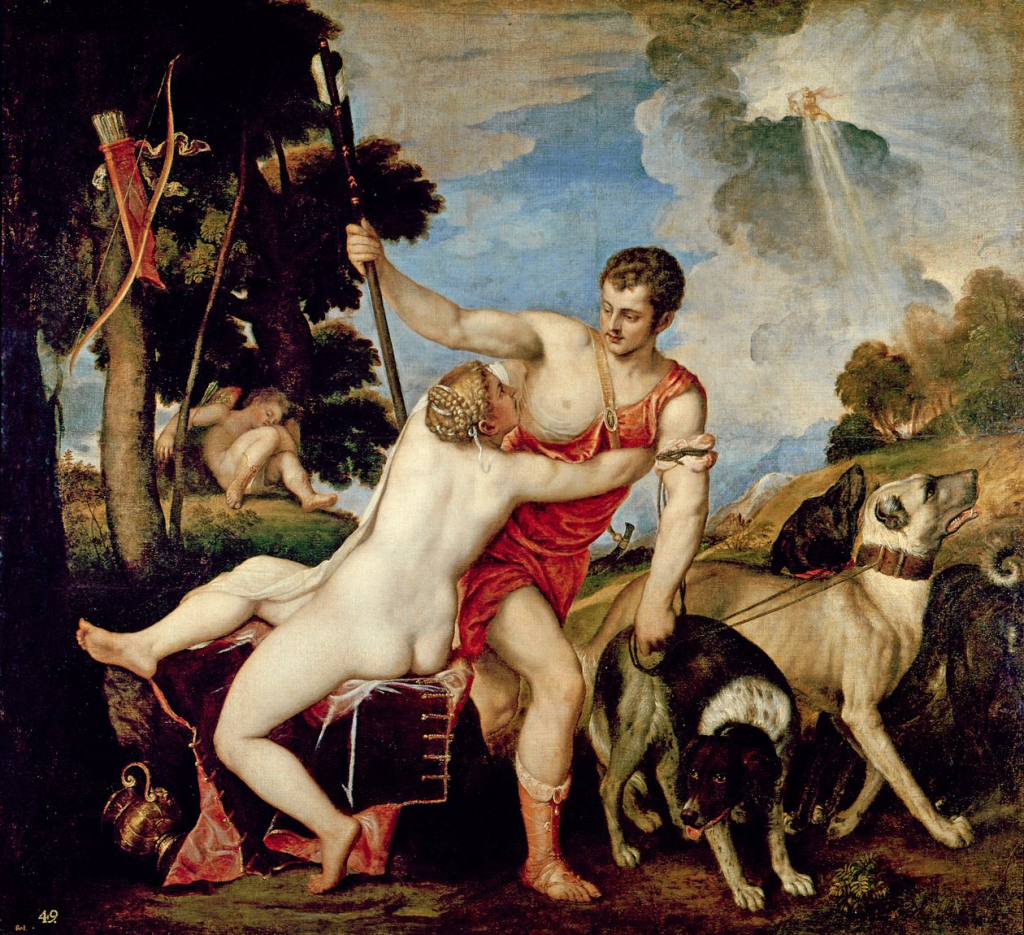
Room 044 in the Museo del Prado carried a disciplined brightness, the sort a ministry might approve, as the building’s stone drank the street and returned it as a pale, steady radiance. I stood where the wall surrendered to Titian’s Venus y Adonis—1554, oil on canvas, 186 × 207 centimetres—hung at a height that set the spine into attention, large enough to resist the casual glance that tourists toss like small change.¹ The canvas behaved as a body confronted by another body: horizontal, intimate, sovereign, and charged with a decision that had already begun to move.
Venus sat with her back toward me, her torso twisting as her arms gathered Adonis into an embrace that carried pleading and possession in one tendon. Adonis leaned toward departure, knee forward, foot set, spear raised as though intent could harden into an oath. Dogs strained at the right edge, their bodies tightened toward a hunt already slipping beyond the frame. Cupid lay under trees to the left, his small limbs given to sleep, his bow and quiver suspended above him like tools hung in a shed after labour. High at the right, a chariot drawn by swans cut the sky, and beams fell toward the lovers with the belated urgency of grace.
My legs learned the painting’s law. At three or four metres, the composition locked into a mechanism: the spear’s vertical insistence braced Venus’s diagonal back, while the dogs dragged the whole rectangle rightward, so motion itself felt like a moral claim. At a metre, surface asserted its own creatureliness. The sky lay thin, so weave and preparation spoke through the blue as though heaven carried grain like breadcrust. Venus’s flesh rose in thicker paint, ridged where brush lifted and returned; light caught on those tiny escarpments and turned illumination into a tactile event. Adonis’s red drapery sat dense and weighty, velvet and blood sharing one pigment economy. Around the trees, darker sweeps carried traces of rag-work, perhaps finger-work, the shadow’s core holding a knuckle’s pressure inside the paint film.
A man beside me, Irish by the vowel and Spanish by the jacket, leaned in as though confession required proximity.
—That red holds its power after centuries—he said, and his voice carried the hushed excitement of a parishioner naming a miracle.
Technical study has given names to what the body already knew. Prado scholarship connected with these early poesie has reported tracing transfer in key elements, pentimenti around Venus’s profile and Adonis’s torso, and thin sky layers that allow preparation to breathe through the paint.² Tracing spoke of workshop intelligence and royal schedule; pentimenti spoke of judgement arriving mid-flight, as the painter revised the emotional engine after the outline had already taken its place on cloth. I leaned toward Venus’s shoulder and felt that revision as a pulse under the surface, the ghost of an earlier decision remaining beneath the final one, a conscience left visible in underpainting.
The surface carried a second biography: care, abrasion, varnish, the slow handling of ownership. Restoration undertaken at the Prado in the mid-2010s, led by Elisa Mora with support from the Fundación Iberdrola España, removed discoloured varnish and intrusive repaint so relations of colour regained legibility and forms regained breath.³ Cleaned tonality changed more than hue. A darker veil encourages a hunter’s posture—head forward, eyes searching for edges—while clarified light grants structure quickly and pushes labour into interpretation, where shame and desire begin to speak.
A uniformed guard took two steps, paused near the rope, and watched a cluster of phones rise toward Venus’s back.
—Frames carry verdicts—he said, and his tone held the mild fatigue of a man who has watched meaning shift with a carpenter’s decision. —A sliver of cloth can change the whole court case—said the guard.
The remark sat in my ribs, as though the painting had found its own witness.
A broader map of workshop practice stands behind that witness. Technical writing from the National Gallery has traced how tracings and cartoons structured repeated designs inside Titian’s shop while allowing adaptation during painting, especially for major clients who required speed married to splendour.⁴ A transferred beginning suited a prince; the painting’s present cruelty depended on what occurred after transfer, in handling and in the fierce particularity of edge, gloss, and colour.
Ethics arrived through the rear view. Venus presented her back with an insistence that turned the spectator into a complicit witness. The customary frontal nude fell away; the eye travelled along shoulder blade, spine’s valley, flank, thigh, so looking began to resemble touch. The spear interrupted that caress with its rigid line, and the hounds seized the pelvis and tried to pull the body laterally, as though the canvas itself performed Adonis’s leaving.
A step to the right aligned the spear with one of the divine beams, and human weapon and heavenly light became twins, instruments of fate held in different hands. A step to the left made Cupid’s corner heavier, and the left zone began to feel like a cul-de-sac where causation slept.
A bibliographic note in National Gallery material recorded a later extension added at the left edge of the Prado canvas, an added strip that recent conservation left covered by the frame; the same record linked Philip’s complaint of a fold from packing to a prominent seam.⁵ The sentence read like clerk’s work, yet it opened a door in the wall. An added strip widens a margin; a covered strip tightens it again. Format shifts the body’s relation to an image, and the body’s relation to an image shifts moral emphasis.
I returned to what the frame allowed. Cupid lay asleep with cheek turned, limbs slack, bow and quiver hanging above him as though eros had set down its tools and walked away from consequence. Under a tightened left boundary, Cupid felt pressed toward exile, shoved into the corner after the harm had already begun. Under a widened boundary, the same figure would breathe as pastoral accessory, a decorative child in shade. The difference lived in posture: tight crop made my gaze ricochet from Venus’s luminous back into Cupid’s negligence with the force of accusation, while a wider margin would grant ease.
The guard watched me watching the corner, as though he had seen this pattern before.
—That strip, that hidden strip, it changes the blame—he said, and he spoke the word blame with a practical softness, the way a man speaks of mould in a wall. —A wider edge lets Cupid sleep like a shepherd’s boy. A tighter edge pins him like a defendant—said the guard.
Royal exchange formed the hidden mechanism behind this canvas. Titian sent mythological paintings—his poesie—to Philip of Habsburg as gifts that carried claims: gift invites obligation, obligation turns into patronage, patronage turns into survival. The correspondence printed in modern form preserves Titian’s explanation of the paired logic of Danaë and Venus and Adonis: one offered the front of the nude, the other offered the contrary side, so painting might rival sculpture through variety of viewpoint.⁶ In front of Cupid’s corner, that “contrary side” felt less like a connoisseur’s trick and more like a trap set for the gaze. The viewer receives Venus’s back as the primary field of desire, then meets Cupid’s sleep where the frame pins him, and sight moves from appetite into judgement.
Transport and possession left marks that entered the painting’s early life. Crowe and Cavalcaselle recorded reports concerning condition and reception, including trouble of shipping and the visible seam that carried royal complaint.⁷ A prince’s irritation at a packing fold placed the canvas’s vulnerability under sovereign eyes. Canvas joins and seams, later strips and covered additions, belong to the biography of the work as fully as the myth belongs to its story.
Ovid supplied the authoritative myth in Book X of the Metamorphoses: Venus wounded by Cupid, Venus seized by love, Venus warning Adonis against dangerous hunts, Adonis pursuing the boar, death, lament, metamorphosis.⁸ Titian chose the moment before catastrophe, and that choice sharpened cruelty into tenderness. The viewer carries foreknowledge; the figures carry conviction. Venus grips as though touch could slow time. Adonis leans forward as though decision could outrun warning. Cupid sleeps as though causation could retire.
Lodovico Dolce’s Dialogo della pittura gave the period’s spectatorship a frank physiology, praising Titian’s handling of seated flesh and speaking of painting’s power to stir male blood.⁹ That language hovered over the room like incense, and it sharpened the ethical question: desire arises in the viewer’s body under the sanction of art, and responsibility seeks an address. Cupid’s corner offers one, especially when the frame tightens the margin.
The Catholic air around Europe tightened its governance of images during these years. The Council of Trent’s decree on the invocation, veneration, and use of images established a framework of decorum and discipline that shaped later attitudes toward visual display, even as mythological nudes survived in princely rooms and private cabinets.¹⁰ In such a world, edges grew political. A widened margin can grant decorum by easing proximity to a nude and distributing attention across neutral space. A tightened margin can restore compression and force the corner’s negligence into prominence. Practical intention may live in carpentry and conformity, while effect lives in ethics, and ethics lives in the viewer’s body.
Venice supplied the material conditions for this wager: pigments bought through trade, canvas prepared in quantity, a workshop able to meet royal demand through routine and improvisation. Studies of historical painting materials and studio practice have shown how pigment economies depended on trade routes and how substances age, shift, and sometimes betray their first splendour.¹¹ In front of Venus and Adonis, that lesson carried weight in the eye: thin blues allowed ground to speak, dense reds asserted heft, flesh transitions carried subtle temperature, gloss and matte passages trained the head to tilt and the feet to step, so the body became the instrument of reading.
Rona Goffen’s work on Titian’s women has framed the cultural stakes of such nudes and the ethical tensions between erotic address and agency.¹² Her thinking rose in me as I watched Venus’s back claim the room while Cupid slept: Venus holds a man whose forward drive carries vanity and appetite for risk, while Cupid’s sleep displaces causality away from Venus and toward a mechanism of eros that ignites obsession and then lies down beside its tools. Under a tight crop, the mechanism feels judicial.
Vasari’s account of Titian, shaped by admiration threaded with rivalry, preserved stories about reputation and workshop theatre that reveal a master attentive to how patrons and rivals read a surface.¹³ A painter who cares for reception cares for edges, as edges choreograph the viewer’s body.
At the lower left, a small vessel caught a faint highlight, a domestic utensil carried into mythic landscape, an object that felt like a servant lingering in a doorway during a quarrel. It turned the left zone into a moral antechamber: eros as craft, love as labour, consequence as the price paid in ordinary rooms.
The guard shifted again, eyes moving from Cupid to the dogs as though he had watched the whole tragedy unfold a thousand times through different faces.
—The hunt pulls the room—he said. —The corner decides who carries the guilt—said the guard.
The wound that deepens during healing lives in seam and added strip: repair changes meaning while it claims preservation. The cure that behaves like a blade lives in the frame’s concealment of the extension, tightening the crop and forcing Cupid’s negligence into prominence. Format, join, varnish, and edge act as metaphysical operators, distributing desire and culpability across the scene with the precision of a judge’s hand. Venus’s back remains luminous in its pale authority, yet Cupid’s corner governs moral pressure, and the hunt that drags rightward feels like the world’s appetite for catastrophe, love clutching at it with all her strength while the agent of love sleeps beside his tools, and I stand in that room with my own gaze on trial, hearing the verdict form in my mouth as a prayer that carries the taste of oil paint and stone, and the sentence keeps moving toward a last word that stays just out of reach—
Scholia:
- Museo Nacional del Prado, Venus y Adonis (P000422), oil on canvas, 1554, 186 × 207 cm, catalogue entry and technical summary (Madrid: Museo Nacional del Prado, 2014–).
- Paul Joannides and Miguel Falomir, ‘Dánae y Venus y Adonis: origen y evolución’, Boletín del Museo del Prado, 32, Extra 1 (Madrid: Museo Nacional del Prado, 2014), pp. 16–51.
Joannides and Falomir offer a model of art history that behaves like a double-entry ledger: connoisseurship on one side, documentary and technical evidence on the other, each entry checked against its counterpart. Their value for my argument lies in how they treat the poesie as objects with a political itinerary and a workshop logic. They keep the reader awake to the fact that invention and replication shared the same room: a design could travel by tracing or cartoon, and yet the decisive psychological tension still emerged through revision in paint. Pentimenti, under that lens, carry more than curiosity; they mark moments where a painter altered the rhetorical temperature of a scene—where a body’s twist became sharper, where a glance became more urgent, where a gesture acquired the force of a plea. That discipline supports any claim about format and margin, because it shows a practice in which “small” adjustments—edge, seam, shift of weapon—could bear the weight of meaning in a royal gift. - Elisa Mora, ‘La restauración de “Dánae” y “Venus y Adonis”, de Tiziano’, Boletín del Museo del Prado, 32, Extra 1 (Madrid: Museo Nacional del Prado, 2014), pp. 52–65.
Mora’s restoration account matters less as a narrative of solvents and more as a record of the painting’s altered social life. Cleaning changes the viewer’s bodily contract with the image. Under a yellowed varnish the eye hunts: it leans forward, it squints, it reads by inference, and the picture encourages a private, almost conspiratorial intimacy. When varnish discolouration and intrusive repaint recede, the picture begins to govern the room again; forms declare themselves at a distance, contrasts sharpen, and edges gain authority. That shift has interpretive consequences. In a composition where reading hinges on pressure at the left margin—Cupid’s position, the corner’s moral weight—clarified tonal relations can make that pressure more legible, more immediate, more difficult to evade. Restoration thus enters ethics through perception: the painting’s meaning remains bound to what the eye can actually see, and what the eye can see depends on choices made by conservators working with evidence, restraint, and accountability. - Jill Dunkerton, David Peggie, Marika Spring, and Rachel Billinge, ‘Titian after 1540: Technique and Style in his Later Works’, The National Gallery Technical Bulletin, 36 (London: National Gallery, 2015), pp. 10–20.
This Technical Bulletin essay supplies a hard floor under any interpretive ceiling. It refuses romantic talk of solitary genius by showing how Titian’s later practice could combine transfer methods with daring surface invention. The key service it performs is methodological: it teaches the reader to distinguish between the stage where a design arrives on canvas and the stage where meaning is forged through handling—scumbling, glazing, revising contours, sharpening gestures, massing darks, letting ground participate in sky. That distinction helps one place greater emphasis on the moral work of format, because it frames “structure” as something that can be set up through workshop procedure while “pressure” is something achieved later through decisions about emphasis, proximity, and edge. The essay also underlines how technical observation becomes historical argument: transfer implies speed, repetition, and reliability for elite clients; variation implies ambition, risk, and the master’s desire to exceed mere competence. A reading of Cupid’s corner benefits from that pairing: the corner can carry an intensity that belongs to late-stage judgement rather than to the mechanical beginning. - ‘Notes and Bibliography’, The National Gallery Technical Bulletin, 36 (London: National Gallery, 2015), pp. 129–131.
The “Notes and Bibliography” section functions like a trapdoor: the most consequential facts sometimes sit there in plain clothing, without fanfare. The mention of a later left-edge extension—added, then covered by framing after recent conservation—offers a rare instance where display history becomes a measurable variable. An extension changes the spatial ethics of the image. A wider margin grants air and distributes attention; a tighter margin compresses attention and increases the sense of intrusion, especially when a morally charged figure sits close to the boundary. The same note’s link between Philip’s packing complaint and a prominent seam also matters. It places physical vulnerability inside early reception: a prince noticed a fold, a seam remained visible, the painting entered royal consciousness as an object with joints and susceptibilities. That is gold for such argument because it anchors “meaning” in the work’s material biography: seams, additions, and frame decisions become part of the painting’s public truth, and therefore part of the ethical reading any serious viewer must carry. - Matthias Wivel (ed.), Titian: Love, Desire, Death (London: National Gallery, 2020), Appendix: ‘The “poesie” in Correspondence’, pp. 216–220.
The correspondence appendix supplies a rare commodity in Titian studies: the painter’s own account of what he thought he was doing, offered within the delicate theatre of patronage. The letters reveal the poesie as a negotiated artefact—gift, claim, performance of learning, and invitation to continued favour—rather than as a private reverie. Titian’s remark about the “contrary side” of the nude often gets treated as a neat paragone flourish, painting challenging sculpture through viewpoint variety. Yet in my framework it becomes ethically charged: viewpoint creates desire, desire creates complicity, and complicity asks where responsibility sits. The appendix also enforces historical modesty. It permits a more precise account of intention: Titian spoke of how the viewer’s eye moves, how a body turns, how pleasure is staged through variety. Once that is on the table, edge and cropping begin to look less like trivial carpentry and more like part of the viewing theory itself—an economy of sight where a few centimetres of margin can decide whether Cupid reads as décor or as indictment. - Joseph Archer Crowe and Giovanni Battista Cavalcaselle, Titian: His Life and Times, 2 vols (London: John Murray, 1877), II, p. 509.
- Ovid, Metamorphoses, Book X, trans. A. D. Melville (Oxford: Oxford University Press, 1986), pp. 223–231.
- Lodovico Dolce, Dialogo della pittura intitolato l’Aretino (Venice: Gabriel Giolito de’ Ferrari, 1557), relevant passage on Venus and Adonis.
Dolce supplies period evidence for the bodily economy of looking. His praise of Titian’s flesh—especially the seated distortion, the weight of the body, the persuasive softness—treats painting as an art that operates on physiology as much as on intellect. That matters because it collapses any safe distance between “aesthetic appreciation” and desire: the text assumes a viewer whose blood stirs, whose body responds, and whose response counts as part of the work’s success. Once that assumption enters, Cupid’s sleep becomes a more dangerous symbol. If eros initiates the wound and the viewer participates through embodied response, responsibility ceases to look like a purely moral abstraction; it becomes a lived question distributed between painter, patron, mythic mechanism, and spectator. Dolce’s language also clarifies why framing and display could become ethical interventions. If the picture works on the body, then a margin that presses Cupid into visibility works on the conscience; it forces the viewer to encounter the agent of desire as a sleeping craftsman beside his tools, and it turns arousal into judgement. - Conciliorum Oecumenicorum Decreta, ed. Giuseppe Alberigo et al. (Bologna: Istituto per le Scienze Religiose, 1973), Session XXV, ‘De invocatione, veneratione et reliquiis sanctorum, et sacris imaginibus’, pp. 774–776.
- J. Kirby, M. Spring, and C. Higgitt (eds), Historical Painting Techniques, Materials, and Studio Practice (Los Angeles: Getty Conservation Institute, 1995), pp. 1–35.
- Rona Goffen, Titian’s Women (New Haven: Yale University Press, 1997), pp. 1–40.
- Giorgio Vasari, Le vite de’ più eccellenti pittori, scultori e architettori, 2nd edn (Florence: Giunti, 1568), ‘Vita di Tiziano’, relevant passages.
Views: 109