

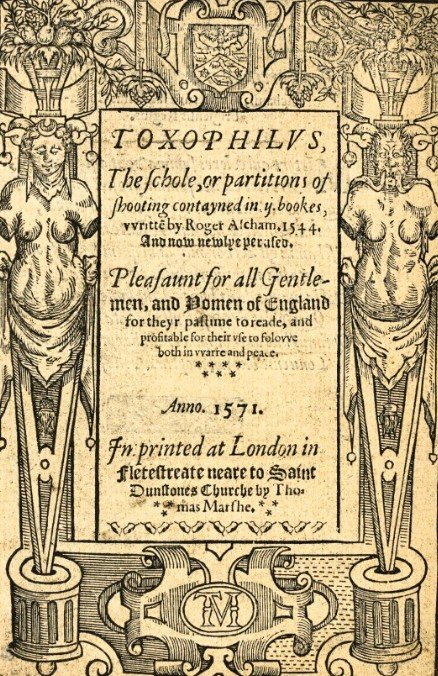
Roger Ascham arrived on my kitchen table bound within a worn volume, carrying the smell of chalky dust alongside old paste. A block of beeswax sat beside my longbow, waiting near a coiled linen string. Holding those threads evoked an argument already concluded, a dialogue bridging the heavy cord resting across my palms and the thoughts pressed into his pages. Toxophilus appeared during the year 1545 as an English treatise defending archery as a discipline appropriate for educated citizens, civic duty, alongside the shaping of human character¹ .
The author selected the conversational format with clear intent. Philologus enters the text embodying the easy condescension belonging to a man familiar with weapons strictly out in barns, assuming scholarship belongs safely enclosed behind college walls. Answering with the warmth of a true enthusiast, the speaker provides reasons rejecting mockery entirely. The structure itself performs the writer’s central ambition. Disputes shared between speakers echo Plato alongside Cicero, grounding the work in spaces where ideas carry social weight. Dragging the yew across that threshold required placing the implement inside this academic shape. A tool associated heavily with physical toil began speaking the language of ethics.
Favouring the vernacular over Latin carried massive weight for his overall thesis. Choosing the ancient tongue would have restricted the readership strictly to scholars. The local dialect welcomed the country gentleman accustomed to reading sermons, the parish clerk keeping accounts, the ambitious courtier seeking polished speech, alongside the tradesman capable of following a plainly reasoned case². Writing for his countrymen allowed the humanist to turn learning toward the commonwealth, addressing a public ready to meet a publication halfway. He hazarded his reputation on the European stage by picking an island tongue. His decision affirms that marksmanship deserves a defence spoken in the vocabulary ordinary people use every day.
History backed the sneering attitude he confronted. Longbowmen had shaped famous victories during the previous century, yet prestige always leaned heavily toward horses, swords, alongside heraldic display. Gunpowder weapons dominated fashionable circles by the time he lived, leaving the court eager for novelty. Archery appeared ancient by comparison, linked firmly to callused hands working village greens. The weapon bore a class stain as well. Society imagined the shooter as a labourer wielding strong shoulders, entirely separate from a thinker possessing a trained mind. The text attacks that prejudice directly by presenting target practice as worthy of the exact seriousness demanded by literature. He opens his case through the human frame. Shooting offers robust health by pulling the athlete into fresh air. The participant experiences measured exertion demanding proper posture combined with deep breathing. The writer contrasts this regimen against games of chance, exposing idle pastimes as breeding grounds for quarrels³ . That comparison sounds moralistic today, yet it rests firmly upon a practical insight regarding focus. A marksman allowing the brain to drift drops the extended arm or shortens the draw. The arrow lands wide, reporting the lapse with a clarity missing entirely from dice. The implement operates as a tutor in this way. It trains attention through physical consequence.
Moving past the flesh, the argument touches upon workmanship. The manual details timber selection alongside draw weights. The author praises skilled artisans while cautioning readers regarding careless execution. He describes shafts with affectionate precision, noting how straight grain aligns with clean nocks. Proper feathers must match heads suited to their specific task. The audience feels a scholar’s delight in distinctions carrying real weight. He wants the art grasped fully, separated from mere performance. In his pages, the bowman resembles the humanist, as both must learn from authorities. They must test claims against experience while respecting the stubborn facts of the material world. These technical passages carry ethical force. A man learning to care about a true cord may also learn to value straight speech.
Classical witnesses strengthen his central claim. The volume cites authors who praised exercise as a pathway to moral fortitude⁴. He invokes Homeric heroes alongside Roman examples, using those figures as evidence that wise cultures valued disciplined populations. He leans heavily on the ethical vocabulary of measure too. Praising moderation while warning against excess echoes Aristotle’s account of virtue as a mean situated between extremes. A recurve teaches this mean through physics. Drawing too little causes the missile to drop short. Overstraining collapses the form entirely. The routine becomes a lesson in proportion. Proportion translates directly into character. Pleasure emerges surprisingly as one of his strongest themes. The tutor loves the sport deeply, withholding any apology for that affection. He argues that recreation supports study in the exact way rest supports labour. A mind reading all day grows dull, just as a frame sitting all day stiffens. A walk to the range restores both faculties. He presents shooting as a companion to letters, distinct from any rival pursuit. The scholar drawing the string returns to books refreshed. The marksman reading gains words for what his hands already know. His defence therefore includes joy as a legitimate reason for participating, provided judgment governs that joy.
Toxophilus also occupies a specific place inside Tudor politics, creating a tension archers still feel today. England had long legislated target practice. Earlier statutes required attendance on Sundays while restricting competing games. The law treated the weapon as a reserve of national defence. The master wrote in a kingdom fearing invasion alongside internal disorder. Praising the discipline as a safeguard for the realm aligns his case firmly with state interest. His moral education doubles as military readiness. The exact drill steadying a citizen’s mind can also steady a soldier’s hand.
Here the troubling question appears regarding when healthy routine becomes preparation for coercion. The weapon teaches obedience to technique, leading directly to obedience toward instruction. A state requiring mandatory practice can demand conformity in other areas. Centuries later, Michel Foucault described discipline as a technology producing docile citizens trained to move efficiently within systems of power⁵. The Tudor era lacked Foucault’s categories, yet the heavy hand of authority exists clearly in his world. The government prized order above all else. Magistrates demanded strict conformity while using violence to enforce submission. The civic virtue of the range could slide toward militarism if rulers treated compliance as an end in itself.
To his credit, the author pushes back by insisting on personal judgment. He urges participants to find good teachers, testing advice against lived experience to avoid foolishness or bravado. He mocks the show-off chasing distance for vanity. He warns against betting on foolish contests that injure athletes while corrupting minds. The yeoman he praises resembles a citizen capable of discernment, distinct from a mindless pawn. Discernment carries massive political weight. A person trained to test claims against results may resist commands violating reality, whether those orders come from a swaggering bully on the field or from a magistrate drunk on authority.
His social vision reinforces that exact point. He treats bow-makers alongside fletchers with respect, praising their knowledge while urging gentlemen to learn from them. The target field creates a space where ranks mix for the length of a session. Skill outranks title when shafts hit the mark. A lord failing to hit the gold learns humility beside a commoner who succeeds. That mingling carries weight in a hierarchical society, offering a modest democratic promise where shared routines teach mutual respect. Imagining the educated man taking counsel from the maker requires power to learn its own limits.
Still, the writer remained a man valuing order. He moved in court circles, eventually tutoring Elizabeth while serving as a diplomat. He admired governance alongside stability, fearing faction alongside chaos. His praise of regular habits therefore carries a political hope where subjects trained in disciplined recreation will become subjects trained in disciplined duty. That hope can support a resilient commonwealth, yet it can also slide toward militarism when rulers treat obedience as the highest good. The Tudor crown enforced religious policy with absolute ferocity. The monarchy also waged wars that bled men alongside the treasury. In such a context, even a humane defence of the bow can become a tool for the state’s appetite.
Reading the treatise in the present allows me to feel the attraction alongside the warning at once. He offers a vocabulary for the art that rejects cheap romance. He elevates the implement above battle glory, distinguishing the weapon from rustic pastimes. He treats the field as a school of attention. The participant learns measure combined with patience. Those virtues remain real on any grass. Every archer knows the moment at full draw when time narrows. The brain must choose its moment, balancing the hold against the release. Holding too long causes the shoulders to tremble. Releasing too quickly sends the shot wild. The act teaches responsibility for timing, turning timing into a moral habit.
That teaching can be borrowed by any power hungry for efficient bodies. The ethical task for the audience lies in keeping his two claims together. Archery can form character, just as archery can serve violence. The tutor tried to anchor the act in virtue by attaching it to learning alongside moderation, keeping pleasure governed by judgment. He also accepted that the state valued the skill for defence, writing directly into that acceptance. A modern shooter can honour him by keeping the core purpose clear. We must seek discipline for honesty over domination, favouring steadiness over cruelty.
Closing the book left wax clinging to my fingers, while paper dust coated my thumb. Those residues felt like a handshake stretching across centuries. The humanist wanted the bow to speak in the language of dignity. People would participate for the sake of health, finding fellowship alongside a calmer mind. His sentences still do that work today. They also remind me that every tool carries two uses. Every virtue can be recruited by force. The archer’s responsibility begins exactly where the string begins. We must choose what the weapon will serve, rejecting the decay of skill into mere display or mere compliance⁶. I think of his insistence on measure, a word carrying musical cadence alongside moral proportion. On the line, measure means drawing to the same anchor point while setting the shoulders. It means letting the sight settle before releasing through the back muscles. In civic life, measure means resisting the temptation to treat neighbours as targets. When the text praises the art as fit for gentlemen, he invites the powerful to learn restraint from a discipline that answers pride with a miss.
His dialogue offers a quieter gift as well, defending the dignity of focused routine. A culture chasing novelty will mock repetition. The bow teaches that repetition can become a path into freedom. Each end repeats, yet each arrow flies differently depending on the shifting wind. The marksman learns to notice those differences, adapting calmly to keep the mind steady while the world shifts. That steadiness resembles the best civic virtue, remaining patient while resisting slogans.
The author wrote to save an art from contempt. He succeeded by making the sport legible to the educated. He also made education hospitable to the shooter. I set the volume down, pick up the yew, and feel his wager continue in my own hands. Careful habits form a careful person.
Scholia:
¹ Ascham presented his dialogue during a period of massive transition for the English commonwealth. He aimed to elevate a physical discipline to the level of academic philosophy. By positioning the longbow as a tool of intellectual gravity, he bridges the gap separating the university from the village green. The book operates as a cultural bridge, offering the physicality of wood alongside string as an extension of the mind’s own focus. I read this text as a foundational document for the philosophy of physical practice, demonstrating how a tangible object becomes a site for ethical development. The printing press allowed his ideas to spread across the island, turning local habits into a cohesive vision of national character. The physical act of drawing the cord transforms into a metaphor for drawing out human potential, creating a framework where sweat alongside study share the same dignified space.
² Choosing the English vernacular over Latin represented a massive political shift during the sixteenth century. Humanists typically preferred classical languages to maintain a scholarly monopoly over philosophical discourse. By writing in the common tongue, Ascham extended an invitation to the yeoman, the merchant, alongside the squire. He built a literature that met the working citizen on familiar ground. I argue that this linguistic choice democratized the pursuit of virtue. The local dialect carries the grit of the soil, grounding lofty ideals in the mud of daily life. The text speaks directly to the hands that shape the timber. Providing philosophical weight to everyday English validates the experiences of ordinary people. The language becomes a vessel for shared civic identity, binding the scholar to the craftsman through a shared vocabulary of proportion, patience, combined with duty.
³ Tudor moralists frequently targeted games of chance as breeding grounds for social decay. Dice alongside cards relied entirely on random fortune, detaching the participant from personal responsibility. Archery demands the exact opposite condition. The shooter owns every mistake, as the arrow reflects the precise state of the athlete’s focus. I propose that Ascham saw the target field as a laboratory for personal accountability. The discipline forces the body to register its own lapses. A dropped arm yields a wild shot, creating a feedback loop where physical reality corrects mental distraction. This dynamic turns recreation into moral education. The archer learns to trace consequences back to their exact origin within the human frame. The range becomes a site of truth, stripping away excuses while forcing the individual to face the material results of their own actions.
⁴ Renaissance thinkers relied heavily on classical antiquity to validate contemporary practices. Ascham aligned the English longbow with the weapons carried by Homeric heroes, borrowing the authority of ancient empires to elevate local customs. The Greeks viewed physical training as an essential component of civic virtue, linking the strength of the body to the resilience of the state. I see this classical framing as a deliberate strategy to shield archery from aristocratic contempt. By wrapping the wooden shaft in the prestige of Roman history, he grants the discipline a towering pedigree. The comparison forces the court to recognize the yeoman’s tool as a classical instrument. The physical exertion of the range becomes a continuation of ancient philosophy, where the athlete participates in a legacy of measured strength, tactical patience, alongside martial honour stretching back to the dawn of Western civilization.
⁵ Michel Foucault articulated how state power operates by shaping docile bodies through repetitive training. While Ascham lived centuries before such theories emerged, the Tudor state applied identical mechanisms to its populace. Mandated archery practice served the crown by producing citizens conditioned for military obedience. I read the historical statutes as early examples of disciplinary technology, where recreation functions as a covert form of conscription. The state transforms the village green into a training ground for imperial ambition. The bow becomes an instrument of statecraft, aligning the muscles of the individual with the desires of the monarch. This historical reality casts a shadow over the humanist praise of civic duty. The physical conditioning required to hit the gold also prepares the citizen to follow orders, creating a tension where personal virtue risks sliding into blind compliance with authoritarian demands.
⁶ The duality of the longbow remains its most compelling feature. The weapon demands profound inner calm, yet its ultimate purpose involves projecting lethal force. Ascham navigated this tension by emphasizing the psychological benefits of the practice, focusing on the mastery of the self rather than the destruction of the enemy. I argue that the ethical archer must remain acutely aware of this paradox. The discipline cultivates a serene focus, yet that serenity can easily serve violent ends. The responsibility lies entirely with the practitioner. We must actively choose to direct our focused attention toward honesty, restraint, alongside fellowship. The physical mastery of the implement must remain subordinated to a mature moral compass. The true target is the perfection of the shooter’s own character, ensuring that the lethal potential of the tool remains governed by a steadfast commitment to civic peace.
Views: 444


