

A cold, fox-coloured light runs across the ridge above the Rother, and a banner—dragon or cross according to the teller—leans into the breath from the Channel. Hooves churn the slope into a paste of chalk and blood; ash feathers from broken shafts; a conch of a horn blows once, twice, and dies. A man lifts his visor to prove that he breathes. Another tightens a grip on an ash-hafted axe and sets his boots against England. Through that image a whole year gathers itself, heavy with law and oath, with weather, wind, and the grain of men. A kingdom tilts, and hands on both coasts reach for the hinge.
To enter 1066 with clean measure, a reader must stand inside English custom and beyond it. The witan—a council as political as it was old—had long weighed the good of the realm when a king died without a son. Edward the Confessor, a saint in the making and a king with Norman ties in his bone, left England without a living boy; he left, instead, an expectation that the living should protect the land. Edgar Ætheling carried royal blood through his veins yet carried a child’s strength through his arms. Harold Godwinson, Earl of Wessex, carried bread, ships, coin, and a proven shield arm. On 6 January the council placed him under a diadem because the kingdom required a man who could ride the circuit, gather the fyrd, and hold the southern coast through a summer of watching.
Beyond that council chamber, another memory took shape in Norman rooms where relics lay thick inside oaken chests. William, Duke of Normandy, had breathed English air as a boy through Edward’s exile; he had housed Norman kin on English land through Edward’s favour. A promise runs two ways in such a web. Norman mouths repeated a tale in which Edward named William as heir by gratitude and prudence, and that tale found its seal in a scene with Harold that English hearts learned to hate: a shipwreck, a forced courtesy at a foreign court, and an oath upon saints carried in silver—an oath that, inside Norman telling, bound Harold to advance William at the hour of succession. A breach of such a pledge required penance. A breach by a crowned head required steel. Rome weighed the claims and, by autumn, Alexander II’s hand had blessed William’s venture with a ring and a banner, because reforming zeal in the papal curia aligned with a duke who promised discipline for a wealthy, unruly church across the water. A war for a crown thus learned the tone of a rite.
A third pressure moved from the north, older in style and younger in appetite. Harald Hardrada, king of Norway, already carried campaigns from Novgorod to Sicily in his bloodstream; he read the old treaty of 1038 with Danish eyes and found a claim that prized England as a prize once more. Tostig Godwinson, Harold’s brother, exiled and proud, offered a pilot’s hand and a traitor’s guide. By September, long ships slid up the Ouse, and men in mail with round shields sang hard songs at Riccall.
Harold, seated at the south with ships at anchor and the southern shires stretched thin with late harvest, heard the news and answered as a man answers a fire on his own roof. He dismissed the fyrd when food and patience ran dry, because a farmer’s duty to field and charter binds as closely as his duty to a king. He kept the housecarls—paid swords hardened in other kings’ wars—under the dragon of Wessex, then turned north with a pace that made chroniclers write as if Pegasus set the cadence. The road from London to York bends through Lincoln and Stamford; five days in the old reckoning set the march; cold air from the Humber cut the lungs as English boots cut the miles. On 25 September at Stamford Bridge, Harold took the Vikings in shirts, because victory at Fulford on the 20th had loosened helmets and coats on a warm morning; the bridge pinched the field; the axe-biters on both banks set a grim music; a berserk figure held the planks until an underbridge thrust found a gap. Hardrada fell with a throat-shot; Tostig fell near him; the survivors pledged peace and sailed home in a handful of ships. England breathed once, long and sore, and turned to the coast again.
Wind, more than any lord, ruled the Channel that summer. Normandy waited through headwinds; England waited through hunger; then the air swung about. On 28 September, William landed near Pevensey with horses and carpenters, with baked bread and prefabricated castle parts, because a duke who conquered in Maine and Brittany understood that a timber keep on a motte secures a beachhead more firmly than a victory song. He rode out, burned the weald because forage fuels cavalry and terror loosens levy, and anchored his force near Hastings. Harold’s scouts caught the scent; the king chose speed over delay because he carried fresh glory from Stamford Bridge, because Sussex blood answered fire with iron, and because a levy held by love sours when asked for second harvest-time. He reached the long ridge near the later town of Battle and placed shields along the crest, where a saddle of ground and a shallow stream created a frame that suited his men.
A shield wall grows from earth and habit rather than from romance. Men of the shires in byrnie or padded coat link boards rim to rim; spears interlace; axes wait; a few archers crouch and watch the sky. Housecarls, men of Harold’s pay-table, hold the core with two-handed Danish axes able to hew a horse to the haunch. The ridge forces a knight to charge uphill; the turf, chewed by hooves, steals a little speed; a good man on a crest multiplies his courage through the ground under his soles.
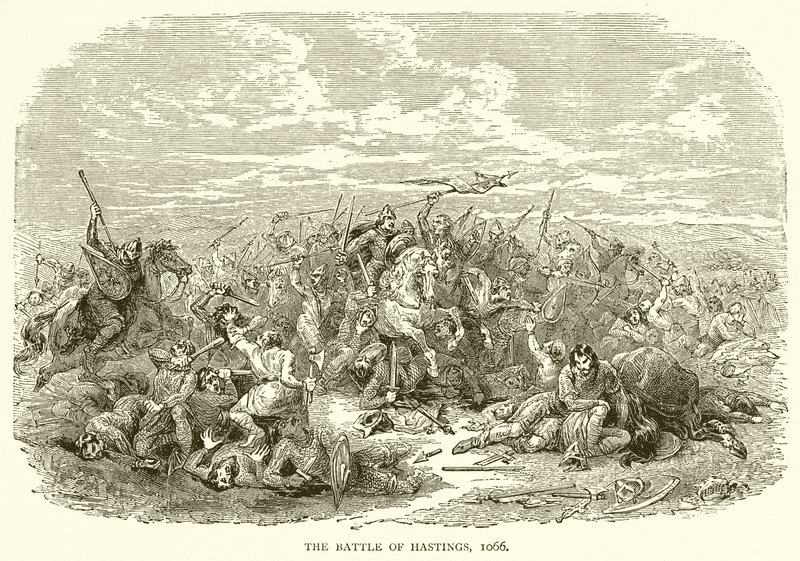
William fought as a commander trained by Norman method. He split his lines—Breton, Norman, French—with archers leading, infantry behind, cavalry third. Arrows rose and fell; the shield wall shrugged; footmen pushed; the ridge answered by refusing to move; then mail-clad riders came on with lances couched. The shock lifted a little turf; the wall held; odds favoured the patient. A rumour rolled along the Norman slope that William lay dead; a duke who knew armies as living creatures lifted his helm, showed his face, and rode the front with a shout that carried his whole future in it. Through the afternoon, the field learned a pattern: a mounted rise; a crash against wood; a roll back down the hill; and, at times, a feigned flight that drew hot English hearts into pursuit. Discipline frays near victory. A man who kills a knight on a slope feels a god in his sinews; his feet forget the wall; the gap he leaves admits a spear-head of enemies. William pressed that lesson until daylight thinned. Gyrth and Leofwine, Harold’s brothers, fell by the king’s side; the core thinned and yet breathed; the banner of Wessex still held a place on the skyline.
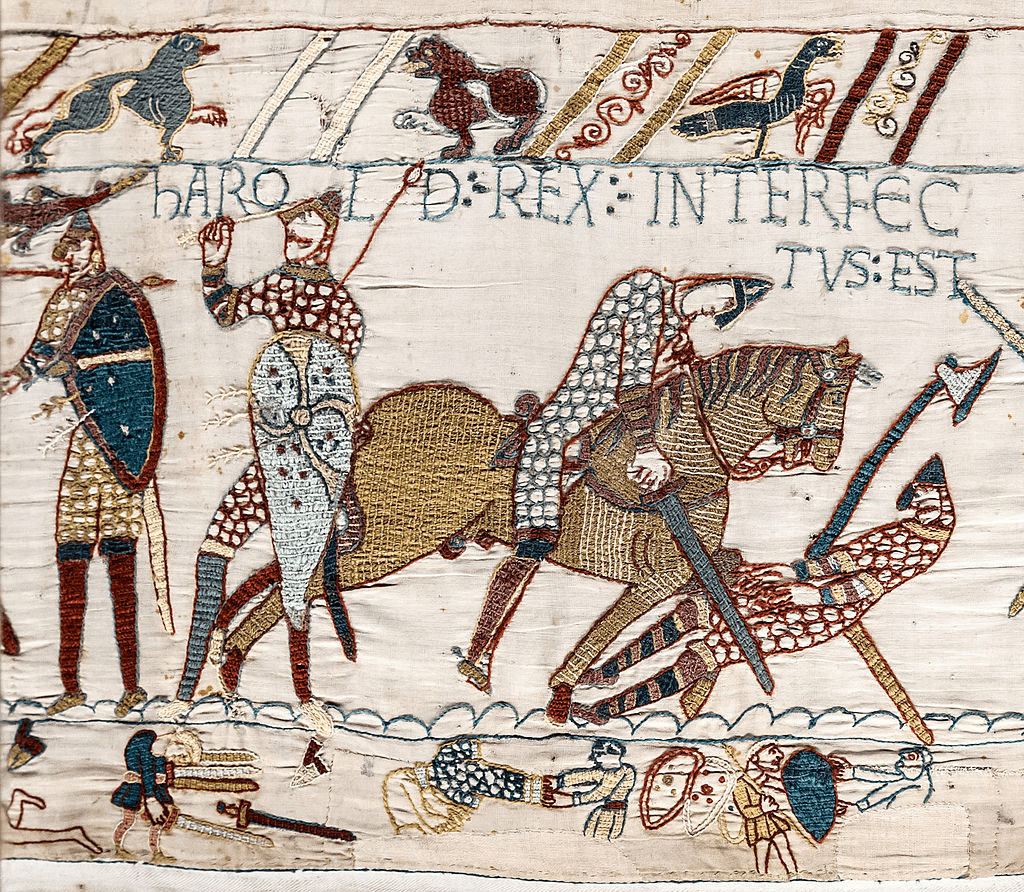
Inside that diminishing light the king’s death entered its long argument. Our most famous cloth from the age—an English embroidery kept in Norman keeping—sews the line Hic Harold rex interfectus est above a scene that pairs a figure with a shaft at the eye and a figure under a horseman’s sword. Needles tell stories with a grammar of sequence and emblem; stitches break and receive repair across centuries; captions float across more than one head without shame. Some drawings from earlier centuries show a missile toward the face; other restorers from the nineteenth century, working under gaslight and zeal, returned an eye-shot that the original perhaps never bore. The cloth refuses to anchor a single pose as final. It gives, instead, a double image: a mark from the sky and a stroke from the hand.
Contemporary pens speak with the same divided mouth. The duke’s chaplain, William of Poitiers—eyewitness to the campaign and servant to Norman prestige—records a royal stand in the front rank, a breach of the wall, and the hacking of a king by a select knot of riders who fought through to the banner. His silence around an arrow deserves weight because hagiography would have served the invaders well, and yet he paints a warrior’s end. The Carmen de Hastingae Proelio, likely composed near the conquest by a learned courtier and dedicated to Odo of Bayeux, offers a fierce, theatrical slaying in which a blow to the thigh joins a storm of cuts—an image that speaks of intimacy and fury rather than of a distant shaft. Later tellers among the Normans—Amatus in Montecassino, William of Jumièges in revised pages, Wace in the Roman de Rou, Henry of Huntingdon with a relish for moral geometry—carry the arrow motif into wider currency until legend finds a natural home inside sermons about perjury and divine measure.
A moral logic invites the arrow because a line of thought, old as Hebrew law and fresh in the homilies of eleventh-century Europe, pairs false oaths with punishment upon the eyes that watched a man swear upon hidden relics. In the embroidery, Harold’s oath over a chest of bones under a draped cloth appears as a public spectacle; in Norman prose, God answers for outraged saints through a missile that descends with the judgment of the sky. An eye receives the price for blindness before grace. Such clarity pleases those who win. Such clarity travels well in halls where a new lord divides manors and grants earldoms to men whose mothers pray better in French than in English.
English voices preserve another cadence. The Waltham Chronicle, composed at the royal foundation that Harold had restored with his private wealth, insists that Edith Swanneck knew the king’s body among the broken through marks placed by love upon living skin. Mutilation, a common payment for victory in that century, turned a monarch into a problem of identification. The abbey’s canons carry a memory of burial in earth that Harold had endowed. Other tellings claim a grave by the sea, so that the king who guarded the coast might keep watch forever; such a sea-burial moves the heart like a ballad, yet the abbey thread—anchored in property, habit, and pride—carries weight among sober readers of gifts and charters.
Geography sets its own pressure upon the narrative. The ridge near Battle—later crowned with an abbey whose high altar marked the place where the standard fell—forms a long saddle with a slight dog-leg; lower ground curls away into marsh; the Norman camp lay to the south-east on a spur that served supply. A late skirmish, remembered under the name Malfosse, speaks of a counter-stroke in the dusk when retreat tangled cavalry with a dike and thicket, and English blades exacted late payment. Such a scene suits the psychology of a broken day: bands fight on in anger, knowing that the larger shape already moves against them, and take courage from revenge because duty to dead brothers knows only forward motion.
Strategy, too, shifts the balance of truth toward one death rather than another. If a king falls in a rush of swords within arm’s reach of his banner, then the wound that matters politically—collapse of command—arrives through proximity and panic. If, however, a shaft finds a royal face through a cloud of arrows, then the army’s heart breaks less through a gap in the line and more through a sign from heaven. A conqueror who needs the papal standard to sanctify confiscation, castle-building, and liturgical reform across a proud island gains by the second tale. A community that nursed the memory of a king who never fled, who marched north then south with unearthly stamina, who stood with brothers at the core, gains by the first.
The wider year presses its thumb upon the scale. Harold’s march north proved bodies and bridles; his victory at Stamford Bridge wiped a whole threat from the board; his turn south bled his men through blister and strain; harvest season thinned the levies; Sussex men carried the anger of fired manors rather than the rest of a long wait. William shepherded a host fed by ships; he landed with carpenters; he paid his allies in the coin of future shires; he fielded archers in depth because a duke raised under Scandinavian-descended cavalry and Frankish discipline understood combined arms. In that frame, a death by swords after a breach at the banner grows plausible through logistics as much as through drama. Yet a death by arrow retains a different kind of probability: a long battle, with archers adapting their arc to rise over shields during late phases, can deliver a blind strike that finds a leader surrounded by men who wear similar gear and carry similar boards. Battlefields produce both kinds of end daily, and both belong to Hastings as long as the sources breathe.
One more influence moves through the scene like a subtle wind: the embroidery’s long captioning habit creates sequences rather than captions for single figures. The Latin line above the final tableau can name both the wounding and the finishing in a phrase that floats across the cloth like a chant, and a viewer trained by liturgy hears the line as a refrain rather than as a museum label. On the linen, that refrain meets a political theology that grew stronger with every charter William sealed. English lands, measured in hides and recorded in a survey that would humble any lord—Domesday by name and by tone—change hands under a logic that aligns conquest with reform. Stories inside such a regime march with the law.
The loss of the old royal house carries further consequence than language or tithe can count. Stone rises where timber once ruled, because a conqueror who distrusts local levies plants garrisons in keeps and rings them with boroughs; a countryside that breathed through moots and reeds now breathes through masons’ scaffolds and marching justiciars. French holds the tone of tenure and plea; English continues at hearth and lane; Latin keeps the altar and the archive; the island learns to walk under three tongues. Yet the dead king’s own weapons live on inside that new grammar. The housecarl axe, shaped by Denmark and proved on English soil, enters romance as the giant’s blade and the saint’s attribute. A shield wall becomes a memory of fellowship that later centuries call again when foreign boots seek harbours. A name—Harold—takes on a warmth that later monarchs find hard to wear because memory loves the man who stands and spends himself cleanly.
Certainty evades the historian because medieval narrative grew from rivalry as much as from record. Yet ambiguity, rightly held, sharpens rather than blunts. A reader who admits both scenes—an eye blackened by a yard of ash and goose-feather, a body ringed and cut by riders who fought their way uphill—gains a fuller England, an England whose fate turned where three traditions collided: a northern appetite for rule through sea-roads, a Frankish method of war and charter, and a Saxon habit of community that had learned to bind kings through counsel. A field near Hastings joined them, tested them, and produced a polity that would carry all three forward.
One can stand today on the ridge while rooks cut letters into the air and sense how bodies decide ideas. A banner’s fall empties men of breath; a brother’s fall tightens a jaw; a rumour about a duke drives a wedge of fear into a cohort; a feigned flight tempts pride, and pride breaks a line. A story about an arrow sanctifies seizure; a story about swords preserves honour. Both narratives wash the same stones; both send their run-off into parish life for centuries. When a monk at Waltham fingers a reliquary in winter and thinks of a benefactor buried beneath coloured tiles, he keeps a warrior’s ending alive through prayer. When a Norman steward reads a French writ that grants a Sussex manor to a kinsman of the duke because God judged quickly upon a perjury, he keeps the arrow alive every time he rides the bounds.
Má bhíonn an bás ag teacht, má thagann sé go lom, tagann an scéal leis (when death comes, when it arrives bare, the story arrives with it)—old people in any parish could have said as much, and chroniclers supplied the proof. The arrow gives a clear sermon, the sword gives a clear courage, and a kingdom, caught between two clarities, learns to carry both within a single memory. The moral bite of the one crowds the military dignity of the other, and yet the braid holds; England grows inside the pull.
Harold’s end, then, forms less a solved puzzle than a field-guide to power, piety, and persuasion in the eleventh century. An embroidery, cut and mended by hands across ages, testifies to the way images receive repair according to the needs of a given noon. A Latin life by a chaplain testifies to loyalty under patronage and to the honour a conqueror claimed through a personal duel within a crowd. A local chronicle from an abbey in Essex testifies to neighbourhood affection for a generous lord and to the way women, charged with memory through touch, keep identity when edges blur. Across them, the year’s long arc teaches a last, bracing rule: men build explanations to fit the work they must accomplish on Monday morning. William required a god in his baggage as well as a smith; Harold required speed, example, and a wall that breathed courage through contact. Their clerks wrote accordingly.
Even the ground obeyed that logic. The sea blew fair only when the duke’s fleet already stood loaded; roads yielded mile upon mile only because a king wagered his best men on one more march; arrows found faces only where bows in depth met a ridge that forced archers to aim high and long; swords found thighs only where riders reached the banner at last light with enough breath to swing. The old gods of weather took counsel with the new God of relics and writs, and England received a settlement that transformed her speech, her skyline, and her law.
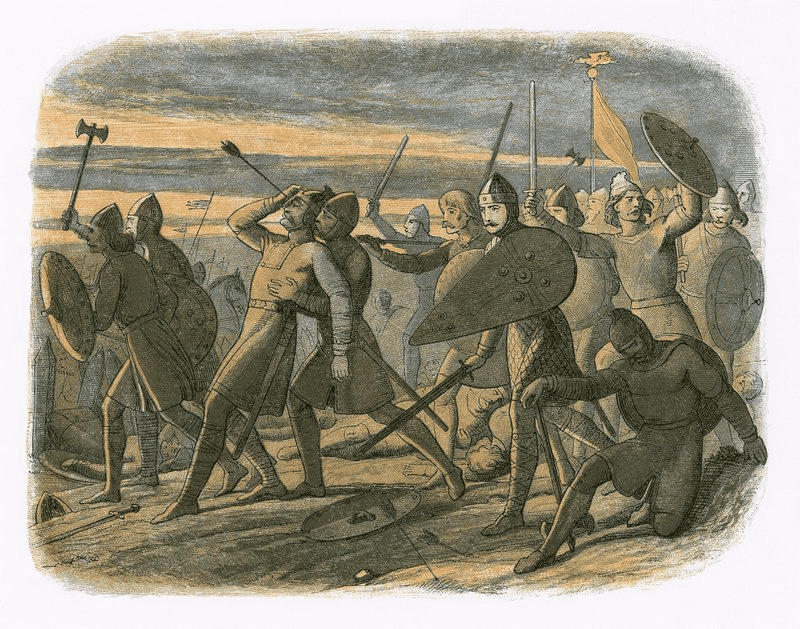
A century and more later, poets in French gathered the story that monks and captains had scattered, and the arrow had by then learned to gleam with allegory. Yet a visitor at Waltham, pausing by a tomb that local men honoured, could still imagine a woman’s hand on scar and freckle and understand why a people chose to remember a king who bled among his own. Both memories serve the island. Both spring from that fox-coloured light on a Sussex ridge where a banner leaned and men decided, minute by minute, how a realm carries itself into the future.
Harold’s eye perhaps drank the sky through a feathered shaft. Harold’s breast perhaps met a ring of blades at arm’s reach. Both truths gather under the same Latin line on old linen. Both bear the weight of a kingdom that, by nightfall, had changed hands and, by morning, had begun to change tongues. The hill keeps its counsel. A reader who listens there with patience hears the old cadence of law, oath, wind, and ground, and accepts the only verdict that answers to evidence and to human practice alike: a king fell, a story rose, and between the two the England that followed learned how to breathe.
Views: 95


