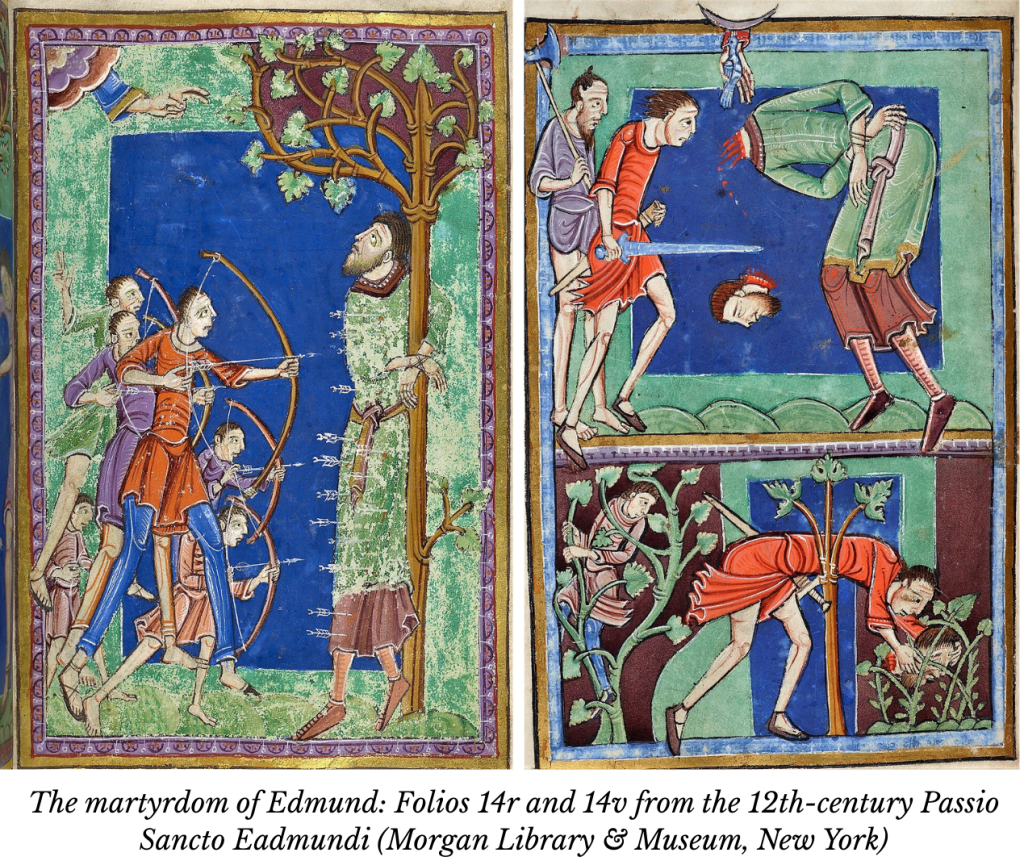
In sanguine martyrum regna Christianorum radicantur¹—in the blood of martyrs the realms of Christians take root. For a medieval mind that line had the weight of a weather proverb. It described how power settled into the soil. A grave that held a martyr’s bones drew law and custom around it the way a fire on a winter road draws travellers. Kings looked different once they had one of these dead beside them. Their charters carried a heavier ink, their oaths felt closer to heaven. In England, that truth condensed around a boy from East Anglia whose life closed early beneath Danish steel. Edmund’s death fed more than a private devotion. It fed an abbey’s appetite, a kingdom’s imagination, a church learning how to speak of kingship through the mouth of a severed head.
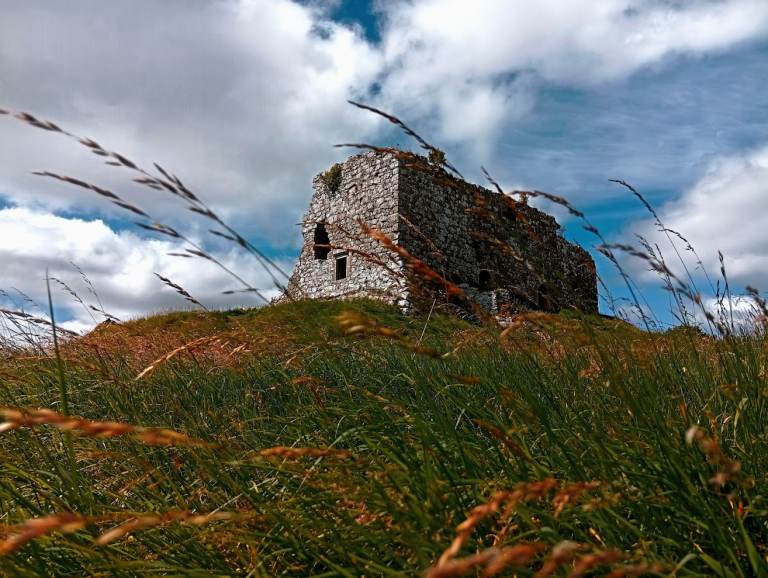
If you drift into Suffolk and let your boots find the paths in among the oaks, the story comes on you slowly, as if it had caught in the bark and in the lichens and stayed there. The land in that corner of Suffolk keeps its head down.² It has no cliffs to strike poses with or showpiece peaks to point at; it stretches itself out instead in long, slack rolls and shallow hollows, keeping easy company with its slow rivers and with hedges that lean into one another like neighbours trading news over a wall. Villages tuck themselves close around their churches, flint and thatch pressed so deep into the soil that the whole cluster feels bitten into the ground, teeth set in a dark jaw. Between those little knots of houses lie scraps of woodland a parish map hardly bothers to mention: strips along old estate-boundaries, leftover wedges from some once-broader wild, pockets that give the odd impression of being older than the lanes that now twist between them and lose their own sense of direction. Step off the grit or the farm-track and let the trees draw in around your shoulders, and the temperature falls by a notch almost before you notice. The air brings damp and leaf-mould, a shy thread of smoke from a cottage you cannot quite place, and buried under all of that, if you stay still and let your mouth think about it, a faint suggestion of iron at the back of the tongue. People say woods are quiet; this one never quite signs that agreement. There is always some small hum in it, a feeling that once a crowd stood in the clearing, spoke hard words, moved off in haste, and for reasons of courtesy or simple forgetfulness left its breath hanging there behind them.
In the year 869 that murmur thickened into dread. The Anglo-Saxon Chronicle,³ no lover of embellishment, writes in its dry Old English of a micel hæþen here, a great heathen army, which had already torn Northumbria apart and gnawed at Mercia before it settled in East Anglia for the winter, coiling itself at Thetford like a snake in the king’s own lap. Names have come down with that host: Ívarr inn beinlausi, Ivar the Boneless, his brother Ubba, Halfdan.⁴ They rode English horses taken as tribute four years earlier when their ships first beached on East Anglian shore. They knew now which rivers took their keels, which tracks ran dry in summer, which abbeys held plate and books worth ransoming. Along the low coast from Dunwich to the Wash, fishermen watched the horizon with a new tension, because the clean line between sea and sky had begun to carry the ghost of carved prows in every shift of light. Inland, men looking up from plough and mill-stone listened for the rumble of hooves under the usual chatter of village life.
Notes:
1 Apologeticum, Tertullian, trans. T.R. Glover, Harvard University Press, Cambridge (MA), 1931, pp. 146–153.
2 The Making of the English Landscape, W.G. Hoskins, Hodder & Stoughton, London, 1955, pp. 194–205; The Origins of Norfolk, Tom Williamson, Manchester University Press, Manchester, 1993, pp. 1–27.
3 The Anglo-Saxon Chronicle, ed. and trans. Michael Swanton, Routledge, London, 1996, pp. 60–69; English Historical Documents I: c. 500–1042, ed. Dorothy Whitelock, Eyre & Spottiswoode, London, 1955, pp. 202–209.
4 The Viking Great Army and the Making of England, Dawn M. Hadley and Julian D. Richards, Thames & Hudson, London, 2021, pp. 15–51; From Pictland to Alba, 789–1070, Alex Woolf, Edinburgh University Press, Edinburgh, 2007, pp. 84–103.
5 “The Cult of King Edmund in Anglo-Saxon England,” Simon Keynes, in The Cult of St Edmund: Patron Saint of East Anglia, ed. Anthony Bale, Boydell & Brewer, Woodbridge, 2018, pp. 15–36; Legends, Traditions and History in Medieval England, Antonia Gransden, Hambledon Press, London, 1992, pp. 87–96.
6 “The Coinage of East Anglia in the Ninth Century,” Mark Blackburn, in Anglo-Saxon Monetary History, ed. Michael A.S. Blackburn and David Dumville, Leicester University Press, Leicester, 1986, pp. 211–230.
7 Alfred the Great: War, Kingship and Culture in Anglo-Saxon England, Richard Abels, Longman, London, 1998, pp. 129–153; Warfare and Society in the Barbarian West, 450–900, Guy Halsall, Routledge, London, 2003, pp. 158–175.
8 “Passio Sancti Eadmundi,” Abbo of Fleury, in Three Lives of English Saints, ed. and trans. Michael Winterbottom, Pontifical Institute of Mediaeval Studies, Toronto, 1972, pp. 67–97; Memorials of St Edmund’s Abbey, Vol. I, ed. Thomas Arnold, Longman, London, 1890, pp. 3–22.
9 “The Career of St Dunstan,” Nicholas Brooks, in St Dunstan: His Life, Times and Cult, ed. Nigel Ramsay, Margaret Sparks and Tim Tatton-Brown, Boydell & Brewer, Woodbridge, 1992, pp. 1–23; “Memorializing the Anglo-Saxon Past: St Edmund in the Twelfth Century,” Alan Thacker, in The Cult of St Edmund: Patron Saint of East Anglia, ed. Anthony Bale, Boydell & Brewer, Woodbridge, 2018, pp. 37–60.
10 “Passio Sancti Eadmundi,” Abbo of Fleury, in Three Lives of English Saints, ed. and trans. Michael Winterbottom, Toronto, 1972, §§13–14, pp. 86–89; Gods and Myths of Northern Europe, H.R. Ellis Davidson, Penguin, Harmondsworth, 1964, pp. 95–106.
11 Ecclesiastical History of the English People, Bede, ed. and trans. Bertram Colgrave and R.A.B. Mynors, Oxford University Press, Oxford, 1969, pp. 252–267; The Royal Saints of Anglo-Saxon England: A Study of West Saxon and East Anglian Cults, Susan J. Ridyard, Cambridge University Press, Cambridge, 1988, pp. 179–213.
12 The Poetic Edda, ed. and trans. Carolyne Larrington, Oxford University Press, Oxford, 1996, pp. 15–35; The Viking Road to Byzantium, H.R. Ellis Davidson, Allen & Unwin, London, 1976, pp. 11–32; The Scandinavian Character of Anglo-Saxon England in the Pre-Viking Period, John Hines, British Archaeological Reports, Oxford, 1984, pp. 125–142.
Views: 18