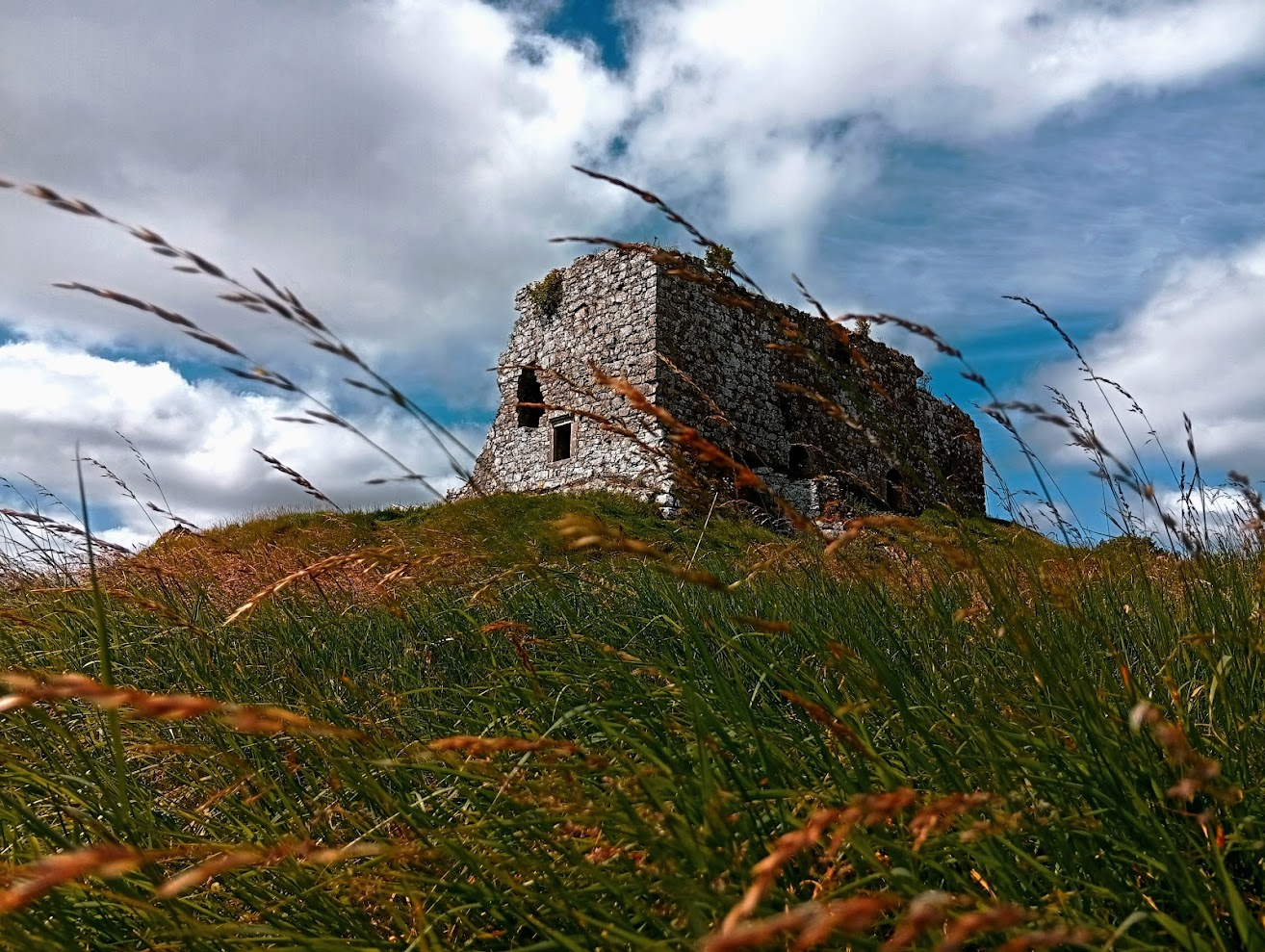
On the Rock of Dunamase the limestone rises with a clenched grammar, as though the earth had learned law from iron, and as though the plain of Laois, which looks gentle when the sun lies low, had carried a memory of horse-hoof and rent-day into the grass itself. I stood there with the wind arriving from Slieve Bloom, saltless yet sharp, while crows worked the thermals and a kestrel held its body in that suspended attention which feels like prayer when one grows old enough to distrust one’s own consolations. The ruin offered its pedagogy through absence, since the missing roof made the sky into a ceiling, and since the broken gate, which had once sorted bodies into tribute and bodies into ash, allowed every visitor to enter as if entering a story already decided. From such stone, one hears the legend of Richard de Clare, Earl of Pembroke, whose later name “Strongbow” has drifted through Irish memory with a bright violence, as though a bowstring had sung the island into a new age; yet the Rock, which tradition binds to his marriage, also forced a colder question, for it asked what a bow means beside a charter, and what a nickname means beside a lineage that travels through women and through law.
Gerald of Wales gave the portrait that later ages repeated with a relish bordering on devotion, since he described the earl’s body as though the flesh itself bore the political weather of the March: *His complexion was somewhat ruddy and his skin freckled; he had grey eyes, feminine features, a weak voice, and short neck; for the rest, he was tall, and a man of great generosity and courteous manner.*¹ Even when the sentence offers praise, it performs a kind of weighing, as though Gerald, trained to moralise landscape and men, had felt the need to justify a figure whose authority sat uneasily within Henry II’s vision of kingship. The details sit close to the skin, while the concluding clause turns from anatomy to virtue, and the turn itself matters, since a conqueror who seems physically fragile may gain authority through manners and gift, which in the twelfth century functioned as currency every bit as sharp as steel. Yet Gerald’s intimacy also tempts the reader into believing that personality drove the whole invasion, whereas the evidence, when read with a clerk’s suspicion, leads toward tenure, marriage, and the transferable fortress.
The Welsh annalists, who carried memory as a chain of brief clauses hammered into year-nails, offered a line that altered my hearing of the entire tale, since it framed Richard through his father’s sobriquet while it named his own identity through a lordship beside the Wye: *In that year, Rickert, earl of Terstig, son of Gilbert Strongbow, having with him a powerful body of cavalry, sailed for Ireland.*² The phrase “son of Gilbert Strongbow” sounded like a door opening inside a familiar house, for the legend I had inherited had placed “Strongbow” upon Richard as though the bow belonged to him alone, as though the very nickname proved his archers’ mastery. Here the sobriquet attached itself to Gilbert, while Richard appeared as “earl of Terstig,” a rendering of Striguil, the marcher lordship at Chepstow. When a chronicle fixes such names, it fixes the order of causes, since it suggests that the bow-like epithet belonged to the father’s reputation, while the son’s public identity, at least in Welsh remembrance, belonged to land, title, and the obligations that followed them.
A Latin witness, whose voice feels like monastic breath pressed into ink, condensed the same emphasis into a sharper point: *Ricardus comes de striguil in hibernia mortuus est et apud dulin sepultus.*³ The entry offered death and burial with a registrar’s plainness, and it attached the man to Striguil, not to a weapon. The mind, if it wishes to remain faithful to the evidence, must then treat “Strongbow” as a migrating label, a sobriquet whose later attachment to Richard belongs to transmission and misunderstanding as much as to lived identity. Such migration matters, since a culture that loves personal prowess will seize the bright emblem of a bow, while a culture that fears baronial autonomy will prefer the duller truth of tenure and charter, and both cultures can inhabit the same century, quarrelling within the same parchment.
Roger of Howden, whose chronicle often reads like royal administration learning to sing, described Richard’s campaign through verbs of organisation and control: *Richard Earl of Striguil, assembled a great army, invaded Ireland and subdued a very great part of it.*⁴ The word “assembled” matters, since it points toward resources, contracts, retinues, and promises of land that drew men into service, while “Earl of Striguil” again displaces the weapon-nickname. Howden’s clause also hints at the royal anxiety that followed, since an earl who could “subdue a very great part” across the sea could also imagine a principality shaped by his own will, unless the crown found a method to bind him. That method, as the later history of Leinster reveals, functioned through inheritance and marriage, which carried castles and jurisdictions the way a river carries silt, slow yet irresistible.
Views: 3