The Forest God and the Forbidden Zone
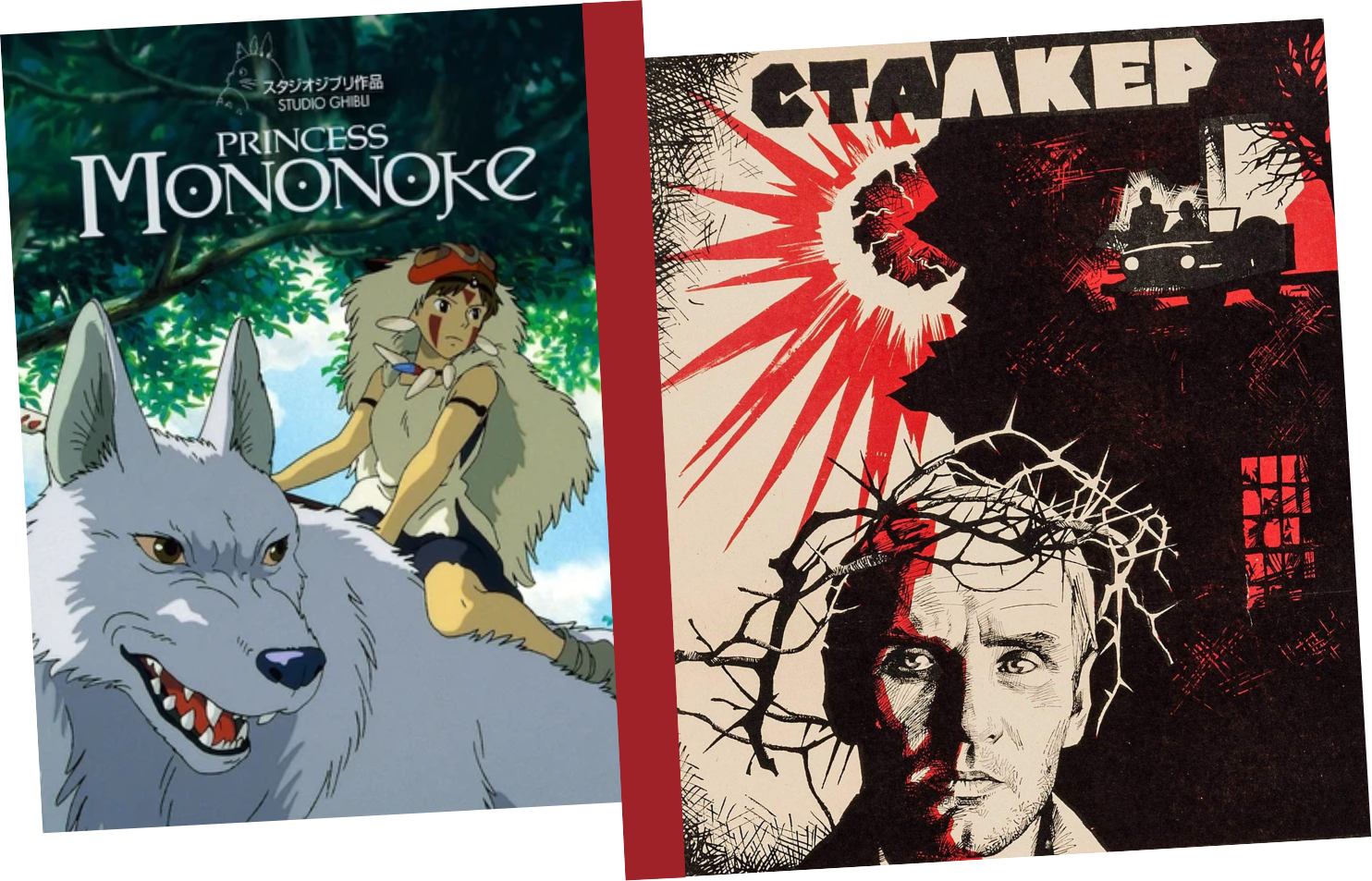
A red elk breaks through cedar shadow with a prince upon its back, each hoof striking root and loam with the grave insistence of blood borne under oath, while, in another cinematic country altogether, a trolley labours over rails toward a waste tract heavy with seepage and fern, carrying three men whose frames pitch beneath the diesel clamour as though every turn of the axle pared language away and left thought exposed before the authority governing the place ahead. My attention returns to those paired entrances with ritual persistence, for each places before the mind the same ruling question through a sharply different tonal medium: what kind of territory receives a human creature as though it had already studied the desire lodged within him, weighed that desire with exacting patience, and shaped an answer in sap, rust, hush, or wreckage? Hayao Miyazaki and Andrei Tarkovsky each imagine forbidden ground¹ whose vitality exceeds decorative symbolism, though that vitality reveals itself under unlike forms of pressure. Through Miyazaki’s vision, divinity advances by way of animal flesh and rooted growth, so that antler, fur, bark, leaflight, and mud appear as visible bearers of sacred order; through Tarkovsky’s, sentience gathers by arrangement, delay, industrial residue, and the peculiar strain laid upon the nerves, so that flooded chambers, sweating brick, weed through concrete, and the bell-metal murmur of derelict machinery acquire the density of direct address. Each territory binds climate to law, from which doubleness reverence emerges as the fitting human reply, while trespass summons reprisal under a distinct moral grain in each work, for Princess Mononoke² drives injury outward through flesh, settlement, and the old quarrel between iron and grove, whereas Stalker turns injury back upon the entrant until a man nearing miracle discovers an adversary waiting in the chamber under the shape of his own face.
Ashitaka enters the ancient wood already marked, and that prior inscription governs the moral pressure of everything that follows. He moves beneath the grave necessity of one sent away under sentence after violence has entered his arm and begun writing itself beneath the skin. A boar-god, twisted by hatred and iron, has crashed from the hills into his village trailing black writhing filaments like animate soot; the arrow has flown, the monstrous body has fallen, and the curse has crossed through contact into bone and muscle. From that moment, departure bears the double weight of expulsion and vocation. Between the trunks the red elk passes while Miyazaki lets the visible world widen by shining water, then by the clicking of kodama in the branches like white bone learning music, and at last by the mounting conviction that the forest belongs to an order preceding roads, charters, and every confidence that a map might enclose it. Sacred presence arrives here in plenitude, a fullness saturating sight, hearing, and air alike until wet fur, leaf rot, and the iron tang of blood along a flank compose a reality whose authority precedes every human explanation. The place seizes the senses before thought begins its labour, so interpretation enters as a later act undertaken after encounter has already taken hold of the flesh.
Elsewhere Tarkovsky adopts a different mode of revelation, and that altered mode changes the pressure of the sacred while preserving its full severity. At first the Zone³ appears under prohibition, within cordon, and by way of rumour carried in the Stalker’s mouth with the furtive gravity of contraband scripture, so that its reality reaches the mind before the eye receives a stable image of it. Reports of disappearance, ripened desire, shifting chambers, and treacherous paths arrive as fragments of witness whose uncertainty deepens their authority, for the region seems to generate a language of warning before it yields anything resembling clear description. Soon the film leaves behind the brown precincts of fatigue and checkpoint habit, entering a green profusion rising from industrial wreckage with a patience that feels almost liturgical. Water glides across floor tiles, grass leans from concrete fissures, rain settles upon metal, and a dog enters the weave of the scene with the uncanny rightness of something breathed out by the country itself. No antlered deity crosses the reeds or the dim chamber-light; instead, authority gathers by interval, by displacement, and by the strain laid upon the nerves while route and obstacle exchange their offices before the traveller can securely name either one. What comes forth, then, is a sentient terrain declining articulate speech while sustaining an unbroken address, with the result that sight keeps seeking a centre, hearing remains poised for instruction, and the soul finds itself sweating beneath a presence that withdraws from every ordinary sign through which manifestation usually declares itself.
Taken together, those opening movements disclose the difference between the two films with a clarity sharpened by contrast, for each director establishes sacred territory under a distinct moral pressure and thereby teaches the viewer how its later judgments are to be read. Miyazaki stages a war legible in material terms, where cracking rifles, falling trees, bleeding gods, and labour bent toward timber and ore give the struggle between industry and woodland a hard visibility, so that violence acquires weight, extension, and historical texture within the world of the film. Tarkovsky, by contrast, stages a territory in which conflict withdraws from spectacle and enters conscience, while the menace of the Zone gathers through uncertainty, delay, and the humiliating suspicion that a man’s deepest wish may bear a shape far meaner than the desire he declares aloud. Both films nevertheless build charged ground through trespass, and each refuses to treat land as passive backdrop suspended behind human drama. The earth enters the action as a judging presence saturated with memory, so that a clearing bears the gravity of tribunal, a ruined tunnel acquires the pressure of confession, moss presents itself with the density of script, and mud begins to press meaning upon the scene with the slow insistence of law. In each case the terrain ceases to serve as scenery and assumes the office of judgment⁴, speaking before human argument has secured the terms in which that speech may be understood.
San’s arrival confirms that the forest keeps defenders shaped by the labour of protection, and her entrance makes that truth visible before any argument has begun. She rides on Moro’s back with blood and mud at her mouth, a girl raised among wolves and instructed by a fierce form of love that knows the burden of iron lodged in living flesh. Exchange with Lady Eboshi takes its place only after action has declared the forest’s meaning, for that meaning already lives in tooth, leap, and wound before doctrine gathers language around what the body has enacted. San bares her teeth, strikes, and enters the iron settlement like vengeance translated into muscle. Her bearing carries the grammar of the place she serves, so completely steeped in the knowledge of root, ridge, scent, pursuit, and danger that every gesture seems to arise from the woodland itself. In her, guardianship exceeds sentiment and assumes the character of enacted law, a discipline inscribed in movement, reflex, injury, and controlled ferocity. Through that figure Miyazaki rejects the gentler fantasy in which nature shines with decorative softness while human industry advances under the sign of calm necessity. Woodland here possesses champions whose service carries grief within it and whose defence of sacred ground takes form through attack, endurance, rage, and sorrow. Moro speaks with the authority of age carried in scar. Okkoto, half-blinded by infestation and fury, bears the grandeur of a god whose holiness has grown volatile under pressure. The Forest Spirit⁵, serene as moonlight over deep water, joins vitality to death within a single gait, so that blossom rises beneath each step even as decay follows in its wake. Across those presences the forest reveals power under shifting intensities, beginning in San’s immediate defensive violence and ascending toward the deer-god’s sovereign indifference.
By wholly different means the Stalker guards his territory, and that contrast clarifies the Zone by giving it a human servant formed under its exacting demands. Bolts and strips of cloth take the place that weaponry would occupy in a more familiar tale of guardianship, and he casts them ahead with the absorbed concentration of a man reading signs so fine that only long discipline has taught him how to trust them. His body moves close to the ground in attitudes of attention, crouching near the gravel, bending to listen, lowering itself with the expectancy of one awaiting disclosure from the humblest substances. San has been tutored by tooth, sap, and wolf heat; the Stalker has come under instruction through abasement before mystery, through long submission to a territory that grants direction only to the man willing to receive it on its own severe terms. Devotion governs his relation to the Zone, though fear inhabits that devotion at every point, and he returns to it with the dependence of a penitent who has found a sanctuary capacious enough to hold the full burden of his damage. Another kind of fierceness burns in him, less immediate in outward gesture yet equally exacting in moral pressure, because his service requires vigilance, self-abasement, and the continual renunciation of any impulse toward mastery. He snaps at the Writer’s swagger, studies the Professor with hunted alertness, and insists upon detour, ritual, obedience, and slowness out of a knowledge won through ordeal, namely that direct movement invites death and that ordinary intelligence degrades into stupidity at the instant it mistakes command for understanding. Sorrow thickens around him the longer the eye remains upon him. A wife loves him, a child bears the strange burden of his vocation in altered existence, a home gathers itself around fatigue and tenderness, yet the Zone continues to draw him with liturgical necessity. He can guide others along the path; conviction within those who follow lies beyond the reach of guidance, and from that division between escort and belief his peculiar torment takes form.
Between San and the Stalker a mirroring relation takes shape through an opposition so exact that kinship arises from contrast itself. Her defence takes the form of assault, whereas his fidelity appears through surrender, and that divergence reveals two distinct orders of the sacred. She stands within a cosmos where holiness breaks forth in animal rage, ancestral injury, and blood-charged reprisal; he serves within a sphere where hidden power has withdrawn into weathered chambers, deceptive passage, and a discipline of belief laid upon men whose lives have been thinned by appetite, cunning, fatigue, and dread. Beneath that visible divergence, a deeper affinity governs both figures with unmistakable authority. Service to ground exceeding human use defines them both. The wound impressed by mediation marks both lives with equal severity. Their gaze upon trespassers carries the painful lucidity of figures able to perceive the distance between declared motive and governing hunger. In that sense both stand as interpreters of charged terrain, though the office arises through scarred relation instead of exposition, and that shared office gives the comparison its real intellectual weight, for both mediators live at the threshold where sacred space encounters human appetite and discover, through repeated ordeal, that service to such ground writes itself into voice, gait, patience, and hope.
Lady Eboshi enters the argument with a dignity that saves the comparison from reduction into sermon or pastoral complaint. Through her authority labour passes to women once bought and cast aside by men, while shelter reaches lepers, and a furnace-town of courage, industry, and common purpose rises under her direction with palpable civic energy. The ring of iron, the breathing of bellows, the emergence of rifles from disciplined hands, the preparation of food, and the passage of laughter across the workshop floor together establish a human order that commands respect before judgment begins. Miyazaki grants her a greatness that gains its full force through moral thickness, and for that reason her desire cuts more deeply. She seeks the head of the Forest Spirit, and within that aim there gathers a longing for mastery secured by decapitation, for release from dependence upon forest caprice, and for the firm consolidation of human settlement on terms she can govern. Resource hunger speaks through her, yet civic care speaks there as well, so that one gesture carries generosity toward her people together with violence toward the sacred order enclosing them. The wish to nourish, defend, and elevate her community presses into the same motion that violates forbidden ground. History repeatedly opens its wound beneath such mixed banners, where mercy travels beside injury and protection moves in company with ambition. Eboshi deepens the whole moral field because she sees in the forest both treasury and obstacle, then raises the rifle with a conviction that intelligence, courage, and labour can bend the earth into human service.
Far from the civic scale represented by Irontown, the Writer and the Professor in Stalker carry desires of a more private order, and precisely that privacy gives their longings a humiliating spiritual exposure. The Writer arrives armoured in irony, swollen with disappointment, reputation, self-disgust, and the half-drunken vanity of a man who has begun to suspect that talent has hardened into performance, so that every gesture of cynicism carries the pressure of a deeper collapse he can scarcely govern. Alongside him moves the Professor, attended by instruments, calculation, and the public composure of reason under strain, a figure whose discipline of mind lends his reserve an air of authority even while that authority conceals motives he has chosen to hold apart from speech. One declares an intention while another lies folded beneath it, and in that doubleness both men approach the Zone already divided within themselves. At the centre stands the Room⁶, promising fulfilment of the deepest wish, and that promise begins its work of exposure precisely by turning away from public script and fastening upon the buried hunger that spoken intention fails to command. Terror gathers there with singular severity, for the chamber grants what lies deepest in a man, and the depths of desire rarely coincide with the noble image he has learned to present in words. A seeker may approach under the sign of brilliance and find wealth waiting at the root of the soul; another may advance in the name of restoration and discover domination concealed within the plea; a third may utter the language of service while the appetite for command has already taken the stronger seat within him. Over the whole journey there hangs the Stalker’s account of Porcupine⁷, whose brother’s death drove him toward the Room, whose return yielded riches in place of resurrection, and whose rope gave final answer to the revelation that wealth had occupied a deeper chamber of desire than mourning. That narrative casts its shadow across every later step toward the threshold, tightening the moral pressure of the approach with dreadful precision. The Room reveals through granting, and in that terrible mode of generosity it subjects the soul to a scrutiny more exacting than any verbal accusation could achieve.
Set beside Eboshi’s campaign, the aims carried by the Writer and the Professor can seem diminished, even spiritually threadbare, though the governing pattern remains continuous across the two works. Human beings approach forbidden ground in search of enlarged command over life, and the instruments may alter while the temptation retains its familiar shape. Irontown presses toward the forest under the sign of extraction and civic continuance, seeking from the earth a yield that will secure settlement and strengthen human control over precarious existence. The Writer moves toward the Room under the pressure of renewal, whether that renewal appears to him as recovered genius or as proof that his life possesses a substance greater than exhausted performance and theatrical pose. The Professor advances under the sign of knowledge, though that knowledge carries within it the colder desire to regulate miracle by submitting it to the terms of managed power, and his hidden bomb gives that desire its clearest visible form. In that concealed instrument the kinship with Eboshi becomes fully legible, for both works show how swiftly the wish to master transformative power turns toward destruction when mastery fails to arrive in usable form. Sacred landscape in both films therefore receives trespassers animated by the old desire to cross the threshold, seize the source, and return carrying a power translated into human use, with the result that spiritual violation in Tarkovsky and material violation in Miyazaki enter the same moral history, however different their surfaces may appear, because the governing appetite remains one.
What, then, does each place offer to those who cross its threshold? Miyazaki answers first through catastrophe, and the scale of that catastrophe gives visible body to the magnitude of sacrilege, as though the violated order of the forest could only disclose its full seriousness by expanding beyond human measure. Once the severed head has been taken, the world itself seems to pass into a monstrous enlargement of consequence: night acquires flesh, the Daidarabotchi sends its black inundation across hills and furnaces, men scatter before it in panic, and an entire structure of settlement buckles beneath the recoil of profanation. Yet the close of Princess Mononoke gathers something more demanding and more morally exacting than despair alone. Dawn spreads across wreckage, green rises through ash, Lady Eboshi, marked by the loss of an arm, speaks of rebuilding, San keeps faith with the forest, and Ashitaka settles near Irontown while love endures across a division that healing has entered yet history continues to mark. Under that pressure the land offers renewal in the sign of memory, a form of grace carrying mud on its hem and blood beneath its fingernails, so that restoration arrives joined to recollection, consequence, and the visible trace of suffering. Human making continues under the discipline of knowledge gained through pain, natural life resumes under the mark of injury, and sacred power exacts its due even as it opens the possibility of a humbler mode of dwelling. What the film finally grants, then, is a wounded continuance in which coexistence appears as a demanding discipline earned through loss and sustained by the hard intelligence born from surviving it.
Harsher in temper, Tarkovsky offers a gift of another order, one whose severity lies in the fact that revelation arrives through suspension and leaves the seeker face to face with what his own desire may disclose. The Writer and the Professor reach the threshold while rain glistens, water trembles, and the Room waits in a charged stillness that gives the entire scene the pressure of imminence, yet the act of entry never takes place. Only after argument has burned through the moral centre of the expedition does the Professor lay aside his plan to tear the place apart, and that renunciation carries its own significance, for it shows how quickly the wish to regulate miracle can harden into an appetite for obliteration. Confronted with the prospect of what his own depths may reveal, the Writer falters before the chamber, discovering at the edge of fulfilment that the soul can fear disclosure more intensely than deprivation. The miracle survives intact, and that survival devastates through its refusal to grant closure, for the untouched Room continues standing as a presence whose power has been proven precisely by the recoil it inspires. Anyone leaving Stalker carries away the sense that the Zone has offered the sharpest thing available, namely reflection stripped of consolation⁸ and returned to the seeker after every ornamental veil has been lifted away. Before that presence the intruders learn that their confidence in intellect, art, scepticism, grievance, and desire rests upon unstable ground, and the collapse of that confidence forms the real crisis of the film. Broken-hearted, the Stalker returns home longing for belief on behalf of others and from within others, hoping that men will approach the sacred in poverty of spirit, only to meet a theatre of self-protection wherever he turns. The Zone grants nothing visible, and through that withholding it confers a truth almost unendurable. Human beings can stand before transformation and draw back from the wish that transformation would bring to light.
Again my thought returns to the severed god-head in one film and to the unopened room in the other, for each image gathers within itself a whole philosophy of sacred trespass and gives that philosophy a form the imagination can continue to inhabit. In Miyazaki, violation bursts outward into visible convulsion, so that the whole world seems to take the wound into itself; in Tarkovsky, the threshold remains physically inviolate, yet the soul enters a crisis of equal magnitude and suffers its convulsion within the sealed chamber of consciousness. Across both works a single governing truth comes clear: charged ground exacts payment from the one who crosses into it, although the shape of that payment changes with the moral atmosphere each director has created. One cinematic order answers trespass through torn flesh, breached settlement, devastated cedar growth, and the spreading scale of catastrophe, so that injury acquires a public body and history receives the mark of sacrilege in forms the eye can read at once. The other answers through humiliation, self-exposure, and the slow collapse of the splendid fictions by which a man has sustained his image of himself, so that suffering takes on duration, hesitation, shame, and arrested action as its principal forms. In either register, trespass yields knowledge, and the knowledge arrives joined to pain with such intimacy that each becomes the means by which the other is understood. Miyazaki writes through flame, antler, battle, curse, and renewal, giving metaphysical injury a visible body in the ruin of place and creature alike; Tarkovsky writes through water stain, metallic echo, dog breath, fatigue, suspended motion, and the prolonged pause before a man consents to see what sort of being he has become, giving spiritual judgment a temporal body shaped by delay, recoil, and inwardly endured exposure.
From that pairing a clarification comes into view with greater fullness than either film supplies on its own, because sacred landscape concerns judgment lodged in place no less than it concerns the life of nature. In Princess Mononoke, the forest lives as an animist presence, yet that presence also bears moral weight, holding the memory of injury within itself and answering violation through a justice tempered by reserves of mercy. In Stalker, the Zone may stand under the sign of disaster, visitation, experiment, or some fissure in reality, yet origin yields pride of place to conduct, for its defining power lies in the ordeals it composes and in the exactness with which it receives each entrant according to the truth carried within him. Once terrain begins to reflect the soul of the intruder, it exceeds the office of setting and assumes the character of revelation, so that the traveller who believes himself to be pursuing some outward object finds another disclosure awaiting him, namely the figure of hunger stripped of self-description, desire in its governing shape, the wound already borne across the threshold, and the hidden service to which his life has in fact been pledged. In both films, place reads the entrant before self-knowledge has ripened within the entrant himself, and by virtue of that priority the sacred appears less as atmosphere than as a judicial intelligence lodged in the ground.
Among the figures moving through these charged territories, Ashitaka alone carries into forbidden ground a grace of unusual rarity, and that grace acquires its full meaning through the injuries already borne with him into the forest. He arrives marked by curse, anger, and remembered killing, yet he continues striving to see with eyes unclouded by hate, a phrase in Miyazaki that carries the plain gravity of prayer and gives his conduct an ethical distinction no other traveller in these films sustains with equal steadiness. The Stalker, cast in a harsher register, reaches toward a kindred purity, although pain, frustration, dependence, and the abrasions of modern contempt have inscribed themselves across his life with far greater severity. Through both figures the films show that entry into sacred ground need not assume the form of seizure or conquest, for approach may also take shape as witness, as the binding of one wound to another, as the bearing of warning, or as the reception of a charge laid upon the self by powers it did not create. Even that humbler mode carries its own exacting cost, for Ashitaka cannot return to his former dwelling in the condition from which he departed, while the Stalker cannot guide men through the Zone without suffering the rupture between his fidelity and the evasions of those who follow him. Grace therefore appears in these works under pressure, joined to injury, patience, and the difficult labour of mediation within worlds whose deepest powers answer appetite with judgment.
Long after plot has settled into silence, what remains continues to press upon reflection with undiminished weight, for the endings of both films refuse the clean recession that would allow their deepest claims to rest as finished spectacle. In Miyazaki’s closing movement, fresh green lies across devastated earth, the image of a rebuilt town begins taking shape within the imagination of a woman schooled by loss, a wolf-girl maintains her fidelity to the forest, and a prince chooses labour near the fraught border between worlds whose relation has entered a new, chastened form. Tarkovsky’s final movement turns toward domestic space, where a wife speaks fidelity, a child moves glasses across a table while train-vibration travels through the room like a secular haunting, and the Stalker lies spent, his vocation wounded yet continuing in a life that has paid dearly for its devotion. Monkey’s last presence carries argumentative weight fully commensurate with anything associated with the Room, for sacred encounter leaves a residue that enters flesh, passes into lineage, and alters capacity in ways that exceed the visible duration of the pilgrimage itself. The forbidden territory thus reveals a permeable edge through which influence crosses the fence, enters the house, gathers within the frame, and writes itself into futurity with quiet tenacity. What survives the trial therefore extends beyond the immediate site of ordeal and continues its work within kinship, labour, speech, and inheritance, so that revelation appears less as an isolated event than as a continuing inscription borne by bodies, dwellings, and children.
Virgil’s golden bough⁹ opens passage through the underworld, and both Miyazaki and Tarkovsky seem to understand that modernity continues reaching for such a branch while letting the reverence once attending descent fall away from its grasp. In their films, the contemporary will to mastery approaches sacred reality under successive cultural disguises, seeking from it a form that can be carried off, inspected, administered, or made answerable to human design. Industry dreams of a god-head rendered portable and enclosed within possession; scepticism approaches wonder under the protocols of examination; art turns toward inspiration as though summons alone could make it appear; political reason desires territory cleared of spirit and made transparent to command. Yet the world-soul, if these films speak truly, keeps its own reckoning with severe patience, receiving every approach within a deeper order of memory and judgment that no modern appetite succeeds in overruling. Before that tribunal pass hoof and rail, prayer and weapon, explosive intent and half-uttered wish, while attention gathers, expectancy thickens, and an answer arrives in the only language each trespasser can finally comprehend. What returns to the seeker comes shaped by his own desire, translated back to him through a place possessed of memory, judgment, and the power to expose spiritual appetite beneath whatever signs of sanctity, utility, brilliance, or necessity human beings choose to present.
A prince rides into cedar-dark with a cursed arm, while three men rattle toward green ruin on an iron trolley, and between those two entrances there opens one of the defining troubles of the age. Human beings continue to cross thresholds under the sign of possession, yet the ground they enter discloses a law more ancient, more exacting, and more alive than the claims they bring with them. At one moment that law appears antlered through mist, bearing sacred authority in visible creaturely form; elsewhere it rises through water pooled on concrete in a chamber where the collapse of illusion becomes the chief event and forces revelation to occur within consciousness itself. Under either aspect, trespass enters the trespasser, sacred power exacts its due, and the world grows more animate, more perilous, more wounded, and more holy beneath the pressure of such visions. Any hand extended toward that hidden heart would do well to know the substance of the offering it carries, whether prayer, hunger, or an axe.
Scholia:
¹ Mircea Eliade, The Sacred and the Profane: The Nature of Religion, trans. Willard R. Trask (New York, Harcourt, Brace & World, 1959), pp. 20–65. Eliade remains useful here for the distinction between ordinary extension and a site that announces itself as qualitatively other. The note serves the essay’s opening claim about “forbidden ground” by clarifying that sacred territory in this tradition does more than provide scenery for human action: it interrupts homogeneous space, establishes orientation, and draws behaviour into relation with an order felt as prior to the traveller. What matters for the present argument lies less in doctrinal theology than in spatial experience. A forest path, a chamber, a threshold, a clearing, each acquires density because the place behaves as though it had already judged the entrant before the entrant formed a judgment of it. That is why Miyazaki’s forest and Tarkovsky’s Zone can both be read as active sites of disclosure. They do not merely contain the sacred as an attribute added from without. They manifest it by compelling altered posture, altered speech, altered attention, and altered consequence. Eliade’s category of hierophany gives a useful conceptual analogue for the essay’s claim that sap, rust, hush, and wreckage may become media through which a law older than human intention makes itself felt.
² Susan Napier, Miyazakiworld: A Life in Art (New Haven, Yale University Press, 2018), pp. 176–194. Napier’s chapter on Princess Mononoke remains one of the strongest concise accounts of the film’s boundary-work, especially where Ashitaka’s passage between forest and Irontown refuses moral simplification. The cue sits at the first naming of the film because the essay depends upon that refusal from the beginning: Miyazaki’s world grants no easy pastoral innocence, no villainy free of civic complexity, no sacred order detached from blood, labour, or historical injury. Napier is especially valuable on the film’s insistence that crossings of border, species, gendered power, and political allegiance generate the drama itself.
³ Vida T. Johnson and Graham Petrie, The Films of Andrei Tarkovsky: A Visual Fugue (Bloomington, Indiana University Press, 1994), pp. 137–155. Johnson and Petrie’s chapter on Stalker offers a durable critical frame for understanding the Zone as more than science-fiction décor or allegorical puzzle. Their reading attends to the film’s severe economy of action, the relation between spatial uncertainty and spiritual ordeal, and the manner in which Tarkovsky converts external journey into a testing ground for desire, faith, and self-knowledge. That emphasis illuminates the essay’s phrasing about prohibition, rumour, and contraband scripture. The Zone reaches the mind before it yields stable visual mastery because Tarkovsky structures experience around delayed legibility. A route ceases to function as route in any ordinary sense; a chamber ceases to behave as architecture alone; a landscape of ruin acquires the pressure of liturgy. Johnson and Petrie help explain why the traveller in Stalker cannot rely on narrative habits inherited from adventure cinema. Movement in the Zone becomes moral exposure. Direction depends upon ritualised indirection. Danger often arises at the instant confidence hardens into method. Their account also clarifies the film’s peculiar tonal fusion of dread, tenderness, and metaphysical expectancy, which allows the Zone to appear at once degraded and numinous, violated and judging. For the present essay, that critical vocabulary helps anchor the claim that Tarkovsky’s sacred terrain addresses the entrant by rearranging relation, pace, and inward measure.
⁴ Belden C. Lane, Landscapes of the Sacred: Geography and Narrative in American Spirituality (Baltimore, Johns Hopkins University Press, 2002), pp. 13–38. Lane’s account of place as spiritually legible terrain helps clarify the essay’s language of tribunal, confession, and script. His argument is geographically broader than either film, yet his insistence that place becomes meaningful through narrative pressure, symbolic density, and practices of attention bears directly upon the way the essay treats clearing, tunnel, moss, and mud. The note supports the claim that terrain can function as judgment before any formal doctrine intervenes.
⁵ Martin van der Linden, ‘Shadowing the Brutality and Cruelty of Nature: On History and Human Nature in Princess Mononoke’, in John L. Hennessey (ed.), History and Speculative Fiction (Cham, Palgrave Macmillan, 2024), pp. 225–244. Van der Linden is especially helpful for resisting the sentimental misreading of Miyazaki’s forest as a utopian refuge whose holiness lies in gentleness alone. His chapter stresses the film’s historical imagination, the brutality of human relations with nature across time, and the indifference that can inhabit nature’s own order. That emphasis matters at the cue attached to the Forest Spirit, whose gait binds blossom to decay, healing to death, serenity to devastation. The note therefore underwrites the essay’s effort to describe the forest as morally charged without collapsing it into a consoling environmental emblem. In this reading, sacred vitality does not promise innocence. It appears instead as a power that exceeds the categories through which human partisans seek to domesticate it. Lady Eboshi’s civic intelligence, San’s defensive rage, Ashitaka’s prayerful effort at mediation, and the deer-god’s remote sovereignty all inhabit a field where holiness includes violence, indifference, and consequences beyond human petition. Van der Linden’s historical emphasis also sharpens the essay’s broader argument that Miyazaki stages a struggle about memory, extraction, and political order as fully as he stages one about ecology. The forest judges because history has entered it, scarred it, and awakened powers that answer injury with a terrible exactitude.
⁶ Jon Hoel, Stalker (Liverpool, Liverpool University Press, 2021), pp. 43–64. Hoel’s study is especially useful on the Zone’s interior logic and on the Room as the film’s impossible centre: a destination whose power consists precisely in destabilising every public account of why one has come. The cue falls at the first naming of the Room because the essay’s argument depends on that reversal. The chamber does not reward declared motive. It measures the buried wish and returns it, transformed into judgment.
⁷ Arkady Strugatsky and Boris Strugatsky, Roadside Picnic, trans. Olena Bormashenko (Chicago, Chicago Review Press, 2012), pp. 1–224. The note attached to Porcupine marks the place where Tarkovsky’s film most clearly brushes against the novel that stands behind it while also departing sharply from it. In the Strugatskys’ fiction, the Zone enters the world under the sign of visitation and aftermath, a residue of alien contact whose artefacts, dangers, and black-market economies reshape human life without yielding metaphysical reassurance. Tarkovsky takes over the Zone, the stalker, the forbidden incursion, and the danger of desire, yet he strips the premise of much of the novel’s sardonic materiality and turns it toward spiritual ordeal. The present essay invokes Porcupine because the anecdote condenses that transfer. What in prose belongs to a broader ecology of illicit scavenging, scientific curiosity, damage, mutation, and dark irony becomes in the film a devastating parable about the soul’s concealed wish. The adaptation therefore matters less as a question of fidelity than as one of transposition. The Strugatskys provide the narrative germ of a territory that changes those who enter it and marks descendants as well as intruders. Tarkovsky receives that germ and deepens it into a theology of exposure. Porcupine remains one of the clearest survivals of the novel’s conceptual inheritance, while the film’s treatment of him reveals how thoroughly the inherited science-fiction premise has been converted into moral and spiritual judgment.
⁸ Andrey Tarkovsky, Sculpting in Time: Reflections on the Cinema, trans. Kitty Hunter-Blair (Austin, University of Texas Press, 1987), pp. 104–163. Tarkovsky’s own reflections on film image, rhythm, sound, and the moral vocation of cinema illuminate the essay’s phrase “reflection stripped of consolation.” The severity of Stalker lies partly in its refusal of explanatory relief, a refusal inseparable from Tarkovsky’s larger aesthetic commitment to duration, pressure, and spiritual attention. This note anchors that relation without forcing the essay into overt theory.
⁹ Virgil, The Aeneid, trans. Robert Fagles, intro. Bernard Knox (London, Penguin, 2006), pp. 182–212. The golden bough in Book VI serves here as more than ornamental classical allusion. In Virgil it is the sign of sanctioned passage into a region where descent requires election, burden, ritual preparation, and submission to an order no hero commands by native strength alone. The essay’s comparison turns on that structure. Miyazaki’s forest and Tarkovsky’s Zone both resemble underworld spaces in the older epic sense: one does not simply arrive there as one arrives at a location on a map. Entrance tests fitness, reveals allegiance, and exacts consequence. The bough therefore clarifies the final movement of the argument about modernity. Industry, scepticism, art, and politics each seek access to what lies beyond the administered surface of the world, yet they seek it under the sign of portable mastery. Virgil offers the opposite pattern. Passage depends upon reverent recognition that the realm ahead obeys a different law and that the traveller brings himself into judgment by crossing over. The allusion also deepens the essay’s concern with burdened return. Aeneas does not emerge unchanged from the kingdom of the dead; revelation alters the quality of action that follows. So too with Ashitaka and the Stalker. Their territories disclose truth in forms the traveller carries back into labour, fidelity, and suffering, which is why the underworld analogy belongs not to decoration but to the essay’s evidential spine.
Views: 1
This article is part of our free content space, where everyone can find something worth reading. If it resonates with you and you’d like to support us, please consider purchasing an online membership.