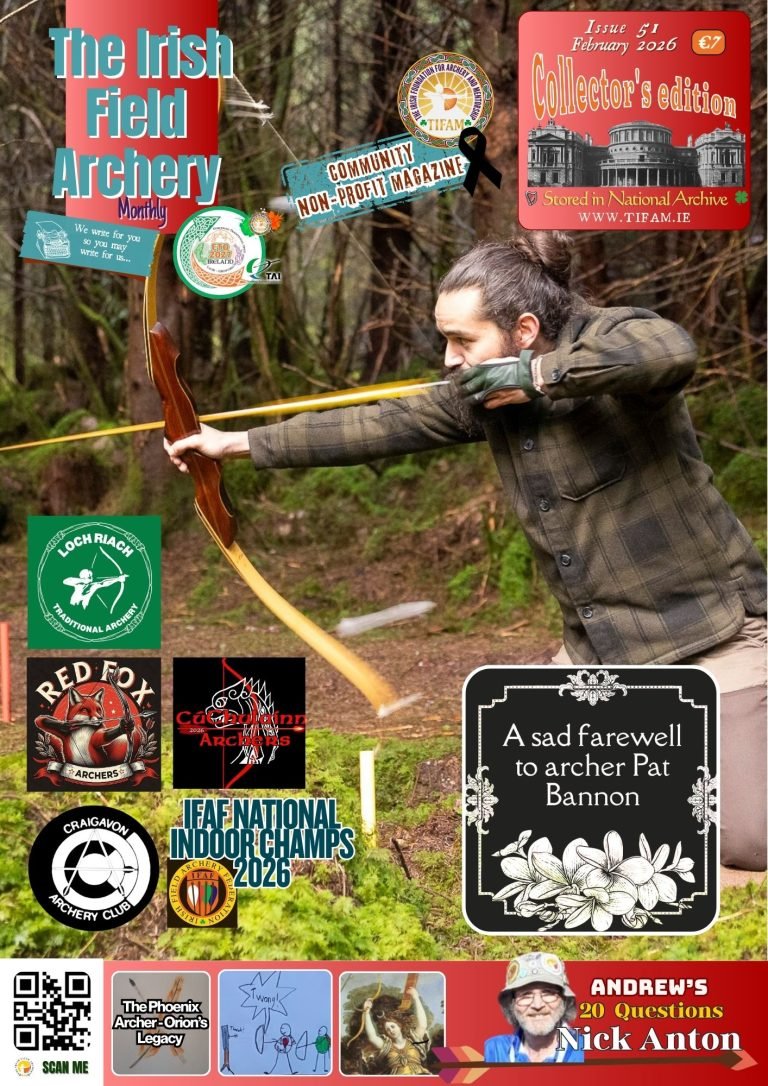
November carries a clear marker for The Irish Field Archery Monthly as Issue 48 completes four uninterrupted years of publication, reflection, and field-bred argument. The magazine stands as a continuous conversation between cold shoots and warm rooms, between physical discipline and intellectual attention, held in place by the loyalty of readers, contributors, and organisers who extend their trust from month to month. Gratitude reaches toward every archer who carries a copy in a bow case or opens the digital edition after work, every club that sends reports from wet woods and farm tracks, every writer who subjects cherished ideas to the accuracy that archery demands.
Issue 48 rests on a core conviction: disciplined prose sharpens sight at the peg, and rigorous thought steadies the hand that anchors under the cheekbone. Each section aligns practical knowledge with philosophical inquiry so that technique, ethics, and imagination reinforce one another. The anniversary format gathers work that treats archery as an art with a history, as a practice with moral consequence, and as a community bound together by field reports, technical rulings, and stories of courage at every level of competition.
The intellectual axis of the magazine turns first toward the Age of Reason. In An Arrow Knows No Master, Marcin Małek sets Descartes, Voltaire, and their contemporaries alongside the shooting line, asking how an era that prized method and clarity might describe the biomechanics of the shot. Spine alignment, muscular recruitment, breath control, and the decision to release receive the same seriousness that a philosopher grants to an argument’s premises. Rational analysis enters the stance, the draw, the hold, and the follow-through, so that every part of the archer’s movement acquires conceptual depth as well as physical necessity.
A second movement in the same philosophical key turns toward the Renaissance. The Holy Shaft reads Torquato Tasso’s Gerusalemme Liberata through its bowstrings and arrow flights, tracing how the poem treats archery as an emblem for spiritual discipline, moral strain, and the directing of desire. The shaft carries prayer, doubt, and obedience through the air at once. Alongside this literary examination stands a stringent reckoning with the so-called monk’s mind of contemporary archery culture, where Marcin scrutinises commercial promises of instant serenity and “Zen” branding. Spiritual language, once bound to years of ascetic effort, appears on merchandise and workshop flyers; the article measures those claims against the slow work of attention that field practice demands, asking whether a marketplace of calm can sustain the weight of genuine contemplative tradition.
Painting enters the discussion through the art-historical study Old Masters Draw the Bow, which focuses on Caravaggio’s The Martyrdom of Saint Ursula. The archer within that canvas, poised at the decisive instant after release, offers a disciplined figure for agency and remorse. The piece moves through the painting’s composition, light, and gesture in order to examine how an arrow, once loosed, binds the shooter to consequence in ways that technical skill alone cannot answer. Caravaggio’s scene becomes a meditation on responsibility at the moment of contact, with obvious implications for any discipline where a single action, honed by repetition, carries irreversible effect.
Alongside these engagements with philosophy and art history, the human dimension of the field archery community receives sustained attention. In A Conversation on Accessibility, Margaret Donnelly leads an exact and open dialogue with Claudia Heinze Banks on the realities of shooting with mobility challenges. They address transport along courses, uneven ground, rest points, facilities, and the emotional toll that repeated obstacles impose. The discussion presses beyond general statements about inclusion toward practical measures through which clubs and organisers can design events that welcome archers with diverse bodies and capacities, so that courage finds recognition wherever it appears on a course.
International achievement follows in World Stage Success, where Andrew Wayland speaks with Catherine Power of Dunbrody Archers. Her bronze medal at the WBHC 2025 in South Africa emerges from years of repetition, travel, and disciplined preparation, and the interview grants readers an inside view of the daily patterns that support a podium result. From there the focus shifts to cultural representations of bravery in The Body of the Hero, where Martin Smallridge sets the stylised combat of The Avengers against the harrowing, intimate sacrifice depicted in Larisa Shepitko’s 1977 film The Ascent. The comparison asks how audiences learn to picture endurance, pain, and loyalty, and what kind of heroic body field archers might wish to honour: spectacular, invulnerable figures, or fallible humans who hold to a chosen course at great cost.
The organisational life of the sport receives equal care. IFAF federation news records a successful AGM, reports on the fully subscribed European Indoor Archery Championship 2026 scheduled for Waterford, and sets out a technical clarification on the acceptable use of sighting aids in styles that depend on instinctive or unsighted shooting. Those decisions shape equipment choices, coaching advice, and training routines across the country. Field reportage then moves through the recent calendar: the MAC 50 Targets shoot, the Wexford Archery 3D Standard round, the Dunbrody “Mushroom Shoot”, and the Valley Bowmen Standard UAR each receive grounded accounts that register conditions, atmosphere, and performance without losing the pleasure of shared effort in weather that often tests patience as much as technique.
Finally, the Blackbird column by James Byrne returns to Laois Archery Club for the frigid tenth-anniversary shoot, where bitter air, humour, and thick soup share equal billing with scores. His narrative preserves the texture of a community whose endurance extends beyond individual ends or events, sustained through hospitality, long memory, and a willingness to laugh through discomfort.
Issue 48 therefore stands as both celebration and commitment: a record of four years in which ideas, images, personal testimonies, and technical decisions have met on the same field of pages. Readers who settle with this anniversary edition—whether after a local shoot, a day of coaching, or a quiet evening at home—enter a space where attention to language accompanies attention to line, distance, and mark. The invitation extends to absorb each contribution in that spirit of concentration, allowing thought to refine practice so that every future arrow carries a little more clarity from mind to target.
The magazine PDF is available as a benefit for our members. We invite you to join and enjoy full access to this and all future content.
Views: 13