Rome Learns Distance
The arrowhead rose from the Mesopotamian soil like a small dark tooth, green under its rust as though it had grown there with the barley. A man in a fluorescent vest and cracked boots—whatever name his century gave him—kicked at a clod near Harran, saw the metal wink, and bent. His fingers rubbed away dust that had drifted since June of 53 before Christ. Under that dust waited a fragment of one decision: a Parthian horseman had drawn a horn bow to the ear, under a sky like hammered tin, while seven Roman legions crouched inside a square of shields and thirst. Somewhere in that square a man from the Sabine hills had lowered his scutum and glimpsed the incoming arc for half a breath, as a farm boy glances at a hawk, and then the arrowhead that now lay in this stranger’s palm had searched for somebody’s ribs. The wind passed over the field again; the barley whispered around his knees with the same rhythm as those swarms of shafts that once fell from Parthian hands upon Roman iron.
He felt more than weight.
Bronze lay in his palm, yet the century pressed through it. The point carried a question that Romans in the last age before their Christ had begun to taste with unease: how long could a state founded upon the intimacy of the sword compel obedience in landscapes that rewarded the long reach of the bow.
Inside their own stories, Romans stood inside a rectangle.
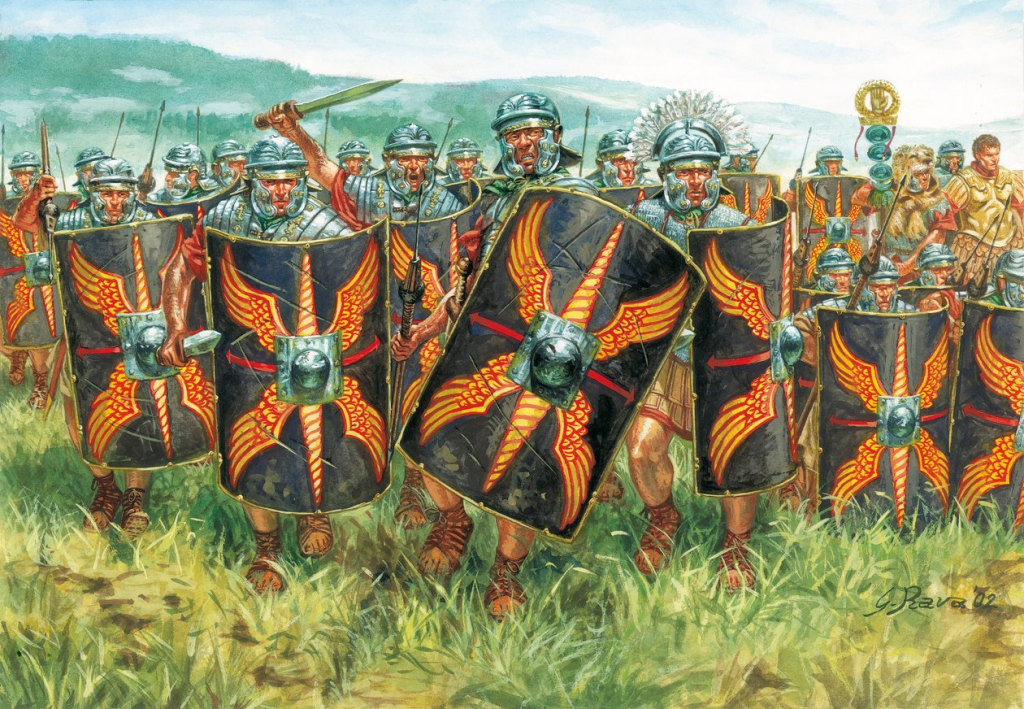
Polybius, the cool Greek historian who walked among their commanders, drew that figure with surveyor’s patience. He described the triplex acies, three lines of heavy infantry arranged in maniples like teeth in a wolf’s jaw, with young men in the front rank, seasoned fighters behind, veterans in the rear; he described light-armed velites skirmishing ahead, and allied cavalry supporting the flanks.¹ The legion in his account resembled a moving hillside, terraced and deliberate. Every citizen who afforded armour imagined himself enclosed somewhere in that grid, breastplate pressing on lungs, pilum shaft abrasive in the hand, short sword waiting as final argument. Training hardened that imagination into habit. Men learned to advance with measured steps, to raise shields on command, to throw their heavy javelins in a single wave, and then to close until another man’s sweat touched their own lips.
Arrows spoke a different language.
Greek songs had long filled Italian minds with images of Apollo sending plague through shafts, of Odysseus bending a great bow among the suitors. On islands such as Crete, boys grew up with recurved bows of layered horn and wood that stung the fingers yet promised meat on the table. By the third and second centuries before Christ, Roman magistrates had begun to approach such men with contracts. Cretan archers entered Roman pay as specialists, hired for campaigns among Macedonian ridges or Aetolian ravines where javelins lost much of their use and close-order infantry moved with difficulty.² They fired from rocky shoulders, from gullies that flanked the main road, from paltry scrub that still offered concealment. They wore Greek cloaks, spoke Greek words, and carried a reputation that preceded their arrival. The Latin tongue often reduced them to a type—simply Cretans—since the island’s name itself had hardened into a guarantee of accurate shooting.
Even so, the bow never fully stepped inside the inner circle of Roman honour during that age. The city loved nearness.
Walk away from battle and follow a narrow track above Praeneste in late autumn. Mist tightens among the olive trunks; the air carries smoke from burnt vine cuttings and the faint vinegar of crushed grapes. A senator in plain tunic and good boots turns aside from the road, followed by two freedmen and a dog with one torn ear. One servant draws from a leather case an object wrapped in linen and unfolds a composite bow that gleams under its sheen of oil. The other bears a quiver whose fletchings spill over his shoulder like the tails of small birds. The senator takes the bow with that particular half-smile of a man who sips his own youth. He places the tips against the earth, strings it in a quick practiced arc, and feels his spine answer.
Views: 10