(Review of Mr and Mrs Perfect: Behind the Bow documentary)
Late light spills over a summer field that could belong to any stop on the World Cup caravan—air thick as steamed linen in Shanghai, sharp as dry paper in Madrid—and in that blur of geography the camera for Mr and Mrs Perfect: Behind the Bow settles, eventually, upon Mike Schloesser holding full draw like a man who has learned to freeze time with his shoulders. The compound bow in his grip bristles with cams, cables and small rubber organs that soften shock, an oddly elegant machine of strain and calculation pressed into the span between his chest and the distant colours. Around him the stadium air thins; crowd noise sinks into a sort of listening hush, that peculiar pause where organised sport tips over into rite and everyone present seems to breathe through someone else’s lungs. Seventy metres away, the red and yellow rings of the target shiver in the heat as if they floated on water. His release aid curls tight around the thumb, a small silver claw with its own tremor of personality, and then the arrow unhooks itself from his hands and goes, a grey needle that the director catches and elongates until it almost drifts, fletchings spinning in slow rotation while, in the corner of the frame, the world-ranking graphic rolls up and lays the old nickname on him again: Mister Perfect. In that stretched heartbeat the film quietly declares where it wants to live: inside the narrow space where measured precision—scores, groups, clean sight pictures—has to carry the heavier, uncounted loads of marriage, long travel, interrupted sleep, the tug of a baby’s cry through a hotel wall, every invisible demand that presses upon an archer in the early decades of this century who earns a living by sending small pieces of carbon towards a painted circle and pretending, at least for the length of each shot, that the centre stays still.
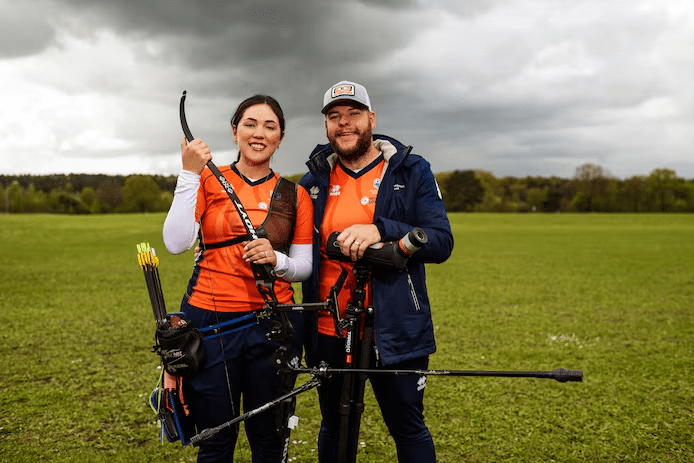
World Archery has built Archery+, its dedicated streaming platform, precisely for such extended looks at the sport beyond podium photos, gathering live events, archives and original features in a single digital range. Mr and Mrs Perfect enters that catalogue as a feature-length expansion of the federation’s long-running Behind the Bow profiles, and follows Mike and his wife, the Mexican-born Dutch recurve archer Gaby Schloesser, through the 2025 season as they juggle parallel careers, an infant daughter and the fragile myth of perfection that surrounds them. Promotional clips carry subtitles like The importance of family and Admit you’ve got a problem, which already frame the couple less as brand mascots and more as case studies in vulnerability under elite expectations. The film’s narrative arc stretches from practice halls in the Netherlands to the big arenas of the Hyundai Archery World Cup and the multi-sport cauldron of Chengdu’s World Games, presenting archery as both everyday labour and global spectacle.
Mike’s story carries the film’s title in his very nickname. In 2015 at Nîmes he became the first archer in history to record a perfect 600 out of 600 in the indoor 18-metre compound round, sixty arrows landing in the ten-ring, a Guinness-ratified achievement that granted him the label “Mister Perfect” and a place in a statistics-obsessed sports culture that treats flawless numbers as a kind of secular sainthood. Subsequent seasons brought world-championship gold, a career grand slam across World Cup, indoor circuit and European title, and a near-permanent occupancy of the world number one ranking through 2024 and into 2025. Earlier short films already probed the burden carried by that moniker, showing him tinkering with equipment and talking through slumps with a candour that undercuts any idea of mechanical invincibility, and the new documentary deepens this line. On screen, his broad frame and quiet humour share space with small tremors: a win greeted by something close to disbelief after weeks of curtailed training, a ranking round where arrows drift wider than his standards allow, an evening hotel scene where the baby monitor glows near the bow case. The camera traces how “perfect” in his life means endurance instead of flawlessness, a habitus built from repetition, humility and an almost monastic willingness to begin again after every release.
Gaby’s arc supplies the film with a complementary energy: where Mike embodies compound archery’s technological density and heavily engineered aiming systems, she draws the classic Olympic recurve, the discipline that carries much of archery’s public image since Munich 1972. She came into the world in Tijuana in 1994 as Ana Gabriela Bayardo, border air in her lungs and the green-white-red already waiting somewhere in her future kit. Mexico carried her first, lifted her onto the line at Rio 2016 under that heavy Brazilian sky, and for a spell her story seemed welded to that flag and that hemisphere. Then the axis shifted: a move to the Netherlands, a small civic office where signatures hardened on paper, a wedding ring, federation letters, and suddenly the Dutch lion sat on her chest, a second sporting citizenship that felt less like a clean break and more like a side door opening on the same mountain, just a harsher slope.
From there the climb turned stubborn and slow, season pressed upon season, until one bright Tokyo afternoon placed her on the Yumenoshima platform beside Steve Wijler, both of them squinting slightly into that flat Olympic glare while the mixed-team final crept their way, arrow answering arrow. When it settled, the silver hung cold and heavy at her collarbone and a new line etched itself into Dutch archery history: a recurve woman, at last, carrying an Olympic medal home to the Low Countries.
From there the calendar thickened: European stages, World Cup finals, podium flowers wilting in hotel sinks, a quiet heap of wins and near-wins that pushed her, almost before anyone quite named it, into the small, bright circle at the centre of world recurve archery. The film leans into that story gently. In the Limburg practice hall you catch a grain of Baja in her vowels, Mexican cadence crossing the low northern light; the fierce orange of the Netherlands runs like a shared stripe across both their jerseys; and when talk in the kitchen wanders toward Paris 2024 and whatever waits beyond, the words slip and swivel between Spanish, English and Dutch, a three-thread braid of language that hints at a wider map, where sport travels along with love, where passports and allegiances grow porous, and where the real country of their labour stretches far outside the tidy geometry of flags and medal tables.
Parenthood enters the frame almost as a third protagonist. In December 2024 the couple announced a “party of three incoming” on social media, and on 29 May 2025 their daughter Luna arrived, just days before Mike departed for the Antalya World Cup stage. World Archery’s own feature on the Schloesser family describes a season in which world-leading results coexist with chronic fatigue, erratic practice hours and emotional release that spills over far more often than his usual contained fist-pump. The documentary follows this thread through hotel corridors and airport lounges as pram and bow case share the same luggage trolley, then into the World Games village at Chengdu, where Luna attends her first major multi-sport event while her parents attempt to balance feeding schedules with field courses and finals matches. A recurring motif sets the glowing archery scoreboards against baby monitors and smartphone video of first smiles, asking what kind of “success” counts when late-night rocking precedes an early-morning elimination round. Those images carry a quiet polemic against the old heroic script of the relentless competitor whose private life fades entirely whenever medals loom; Mike’s gold in Chengdu and Gaby’s return to major competition just months after childbirth instead appear as shared family experiments in sustainable ambition, fragile, unresolved and therefore believable.
Every time the film lingers on Gaby’s loose or on Mike’s follow-through, it reaches back into a history where archery served as warfare, ritual and, later, controlled leisure. If you walk the thing backwards, the current shooting line stretches all the way to Finsbury Fields, summer of 1583, when some three thousand souls in English hose and leather jerkins gathered under a mixed sky to loose their longbows in a vast civic revel, a day where archery turned from battlefield habit into public spectacle and shared pride.From that old Finsbury afternoon the line runs on, through long centuries of drill, boredom, odd flashes of glory and a good deal of municipal fussing over fields and markers, until—almost as if someone flicked a switch in the sky—it steps into the white blaze of the modern Games. Paris 1900 takes it first, archery perched a little uncertainly on the programme, half trial, half curiosity; then comes the long drowse while other sports crowd the stage and the bow drifts into the wings, before Munich 1972 hauls it back under stadium lights and hands it over to the federation that would, by slow accretion of committees and rulebooks and mildly quarrelsome congresses, grow into the body we now call World Archery.
Along that western stream, as if a second river kept pace behind a low ridge, East Asian practice minded its own current: Japanese kyūdō speaking of the draw and the release as walking meditation, a narrow path of shin-zen-bi—truth, goodness, beauty—where a clean, centred posture carries at least the same moral weight as a split shaft in the target, and on some days, if the old masters have their way, carries a touch more.
Mike and Gaby stand right where those currents meet: compound mechanisms and carbon shafts in their hands, sponsor marks and broadcast graphics stitched across their sleeves, yet also the habit of slow breathing, the sessions with mental coaches, and that persistent curiosity about the hair-thin frontier where deliberate aiming dissolves into mushin, the empty-minded state those old kyūdō manuals keep circling around, as if language itself strained to follow the arrow. Mr and Mrs Perfect frames their training sessions with a kind of liturgical regularity—string waxed, sight checked, stance aligned—so that each shot bears the weight of centuries of shooters who sought salvation, survival or serenity through a straight-flying shaft.
In that sense the film offers a portrait of 2025 as sharply as it offers a portrait of two athletes. Archery+ itself belongs to the proliferating archipelago of sport-specific streaming platforms, from which federations seek direct contact with niche fanbases, subscription revenue and data, a departure from dependence on traditional broadcasters. World Archery’s partnership with the Joymo OTT infrastructure and its recent move to in-house live production at the Lausanne Excellence Centre reveal a governing body eager for control over images and narratives, promising increased coverage of up to two hundred events a year. Within that media ecology, Mr and Mrs Perfect functions simultaneously as intimate profile and strategic asset: by giving faces, accents and family scenes to the abstract figure of “world number one”, the federation makes compound and recurve archery more legible to viewers accustomed to drive-through highlight reels. The documentary arrives in the same moment as India’s franchise-based Archery Premier League and renewed Korean domination at Olympic level, so every quiet kitchen conversation in Limburg belongs implicitly to a wider contest in which nations and leagues compete for relevance within a crowded global calendar. A sequence in which Mike fields sponsor commitments between nappy changes and travel bookings for World Cup stages carries that tension lightly, yet the subtext stays clear: in contemporary sport, “perfection” lives inside a matrix of rankings, sponsorship contracts, streaming schedules and family duties that never sleeps.
Formally the documentary leans on a visual language familiar from World Archery’s event coverage—crisp super-slow-motion at release, graphic overlays for scores and wind, drone sweeps over finals arenas—yet extends it through domestic and training-hall textures that rarely surface in simple highlight packages. Trailer and clips already advertise this blend: in The importance of family the framing stays close on Gaby’s face as she speaks about support structures and sacrifice, while the background hum of a range or hotel room suggests constant movement; in Admit you’ve got a problem the tight shot on Mike’s expression during a rough patch foregrounds self-diagnosis instead of triumphant celebration. Over ninety minutes, stretches of match footage, with their drumbeat of tens and nines, occasionally approach monotony for viewers already familiar with archery’s cadence, yet the editing usually redistributes attention in time, returning from the target faces to Luna’s pram or to quiet calibration sessions where both archers test arrows and sight marks under fluorescent winter light. The sound, laid in almost shyly under the picture, lingers on the dry slap of string into guard, the small scuff and shuffle of feet edging along the shooting line, the low river-talk of many tongues folding over the grandstand, so that the whole thing thickens in the ear and in the ribs, where television coverage usually rubs archery thin and glossy, like ink spread too far on cheap paper.
By the time the credits wander up the screen, Mr and Mrs Perfect has drifted away from its cheeky wink and sits there instead as a kind of quiet riddle the film leaves in your hands. The film’s answer emerges through repetition: arrow after arrow leaves the string under conditions that rarely feel optimal—jet lag, sleeplessness, doubts over equipment set-up, an infant’s cry from the stands—and yet both Mike and Gaby return to the line because their lives have fused with this peculiar discipline in which success depends on surrender as much as on control. That fusion reflects a broader human predicament in an age of data dashboards and public rankings, where many professions demand an archer’s steadiness while subjecting workers to winds far less predictable than those that swirl around outdoor finals fields. In classical terms one could call their pursuit an effort toward aretē, excellence of character and form, with the arrow’s flight serving as outward sign of an inward adjustment that continues long after medals and records pass to other names. The documentary succeeds when it allows those inward adjustments to surface—Mike’s rueful smile after a rare stray arrow, Gaby’s frank admission of fear and determination before a comeback event—so that archery appears less as niche curiosity and more as emblem of a world in which every person, somewhere, stands at their own shooting line, breathing through fatigue, sighting on a distant ring of colour, and trusting that the next release will travel slightly closer to the centre.
Views: 15
This article is part of our free content space, where everyone can find something worth reading. If it resonates with you and you’d like to support us, please consider purchasing an online membership.