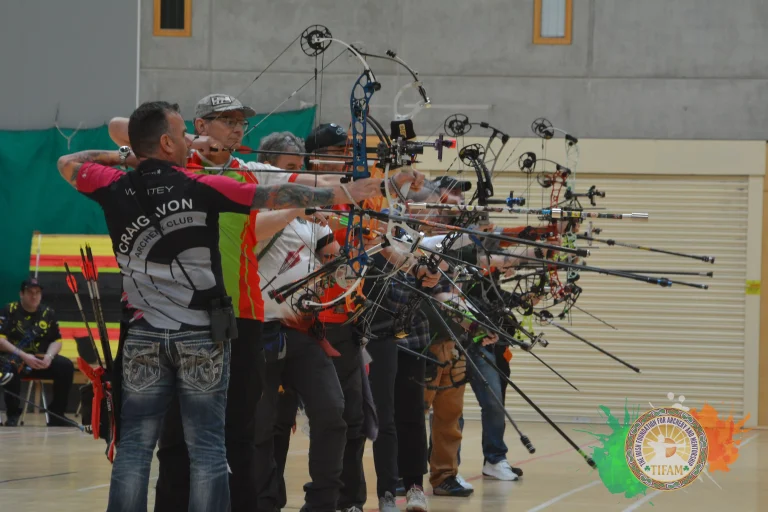
In archery, the follow-through is arguably more critical than in golf or tennis, because the “engine” of the shot is the tension in your own body. While the arrow leaves the bow quickly, any collapse or movement at the moment of release—or even a fraction of a second after—will alter the arrow’s flight path.
A perfect follow-through in archery is not an added motion; it is the natural conclusion of redirected tension.
You are a spring under tension. The follow-through ensures that this tension releases in a straight line.
If you have proper back tension, your draw hand should naturally move backward and slightly around your neck after the release. If your hand moves outward (away from your face) or drops down, it indicates you were using your arm muscles rather than your back, which usually causes the arrow to veer left or right.
In most sports, the word “anchor” implies something stuck, heavy, and unmoving. If you treat your anchor point like a “stop sign,” your shot will likely fail.
Many elite coaches actually dislike the word “anchor” for exactly this reason. They prefer the term “reference point.”
The Anchor Mindset: You pull until you hit your face, and then you stop. This causes your back muscles to relax (collapse), and you end up “holding” the weight with your arm. When you release from a dead stop, the string has to shove your fingers out of the way, leading to a “plucked” string and a weak shot.
The Reference Mindset: Your face is just a “checkpoint” you pass through. You touch your jaw or the corner of your mouth to confirm alignment, but the tension never stops growing.
Using this reference mindset—countering the static nature of the word anchor—archers use a concept called expansion and/or an alignment check. Imagine you are at full draw. Even though your hand is touching your face and the bow isn’t moving further back, you are still moving (as slow as it may be): expanding your chest and squeezing your shoulder blades together until the shot breaks. The natural effect of this should be your bow arm moving forward and your released hand moving back. The follow-through.
Yes, it is a bold but highly effective coaching philosophy to teach the follow-through first. While most beginners want to focus on aiming or where their hands go (and yes, that should be taught), starting with the finish builds the “soul” of the shot.
The follow-through is the most important foundational element to teach before anything else. If you tell a beginner to “use your back muscles,” they often don’t understand the feeling. However, if you tell them, “Your hand must end up behind your ear after the shot,” the only way for them to get it there is to engage their rhomboids and lats. I find some of the language used—although correct—can be over-compared for a beginner. Your job as a coach is to teach all of the movement involved in the full shot cycle.
I can also argue the point that bow grip should come first, or maybe anchor. Here is my take: all of them are important. Teaching all of the movement involved in an archery shot from the start helps the new archer understand what’s needed to fully complete the shot cycle. Like a golfer holding a club, or a tennis player’s racket grip—important stuff nonetheless. A golf swing doesn’t stop when the club meets the ball, nor does a tennis swing finish the moment the racket meets the ball. For both, the follow-through is arguably the most important part happening there.
Views: 16
This article is part of our free content space, where everyone can find something worth reading. If it resonates with you and you’d like to support us, please consider purchasing an online membership.