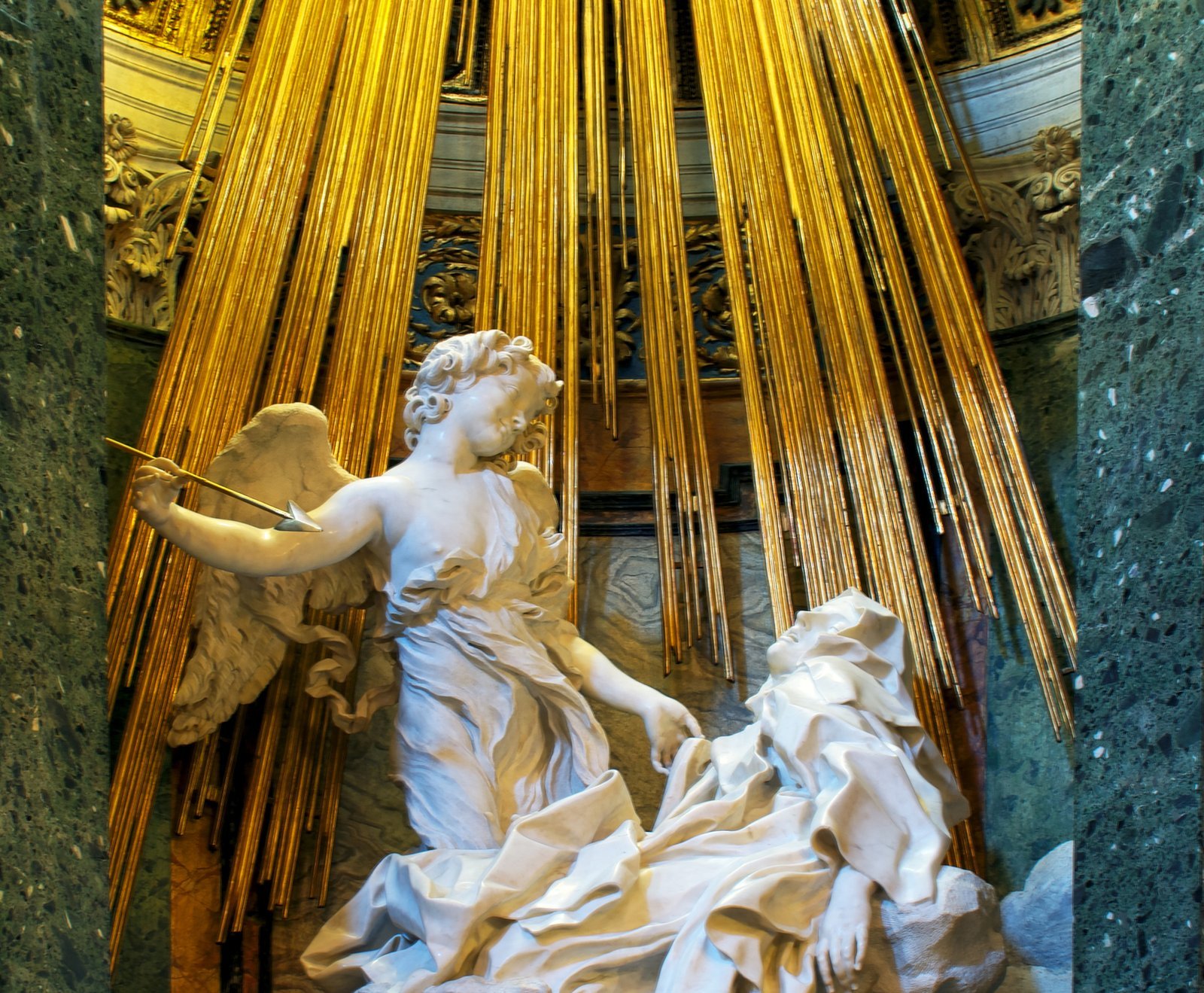
What does Teresa’s transverberation reveal about embodied theology? I read chapter 29 of the Vida as an account of knowledge entering the creature through injury, motion, heat, cry, and aftermath. The famous angel with the flaming shaft does not ornament a prior doctrine. He performs it. Teresa receives divine truth in a mode that passes through the heart, unsettles speech, alters posture, and leaves the body bearing a share in what the soul undergoes. When Bernini later lifts that scene into marble in the Cornaro Chapel, he does not merely illustrate a saint’s memory. He stages a material exegesis of Teresa’s claim that grace arrives as event, that God is known through a penetration which wounds in order to disclose, and that theological understanding may take the form of measured disturbance.¹
The scene in Teresa’s prose opens with precise sensory economy. An angel appears at her left side. His beauty burns. In his hand she sees a golden dart tipped with fire. He drives it into her heart repeatedly, so deeply that it seems to reach the entrails; when he draws it out, he seems to carry part of her with it, leaving her “all on fire with great love of God.” The report continues through paradox: pain so intense it produces moaning, sweetness so abundant that the soul desires no release, and an experience Teresa names spiritual while insisting that the body shares in it “a great deal.”² Her language refuses any pious evacuation of flesh. The event takes place in the crossing where spirit transacts through muscle, nerve, breath, and voice. Theology here enters history through the body’s susceptibility.
That last insistence matters. Teresa does not offer a body as metaphor while reserving the real action for some sealed interior chamber. She records participation.The body participates. The moan gives it voice. The stupefaction that follows carries its effect forward. During the days in which the effect lasts, she goes about “as though stupefied,” desiring silence and solitude so that she may keep close to the pain which now bears greater sweetness than created things.³ One feels here a theology of consequence. Revelation leaves traces. It governs movement in the corridor, speech among others, the capacity to attend ordinary company. The vision therefore reveals embodied theology in its strict sense: God’s address reaches the person as a whole living composite, and the knowledge granted bears measurable aftermath in time.
I dwell on the word measurable with intent. Teresa’s prose keeps count through repeated motion. The dart enters several times. The moan marks a threshold where inward visitation becomes audible event. The body’s share becomes a kind of index. Days pass under the lingering wound. Spiritual rapture in this text has kinetics. It possesses vector, depth, recurrence, duration. One might say that love acquires a geometry. The line is the shaft. Depth lies in the penetration toward the entrails. Heat rises at the burning tip. Temporal extension appears in the stunned days that follow. For that reason the vision offers more than ecstatic excess. It yields an epistemology. Teresa knows by being pierced. Love becomes an incision that cuts through the soft evasions of abstract speech and gives certainty the contour of an inflicted event.⁴
Michel de Certeau helps clarify what is at stake in that incision. In his account of mystic speech, the mystic appears where discourse strains toward what it cannot stabilize as object. Such language “erases itself,” remains an unstable metaphor for what stays inaccessible, and moves toward regions associated with quoted voices, cry, song, body, and the extraordinary.⁵ Teresa’s transverberation bears precisely this pressure. Her prose does not master the event. It circles it through “seemed,” “as though,” and analogical approximation. Yet that instability does not weaken the testimony. It becomes the form required by a truth that exceeds conceptual possession. The body enters as witness where definition yields. Moaning utters what scholastic neatness cannot. In that register, the wound becomes articulate.
De Certeau also lets one see that Teresa’s speech is neither private gush nor mere confession. Mystic language in his sense lives at the edge where the ordered regimes of theological discourse meet a speaking subject altered by encounter. It slips toward cry, voice, and the authority of what has been undergone.⁶ Teresa’s chapter 29 exemplifies that threshold form. She writes with an exactness born from obedience, yet the content resists reduction to doctrinal proposition. The angel’s dart produces a kind of theological speech act in the flesh. It authorizes her through having happened to her. She speaks from wounded credibility. Thus embodied theology emerges as a mode of knowledge in which truth authorizes itself by transforming the knower’s capacities of sensation, utterance, and endurance.
The arrow of love therefore deserves to be read as epistemic incision. Incision opens. It separates surface from hidden recess. It gives access through cutting. Teresa’s account turns each of these meanings toward divine knowledge. The spear opens the heart and reaches the entrails, language that carries both intimacy and violence. Surface devotion gives way to exposure. The deepest part of the self seems drawn outward with the dart’s withdrawal. The self comes to know God through being made vulnerable to God’s entry. That movement differs sharply from any theology that imagines truth as a possession calmly acquired by detached reason. Teresa’s knowledge arrives through surrender to an action she undergoes before she can parse it. Here contemplation has the structure of passive reception before it becomes reflective articulation.⁴
At this point Bernini becomes decisive. The sculptural group in the Cornaro Chapel, executed between 1647 and 1652, takes Teresa’s text and translates its motions into stone, bronze, light, and architecture. The chapel gathers sculpture, fresco, gilded rays, colored marble, donor portraits, and a hidden window so that the viewer confronts an entire apparatus of sensation. Teresa reclines upon a cloud. The angel smiles with delicate concentration. Gold rays descend from above. Members of the Cornaro family lean from marble boxes as though in a theatre, watching the event unfold. Bernini thus reads Teresa correctly: this mystical injury is both intensely intimate and irreducibly public. It demands spectators, bodies, space, and staging.⁷
The sculpture is often discussed through the tension between sensuality and sanctity. I find that opposition too blunt for the work before us. Bernini’s exegesis grows stronger once one grants Teresa her own categories. She herself says the pain is spiritual while the body shares in it greatly. Bernini gives that claim material density. The heavy folds of the habit ripple beyond ordinary gravity. The saint’s head falls back. Her mouth opens. The angel’s hand gathers cloth with surgical lightness. Hidden illumination strikes the scene so that matter appears visited from within. The chapel does more than depict transverberation. It reenacts the event’s logic. Divine address arrives by sensation, through a half-seen aperture, with impact upon flesh.⁷
One can press the point further. Bernini measures motion in marble. Teresa’s written account already contains repeatable kinetic signs: plunge, withdrawal, moan, lingering stupor. Bernini arrests those signs at the threshold of culmination. Marble performs imminence. The saint appears at once yielded and seized. The spear hovers in a pause dense with consequence. The folds flare almost into flame. A seventeenth-century sculptor thus becomes a reader of mystical prose at the level of mechanics. Material exegesis, in this instance, means that stone interprets text by discovering its hidden physics. Love moves along a line. Grace descends through a shaft of light. The soul’s assent appears as altered musculature and suspended weight. In Bernini’s hands, theology takes on velocity, direction, and pressure.⁷
The Cornaro witnesses deepen the argument. Their presence has often been read as theatrical framing, which it is, yet the theatricality carries theological force. Teresa’s ecstasy enters a church as an event open to communal apprehension. Mystical experience here does not dissolve into private inwardness. It becomes visible in the economy of worship, patronage, devotion, and artistic mediation. A body under divine action calls forth other bodies who see, discuss, and inhabit the same charged space. Bernini therefore rebukes the modern temptation to isolate spiritual experience within interior privacy. Embodied theology spreads outward. It organizes spectatorship. It orders architecture. It creates a public around the wound.⁷
Yet the work retains a reserve that saves it from vulgar literalism. Teresa’s own prose never collapses the spiritual into the merely physiological. She keeps distinction alive while refusing separation. Bernini follows suit. The cloud lifts the figures from ordinary ground. The rays announce descent from above. The hidden window keeps the true source of light partly concealed. Flesh receives, but flesh does not exhaust what it receives. That is why the sculpture feels exact to the text. Materiality here serves transcendence by becoming the place where transcendence touches down. One might call this sacramental intelligence in Baroque form: invisible grace disclosed through visible signs, yet disclosed so intensely that the signs themselves tremble under the weight of what they bear.⁷
Teresa’s transverberation, then, reveals embodied theology in four linked ways. First, it shows that divine knowledge comes through passibility, through the creature’s capacity to be affected. Second, it demonstrates that spiritual truth may register as measurable motion: penetration, heat, cry, aftermath. Third, it authorizes a kind of speech whose broken metaphors arise from encounter rather than abstraction, a point de Certeau sharpens with great precision. Fourth, through Bernini’s sculpture, it proves that matter can interpret matter, that stone, light, cloth, posture, and architectural framing can read a mystical text with intellectual seriousness. The flaming shaft is therefore no decorative emblem. It is a theological instrument. It cuts a path by which love becomes knowledge.
I return, in closing, to the governing question, which Teresa’s vision answers by presenting theology as a truth that arrives within lived flesh as a suffered occurrence, so that divine knowledge takes hold through penetration, passes into cry, and settles only afterward into an intelligible form the afflicted person can sustain and speak. Before any doctrinal formulation gathers around it, transverberation appears in her account as an event of knowing, one in which comprehension follows incision and love discloses itself through the very passage that tears open the creature for reception. Bernini recognized that sequence with exceptional acuity when he translated Teresa’s prose into the theatrical and sculptural order of the Cornaro Chapel, where pressure, sensation, exposure, and suspended release turn interpretation into something visible, concrete, and exacting. Within that charged arrangement, the saint’s frame becomes the place at which theology assumes form, while form itself acquires reflective power through the disciplined representation of what the soul and the suffering organism undergo together. The flaming shaft therefore teaches that divine love comes to know the person through piercing contact, while the person comes to know divine love through endurance of that incision transfigured into praise.
Scholia:
¹ Teresa places the event within a larger sequence of visions and assurances in Vida chapter 29, yet the transverberation acquires singular status through its tactile precision. I take that precision as the hinge of the chapter. A vision of Christ or an audition may remain narratable through visual or verbal categories already available to devotional culture. The dart changes the register. It introduces instrument, trajectory, fire, penetration, removal, and lingering physiological effect. In that sense the passage does not merely recount an extraordinary favor; it theorizes mystical knowledge through enacted contact. Bernini’s later chapel grasps this singularity by refusing a small illustrative panel and choosing instead an immersive setting. The saint’s body, poised between collapse and exaltation, becomes the hermeneutic center. Text and sculpture converge on one claim: grace reaches understanding through the wound it opens. Kieran Kavanaugh and Otilio Rodriguez, trans., The Collected Works of St. Teresa of Avila, vol. 1 (Washington, DC, Institute of Carmelite Studies, 1976), pp. 244–47.
² The famous lines concerning the golden dart, the fire at its tip, the penetration into the heart and entrails, and the mingling of intense pain with superabundant sweetness remain the decisive primary evidence. Teresa’s refusal to sever spiritual pain from bodily participation gives the passage its lasting theological fertility. Kieran Kavanaugh and Otilio Rodriguez, trans., The Collected Works of St. Teresa of Avila, vol. 1 (Washington, DC, Institute of Carmelite Studies, 1976), pp. 244–45.
³ Teresa’s report of going about “as though stupefied,” desiring neither speech nor company while cherishing the pain, matters by reason of its temporal extension. Ecstasy here leaves a durable trace rather than a vanishing instant. That durability gives the episode probative weight within her own self-interpretation. Kieran Kavanaugh and Otilio Rodriguez, trans., The Collected Works of St. Teresa of Avila, vol. 1 (Washington, DC, Institute of Carmelite Studies, 1976), p. 245.
⁴ I use the phrase “epistemic incision” to mark a structure already latent in Teresa’s report. The dart does cognitive work. It opens what remains concealed, exposes the deepest region of the self, and produces certainty through undergone alteration. Such a reading aligns Teresa with a wider Christian tradition in which love and knowledge interpenetrate, yet her language gives that relation unusual somatic sharpness. The point gains further force when set beside the post-Tridentine interest in bodily signs of sanctity. Teresa’s body does not function as decorative residue. It becomes an index of truth and a contested site where discernment must occur. Her account therefore bears devotional, theological, and institutional significance at once. Michel de Certeau later clarifies why such passages matter: they speak where systematic discourse reaches its own edge. Michel de Certeau, The Mystic Fable, Volume One: The Sixteenth and Seventeenth Centuries, trans. Michael B. Smith (Chicago, University of Chicago Press, 1992), pp. 299–304.
⁵ De Certeau’s language about mystical discourse as unstable metaphor, self-erasing speech, and proximity to cry, song, body, and extraordinary voices helps explain why Teresa’s most exact lines remain analogical rather than clinical. He supplies a theory of why mystical testimony intensifies precisely where ordinary conceptual command thins out. Michel de Certeau, Heterologies: Discourse on the Other, trans. Brian Massumi (Minneapolis, University of Minnesota Press, 1986), pp. 80–83.
⁶ One of de Certeau’s lasting achievements lies in refusing the reduction of mysticism either to private experience or to doctrinal oddity. He treats it as a historical practice of speech, one that emerges amid tensions among institution, desire, scriptural inheritance, and the speaking body. That approach proves especially helpful for Teresa, whose writing joins obedience to confessor and church with startlingly singular testimony. The mystic neither exits discourse nor masters it. She speaks from a site where language bears the pressure of what exceeds it. Teresa’s moan, her recourse to approximation, her insistence that the body “has its share,” all belong to that pressured speech. De Certeau lets one see that such utterance carries epistemic dignity. It speaks from transformation, and the authority of that speech derives from the event inscribed in the subject who narrates it. Michel de Certeau, Heterologies: Discourse on the Other, trans. Brian Massumi (Minneapolis, University of Minnesota Press, 1986), pp. 80–83; Michel de Certeau, The Mystic Fable, Volume One: The Sixteenth and Seventeenth Centuries, trans. Michael B. Smith (Chicago, University of Chicago Press, 1992), pp. 297–304.
⁷ Bernini’s sculptural group for the Cornaro Chapel, Santa Maria della Vittoria, Rome, completed 1647–52, remains the most influential visual interpretation of Teresa’s transverberation. Its significance lies in the union of sculpture, architecture, light, and spectatorship. The chapel does not isolate a statue; it creates an environment in which mystical event becomes communal perception. Gian Lorenzo Bernini, Ecstasy of Saint Teresa, Cornaro Chapel, Santa Maria della Vittoria, Rome, 1647–52; see also Rudolf Wittkower, Gian Lorenzo Bernini: The Sculptor of the Roman Baroque, 4th edn (London, Phaidon, 1997), pp. 159–69.
Views: 2
This article is part of our free content space, where everyone can find something worth reading. If it resonates with you and you’d like to support us, please consider purchasing an online membership.