Dear Archers, this time I bring you something a little different, written especially with those of you shooting the IFAA European Indoor Championships in March 2026 in SETU Arena, Waterford in mind; the article “Holding Focus In Waterford’s Arena” is a personal meditation on how to keep your mind steady during high-stakes indoor rounds, when the air fills with whistles, flags, layered rows of target faces and the drum of hundreds of arrows striking foam, and I write here as a fellow archer, not a qualified coach. Instead I draw my knowledge from years of extensive reading and study of closely related topics, the scholarly work I have carried through TIFAM, many earlier essays on similar themes, and my own experience on the line at events of this scale, so please treat it as one archer’s considered view rather than formal coaching advice; my aim has been to look at focus in a disciplined, academic way, grounding every claim in sport psychology and cognitive science research that you can follow in the endnotes and bibliography, and I warmly encourage you to dig into those sources, chase the references, and let your own study deepen both your shooting and your understanding of what happens inside the mind at full draw.
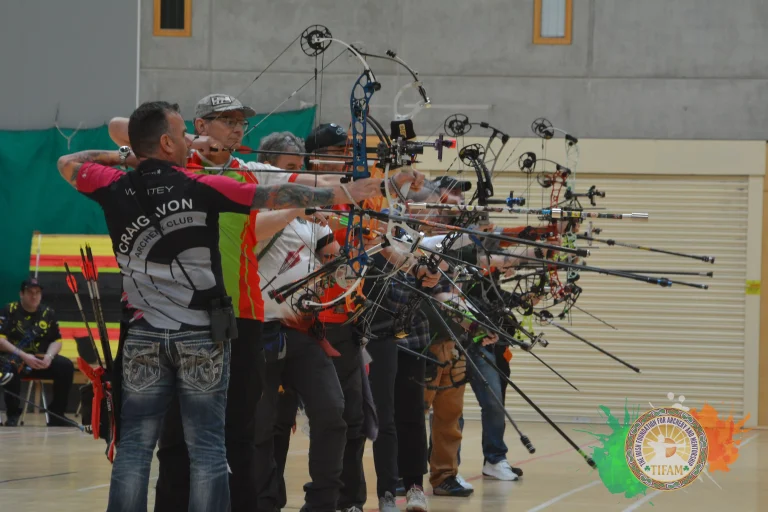
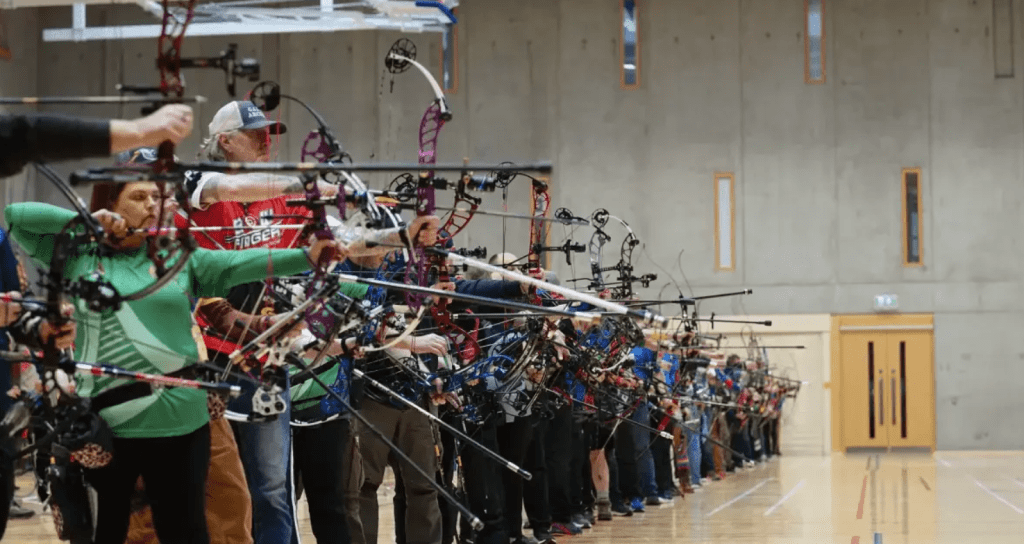
European indoor championships press toward Waterford with the steady insistence of a date long ago ringed in red on the calendar, and already the air inside the SETU Arena feels crowded in the imagination: targets in long bright ranks, whistles, dealer tables, national flags, the low thunder of hundreds of conversations laid over the hard metronome of arrows striking foam.¹ In early March 2026, that hall will hold the IFAA European Indoor Archery Championships over several long days, with IFAF as host and the Indoor and Flint rounds as the chosen ordeals.² In theory the task sounds simple: stand at twenty yards, repeat your shot process, score as high as you can. In practice the task becomes a question for psychology: how long can a human mind maintain a precise, disciplined focus inside an arena that hums with movement and consequence.
Psychology speaks first in a dry register. Attention in the cognitive tradition means a system that selects certain streams of information for deeper processing while other streams receive only partial registration.¹ This system behaves like a movable beam that shifts, narrows, or widens under demands of task and environment, with clear energetic limits. Concentration in sport grows out of that framework. Sport psychologists treat it as the voluntary direction of this limited resource toward cues that matter for performance in the present moment, while other stimuli recede toward the edges of awareness.² In archery that “present moment” stretches into a small architecture of time: stance, set-up, draw, anchor, aim, expansion, release, follow-through. Each phase invites attention toward a specific cluster of sensations and perceptions, and each phase offers abundant opportunity for intrusion, both from outside the body and from within it.
The geometry of European indoor competition tightens this demand. Under IFAA rules, championships in halls such as SETU usually hinge on two standard formats: the Indoor Round and the Flint Indoor Round.³ The Indoor Round gathers sixty arrows into two Standard Units. Each unit presents six ends of five arrows at twenty yards toward a blue forty-centimetre face with concentric scoring from inner white outward. The Flint Round complicates the pattern: two seven-end units, four arrows per end, with distances that step from ten to thirty yards and with multiple black-and-white field faces set in specific combinations.⁴ Across qualification and subsequent stages an archer may send several hundred arrows down the same lane, under the same lights, inside air thick with sound and consequence. Attention therefore requires two scales: a micro-focus built around the seconds of each shot, and an endurance focus that must survive morning sessions, eliminations, and medal matches.
Laboratory work on vigilance offers a kind of prophecy for such situations. Classical experiments showed that when a person monitors a display for rare signals across extended time, accuracy tends to decline, response variability increases, and lapses appear more frequently as minutes accumulate.⁵ In those studies, performance rises again when the task carries clear meaning, when feedback arrives immediately, and when the observer applies deliberate strategies to refresh engagement. Archery during a long indoor round often mirrors this curve in a more human key. Coaches who chart scores arrow-by-arrow see an early phase of adjustment and calibration, then a broad middle region where attention wavers and groups drift, then a late phase where athletes either hold form despite fatigue or slide into over-correction. A clean first unit on the Indoor Round can create a seductive cushion; the archer walks into the second unit already half-distracted by imagined totals and records. A single poor end at the midpoint can seed a narrative of collapse that occupies cognitive space during subsequent draws.
To describe these shifts with more precision, many practitioners adopt Robert Nideffer’s scheme of attentional styles.⁶ He arranges focus along two axes: broad versus narrow and internal versus external. Four quadrants follow. Broad-external attention surveys the whole environment. Broad-internal attention scans thoughts, plans, and emotional state. Narrow-external attention rests on a small region of space—such as the ten-ring at twenty yards. Narrow-internal attention dwells on a limited set of bodily sensations or technical cues. A European indoor line demands fluid movement across all four. During the shot cycle, the archer lives mainly in narrow-internal and narrow-external modes: feel of balance through the feet, shape of the bow shoulder, contact of string against face, then visual relationship between sight and niner x. Between ends, survival depends on a controlled widening: broad-external awareness registers timing lights, judge calls, crowd behaviour; broad-internal awareness registers fatigue, breathing pattern, emotional temperature. Trouble begins once attention sticks in a single quadrant. A competitor who lingers in narrow-internal mode while walking back from the line carries self-critique into every step. Another who allows broad-external awareness to intrude during anchor grants power to every cough in the stands.
Elite archers describe concentration far less as a trance and far more as a rhythm. Qualitative studies with Olympic squads reveal that athletes who sustain high performance across long rounds tend to speak in pulses: a deliberate tightening of focus during the seconds of shooting, a brief softening at the moment of lowering the bow, a reset during the walk back, a fresh narrowing with each first arrow of a new end.⁷ They cultivate, often with sport psychologists, the capacity to notice their own state without panic: a spike of anxiety, a trace of boredom, an intrusive thought about standings appear, gain a quick label, then lose force. This meta-awareness belongs to the same family as the physical “feel” of the shot; both grow through practice, debrief, and reflection, and both enter the performance field during a European championship with equal authority.
As stakes rise, attention acquires a different flavour. Attentional Control Theory, developed within the anxiety literature, proposes that heightened anxiety draws processing resources away from goal-directed systems toward stimulus-driven systems that scan for threat, while the person applies extra effort in an attempt to preserve effectiveness.⁸ In a quiet mid-week training session that extra effort often compensates successfully. In an international-scale indoor final, rewarded and punished by instant digital numbers, the threat system receives far richer diet. Scoreboards flash totals in bright colours, commentators analyse arrow by arrow, coaches confer in tight clusters behind the waiting line. Every cheer in the hall signals someone else’s success. Under those conditions an archer’s attentional system receives constant invitations to inspect potential danger: the number beside a rival’s name, the expression of a coach, the murmur after an eight. The cost of maintaining focus on process cues—breath, expansion, sight picture—rises with every end.
Inside target sports a specific disturbance often grows from that soil: the complex phenomenon that archers call target panic and golfers call the yips. Its academic literature remains modest in size yet confirms many themes from coaching lore.⁹ The condition appears in several forms: a freeze during draw, an inability to settle the sight in the x, an involuntary burst release. Each form reflects a distortion of the usual relationship between automatic motor programs and conscious oversight. Movements that once flowed with minimal attention fall under a harsh internal spotlight; catastrophic expectations about outcome crowd the field. Championship conditions extend that spotlight and feed those expectations. An archer with a history of panic walks to the line in Waterford already scanning internally for symptoms; that scan itself consumes attention that the technique requires. A slight tremor of sight pin then confirms fear, and a loop of self-monitoring, anxiety, and degraded execution repeats across ends.
Sport psychology answers through several clusters of methods, each cluster addressing attention from a different flank. Goal-setting practices encourage archers to frame the European indoors as a sequence of process objectives instead of a single verdict event.¹⁰ An athlete commits, for example, to a consistent pre-shot breathing pattern through the entire Indoor Round, or to complete each shot without forced corrections during aim, or to preserve full follow-through on every arrow, independent of score. Outcome goals—qualification rank, personal best, medal—remain present yet move to a more distant horizon. Imagery work invites competitors to rehearse the full sensory experience of SETU Arena before arrival: the shine of blue faces under lights, the echo of whistles, the feel of twenty-yard depth in that specific hall, the slight tack of the floor under shoes.¹¹ When such imagery includes kinesthetic and emotional elements—the weight of the bow, the quiet satisfaction of a clean release—it strengthens associations between focused attention and successful execution under similar sensory conditions.
Self-talk occupies a related channel. Researchers distinguish between instructional self-talk, which carries technical cues, and motivational self-talk, which carries emotional encouragement.¹² In precision sports, instructional phrases during the shot usually serve better: “strong front,” “smooth through back,” “see it float,” spoken internally in brief cadence, provide a scaffold for attention. They anchor the mind to controllable actions and leave little space for destructive commentary. Long inner monologues about failure, unfairness, or reputation struggle under a strict indoor timing clock, since each second spent in rumination brings the archer closer to a hurried last arrow.
In recent decades mindfulness-based programmes have entered performance settings and now influence preparation for high-level indoor archery. Their language differs from traditional motivational talk. Instead of promising a permanently quiet head, they train athletes to alter their relationship with thoughts and sensations.¹³ A wave of anxiety before a decisive end receives recognition as “a wave of anxiety” instead of a verdict on character. The archer learns to feel tension in shoulders or hands as information rather than as shame. Attention returns again and again to breath, to contact with the floor, to the simple fact of sight ring against blue. Evidence from shooting and related precision sports indicates that such programmes can reduce measured competition anxiety and yield steadier aim under evaluation, although effect sizes vary and the training demands consistency over long periods.¹⁴
Every discussion of long-form concentration in archery eventually touches flow. Mihály Csíkszentmihályi describes flow states as episodes where action and awareness coincide, goals remain clear, feedback arrives immediately, and self-conscious evaluation fades.¹⁵ In that description, a clean six-arrow end in an indoor final fits perfectly. Archers who experience flow in competition report that time narrows into the rhythm of whistle, draw, release, retrieval; the hall recedes into abstraction; each shot feels both deliberate and effortless. European indoor formats support such states because the task remains stable: constant distance, familiar target faces, predictable timing. Yet flow during a championship usually arrives in brief arcs instead of a continuous band across the day. It often visits after an athlete accepts the presence of imperfect arrows and releases the fantasy of absolute control. Attempting to chase flow as an explicit goal tends to reintroduce self-consciousness and fragments attention again. Coaching wisdom here treats flow as a by-product of sound routines, appropriate challenge, and a seasoned stance toward risk.
The built environment of SETU Arena shapes every one of these processes. Descriptions of the facility present a large multipurpose hall with strong artificial lighting, a floor wide enough for long ranks of targets, and spectator seating along at least one side.¹⁷ Concrete, steel, and glass reflect sound; applause, dropped arrows, judge whistles, and casual conversation merge into complex acoustic waves. An archer at full draw stands inside those waves, perceiving them as gusts of noise that rise and fall during aim. Attention therefore operates inside a sensory storm. Athletes who train only in small, quiet clubs encounter, during a first ever continental-like championship, an entirely new level of auditory density. Preparatory programmes that include simulated noise—recorded crowd sound, music, sudden announcements—help them fold that density into their personal definition of “normal” competition.
Alongside architecture stands social structure. European indoor lines gather archers from many nations: seasoned internationals, young aspirants, national-path qualifiers for whom SETU in March 2026 brings a first taste of this scale internationalstage. Each occupies a marked lane, yet their elbows nearly touch at full draw. Social comparison arises almost automatically. A side glance catches a neighbour’s string-walking finesse, stabiliser configuration, or tight group in the ten. Social identity theory suggests that athletes build self-concept partly through group memberships—club, federation, nation.¹⁶ Wearing an international shirt in that hall introduces a further layer of meaning: every arrow speaks for personal skill and also for the flag on the back. Attention that drifts toward judgments about worthiness under that flag leaves fewer resources available for the immediate demands of stance and expansion.
For the psychologist and the experienced coach, a championship such as the European indoors at SETU Arena becomes an informal laboratory. Each athlete arrives with unique history: childhood games with simple bows, early coaching, first club competitions, older failures that left scars, long sequences of training days where technical foundations deepened. Each arrives with a personal repertoire of attentional tools: some polished and grounded in evidence, others half-superstitious rituals about socks, sequence of warm-up arrows, or preferred position on the waiting line. Across several days, those repertoires encounter objective structures: the exact order of Indoor and Flint rounds, the timing system, the acoustics, the behaviour of judges and other archers. Concentration rises and falls like a tide across the hall. Patterns emerge for those who watch closely. Athletes who respond flexibly to early setbacks—a narrow out-called line-cutter, a slight timing miscalculation, a loose group—tend to employ clear routines for recovery: a breathing practice, a micro-technical adjustment, a brief private exchange with coach, then full attention back to the next end. Others carry each early arrow as a wound; their gaze attaches to the previous group during scoring instead of treating each pull as closure, and attention reaches the next shooting line already fatigued.
In the end, concentration during a busy European indoor championship refuses description as a fixed trait that some athletes possess forever and others forever lack. It behaves more like a living event that arises whenever nervous system, environment, and task align in a certain configuration. An archer can spend months refining technique, calibrating equipment, reading theory on attention and anxiety, rehearsing mental skills in the quieter hall at home. During the February days inside SETU, attention will still move in waves. The labour of preparation regards those waves with seriousness: reducing the amplitude of lapses, shortening recovery from distraction, lengthening stretches of clarity. When whistles sound, when the long line raises bows and the hum of the arena narrows for a moment into the silence before release, every arrow will manifest a temporary achievement of mind over noise. In that brief alignment between eye, hand, and x, the psychology of sport leaves theory behind and enters, arrow by arrow, the air of Waterford.
Notes:
- Donald E. Broadbent, Perception and Communication (London: Pergamon Press, 1958); Daniel Kahneman, Attention and Effort (Englewood Cliffs, NJ: Prentice-Hall, 1973). Broadbent models attention as an early-selection filter, while Kahneman presents a capacity-limited resource model; together they provide a conceptual spine for later sport-psychology accounts of how athletes allocate mental energy under pressure and fatigue.
- Aidan P. Moran, Sport and Exercise Psychology: A Critical Introduction, 3rd ed. (London: Routledge, 2017), chap. 5; Joan N. Vickers, Perception, Cognition, and Decision Training: The Quiet Eye in Action (Champaign, IL: Human Kinetics, 2007). Moran offers a bridge between laboratory research and practice, while Vickers introduces the “quiet eye” construct, where stable final fixation correlates with accuracy in aiming tasks, including archery.
- International Field Archery Association, Book of Rules, Section IV: “Indoor Rounds” (Erkrath: IFAA Office, 2023). This section codifies the Standard Indoor Round, including number of arrows, target dimensions, scoring zones, and recognition of European and world records, thereby shaping the temporal and spatial structure that archers must endure in events such as the 2026 European Indoor Championships.
- International Field Archery Association, Book of Rules, Section V: “Flint Rounds” (Erkrath: IFAA Office, 2023). The Flint format arranges different target sizes at distances from ten to thirty yards in a fixed sequence; frequent changes of sightmark and aiming picture create a rolling cognitive demand, so that attention must track distance cues, face layout, and timing across the entire unit.
- Norman H. Mackworth, “The Breakdown of Vigilance during Prolonged Visual Search,” Quarterly Journal of Experimental Psychology 1, no. 1 (1948): 6–21; D. Patrick Warm, Raja Parasuraman, and Gerald Matthews, “Vigilance Requires Hard Mental Work and Is Stressful,” Human Factors 50, no. 3 (2008): 433–441. Mackworth’s classic clock-test and later work by Warm and colleagues show that vigilance declines with time on task, that effort increases as a compensatory response, and that meaning, feedback, and self-regulation strategies can moderate that decline.
- Robert M. Nideffer, “Test of Attentional and Interpersonal Style,” Journal of Personality and Social Psychology 34, no. 3 (1976): 394–404; Robert M. Nideffer, The Inner Athlete (New York: Thomas Crowell, 1976). Nideffer’s four-quadrant model—broad-external, broad-internal, narrow-external, narrow-internal—has entered coaching handbooks and mental-skills workshops worldwide; in archery it offers a practical diagram for teaching athletes when to widen awareness (between ends) and when to narrow it (during aim and release).
- Patrick McCarthy, Aidan P. Moran, and Gerard R. Jackson, “Multidimensional Assessment of Anxiety and Self-Confidence in Archery,” Journal of Sport Behavior 35, no. 1 (2012): 19–38. This study, alongside qualitative interviews with Olympic-level archers reported in applied sport-psychology support materials, indicates that successful international archers rely on rhythmic patterns of attention and on conscious monitoring of their own emotional and cognitive states across long competitions.
- Michael W. Eysenck, Nazanin Derakshan, Rita Santos, and Manuel G. Calvo, “Anxiety and Cognitive Performance: Attentional Control Theory,” Emotion 7, no. 2 (2007): 336–353. The theory explains how anxiety shifts processing toward stimulus-driven systems and threat monitoring, with increased effort as compensation; precision sports such as archery provide fertile test-beds, since small alterations in attentional control yield clear differences in scores.
- Daniel M. Landers, “The Influence of Biofeedback on Sport Performance,” in Handbook of Research on Sport Psychology, ed. Robert N. Singer, Milan Murphey, and L. Keith Tennant (New York: Macmillan, 1993), 740–765; combined with practical accounts in national archery federation coaching materials on target panic. Landers surveys psychophysiological interventions, including biofeedback, that alter arousal and attentional patterns; when applied to archery, such methods aim to retrain the link between aiming, trigger activation, and emotional response that lies at the heart of target panic.
- Edwin A. Locke and Gary P. Latham, A Theory of Goal Setting and Task Performance (Englewood Cliffs, NJ: Prentice-Hall, 1990); Robert S. Weinberg and Daniel Gould, Foundations of Sport and Exercise Psychology, 8th ed. (Champaign, IL: Human Kinetics, 2023). Goal-setting theory encourages specific, challenging, and controllable goals; in archery manuals that follow this literature, coaches often urge athletes to place process goals (timing, posture, follow-through) alongside outcome goals to stabilise concentration across entire rounds.
- Tony Morris, Michael Spittle, and Anthony P. Watt, Imagery in Sport (Champaign, IL: Human Kinetics, 2005). For archers, imagery scripts frequently include detailed rehearsal of competition venues—target banks, lighting, crowd layout—so that when the athlete enters a hall such as SETU Arena, the sensory field already carries a sense of familiarity and the attentional system faces fewer surprises.
- Judy L. Van Raalte et al., “Self-Talk and Sport Performance,” Journal of Sport and Exercise Psychology 12, no. 4 (1990): 438–446; Graham Jones, Sheldon Hanton, and Declan Connaughton, What Is This Thing Called Mental Toughness in Sport? (London: Routledge, 2007), chap. 4. Van Raalte and colleagues show that structured, positive self-talk links with improved performance, while Jones and co-authors frame disciplined internal dialogue as a component of “mental toughness” across elite sport.
- Frank L. Gardner and Zella E. Moore, Mindfulness and Acceptance in Sport: How to Help Athletes Perform and Thrive under Pressure (New York: Routledge, 2012). Gardner and Moore adapt acceptance- and mindfulness-based therapies for athletes, introducing practices such as present-moment awareness, cognitive defusion, and values-based action, all of which aim to free attentional resources from unhelpful struggle with thoughts and feelings during performance.
- Håvard H. Johansen et al., “Mindfulness Training, Attention, and Shot Performance in Elite Shooters: A Controlled Study,” Scandinavian Journal of Medicine & Science in Sports 28, no. 3 (2018): 100–110. Johansen’s work indicates that structured mindfulness training can improve attentional stability and shooting scores under competitive conditions; similar protocols feature in applied programmes with national archery squads preparing for major indoor and field events.
- Mihály Csíkszentmihályi, Flow: The Psychology of Optimal Experience (New York: Harper & Row, 1990); Susan A. Jackson and Mihály Csíkszentmihályi, Flow in Sports: The Keys to Optimal Experiences and Performances (Champaign, IL: Human Kinetics, 1999). These texts describe flow as a state of deep absorption where challenge and skill match closely; case studies of archers and shooters in the sports volume illustrate how such states arise during sequences of well-executed shots.
- Henri Tajfel and John C. Turner, “An Integrative Theory of Intergroup Conflict,” in The Social Psychology of Intergroup Relations, ed. William G. Austin and Stephen Worchel (Monterey, CA: Brooks/Cole, 1979), 33–47; Stephen Reicher, Nick Hopkins, and Jolanda Jetten, Self and Nation: Categorization, Contestation and Mobilization (London: Sage, 2005). Social identity theory explains how team and national memberships feed into self-concept; in elite sport this framework helps to interpret the extra attentional load that accompanies international colours and anthem-bearing events.
- South East Technological University, “SETU Arena Facilities Guide” (Waterford: SETU, 2023); Irish Field Archery Federation, announcements and reports on national indoor championships. These sources describe a large multi-purpose sports hall with extensive floor area, divisible courts, and spectator seating, whose hard surfaces create strong reverberation; such physical features shape the sensory environment in which archers must regulate attention during European indoor competition.
Views: 40
This article is part of our free content space, where everyone can find something worth reading. If it resonates with you and you’d like to support us, please consider purchasing an online membership.