

Dublin Airport – Portlaoise Bus and train routes
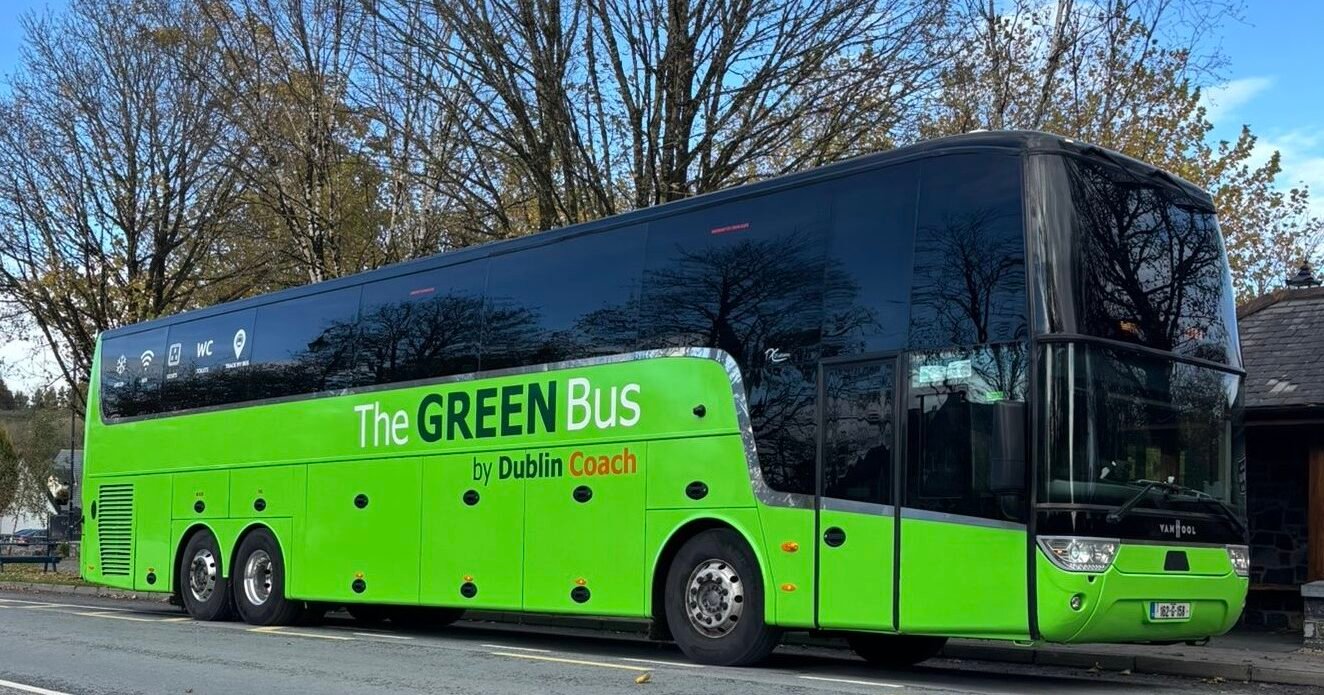
1. Dublin Coach — Route 726 (N7 Service)
This is the most frequent direct connection between the Airport and Portlaoise. It operates 24 hours a day, 7 days a week.
- Frequency: Generally every hour, departing the Airport at 30 minutes past the hour (e.g., 00:30, 01:30, 02:30).
- Journey Time: Approximately 2 hours.
- Departure Point: Dublin Airport Zone 16.
- Portlaoise Stops: JFL Avenue (Laois Shopping Centre), Portlaoise Hospital, and Kilminchy.
- Booking: Visit dublincoach.ie. Online booking is highly recommended to secure your seat.
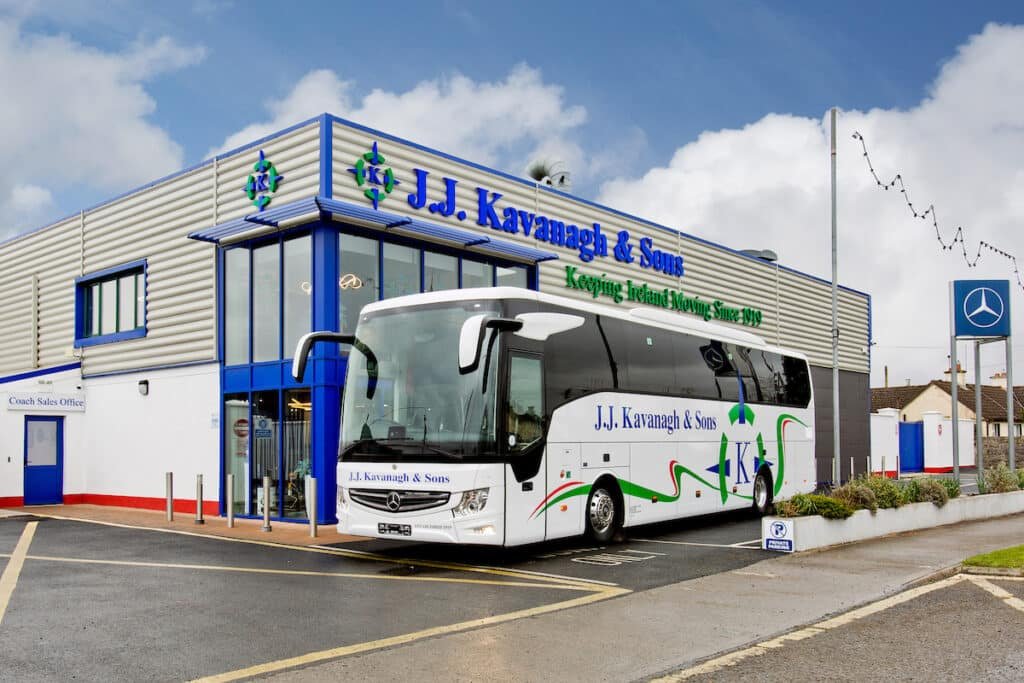
2. JJ Kavanagh — Route 735 (Limerick Express)
A reliable express service that offers a direct link, though with fewer daily departures than Dublin Coach.
- Frequency: Approximately 8–10 times daily.
- Key Departures: 04:10, 07:15, 08:50, 10:30, 12:55, 15:05, 17:20, and 21:15.
- Journey Time: Approx. 1 hour 45 minutes to 2 hours.
- Departure Point: Dublin Airport Zone 16.
- Portlaoise Stop: JFL Avenue (Laois Shopping Centre).
- Note: Pre-booking at jjkavanagh.ie is essential as this service often fills up with passengers traveling further to Limerick.
3. Irish Rail + Dublin Express (via Heuston Station)
For those who prefer the train, you can take a high-frequency shuttle from the Airport to the city’s main western rail terminal.
The Step-by-Step Route:
- Coach: Take the Dublin Express (Route 782) from Terminal 1 (Zone 1) or Terminal 2 (Zone 21) to Heuston Station.
- Frequency: Every 15–30 minutes.
- Travel Time: 30–40 minutes (via the Port Tunnel).
- Train: From Dublin Heuston, take the Intercity or Commuter train to Portlaoise.
- Frequency: Generally every hour.
- Travel Time: 45–60 minutes.
- Integrated Tickets: You can purchase an “Add-on” bus transfer when buying your train ticket at irishrail.ie.

Belfast – Portlaoise Bus and train routes
Option 1: The “Enterprise” Train (Belfast → Dublin → Portlaoise)
This is generally the most comfortable and fastest method (approx. 3h 45m total travel time).
Step 1: Belfast to Dublin Connolly
- Departure: Belfast Grand Central Station (Note: Services have moved here from Lanyon Place).
- Service: The Enterprise (Jointly run by Translink and Irish Rail).
- Frequency: Generally hourly.
- Journey Time: Approx. 2h 10m.
Step 2: Transfer (Connolly to Heuston)
- Trains for Portlaoise depart from Dublin Heuston Station.
- Take the Luas Red Line (tram) from outside Connolly Station directly to Heuston (approx. 15–20 mins). Your train ticket may include this transfer; check at the time of booking.
Step 3: Dublin Heuston to Portlaoise
- Service: Intercity (Cork/Limerick lines) or Commuter trains.
- Frequency: Every 30–60 minutes.
- Journey Time: 45–60 minutes.
- Booking: irishrail.ie or translink.co.uk.
Option 2: Coach via Dublin Airport (The Easiest Connection)
This is often the most convenient “one-change” route, as both buses use the same terminal area at the airport.
Step 1: Belfast to Dublin Airport
- Operators: * Dublin Express (Route 785): Departs from Belfast Grand Central.
- Aircoach (Route 705X): Departs from Belfast Grand Central.
- Translink Goldliner (X1/X2): Departs from Belfast Grand Central.
- Frequency: Every 15–30 minutes combined.
- Journey Time: Approx. 1h 50m – 2h.
Step 2: Dublin Airport to Portlaoise
- Operator: Dublin Coach (Route 726).
- Departure: Dublin Airport Zone 16. (A short 5-minute walk from where the Belfast buses drop you at T1 or T2).
- Frequency: Hourly (24/7).
- Journey Time: Approx. 2h.
🎒 Important Information for Teams & Groups
- Baggage: If you are carrying archery equipment, coaches generally have more under-bus storage than trains, which rely on overhead or end-of-carriage racks.
- Ticketing: For the best value, book the Belfast–Dublin leg and the Dublin–Portlaoise leg separately online. There is currently no single “through-ticket” that covers both the cross-border bus and the local Irish bus.
- Grand Central Station (Belfast): Please ensure your team knows to go to the new Belfast Grand Central Station, which replaced Great Victoria Street and handles all Dublin-bound coach and rail traffic as of 2025/2026.
⚠️ Advisory & Responsibility
- Check Timetables: Always verify exact departure times on the operator websites (Translink, Irish Rail, Dublin Coach) 24 hours before travel.
- Event Coordination: TIFAM provides this as a guide; we are not responsible for delays or missed connections.
🏹 Ryanair Archery Equipment Guide
If you are flying to the competition with Ryanair, please note that bows, crossbows, and arrows are strictly prohibited from the aircraft cabin. They must be checked into the hold as “Sports Equipment.”
📋 Key Rules & Fees
- Booking: It is significantly cheaper to add “Sports Equipment” to your booking online via the Ryanair app or website before you arrive at the airport.
- Weight Limit: The standard allowance for a sports item is 20kg.
- Excess Weight: If your case exceeds 20kg, you will be charged an excess baggage fee of approximately €11 / £11 per kilogram (up to a maximum of 32kg).
- Pricing:
- Online: ~€35 / £35 per flight.
- At Airport: ~€40 / £40 per flight.
📦 Packing & Security Requirements
- Hard-Shell Case: Use a rigid, lockable bow case. Ryanair may refuse items that are fragile or poorly packaged.
- Secure the Points: Arrows and sharp tools must be securely wrapped or stored in a dedicated tube within your case to prevent injury to staff.
- Identification: Clearly label your case with your name and the competition venue address.
⚠️ Important Advisory & Responsibility
Please Read Carefully:
- Verification is Mandatory: Airline policies, fees, and security regulations are subject to frequent updates. It is your sole responsibility to contact Ryanair (or your chosen carrier) directly to clarify and verify the most current policies before you travel.
- Advisory Purpose Only: The information provided on this page is for advisory purposes to assist our participants. While TIFAM makes every effort to provide helpful guidance, we do not create these policies and cannot be held responsible for any changes, additional fees, or boarding issues.
- Direct All Queries: TIFAM cannot answer specific questions regarding individual airline contracts. All further questions should be directed to the relevant airline you have chosen for your trip.
📞 How to Contact Your Airline
If you have any doubts about your specific gear or recent policy changes, use the official channels below:
- Ryanair Ryanair Help Centre & Live Chat
- Aer Lingus Special Items & Sports Equipment
- Lufthansa Sports Baggage Regulations
- EasyJet Sports Equipment Policy
⛴️ Ferry Travel Guide
Traveling by ferry is often the preferred method for archery teams because there are no weight limits for equipment carried in a private vehicle.
🗺️ Popular Ferry Routes to Ireland
From France
- Cherbourg ↔ Dublin
- Operator: Irish Ferries
- Duration: 19h 45m
- Cherbourg ↔ Rosslare
- Operators: Brittany Ferries / Stena Line
- Duration: 18h – 20h
- Roscoff ↔ Cork
- Operator: Brittany Ferries
- Duration: 14h
From Spain
- Bilbao ↔ Rosslare
- Operator: Brittany Ferries
- Duration: 28h – 30h
From United Kingdom
- Holyhead ↔ Dublin
- Operators: Irish Ferries / Stena Line
- Duration: 3h 15m
- Pembroke ↔ Rosslare
- Operator: Irish Ferries
- Duration: 4h
- Fishguard ↔ Rosslare
- Operator: Stena Line
- Duration: 3h 30m
- Liverpool ↔ Belfast
- Operator: Stena Line
- Duration: 8h
🏹 Transporting Archery Gear on Ferries
🚗 If you are traveling by Car:
- Storage: Equipment must remain inside your vehicle for the duration of the voyage. You will not have access to the car deck once the ship has departed.
- Declaration: Most operators (Irish Ferries, Stena Line, Brittany Ferries) classify bows and arrows as “Sporting Weapons.” You must declare them at the time of booking or at the check-in desk.
- Security: Keep gear in a locked hard-shell case and ensure it is not visible through the windows of the car.
🚶 If you are a Foot Passenger:
- STRICT PROHIBITION: Most ferry lines (including Irish Ferries and Brittany Ferries) strictly prohibit foot passengers from carrying “dangerous weapons,” which includes bows, arrows, and knives.
- Confiscation Risk: If you attempt to board as a foot passenger with a bow case, security may confiscate the items, and you may be denied boarding.
- Exception: Some operators may allow gear if pre-arranged and stored in the ship’s “Checked Luggage” hold, but this is rare. You must contact the operator at least 48 hours in advance to ask for special permission.
⚠️ Important Advisory & Responsibility
Please Read Carefully:
- Verification is Mandatory: Ferry operators frequently update their “Conditions of Carriage.” It is your sole responsibility to contact your ferry provider directly to confirm their 2026 policy on sporting equipment before booking.
- TIFAM Disclaimer: This information is for advisory purposes only. TIFAM is not responsible for any changes in ferry policy, boarding denials, or equipment confiscations.
- Customs: If traveling from the UK to Ireland (Republic), be aware of customs regulations regarding the temporary importation of sporting goods. Carry your competition invitation to show it is for a sporting event.
📞 Ferry Operator Contact Links
🛂 Customs & Borders: Guidelines for Archers
If you are traveling from an EU Member State, there are generally no customs formalities for your equipment. However, if you are traveling from outside the EU (e.g., UK, USA, Canada, Norway), you must follow these rules.
📜 1. Proving Temporary Admission
To avoid paying import duties and VAT (Value Added Tax) on your gear, you must prove that the equipment is only entering Ireland temporarily for a competition.
- The Invitation Letter: Always carry a printed copy of your official competition invitation or registration. If stopped by customs, this proves you are a “Sportsman/woman” importing gear for a specific event.
- Inventory List: Carry a detailed list of your equipment, including:
- Item description (e.g., “Recurve Bow”)
- Serial numbers (if available)
- Estimated value
- Country of origin
🛡️ 2. The ATA Carnet (Recommended for High-Value Gear)
The ATA Carnet is often called a “Passport for Goods.” It is an international document that allows for the duty-free and tax-free temporary import of professional and sports equipment for up to one year.
- Why use it? It simplifies the border process and acts as a guarantee to Irish Customs that you will take the gear back home.
- Digital Transition (June 2026): Note that as of June 1, 2026, the EU and UK have transitioned to eATA Carnets (Digital Carnets). Paper versions may still be accepted, but digital processing is now the standard at major ports like Dublin and Rosslare.
- Where to get one: Contact your local Chamber of Commerce (e.g., London Chamber of Commerce in the UK) at least 2–4 weeks before travel.
🗣️ 3. Oral Customs Declaration (For Private Travelers)
For individuals traveling with a single bow and arrows, Irish Revenue often allows an “Oral Declaration.”
- The Process: You simply walk through the Red Channel (Goods to Declare) and tell the officer you are importing sports equipment for a competition.
- Form 1040/Inventory: They may ask you to sign a simple inventory form. Keep the copy they give you! You must show this when leaving Ireland to prove you are taking the gear out of the country.
⚠️ Important Advisory & Responsibility
Please Read Carefully:
- Customs is Your Responsibility: Every traveler is legally responsible for their own customs declarations. TIFAM cannot provide legal advice or act as a customs broker.
- Fees & Delays: Failure to have the correct paperwork may result in a “Security Deposit” being required at the border (often 23% of the gear’s value), which can take weeks to be refunded.
- Bow Hunting Prohibited: Note that while target archery is legal, bow hunting is strictly illegal in Ireland. Customs may ask for clarification that your gear is for target shooting only.
🔗 Useful Links
Navigating Irish Regulations and Police Assistance
For any archer traveling through or competing in Ireland, understanding local protocols for police assistance and regulations regarding “offensive weapons” is essential. While Ireland is a welcoming destination for sports, clear communication with An Garda Síochána (the Irish police service) ensures a smooth experience.
When to Contact An Garda Síochána
While unlikely, the following scenarios require formal Garda involvement:
- Theft or Loss of Equipment: If bows, arrows, or specialized gear are stolen or lost, report it to a Garda station immediately. You will need a PULSE report number for insurance claims and to explain missing equipment at customs or transit points.
- Transport Disputes: In Ireland, a bow is generally classified as sporting equipment. However, under the Firearms and Offensive Weapons Act, any item can be deemed an “offensive weapon” if there isn’t a reasonable excuse for its possession in a public place.
- Accidental Injury: In the event of a range accident involving a third party, the Gardaí may attend to file an official report for liability and safety records.
- Trespass or Range Interference: If a designated shooting area is compromised by unauthorized persons who refuse to leave, the Gardaí can assist in removing trespassers to maintain a safe shooting environment.
Best Practices for Transport
To avoid legal ambiguity, always adhere to the following transport standards:
- Unstrung & Cased: Never transport a strung bow. Use a locked, hard-shell or heavy-duty soft case.
- Discreet Storage: Keep equipment in the boot (trunk) of your vehicle, out of public view.
- Proof of Intent: Carry your tournament invitation, club membership card, or a pre-filled equipment manifest.
Emergency Contact Numbers
Ireland uses two primary emergency numbers. Both are free to call and connect to the same Emergency Call Answering Service (ECAS).
Primary Emergency Number: 999
- Description: The traditional emergency number in Ireland.
- Usage: Use this for immediate assistance from Gardaí (Police), Ambulance, Fire, or Coast Guard.
EU Standard Emergency Number: 112
- Description: Works across all EU countries; ideal for international travelers.
- Usage: This number can be dialed from any mobile phone (even without a SIM card) and provides the same level of emergency response as 999.
When calling, be prepared to provide:
- The specific service required (Gardaí, Ambulance, Fire, or Coast Guard).
- Your Eircode (postcode) if indoors, or a landmark/GPS coordinate if on a field.
- A clear, brief description of the incident.
Non-Emergency Assistance
For non-urgent matters (e.g., reporting a theft that occurred hours earlier), do not use 999/112. Instead, contact your Local Garda Station. You can locate the nearest branch using the “Station Finder” on garda.ie.